
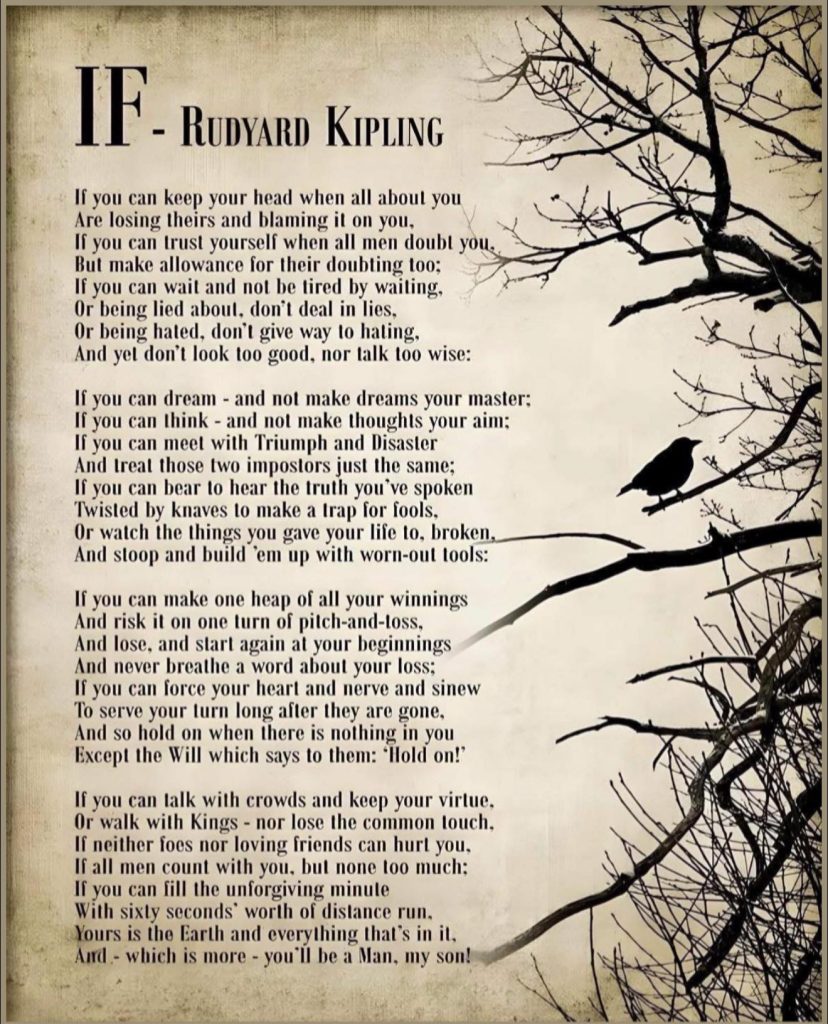
Few poems have permeated the global consciousness quite like Rudyard Kipling’s “If”. First published in 1910 within his collection Rewards and Fairies, it has become a definitive anthem of Victorian stoicism and “British grit.” Despite being over a century old, its lines are still found on graduation cards, locker room walls, and even above the players’ entrance at Wimbledon’s Centre Court.
The Message: A Blueprint for Character
The poem is structured as a series of conditional statements – “If” you can do X, Y, and Z – culminating in the promise that “you’ll be a Man, my son.” It serves as a paternal advice column in verse, focusing on several key virtues:
- Self-Possession: Maintaining composure when those around you are losing theirs.
- Resilience: Dealing with both “Triumph and Disaster” and treating those “two impostors just the same.”
- Integrity: Remaining truthful and humble, even when facing lies or popularity.
- Persistence: Forcing “heart and nerve and sinew” to serve you even when they are exhausted.
The Man Behind the Pen: Rudyard Kipling
Rudyard Kipling (1865–1936) was a titan of English literature, though his legacy today is complex. Born in Mumbai (then Bombay), India, his work was deeply shaped by the British Empire.+1
| Fact | Detail |
| Major Works | The Jungle Book, Kim, Just So Stories |
| Accolades | Youngest-ever recipient of the Nobel Prize in Literature (1907) |
| Inspiration | “If” was inspired by Leander Starr Jameson, a leader of a failed raid against the Boers, whom Kipling admired for his stoicism in defeat. |
While Kipling’s mastery of short stories and verse is undisputed, modern readers often grapple with his vocal support for imperialism. However, “If” largely transcends political boundaries by focusing on the universal struggle of the individual to master their own character.
“If you can fill the unforgiving minute / With sixty seconds’ worth of distance run, / Yours is the Earth and everything that’s in it…”
Why It Endures
The poem’s popularity lies in its accessibility. It doesn’t rely on abstract metaphors; it provides a concrete, albeit difficult, checklist for living. In an era of constant digital noise and emotional volatility, Kipling’s call for a “cool head” and “unforgiving” effort remains a grounding force for many.
