Tag: literature-poetry
The Epistemology of Assimilation: A Comprehensive Analysis of Walt Whitman’s “There Was a Child Went Forth”
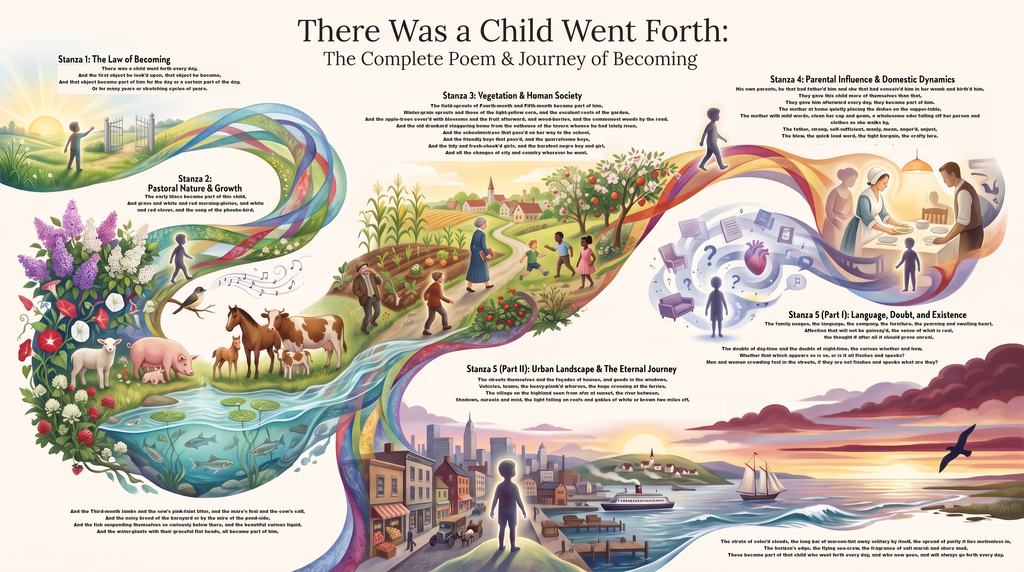
Biographical Context and Intellectual Genesis
Walt Whitman’s poetic vision emerged from a complex interplay of ancestral legacy, volatile family dynamics, self-directed intellectual development, and the rapidly shifting social landscape of nineteenth-century America [cite: 1, 2, 3]. Born on May 31, 1819, in West Hills, Long Island, Whitman was descended from English and Dutch settlers whose roots in North America stretched back to the seventeenth century [cite: 1, 2]. The Whitman family presence on Long Island began when Zechariah Whitman emigrated from England in 1660, followed by his son Joseph, who acquired land that eventually expanded into a 500-acre farmstead [cite: 1]. By the late eighteenth century, this estate was managed by Whitman’s paternal great-grandparents, Nehemiah and Phoebe Whitman [cite: 1]. Local history remembered Phoebe as a formidable, assertive woman who commanded the estate with strict authority [cite: 1]. However, subsequent generations experienced severe economic contraction; by the time Whitman’s father reached adulthood, the family holdings had dwindled to merely 60 acres [cite: 1].
Continue reading “The Epistemology of Assimilation: A Comprehensive Analysis of Walt Whitman’s “There Was a Child Went Forth””The Odyssey of Homer: Philological Foundations, Allegorical Hermeneutics, and Cognitive Blueprints

Epistemic Origins and the Chronology of Composition
The genesis of Homer’s Odyssey represents a transitional epoch in Mediterranean history, capturing the structural collapse of the Late Bronze Age Mycenaean civilizations and the subsequent intellectual awakening of the Archaic Greek polis [cite: 1, 2]. While the narrative events of the Trojan War and its aftermath are archaeologically situated in the late second millennium BCE, the consolidation of the epic is widely placed by contemporary classicists in the late eighth or early seventh century BCE [cite: 1, 3, 4]. This period of composition coincided with the re-emergence of maritime trade, the development of the Greek alphabet adapted from Phoenician scripts, and the end of the Greek Dark Ages, which spanned roughly from 1100 to 750 BCE [cite: 1, 2, 5]. Consequently, the Odyssey functions as both a repository of collective memory from a lost heroic age and a highly sophisticated reflection of the anxieties, economic rivalries, and colonial expansions of the early Archaic period [cite: 1, 2, 5].
A primary piece of evidence for dating the Odyssey later than its sister epic, the Iliad, lies in the shifting socio-economic representations of external cultures, particularly the Phoenicians [cite: 1]. In the Iliad, the Phoenicians are characterized almost exclusively as elite artisans and weavers of peerless skill whose luxury goods are highly prized by Mycenaean kings [cite: 1, 6]. In the Odyssey, however, while their technical renown remains, they are increasingly depicted as deceptive, opportunistic merchants and skilled agents of commercial trickery [cite: 6, 7]. This linguistic and cultural shift directly corresponds to historical realities between the eighth and seventh centuries BCE, when Greek maritime colonization began to clash with established Phoenician trade routes, transforming a once-revered culture into active economic rivals [cite: 1, 6].
The linguistic structure of the Odyssey further reinforces this evolutionary timeline, as the epic is composed in an artificial literary dialect—a highly stylized amalgam of Ionic and Aeolic Greek, interspersed with archaic Mycenaean remnants [cite: 5]. For generations, the “Homeric Question” divided classicists into Analysts, who viewed the text as a clumsy compilation of distinct, shorter lays, and Unitarians, who argued for a single, monumental author [cite: 1, 4]. This scholarly impasse was resolved in the early twentieth century by the pioneering work of Milman Parry and Albert Lord [cite: 1, 8, 9]. Influenced by the comparative linguistic methodologies of Antoine Meillet, Parry demonstrated that the Homeric poems are entirely built from a traditional formulaic system [cite: 8, 9]. Bards (aoidoi) did not memorize fixed texts but instead improvised long, complex hexameter verses using an inherited mental database of repetitive phrases, metrical chunks, and ornamental epithets tailored to distinct rhythmic constraints [cite: 1, 8, 9]. This oral-formulaic tradition allowed the epic to remain fluid for centuries, adapting to live performances and audience feedback before being committed to writing [cite: 1, 4].
The transition of the Odyssey from a fluid performance medium to a stable written text likely involved a multi-stage standardization process [cite: 1, 5, 10]. Ancient historical testimonies are virtually unanimous in stating that the Athenian tyrant Peisistratos, who ruled in the mid-sixth century BCE, commissioned an editorial committee to compile, standardize, and record the Homeric epics to ensure systematic recitations at the Panathenaic Games [cite: 1, 5]. While some radical Homerists argue that a truly canonical text did not emerge until the meticulous editorial work of Alexandrian librarians in the third and second centuries BCE, the Peisistratid recension represents the primary institutional anchor that preserved the structural architecture of the twenty-four books we read today [cite: 1, 4, 11].
Continue reading “The Odyssey of Homer: Philological Foundations, Allegorical Hermeneutics, and Cognitive Blueprints”The Stoic Standard: Rudyard Kipling’s “If”

Few poems have permeated the global consciousness quite like Rudyard Kipling’s “If”. First published in 1910 within his collection Rewards and Fairies, it has become a definitive anthem of Victorian stoicism and “British grit.” Despite being over a century old, its lines are still found on graduation cards, locker room walls, and even above the players’ entrance at Wimbledon’s Centre Court.
Continue reading “The Stoic Standard: Rudyard Kipling’s “If””