Author: BlackHole
The Epistemology of Assimilation: A Comprehensive Analysis of Walt Whitman’s “There Was a Child Went Forth”

Biographical Context and Intellectual Genesis
Walt Whitman’s poetic vision emerged from a complex interplay of ancestral legacy, volatile family dynamics, self-directed intellectual development, and the rapidly shifting social landscape of nineteenth-century America [cite: 1, 2, 3]. Born on May 31, 1819, in West Hills, Long Island, Whitman was descended from English and Dutch settlers whose roots in North America stretched back to the seventeenth century [cite: 1, 2]. The Whitman family presence on Long Island began when Zechariah Whitman emigrated from England in 1660, followed by his son Joseph, who acquired land that eventually expanded into a 500-acre farmstead [cite: 1]. By the late eighteenth century, this estate was managed by Whitman’s paternal great-grandparents, Nehemiah and Phoebe Whitman [cite: 1]. Local history remembered Phoebe as a formidable, assertive woman who commanded the estate with strict authority [cite: 1]. However, subsequent generations experienced severe economic contraction; by the time Whitman’s father reached adulthood, the family holdings had dwindled to merely 60 acres [cite: 1].
Continue reading “The Epistemology of Assimilation: A Comprehensive Analysis of Walt Whitman’s “There Was a Child Went Forth””The Glass Bead Game – Das Glasperlenspiel
Deconstructing Hermann Hesse’s Masterpiece of Eternity, Time, and Intellect


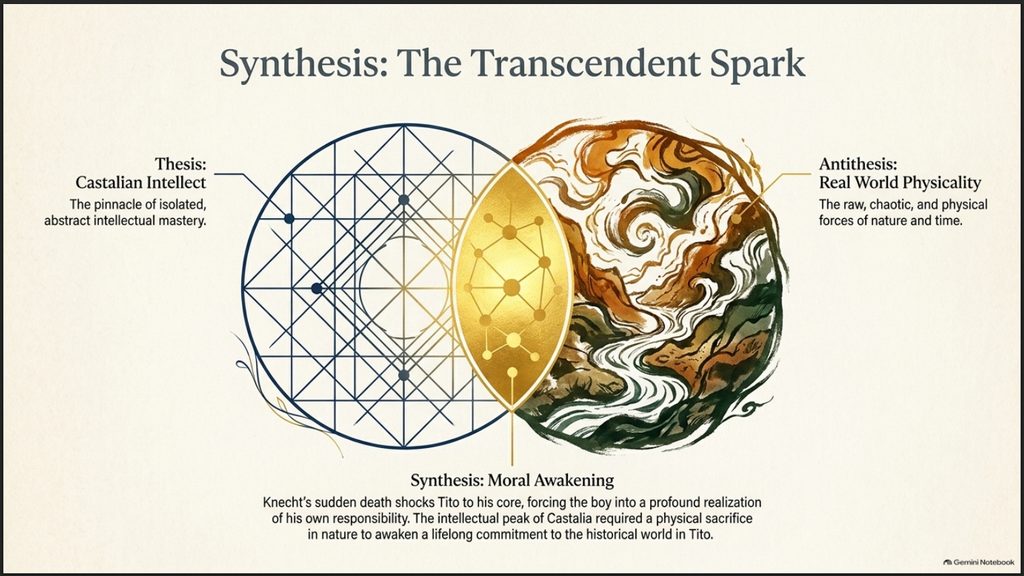

The Dialectics of Authenticity: Biography, Ideology, and Literary Aesthetics in the Works of Hermann Hesse

Biographical Foundations: The Genesis of a Pilgrim
The literary trajectory of Hermann Karl Hesse (1877–1962) represents one of the most sustained explorations of individual authenticity, psychological integration, and existential self-determination in twentieth-century European literature [cite: 1, 2, 3]. Born on July 2, 1877, in Calw, within the Kingdom of Württemberg, Hesse was immersed from birth in a complex, high-minded, yet psychologically repressive cultural milieu [cite: 1, 4, 5]. His father, Johannes Hesse, was a Baltic German born in Estonia, while his mother, Marie Gundert, was of French-Swiss origin and born in India to Protestant missionaries [cite: 5]. This international, pietistic family background imbued Hesse with an early awareness of non-European cultures, particularly Indian spiritual traditions, while simultaneously subjecting him to an unyielding religious discipline [cite: 2, 4, 5].
Continue reading “The Dialectics of Authenticity: Biography, Ideology, and Literary Aesthetics in the Works of Hermann Hesse”The Architecture of Self-Reference: An Exhaustive Analysis of Douglas Hofstadter’s Gödel, Escher, Bach

The central inquiry of Douglas Hofstadter’s Pulitzer Prize-winning masterpiece, Gödel, Escher, Bach: An Eternal Golden Braid, is fundamentally ontological: how can conscious, animate selves emerge from inanimate, selfless matter [cite: 1, 2]? Hofstadter pursues this question not through speculative metaphysics, but by constructing an elaborate, interdisciplinary analogy [cite: 1, 3]. This analogy maps the relationship between meaningless physical tokens and emergent semantic systems [cite: 1, 4]. By braiding the mathematical logic of Kurt Gödel, the visual paradoxes of M. C. Escher, and the contrapuntal music of Johann Sebastian Bach, Hofstadter reveals a shared underlying structure: the “Strange Loop” [cite: 4, 5]. This structural phenomenon, wherein moving hierarchically through a system unexpectedly returns one to its origin, is proposed as the foundational mechanism of human consciousness and self-awareness [cite: 4, 5, 6].
Introduction: A Musico-Logical Offering and the Genesis of Strange Loops

The treatise opens with the historical visit of Johann Sebastian Bach to the court of King Frederick the Great of Prussia at Potsdam in 1747 [cite: 7, 8, 9]. The King, an enthusiastic flutist and patron of Gottfried Silbermann’s newly developed fortepianos, presented Bach with a complex, highly chromatic “Royal Theme” and challenged him to improvise a three-part fugue on it [cite: 7, 8, 9].
Bach complied, subsequently composing The Musical Offering (including a three-part ricercar, a six-part ricercar, ten canons, and a trio sonata) [cite: 10, 11]. This historical vignette introduces the primary themes of the book [cite: 8, 9, 12]. Hofstadter demonstrates that The Musical Offering is saturated with self-reference and structural loops [cite: 8, 9, 12]. Specifically, the Canon per Tonos (the Endlessly Rising Canon) modulates upward through six successive keys ($C \to D \to E \to F^\sharp \to G^\sharp \to A^\sharp \to C$) [cite: 11]. This structural architecture means that while the listener feels a constant rise in pitch, they are returned to the starting key, demonstrating a musical Strange Loop [cite: 4, 10, 11].
Hofstadter links Bach’s musical transformations to mathematical isomorphisms [cite: 11]. Transposing, inverting (flipping a theme upside-down), and retrograde copying (playing a theme backward in time, as in a crab canon) are presented as formal, structural operations that preserve relational information while altering physical form [cite: 11, 13]. A strange loop arises when moving only upwards or downwards through a hierarchical system unexpectedly brings one back to the starting point [cite: 5, 6]. To explore how these loops generate consciousness, Hofstadter weaves a continuous, alternating narrative of expository chapters and whimsical dialogues featuring characters borrowed from Lewis Carroll—principally Achilles and the Tortoise [cite: 4, 14, 15]. Each dialogue foreshadows or allegorically embeds a logical or mathematical concept that the subsequent chapter explores at the formal object level [cite: 4].
Continue reading “The Architecture of Self-Reference: An Exhaustive Analysis of Douglas Hofstadter’s Gödel, Escher, Bach”The Architecture of Infinity: A Comprehensive Analysis of the Life, Art, and Mathematical Legacy of M.C. Escher
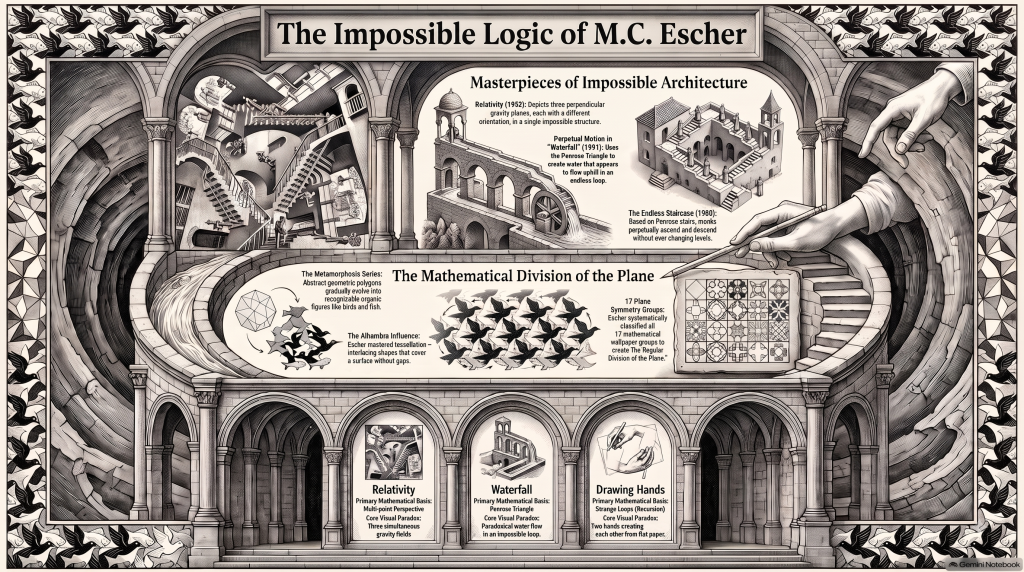
1. Background and Early Life
Maurits Cornelis Escher (1898–1972) occupies a distinct and somewhat paradoxical position in the history of twentieth-century visual culture. Born on June 17, 1898, in Leeuwarden, the capital of the Dutch province of Friesland, Escher was the youngest son of George Arnold Escher and his second wife, Sara Gleichman1. His father was a prominent civil and hydro-mechanical engineer who had spent years working on harbors and dams in Japan at the behest of the emperor1. Raised in a stately city palace known as the Princessehof, the young Escher—affectionately nicknamed “Mauk” by his family—grew up in an environment characterized by intellectual rigor, discipline, and upper-middle-class comfort1. It is highly probable that the influence of his father, whose profession required structural logic and precise drafting, laid the earliest subconscious foundations for Escher’s later obsession with spatial geometry.
Despite this privileged upbringing, Escher’s childhood was marked by physical fragility. A sickly constitution frequently kept him indoors, and in 1905, at the age of seven, he was sent to a children’s convalescent home in Zandvoort for an extended period to recover his strength1. This physical isolation forced the young boy to entertain himself through acute observation of his immediate surroundings, cultivating a meticulous eye for the structural anomalies of the physical world. His family encouraged a broad education; he took carpentry and piano lessons, and frequently used a telescope mounted on the flat roof of his home to observe the stars with his father1.
Academically, Escher struggled profoundly. After the family relocated to Arnhem in 1903, he attended secondary school but proved to be an unexceptional student. He was left-handed, highly intelligent, but socially perceived as an outsider3. Ultimately, he failed his final secondary school examinations in 19181. A persistent lack of aptitude for formal mathematics was particularly notable; Escher would later famously confess to having never received a passing grade in the subject4. Hoping to channel his son’s undeniable talent for drawing into a respectable profession, George Escher leveraged his connections to enroll Maurits at the Technical College of Delft in 1918 to study architecture1. However, recurring illness and a lack of passion for the rigid curriculum led to his swift departure before completing his first year1.
The pivotal turning point in Escher’s early development occurred in the autumn of 1919 when he transferred to the Haarlem School of Architecture and Decorative Arts. Although he initially enrolled in the architecture department to placate his parents, his graphic experiments caught the eye of Samuel Jessurun de Mesquita, a highly regarded graphic arts instructor and Jewish artist known for his bold, definitive style2. Recognizing an innate genius for printmaking, de Mesquita persuaded both Escher and his skeptical parents that the young man was “too good to waste his time on architectural drawings”1. Under de Mesquita’s mentorship, Escher mastered the unforgiving techniques of woodcut and linocut. These mediums require absolute precision, a flawless understanding of positive and negative space, and a high degree of forethought—skills that became the cornerstone of his mature aesthetic3. In 1922, he produced an early masterpiece of interconnectivity, Eight Heads, signaling his burgeoning interest in tessellating forms10.
Following his graduation in 1922, Escher embarked on extensive recuperative and educational travels through Italy and Spain. The Mediterranean landscape, with its intense light, dramatic coastal cliffs, and cascading hilltop towns, captivated him8. Settling in Rome in 1923, he met Jetta Umiker, whom he married in 1924, and the couple subsequently had three sons6. For the next decade, Escher operated primarily as an observational landscape artist. He spent his springs hiking through the desolate, rugged terrains of Tuscany, Calabria, and the Amalfi Coast, executing meticulously detailed sketches that he later transformed into lithographs and woodcuts in his studio3. These early works, though lacking the impossible geometry of his later output, demonstrate an emerging fascination with unusual perspectives, plunging viewpoints, and the structural interplay between natural rock formations and human architecture8.
The trajectory of Escher’s art was forcibly altered by geopolitical instability. The rise of Benito Mussolini’s fascist regime in Italy created a stifling and increasingly dangerous atmosphere, prompting the Escher family to flee to Château-d’Oex, Switzerland, in 19357. Denied the beloved Italian landscapes that had fueled his inspiration, and finding the Swiss snowscapes visually unstimulating, Escher turned his creative gaze inward. To escape the high cost of living and the unfavorable climate, Escher brokered a deal with the Adria shipping company, trading original prints for passage on a Mediterranean freighter, allowing him to revisit Southern Europe and Spain7. Following this, the family moved to Belgium in 1937, and finally, driven by the German invasion during World War II, settled permanently in Baarn, the Netherlands, in 19416.
This period of geographical dislocation and eventual internal exile forced him to transition from observing the external world to exploring the “landscapes of the mind,” marking the genesis of his signature style: the exploration of mathematical theory, rational symmetry, and impossible architectures6.
Continue reading “The Architecture of Infinity: A Comprehensive Analysis of the Life, Art, and Mathematical Legacy of M.C. Escher”The Odyssey of Homer: Philological Foundations, Allegorical Hermeneutics, and Cognitive Blueprints

Epistemic Origins and the Chronology of Composition
The genesis of Homer’s Odyssey represents a transitional epoch in Mediterranean history, capturing the structural collapse of the Late Bronze Age Mycenaean civilizations and the subsequent intellectual awakening of the Archaic Greek polis [cite: 1, 2]. While the narrative events of the Trojan War and its aftermath are archaeologically situated in the late second millennium BCE, the consolidation of the epic is widely placed by contemporary classicists in the late eighth or early seventh century BCE [cite: 1, 3, 4]. This period of composition coincided with the re-emergence of maritime trade, the development of the Greek alphabet adapted from Phoenician scripts, and the end of the Greek Dark Ages, which spanned roughly from 1100 to 750 BCE [cite: 1, 2, 5]. Consequently, the Odyssey functions as both a repository of collective memory from a lost heroic age and a highly sophisticated reflection of the anxieties, economic rivalries, and colonial expansions of the early Archaic period [cite: 1, 2, 5].
A primary piece of evidence for dating the Odyssey later than its sister epic, the Iliad, lies in the shifting socio-economic representations of external cultures, particularly the Phoenicians [cite: 1]. In the Iliad, the Phoenicians are characterized almost exclusively as elite artisans and weavers of peerless skill whose luxury goods are highly prized by Mycenaean kings [cite: 1, 6]. In the Odyssey, however, while their technical renown remains, they are increasingly depicted as deceptive, opportunistic merchants and skilled agents of commercial trickery [cite: 6, 7]. This linguistic and cultural shift directly corresponds to historical realities between the eighth and seventh centuries BCE, when Greek maritime colonization began to clash with established Phoenician trade routes, transforming a once-revered culture into active economic rivals [cite: 1, 6].
The linguistic structure of the Odyssey further reinforces this evolutionary timeline, as the epic is composed in an artificial literary dialect—a highly stylized amalgam of Ionic and Aeolic Greek, interspersed with archaic Mycenaean remnants [cite: 5]. For generations, the “Homeric Question” divided classicists into Analysts, who viewed the text as a clumsy compilation of distinct, shorter lays, and Unitarians, who argued for a single, monumental author [cite: 1, 4]. This scholarly impasse was resolved in the early twentieth century by the pioneering work of Milman Parry and Albert Lord [cite: 1, 8, 9]. Influenced by the comparative linguistic methodologies of Antoine Meillet, Parry demonstrated that the Homeric poems are entirely built from a traditional formulaic system [cite: 8, 9]. Bards (aoidoi) did not memorize fixed texts but instead improvised long, complex hexameter verses using an inherited mental database of repetitive phrases, metrical chunks, and ornamental epithets tailored to distinct rhythmic constraints [cite: 1, 8, 9]. This oral-formulaic tradition allowed the epic to remain fluid for centuries, adapting to live performances and audience feedback before being committed to writing [cite: 1, 4].
The transition of the Odyssey from a fluid performance medium to a stable written text likely involved a multi-stage standardization process [cite: 1, 5, 10]. Ancient historical testimonies are virtually unanimous in stating that the Athenian tyrant Peisistratos, who ruled in the mid-sixth century BCE, commissioned an editorial committee to compile, standardize, and record the Homeric epics to ensure systematic recitations at the Panathenaic Games [cite: 1, 5]. While some radical Homerists argue that a truly canonical text did not emerge until the meticulous editorial work of Alexandrian librarians in the third and second centuries BCE, the Peisistratid recension represents the primary institutional anchor that preserved the structural architecture of the twenty-four books we read today [cite: 1, 4, 11].
Continue reading “The Odyssey of Homer: Philological Foundations, Allegorical Hermeneutics, and Cognitive Blueprints”The Enochian Nexus: A Socio-Intellectual History of the Dee-Kelley Partnership

Socio-Educational Backgrounds and the Crucible of Early Modern Science
The intellectual landscape of late sixteenth-century England was a highly fluid environment in which scholasticism, humanism, mathematical practitioner culture, and Hermetic-Cabalist philosophy intertwined.[1, 2, 3] John Dee was born on July 13, 1527, in London, entering a world defined by the political and religious transformations of the Tudor court.[2, 3] An exceptionally gifted student, Dee attended school in Chelmsford and London before matriculating at St. John’s College, Cambridge, in 1542 at the age of sixteen.[4] He received his Bachelor of Arts in 1548 and was appointed a founding fellow of Trinity College.[4]
It was during this early academic tenure that the public association between Dee’s mechanical brilliance and sorcery was first forged.[3, 5] For a theatrical production of Aristophanes’ Peace, Dee constructed a realistic, flying mechanical beetle that appeared to ascend to the ceiling of the hall with a man on its back.[4, 5, 6] This mechanical prop astounded and terrified the audience, sparking rumors of demonic conjuration that would shadow him for the rest of his life.[3, 4, 5]
Seeking advanced mathematical training unavailable in England, Dee traveled to the Continent in 1548, studying at the University of Leuven.[3, 4] In Leuven, he established lifelong personal and intellectual relationships with the premier cartographers and mathematicians of the age, including Gerardus Mercator, Abraham Ortelius, and Gemma Frisius.[3] He lectured in Paris on Euclidean geometry to packed audiences, demonstrating a brilliant grasp of both theoretical and applied mathematics.[3]
Upon his return to England, Dee leveraged his continental prestige to enter royal circles.[2, 4] Prior to the accession of Elizabeth I, Dee cast her personal horoscope and predicted she would ascend to the throne.[5] This mathematical “calculation” was viewed with intense suspicion by the Catholic regime of Queen Mary I, who had Dee arrested and charged with practicing sorcery against the Crown.[2, 5] Though acquitted, this trial established a permanent link between his mathematical practices and illegal divination.[2, 5]
Continue reading “The Enochian Nexus: A Socio-Intellectual History of the Dee-Kelley Partnership”The 2026/2027 Super El Niño: A Strategic Review of UK Weather, Food Security, and Economic Impacts

1. Understanding the Phenomenon: The Mechanics of the 2026 Super El Niño
The El Niño Southern Oscillation (ENSO) is the primary driver of global climate variability, and for the United Kingdom’s interconnected economy, its current trajectory represents a critical strategic risk. While ENSO is a Pacific-based cycle, it acts as a “global circulation reset,” triggering a reorganization of atmospheric patterns that reset weather conditions thousands of miles away. Understanding these mechanics is essential for navigating the systemic shocks now entering the North Atlantic corridor.
The 2026 event is characterized by a breakdown in the Walker Cell circulation. Typically, trade winds push warm surface water toward Asia, but a significant weakening—and in some regions, a reversal—of these winds has allowed a massive subsurface reservoir of heat to migrate eastward. This “Kelvin Wave,” driven by westerly wind bursts, is now surfacing in the eastern Pacific. As this energy is released into the atmosphere, it acts as a “pressure release valve” for years of accumulated oceanic heat, creating an “atmospheric bridge” that alters the global jet stream.
Current projections suggest the 2026 event will reach unprecedented severity, likely becoming the strongest El Niño in recorded history.
Continue reading “The 2026/2027 Super El Niño: A Strategic Review of UK Weather, Food Security, and Economic Impacts”The Vitreous Frontier: A Comprehensive Analysis of Obsidian Genesis, Cultural Iconography, and Modern Techno-Scientific Applications

Petrochemical Genesis and Thermodynamics of Volcanic Amorphous Materials
Obsidian is an igneous rock and a volcanic glass mineraloid that does not crystallize under the slow, rhythmic conditions of ordinary geological time.[1, 2, 3] Instead, it is forged in rapid thermal events, quenched so fast that its constituent atoms have no opportunity to organize into a structured crystalline lattice.[2, 3, 4] Chemically, obsidian is classified as a highly felsic volcanic glass, dominated by silicon dioxide (SiO2), which typically makes up 70% to 75%—and occasionally more than 80%—of its total weight.[1, 2, 5] It is the chemical analogue of granite and rhyolite, sharing an identical chemical composition but differing entirely in structural organization due to disparate cooling rates.[1, 6]
Continue reading “The Vitreous Frontier: A Comprehensive Analysis of Obsidian Genesis, Cultural Iconography, and Modern Techno-Scientific Applications”The Teleology of Action and the Metaphysics of All-Unity: A Comparative Analysis of Vladimir Solovyov, August Cieszkowski, and Nikolai Berdyaev
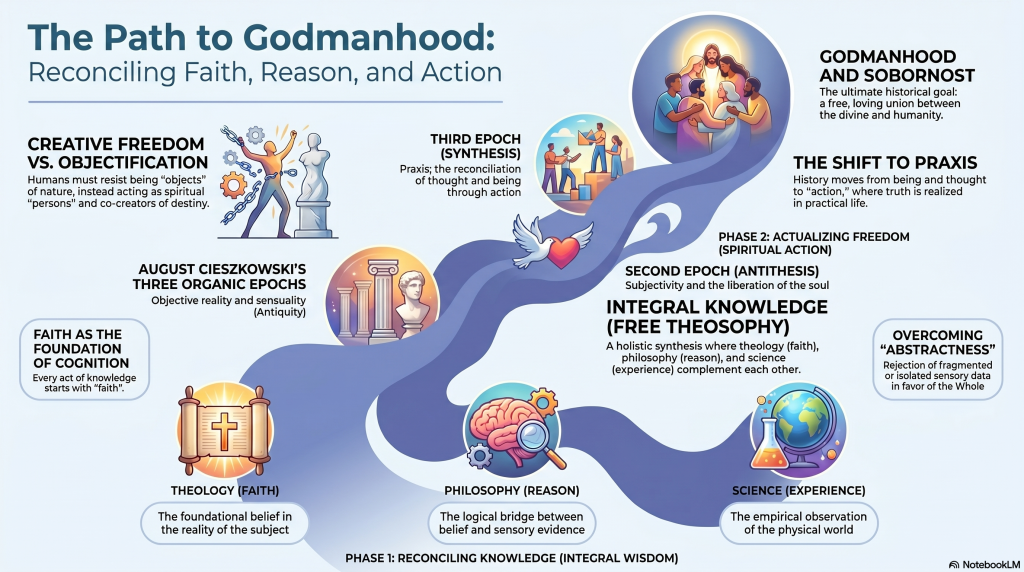
The intellectual landscape of Eastern and Central Europe during the nineteenth and early twentieth centuries was characterized by a profound struggle to reconcile the inherited structures of Christian revelation with the burgeoning demands of rationalist philosophy, the empirical rigors of modern science, and the urgent necessity for historical praxis. This intellectual ferment found its most sophisticated expressions in the work of Vladimir Solovyov, the foundational figure of the Russian religious-philosophical renaissance; Count August Cieszkowski, the Polish philosopher who transformed Hegelian dialectics into a philosophy of action; and Nikolai Berdyaev, the existentialist thinker who synthesized these traditions into a radical defense of creative freedom and personalism. These three figures, though rooted in distinct national contexts—Russian Orthodoxy and Polish Messianism—shared a common vision of history as a divinely-human process (Godmanhood) moving toward a definitive “Kingdom of God” or an “Epoch of the Holy Spirit.” Their philosophies represent an attempt to move beyond the “abstract principles” of Western metaphysics toward an “integral knowledge” where thought and action, the divine and the human, find their ultimate reconciliation.[1, 2]
Continue reading “The Teleology of Action and the Metaphysics of All-Unity: A Comparative Analysis of Vladimir Solovyov, August Cieszkowski, and Nikolai Berdyaev”