
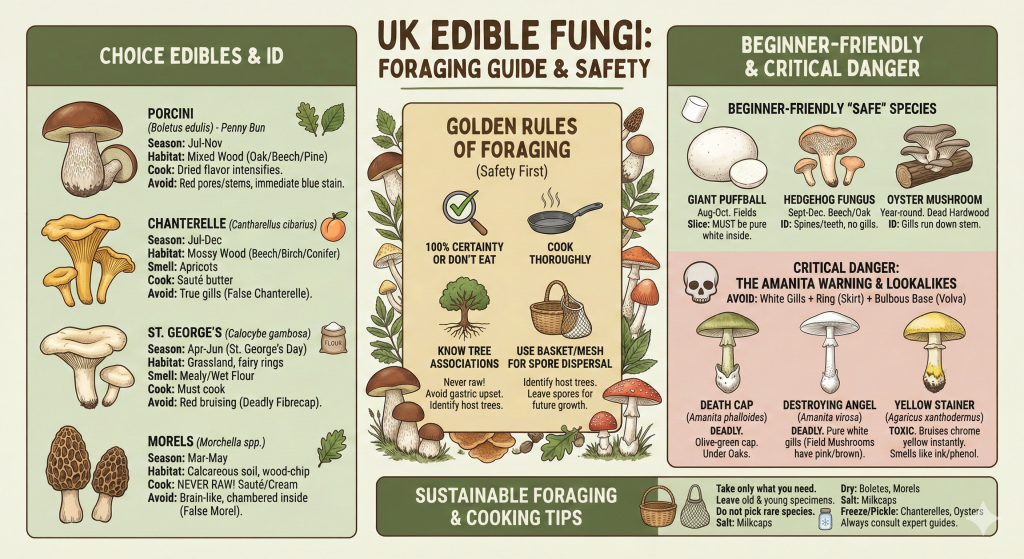
1. Introduction to British Mycology and Foraging Dynamics
The mycological landscape of the United Kingdom presents a biological resource of immense diversity and complexity. With a temperate maritime climate characterized by mild winters, cool summers, and consistent precipitation, the British Isles support over 15,000 distinct species of fungi.1 This biodiversity is not merely of academic interest; it represents a substantial, albeit underutilized, gastronomic resource. Unlike the mycophilic cultures of continental Europe—specifically France, Italy, and Poland—the UK has historically retained a degree of “mycophobia,” viewing wild fungi with deep suspicion, a sentiment encapsulated by the catch-all pejorative “toadstool”.2 However, contemporary trends indicate a significant cultural shift. The resurgence of interest in wild food, driven by the “slow food” movement and high-profile culinary advocacy, has led to a dramatic increase in foraging activity across the UK.4
This report serves as a comprehensive technical analysis of the edible fungi of the UK. It moves beyond basic identification to explore the intricate ecological relationships that govern distribution, the biochemical profiles that dictate cooking requirements, and the rigid legal frameworks that distinguish lawful foraging from environmental crime. It is designed to equip the professional forager, ecologist, or culinary expert with the nuanced understanding required to navigate the fine line between a choice edible and a toxic lookalike.
2. Ecological Frameworks and Habitat Associations
To successfully locate specific fungi, one must understand their ecological function. Fungi are not randomly distributed; they occupy specific trophic levels as saprophytes (decomposers), parasites, or mycorrhizal symbionts. The latter group, which includes many of the most prized edible species such as the Penny Bun (Boletus edulis) and the Chanterelle (Cantharellus cibarius), exists in obligate symbiosis with specific tree species.
2.1 Mycorrhizal Associations: The Tree-Fungus Partnership
The distribution of mycorrhizal fungi is mapped directly to the distribution of their host trees. These fungi form a mantle around the tree roots, exchanging soil mineral nutrients (phosphorus, nitrogen) for photosynthetically derived sugars. Consequently, the forager’s primary task is dendrology—the identification of trees—rather than the random scanning of the forest floor.6
2.1.1 The Quercus-Fagus (Oak-Beech) Complex
Deciduous woodlands dominated by Oak (Quercus) and Beech (Fagus) are the most productive habitats for high-value biomass in the UK. The deep leaf litter and specific soil chemistry support a vast array of species.
- Boletes: The Oak is a primary host for Boletus edulis (Penny Bun), Boletus aereus (Bronze Bolete), and Butyriboletus appendiculatus (Oak Bolete).7 Beech woods are particularly noted for Boletus pinophilus (Pine Bolete—confusingly also associated with Beech) and Xerocomus subtomentosus (Suede Bolete).7
- Chanterelles: Cantharellus cibarius forms extensive networks in the mossy understory of ancient Beech stands, often fruiting in the same location for decades due to the perennial nature of the mycelium.8
- Russulaceae: Both Oak and Beech support the Lactarius (Milkcaps) and Russula (Brittlegills) families. Specifically, the Charcoal Burner (Russula cyanoxantha) is a frequent denizen of these hardwoods.9
2.1.2 The Betula (Birch) Association
Birch woods, often pioneer ecosystems or heathland fringes, host a specific subset of fungi that will not be found elsewhere.
- The Leccinum Genus: This genus is almost exclusive to Birch in the UK. The Brown Birch Bolete (Leccinum scabrum) and the Orange Birch Bolete (Leccinum versipelle) are ubiquitous here. Their specificity is so high that finding an Orange Birch Bolete more than a few meters from a Birch tree is virtually biologically impossible.7
- Amanita muscaria: The iconic Fly Agaric, while toxic, serves as a critical indicator species. It favors Birch and Pine and often fruits in the same micro-climates as Boletus edulis. The presence of Fly Agaric is a strong signal to search the immediate area for Penny Buns.2
2.1.3 The Coniferous Plantation (Pine, Spruce, Larch)
Often dismissed as ecological monocultures, coniferous forests are highly productive for specific mycological groups, particularly the genus Suillus and certain Lactarius.
- Pine (Pinus): Hosts the Slippery Jack (Suillus luteus) and the Bay Bolete (Imleria badia). The Bay Bolete is arguably the most common edible bolete in the UK, thriving in the acidic needle litter of pine plantations.7
- Larch (Larix): The Larch Bolete (Suillus grevillei) is obligately associated with Larch trees. It is rarely found elsewhere.7
- Spruce (Picea): A key habitat for the Wood Hedgehog (Hydnum repandum) and the highly prized Saffron Milk Cap (Lactarius deliciosus), which requires pine or spruce needles to fruit.12
2.2 Saprophytic and Parasitic Niches
Non-mycorrhizal fungi are less dependent on specific trees and more on the substrate condition.
- Grassland Specialists: The Field Mushroom (Agaricus campestris) and the St. George’s Mushroom (Calocybe gambosa) are saprophytes of permanent pasture. They require soil rich in organic matter but undisturbed by deep ploughing, making ancient parkland and unfertilized meadows prime habitats.13
- Lignicolous (Wood-Rotting) Fungi: Species such as Chicken of the Woods (Laetiporus sulphureus) and Oyster Mushrooms (Pleurotus ostreatus) are found directly on standing trunks or fallen logs. L. sulphureus is a parasite causing brown rot in Oak, Sweet Chestnut, and Yew, while Oysters are primarily saprophytes on dead deciduous wood like Beech.15
3. Comprehensive Taxonomy of Edible British Fungi
The following profiles provide a detailed analysis of the major edible species, focusing on diagnostic morphology and the critical distinctions required for safe consumption.
3.1 The Boletaceae (The Boletes)
The Bolete family is defined by a hymenium (spore-bearing surface) consisting of vertical tubes ending in pores, rather than gills. This feature alone separates them from many dangerous species.
3.1.1 Boletus edulis (Penny Bun / Cep / Porcini)
- Seasonal Window: August to November (occasionally July after thermal shock).11
- Morphology: The cap resembles a baked bread roll, ranging from pale tan to dark chestnut, often with a distinct white line at the margin. The pore surface is initially white and firm (stuffed), turning yellow and eventually olive-green as spores mature. The stipe is robust, barrel-shaped or clavate, and features a distinctive white reticulation (net-like pattern) on the upper portion.11
- Habitat: Broadleaved and coniferous woods; highly mycorrhizal with Oak, Beech, and Spruce.7
- Lookalikes:
- Tylopilus felleus (Bitter Bolete): Features a dark reticulum on a light stalk (inverse of B. edulis) and pores that turn pink with age. It is not toxic but intensely bitter, rendering any dish inedible.1
- Rubroboletus satanas (Devil’s Bolete): Rare and poisonous. Distinguished by a chalk-white cap, bright red pores, and a bulbous red-patterned stem.18
3.1.2 Imleria badia (Bay Bolete)
- Seasonal Window: August to November.1
- Morphology: A bay-brown cap that is dry/velvety when young but sticky when wet. The pores are lemon-yellow, bruising blue-green when pressed—a diagnostic feature that alarms novices but is harmless in this species. The stem lacks reticulation, appearing longitudinally streaked.9
- Culinary Note: A superior edible, often considered second only to the Cep. The flesh remains firm upon cooking.9
3.1.3 Leccinum Species (The Scaber Stalks)
- Key Species: Leccinum versipelle (Orange Birch Bolete) and Leccinum scabrum (Brown Birch Bolete).
- Morphology: Characterized by a rough, scaly stem (scabers) resembling 3-day beard stubble. L. versipelle has a vibrant orange cap and bruises purple-black at the base when cut.7
- Toxicity Warning: While traditionally considered safe, recent reports indicate that Leccinum species, particularly the Orange Birch Bolete, contain heat-labile toxins that cause significant gastrointestinal distress if undercooked. They must be cooked thoroughly for at least 20 minutes.19
3.2 The Agaricaceae (True Mushrooms)
This family includes the familiar store-bought mushrooms but also presents the highest risk profile due to similarities with toxic Amanita and Agaricus species.
3.2.1 Agaricus campestris (Field Mushroom)
- Seasonal Window: May to October.1
- Morphology: Cap white and silky, extending over the gills. Gills are the critical identifier: they start deep pink in young specimens and mature to dark chocolate brown. They are never white. The stem tapers at the base and has a fragile ring.20
- Lookalike (Toxic): Agaricus xanthodermus (Yellow Stainer).
- Differentiation: A. xanthodermus bruises bright chrome yellow immediately at the base of the stem when cut. It smells strongly of phenol (ink/disinfectant), whereas A. campestris smells pleasant and mushroomy. Amanita phalloides (Death Cap) grows in woods, has white gills, and a volva—distinct from the Field Mushroom’s habitat and morphology.21
3.2.2 Agaricus arvensis (Horse Mushroom)
- Seasonal Window: Summer to Autumn.12
- Morphology: Larger than the Field Mushroom, with a “cog-wheel” pattern on the underside of the ring. It smells distinctly of aniseed or almonds.
- Differentiation: Like the Field Mushroom, it must be distinguished from the Yellow Stainer. The Horse Mushroom may bruise slightly yellow, but it is a slow, pale cream-yellow, not the flash chrome-yellow of the toxic variety.23
3.2.3 Agaricus augustus (The Prince)
- Seasonal Window: Late Summer to Autumn.1
- Morphology: A magnificent species with a cap covered in golden-brown scales. It has a powerful aroma of bitter almonds. Found in coniferous litter and garden borders.24
3.3 The Cantharellaceae and Hydnaceae
3.3.1 Cantharellus cibarius (Chanterelle)
- Seasonal Window: July to December (frost dependent).1
- Morphology: Funnel-shaped, egg-yolk yellow to apricot orange. The defining feature is the hymenium: it possesses false gills (ridges or folds) that are decurrent (run down the stem), blunt, and cross-veined, rather than the thin, blade-like true gills of agarics.25
- Lookalikes:
- Hygrophoropsis aurantiaca (False Chanterelle): Has true, crowded, forked gills and a more orange-coppery color. Not dangerous, but culinarily inferior and potentially hallucinogenic/emetic to sensitive individuals.27
- Omphalotus illudens (Jack-o’-Lantern): A serious toxic lookalike. It grows in dense clusters on rotting wood (Chanterelles grow in soil), is larger, and has true gills. It is bioluminescent in fresh specimens.26
3.3.2 Hydnum repandum (Hedgehog Fungus)
- Seasonal Window: August to December.12
- Morphology: Pale buff/cream cap, irregular and bumpy. The underside features brittle white spines (teeth) instead of gills or pores.
- Status: Considered a “safe” mushroom for beginners as there are no poisonous white fungi with spines in the UK. The texture is firm and nutty.15
3.4 The Polypores (Bracket Fungi)
3.4.1 Laetiporus sulphureus (Chicken of the Woods)
- Seasonal Window: May to August.1
- Morphology: Large, tiered brackets of sulphur-yellow and orange. No gills; the underside is yellow with minute pores. Texture is soft and succulent when young, becoming chalky and brittle with age.28
- Toxicity Vector: This species absorbs alkaloids from its host tree. Specimens growing on Yew (Taxus baccata) are deadly poisonous due to taxine absorption. Specimens on Oak or Willow are generally safe, though they can cause allergic reactions in some individuals.29
3.4.2 Fistulina hepatica (Beefsteak Fungus)
- Seasonal Window: Late Summer to Autumn.12
- Morphology: Resembles a raw slab of liver protruding from Oak trunks. The surface is sticky and red; the flesh exudes a red juice when cut.
- Habitat: Almost exclusive to Oak (Quercus).15
- Preparation: The flesh is acidic due to tannic acid. Soaking in milk or salted water is recommended to neutralize the flavor before cooking.15
3.5 Seasonal Specialists
3.5.1 Calocybe gambosa (St. George’s Mushroom)
- Seasonal Window: Late April (St. George’s Day) to June.13
- Morphology: White/cream cap with an inrolled margin, white crowded gills. The most diagnostic feature is the strong smell of raw flour (mealy).14
- Lookalikes: Inocybe erubescens (Deadly Fibrecap) appears in late spring but stains red/pink and lacks the mealy smell.32
3.5.2 Morchella Species (Morels)
- Seasonal Window: March to May.12
- Morphology: Distinctive honeycomb pitted cap. The cap and stem are fused and form a single continuous hollow chamber.33
- Lookalikes:
- Verpa conica (Thimble Morel): Cap hangs free like a skirt; stem contains cottony pith (not hollow). Rare and best avoided.34
- Gyromitra esculenta (False Morel): Cap is brain-like and lobed, not pitted. Deadly poisonous (contains Gyromitrin).36
4. Toxicological Risks and Identification Protocols
The distinction between edible and lethal fungi often rests on subtle morphological details. The UK is home to several deadly species, primarily from the Amanita genus.
4.1 The Amanitaceae: The Lethal Profiles
4.1.1 Amanita phalloides (Death Cap)
Responsible for the majority of fatal mushroom poisonings globally.
- Toxins: Amatoxins (alpha-amanitin), which inhibit RNA polymerase II, leading to cell necrosis, liver failure, and death. The toxins are heat-stable and cannot be removed by cooking or drying.21
- Identification: Cap olive-green to yellowish (variable). Gills white and free. Stem features a skirt-like ring and a volva (membranous sac) at the base, often buried in leaf litter.
- Confusion Risk: Often confused by novices with the Field Mushroom (A. campestris) or the Paddy Straw Mushroom (Volvariella volvacea) by foragers familiar with Asian fungi. The key distinction is the white gills and volva of the Death Cap versus the pink/brown gills and lack of volva in the Field Mushroom.20
4.1.2 Amanita virosa (Destroying Angel)
- Toxins: Amatoxins.
- Identification: Pure white. Cap, gills, stem, ring, and volva are all white.
- Confusion Risk: Young “button” stages can resemble edible Puffballs or Button Mushrooms.
- Protocol: Always cut white “eggs” in half. If there is a mushroom outline inside, it is a deadly Amanita. If it is solid white homogenous flesh, it is a Puffball.3
4.1.3 Amanita pantherina (Panther Cap)
- Toxins: Ibotenic acid and Muscimol (neurotoxins).
- Lookalike: Amanita rubescens (The Blusher – Edible cooked).
- Differentiation:
- The Blusher: Flesh turns pink/red (“blushes”) when damaged. The ring has vertical striations (grooves).
- The Panther Cap: Flesh remains white (does not blush). The ring is smooth. Cap scales are pure white.40
4.2 The Yellow Stainer Syndrome
Agaricus xanthodermus causes severe gastric upset. It is identified by the “Yellow Stainer Test”: immediately cut the base of the stem. If it turns bright chrome yellow instantly, it is toxic. If it turns yellow slowly or palely, it may be an edible Agaricus (like the Horse Mushroom). The smell of phenol (chemical/ink) is the second confirmatory sign.22
5. Foraging Law, Conservation, and Ethics
The legal landscape of foraging in the UK is a complex interplay of ancient rights and modern statutes.
5.1 The Theft Act 1968
Section 4(3) of the Theft Act 1968 provides the fundamental legal basis for foraging. It states that a person does not steal fungi growing wild on any land unless they do so for “reward or for sale or other commercial purpose”.42
- Personal Use: Picking mushrooms for one’s own table is not theft, even on private land (though access to that land may constitute trespass).
- Commercial Use: Picking with the intent to sell (to restaurants, markets, or for commercial processing) is theft and requires the landowner’s permission.
5.2 The Wildlife and Countryside Act 1981
This Act protects specific species and habitats.
- Schedule 8: It is a criminal offence to pick, uproot, or destroy fungi listed in Schedule 8. As of 2025, this list includes:
- Hericium erinaceus (Bearded Tooth / Lion’s Mane).44
- Boletus regius (Royal Bolete).45
- Battarrea phalloides (Sandy Stilt Puffball).45
- Piptoporus quercinus (Oak Polypore).45
- Uprooting: It is technically an offence to “uproot” any wild plant without permission. While biological definitions of “plant” in law can be ambiguous regarding fungi (which are biologically distinct), the act of digging up mycelium is generally discouraged and potentially illegal.46
5.3 Site-Specific Restrictions (Bylaws)
Specific areas have enacted bylaws that supersede common law foraging rights.
- Epping Forest: Managed by the City of London Corporation, bylaws strictly prohibit the picking of any fungi. This is rigorously enforced to protect the forest’s ecology, with fines and prosecutions for offenders.47
- The New Forest: A Site of Special Scientific Interest (SSSI). The Forestry Commission enforces a “no picking” code for rare species and commercial limits. While personal foraging is tolerated in some zones, strict “non-picking” protection applies to the SSSI’s designated mycological features. Bylaws allow for the removal of privileges if damaging practices are observed.49
5.4 Sustainable Harvesting Protocols
To maintain fungal populations, the following code of conduct is recommended by the British Mycological Society and conservation trusts:
- Spore Dispersal: Use open-mesh baskets or nets to allow spores to fall back to the forest floor during transport. Avoid plastic bags, which accelerate rotting and prevent sporulation.51
- Population Management: Harvest no more than half of the fruiting bodies in any one cluster. Leave mature specimens to release spores and young buttons to develop.9
- Treading Lightly: Minimize compaction of the soil, which can damage the delicate mycelial networks underground.53
6. Culinary Preparation and Preservation
The chemical composition of wild fungi necessitates specific preparation methods to neutralize toxins and optimize palatability.
6.1 Heat-Labile Toxins and Cooking
Many “edible” species are toxic in their raw state due to the presence of haemolysins (compounds that destroy red blood cells) or gastrointestinal irritants.
- Wood Blewits (Lepista nuda): Contain haemolysins. Must be cooked thoroughly to denature these proteins.54
- Honey Fungus (Armillaria mellea): Mildly toxic raw. Requires par-boiling for 10-15 minutes before frying. Some individuals remain sensitive even to cooked specimens; a small “tolerance test” portion is advised.56
- Morels (Morchella): Contain trace hydrazines. Must be cooked well.
6.2 Preservation Methods
- Drying: The preferred method for Boletus edulis (Ceps), Craterellus cornucopioides (Horn of Plenty), and Marasmius oreades (Fairy Ring Champignon). Drying intensifies the umami flavor profiles. Mushrooms should be sliced (except small Morels) and dehydrated until “cracker dry”.58
- Pickling: Ideal for firm-textured fungi like Chanterelles and Hedgehog Fungus. A brine of vinegar, sugar, and spices preserves the texture.60
- Freezing: Raw mushrooms do not freeze well; cell walls rupture, leading to a slimy texture upon thawing. The optimal method is Duxelles: finely chop or slice the mushrooms, sauté in butter/oil until all moisture is released and evaporated, then freeze the resulting concentrate.61
- Salting: A traditional Eastern European method often used for Lactarius species, though less common in the UK.
6.3 Species-Specific Recipes
- Giant Puffball Schnitzel: Due to its soft, marshmallow-like texture, Puffball slices can become slimy if stewed. The recommended preparation is to slice them into “steaks,” dip in egg and breadcrumbs, and fry until crisp.15
- Mushroom Powders: Tough or woody specimens, such as mature Dryad’s Saddle or the stems of Parasol Mushrooms, can be dried and pulverized into a powder. This serves as a potent umami seasoning for stocks and stews.62
7. Conclusions
The edible fungi of the United Kingdom offer a rewarding intersection of natural history and gastronomy. From the highly sought-after Penny Bun in the Oak forests of autumn to the vernal appearance of the St. George’s Mushroom in the chalk downlands, the mycological calendar is rich with opportunity. However, the risks associated with misidentification—exemplified by the lethal Death Cap and the deceptive Yellow Stainer—necessitate a disciplined approach to foraging.
By adhering to the strict identification protocols outlined in this report, respecting the legal boundaries of the Theft Act and SSSI protections, and utilizing proper culinary preparation to neutralize heat-labile toxins, foragers can safely utilize this abundant natural resource. The future of sustainable foraging relies on this balance of utilization and conservation, ensuring that the mycelial networks of the British Isles continue to thrive for future generations.
Data Tables
Table 3: Summary of Key Edible Species and Habitat Associations
| Common Name | Latin Name | Tree/Habitat Association | Season | Culinary Note |
| Penny Bun / Cep | Boletus edulis | Oak, Beech, Birch, Pine | Aug-Nov | Choice edible. Dry or fresh. |
| Chanterelle | Cantharellus cibarius | Beech, Birch (mossy soil) | Jul-Nov | Choice. Apricot aroma. |
| Hedgehog Fungus | Hydnum repandum | Beech, Mixed Wood | Aug-Dec | Foolproof. Safe spine ID. |
| Chicken of the Woods | Laetiporus sulphureus | Oak, Willow (Avoid Yew) | May-Aug | Chicken texture. Toxic on Yew. |
| Wood Blewit | Lepista nuda | Leaf Litter (Saprophyte) | Oct-Dec | Toxic raw. Cook well. |
| St. George’s | Calocybe gambosa | Grassland / Pasture | Apr-Jun | Mealy smell. Spring specialty. |
| Giant Puffball | Calvatia gigantea | Grassland / Meadows | Summer | Edible only if pure white inside. |
| Orange Birch Bolete | Leccinum versipelle | Birch (exclusive) | Aug-Oct | Cook 20 mins+ (gut irritant). |
Table 4: Critical Toxic Lookalikes
| Edible Target | Toxic Lookalike | Key Differentiator |
| Field Mushroom | Yellow Stainer (A. xanthodermus) | Stains bright yellow at base; phenol smell. |
| Field Mushroom | Death Cap (A. phalloides) | White gills (Field = pink/brown); Volva at base. |
| Chanterelle | Jack-o’-Lantern (Omphalotus illudens) | True gills (thin); grows on wood in clusters. |
| Morel | False Morel (Gyromitra esculenta) | Brain-like lobes (not pitted); no hollow chamber. |
| Blusher | Panther Cap (Amanita pantherina) | No blushing (white flesh); smooth ring (no grooves). |
Works cited
- Mushroom Guide – Wild Food UK, accessed February 5, 2026, https://www.wildfooduk.com/mushroom-guide/
- Wild Edible Mushrooms – The Grizzly Forager: The Definitive Guide to Foraging with Kids, accessed February 5, 2026, https://www.thegrizzlyforager.co.uk/mushrooms/
- Most Poisonous Mushrooms in the UK – Woodland Trust, accessed February 5, 2026, https://www.woodlandtrust.org.uk/blog/2025/02/poisonous-mushrooms/
- The ethics of urban mushroom foraging: Can it be done without harming nature? – South West Londoner, accessed February 5, 2026, https://www.swlondoner.co.uk/life/04122025-the-ethics-of-urban-mushroom-foraging-can-it-be-done-without-harming-nature
- The Ethnobiology of Contemporary British Foragers: Foods They Teach, Their Sources of Inspiration and Impact – MDPI, accessed February 5, 2026, https://www.mdpi.com/2071-1050/13/6/3478
- Fungi | Forestry England, accessed February 5, 2026, https://www.forestryengland.uk/new-forest/fungi
- Trees and their fungal partners – Wild Food UK, accessed February 5, 2026, https://www.wildfooduk.com/articles/trees-and-their-fungal-partners-by-attila-fodi/
- False Chanterelle – Wild Food UK, accessed February 5, 2026, https://www.wildfooduk.com/mushroom-guide/false-chanterelle/
- Foraging in Autumn: Wild Mushrooms – Woodland Trust, accessed February 5, 2026, https://www.woodlandtrust.org.uk/blog/2018/10/foraging-in-autumn-wild-mushrooms/
- Foraged Mushroom 13: Brown Birch (and other) Bolete, accessed February 5, 2026, https://www.theforagingfoodie.co.uk/mushrooms/foraged-mushroom-13-brown-birch-and-other-bolete/
- Penny Bun – Wild Food UK, accessed February 5, 2026, https://www.wildfooduk.com/mushroom-guide/cep/
- Edible British Mushrooms – EveryoneLovesAFungi – WordPress.com, accessed February 5, 2026, https://everyonelovesafungi.wordpress.com/profiles/
- St George’s mushroom | The Wildlife Trusts, accessed February 5, 2026, https://www.wildlifetrusts.org/wildlife-explorer/fungi/st-georges-mushroom
- St. George’s Mushroom – Wild Food UK, accessed February 5, 2026, https://www.wildfooduk.com/mushroom-guide/st-georges-mushroom/
- Wild Mushrooms for Beginners, accessed February 5, 2026, https://www.wildfooduk.com/articles/tips/wild-mushrooms-for-beginners/
- Foraging for Wild Mushrooms in the UK: A Comprehensive Guide -, accessed February 5, 2026, https://totallywilduk.co.uk/2023/08/16/foraging-for-wild-mushrooms-uk/
- Porcini / penny bun / Cep (Boletus edulis) Foraging – – Totally Wild UK, accessed February 5, 2026, https://totallywilduk.co.uk/2021/11/30/porcini-penny-bun-cep-boletus-edulis-identification/
- Penny Bun (Boletus edulis) – British Fungi – Woodland Trust, accessed February 5, 2026, https://www.woodlandtrust.org.uk/trees-woods-and-wildlife/fungi-and-lichens/penny-bun/
- Identifying Boletus Mushrooms – Wild Food UK, accessed February 5, 2026, https://www.wildfooduk.com/articles/identifying-mushrooms-and-plants/identifying-boletus-mushrooms/
- Death Cap vs Field Mushroom | Fungi, accessed February 5, 2026, https://mushroomexam.com/death-cap-vs-field-mushroom.html
- How to Tell the Difference Between Poisonous and Edible Mushrooms – Wild Food UK, accessed February 5, 2026, https://www.wildfooduk.com/articles/tips/how-to-tell-the-difference-between-poisonous-and-edible-mushrooms/
- Yellow Stainer Mushroom (Agaricus Xanthoderma) Identification – – Totally Wild UK, accessed February 5, 2026, https://totallywilduk.co.uk/2018/12/19/yellow-stainer-mushroom-foraging/
- Horse & Field Mushroom Imposter! – The Yellow Stainer, accessed February 5, 2026, https://www.mushroomdiary.co.uk/2010/08/horse-and-field-mushroom-imposter-the-yellow-stainer/
- The Prince Mushroom (Agaricus augustus), accessed February 5, 2026, https://zombiemyco.com/pages/the-prince-mushroom-agaricus-augustus
- Jack O’Lantern Mushrooms: A Poisonous Chanterelle Look A Like – – Forager | Chef, accessed February 5, 2026, https://foragerchef.com/know-thy-enemies-jack-olantern-mushrooms/
- Chanterelles vs. Jack-o’lantern Mushrooms – A-Z Animals, accessed February 5, 2026, https://a-z-animals.com/blog/chanterelles-vs-jack-olantern-mushrooms/
- Chanterelles or False Chanterelles? – – Totally Wild UK, accessed February 5, 2026, https://totallywilduk.co.uk/2023/02/20/chanterelles-or-false-chanterelles/
- Eating the Chicken of the Woods – Cornell Mushroom Blog, accessed February 5, 2026, https://blog.mycology.cornell.edu/2006/10/31/eating-the-chicken-of-the-woods/
- Chicken of the Woods (Laetiporus sulphureus) – Woodland Trust, accessed February 5, 2026, https://www.woodlandtrust.org.uk/trees-woods-and-wildlife/fungi-and-lichens/chicken-of-the-woods/
- Toxicity of Yew Wood and Roots – Penn State Extension, accessed February 5, 2026, https://extension.psu.edu/toxicity-of-yew-wood-and-roots
- Calocybe gambosa, St George’s Mushroom, identification – First Nature, accessed February 5, 2026, https://www.first-nature.com/fungi/calocybe-gambosa.php
- St George Mushroom Identification, Look-alikes and Recipes – Wild foodie, accessed February 5, 2026, https://www.wildfoodie.co.uk/post/st-george-mushroom-identification-look-alikes
- The Morel of the Story – Foraging Adventures, accessed February 5, 2026, http://www.foragingadventures.co.uk/the_morel_of_the_story/
- Thimble Morel – Wild Food UK, accessed February 5, 2026, https://www.wildfooduk.com/mushroom-guide/thimble-morel/
- Half-free morels and Verpa – The Fake False Real False Morels, accessed February 5, 2026, https://www.morelinfo.com/2019/05/half-free-morels-and-verpa-fake-false.html
- False Morel – Wild Food UK, accessed February 5, 2026, https://www.wildfooduk.com/mushroom-guide/false-morel/
- Wild Mushrooms Identify Gyromitra, False Morels, #mushroomhunting, #foraging, #springmushrooms – YouTube, accessed February 5, 2026, https://www.youtube.com/watch?v=50nKCXlbX4U
- Mushroom Poisoning – PMC, accessed February 5, 2026, https://pmc.ncbi.nlm.nih.gov/articles/PMC7868946/
- Top 20 Poisonous Mushrooms in the UK to Avoid – – Totally Wild UK, accessed February 5, 2026, https://totallywilduk.co.uk/2024/10/16/20-poisonous-mushrooms-in-the-uk/
- The Blusher – Edibility, Identification, Distribution – Galloway Wild Foods, accessed February 5, 2026, https://gallowaywildfoods.com/the-blusher-edibility-identification-distribution/
- Identifying Edible vs. Toxic Mushrooms: The Blusher and Panther Cap. – YouTube, accessed February 5, 2026, https://www.youtube.com/watch?v=-3hq0OZz-Gs
- Is foraging legal in the UK? – – Totally Wild UK, accessed February 5, 2026, https://totallywilduk.co.uk/2023/01/05/is-foraging-legal-in-the-uk/
- Foraging In The UK – Its Meaning And Rules – Country Living Magazine, accessed February 5, 2026, https://www.countryliving.com/uk/wildlife/countryside/a61450279/foraging-uk/
- Wildlife and Countryside Act 1981 | Schedule 8 | Plants which are protected, accessed February 5, 2026, https://www.ukwildlife.com/index.php/wildlife-countryside-act-1981/schedule-8/
- Protected UK Fungi – Wild Food UK, accessed February 5, 2026, https://www.wildfooduk.com/protected-uk-fungi/
- Foraging Guidelines – Woodland Trust, accessed February 5, 2026, https://www.woodlandtrust.org.uk/visiting-woods/things-to-do/foraging/foraging-guidelines/
- Epping Forest byelaws – City of London, accessed February 5, 2026, https://www.cityoflondon.gov.uk/things-to-do/green-spaces/epping-forest/epping-forest-byelaws
- Foragers urged: Please don’t pick mushrooms in Epping Forest – Newsroom City of London, accessed February 5, 2026, https://news.cityoflondon.gov.uk/foragers-urged-please-dont-pick-mushrooms-in-epping-forest/
- Fungi | New Forest Association, accessed February 5, 2026, https://newforestassociation.org/tag/fungi/
- Fungi and the Law (a summary) | New Forest Association, accessed February 5, 2026, https://newforestassociation.org/fungi-and-the-law-a-summary/
- Responsible and Sustainable Mushroom Picking – Modern Forager, accessed February 5, 2026, https://modern-forager.com/sustainable-mushroom-picking/
- Expert Guide to Foraging Basket Materials and Key Features – Eaten Wild, accessed February 5, 2026, https://eatenwild.com/best-foraging-basket-review/
- How to harvest wild mushrooms – Cutting v Picking – Galloway Wild Foods, accessed February 5, 2026, https://gallowaywildfoods.com/how-to-harvest-wild-mushrooms-cutting-v-picking-26711/
- Field Blewit, Wood Blewits and their Look Alikes | UK – Wild foodie, accessed February 5, 2026, https://www.wildfoodie.co.uk/post/field-blewit-wood-blewits
- Field Blewit – Wild Food UK, accessed February 5, 2026, https://www.wildfooduk.com/mushroom-guide/field-blewit/
- Honey fungus | Armillaria mellea (recipe) – Gone71° N, accessed February 5, 2026, https://www.gone71.com/honey-fungus-armillaria-mellea/
- How To Prepare The Honey Mushroom: Cleaning, Prepping, and Cooking, accessed February 5, 2026, https://www.mushroom-appreciation.com/how-to-prepare-the-honey-mushroom.html
- 4 Easy Ways to Preserve Mushrooms – North Spore, accessed February 5, 2026, https://northspore.com/blogs/the-black-trumpet/4-easy-ways-to-preserve-mushrooms
- Preserving mushrooms – OSU Extension Service – Oregon State University, accessed February 5, 2026, https://extension.oregonstate.edu/catalog/sp-50-919-preserving-mushrooms
- How To Pickle Wild Mushrooms, accessed February 5, 2026, https://gallowaywildfoods.com/how-to-pickle-wild-mushrooms/
- Preserving your bounty – Wild Food UK, accessed February 5, 2026, https://www.wildfooduk.com/articles/preserving-your-bounty/
- Preserving Mushrooms Helps You Enjoy Your Harvest Longer – Garden Culture Magazine, accessed February 5, 2026, https://gardenculturemagazine.com/preserve-mushrooms/
