
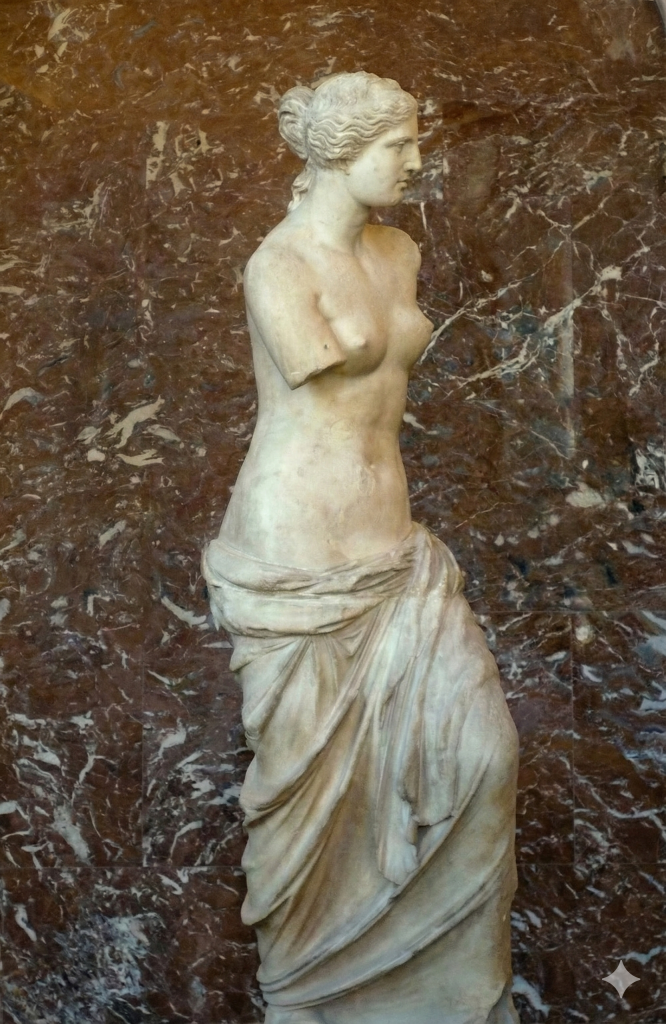
Discovered in 1820 on the Greek island of Milos, the Venus de Milo is arguably the most famous example of Hellenistic sculpture in the world. Carved from Parian marble around 100 BCE, she is widely believed to represent Aphrodite, the Greek goddess of love and beauty (known as Venus to the Romans). However, her identity remains a subject of scholarly debate; some suggest she might actually be Amphitrite, the sea goddess worshipped on Milos.
The sculpture is a masterclass in Hellenistic aesthetics, characterized by a shift away from the stiff, idealistic poses of earlier eras toward more dynamic, human-like movement. Venus is captured in a contrapposto stance—her weight shifted onto one foot, creating a subtle “S-curve” in her torso. This technique gives the heavy stone a sense of fluidity and life.
But what about those famous missing arms? When she was unearthed by a peasant named Yorgos Kentrotas, fragments of a hand holding an apple and a left upper arm were reportedly found nearby. These fragments suggested she was originally holding the “Apple of Discord” from the Judgment of Paris. However, during the journey to France and subsequent restoration, these pieces were separated or lost, and the Louvre eventually decided to display her as she was found to avoid inaccurate reconstructions.
Interestingly, Venus wasn’t always the “plain” white marble we see today. Like most classical statues, she was likely originally polychromed (painted in vibrant colors) and adorned with metal jewelry. Holes in her ears, head, and arms indicate she once wore earrings, a headband, and armbands.
Today, she stands as a symbol of classical perfection, proving that even a “fragmented” masterpiece can possess a timeless, complete beauty.
