
Introduction: The Battlefield of the Mind
In the modern era, we are frequently besieged by a “paralysis of choice.” We inhabit a world of infinite digital noise and existential overwhelm, where every decision feels weighted with the pressure of optimal outcomes and the crushing visibility of the “global village.” This internal friction is not a product of the internet age, but a fundamental human condition described vividly in the Bhagavad-Gita, a third-century dialogue set on the precipice of a great war.
The narrative opens on the battlefield of Kurukshetra, where the warrior-prince Arjuna stands paralyzed between two massive armies. Confronted with the prospect of fighting his own kinsmen, his “members fail” and his “life within seems to swim and faint.” Arjuna’s distress is a profound metaphor for our own inner conflicts—the moments when duty, desire, and doubt collide, leaving us frozen. His guide, the divine charioteer Krishna, responds not with simple platitudes, but with a rigorous philosophical framework for navigating life with clarity and a radical, detached focus.
I. The Paradox of Detached Excellence
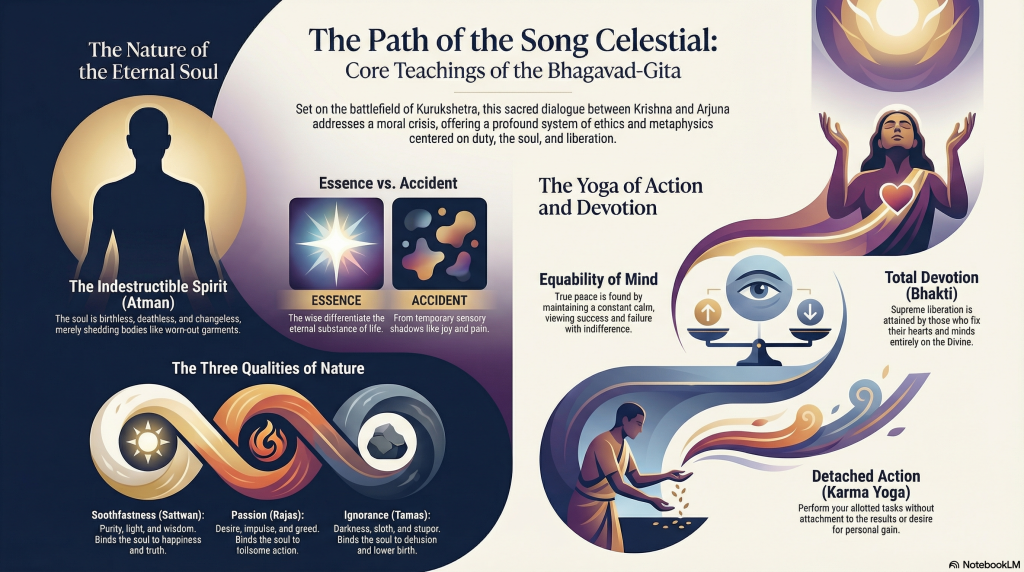
The Gita introduces the concept of Karma-Yog, or the “Virtue in Work,” which offers a counter-intuitive solution to performance anxiety. Krishna teaches that while we have total agency over our actions, we have no claim to the results. We are entitled to the work itself, but never to the “fruit” or reward of that work.
By decoupling our effort from the outcome, we eliminate the primary source of mental agitation: the fear of failure and the hunger for validation. When the mind is no longer “aching to satisfy desires,” it achieves a state of pure focus. Excellence, therefore, is not a means to an end, but a state of being—a commitment to “doing right in right” regardless of the world’s applause or calumny.
“Find full reward of doing right in right! Let right deeds be thy motive, not the fruit which comes from them.” (Chapter II)
II. The Immortal Perspective: Beyond the “Fleeting Frames”
To achieve radical focus, one must adopt a “long-view” perspective that transcends the immediate crisis. Krishna explains that our modern obsession with “fleeting frames”—our digital status, our career trajectories, and our curated identities—is rooted in a misunderstanding of the self. He describes the soul (Atman) as indestructible, changing bodies as a person might discard “worn-out robes” for new ones.
This perspective is the ultimate engine of resilience. In a “disposable” career culture where we are often defined by our last success or failure, recognizing the “birthless and deathless” nature of the spirit provides an unshakeable foundation. When we view our current challenges not as terminal ends but as temporary “layings-down” of one life-abode for another, the fear of loss loses its grip. We can act with boldness because we know that the core of our being remains “unentered, unassailed, unharmed.”
“Never the spirit was born; the spirit shall cease to be never; Never was time it was not; End and Beginning are dreams! Birthless and deathless and changeless remaineth the spirit for ever; Death hath not touched it at all, dead though the house of it seems!” (Chapter II)
III. Action in Inaction: Mastering the Mind’s Motion
A subtle yet powerful teaching in Chapter IV involves mastering the rhythm of effort. Krishna describes the “wise man” who finds “rest in action” and “action in rest.” This is the mastery of the mind’s motion, acting without the “prickings of desire” that usually drive us toward burnout.
In contemporary psychology, this mirrors the “flow state”—a condition where intense activity feels effortless because the ego has been sidelined. A person who is “self-satisfying” and “quit of fear and hope” can perform complex duties while maintaining an internal sanctuary of stillness. They are fully engaged in the world’s work, yet they remain resting in their own purpose, undistracted by the frantic “action” of a worried mind.
“He who sees how action may be rest, rest action–he is wisest ‘mid his kind.” (Chapter IV)
IV. The Three Strings of Nature: Understanding Your Drivers
The Gita categorizes human nature into three Gunas, or qualities, which act as the internal drivers for our behavior. Identifying which quality is pulling your strings is essential for reclaiming focus:
• Sattwan (Soothfastness): The quality of purity and light. It binds the soul to happiness and wisdom, functioning as a “Lamp of Knowledge” that illuminates the right path.
• Rajas (Passion): Described as “kin to appetite,” this quality breeds “longing and ardour.” It binds the soul through a “toilsome strain” and a restless “ache to have.”
• Tamas (Ignorance): The quality of darkness and “witlessness.” It “blots the beams of wisdom,” binding the soul to “sloth,” “stupor,” and “drowsiness.”
While modern culture often celebrates “Passion” (Rajas) as the ultimate motivator, the Gita warns that it is a source of “unrest” and “avarice.” Radical focus requires the cultivation of Sattwan, which allows for action that is enlightened and steady rather than impulsive and draining.
V. Radical Equanimity: The Equal Eye
The ultimate mark of the Yogi is equanimity, or the “equal eye.” This is the ability to view “the clod, the rock, and the glistering gold” as one. This is not a state of apathy; rather, it is a “sovereign soul” that remains unruffled by the “pairs of opposites”—pleasure and pain, success and failure, praise and blame.
Krishna uses the metaphor of the ocean to describe this state of radical focus. Just as the ocean receives “floods from all lands” but remains “unswelled” and within its boundaries, the disciplined mind receives the “streams of witchery” from the world of the senses without being moved to “commotion.” You see the world clearly, but it does not move the foundation of your peace.
“So is the perfect one! to his soul’s ocean The world of sense pours streams of witchery; They leave him as they find, without commotion.” (Chapter II)
Conclusion: Walking the “Farther Path”
The Bhagavad-Gita suggests that peace is not the absence of external conflict, but the presence of “self-governance” and “steadfastness” in the midst of it. By focusing on the purity of the deed rather than the reward, and by understanding the strings that move us, we can walk the “farther path” toward a life of purpose.
In your own life, what “battle” currently demands your attention? As you stand upon your own Kurukshetra, remember that the Divine Charioteer—your higher intellect and soul—is ready to guide the journey. If you were to take the reins of your senses and act with a detached heart, how would your approach change? The chariot is waiting; the question is whether you will “arise” and take the field.
