
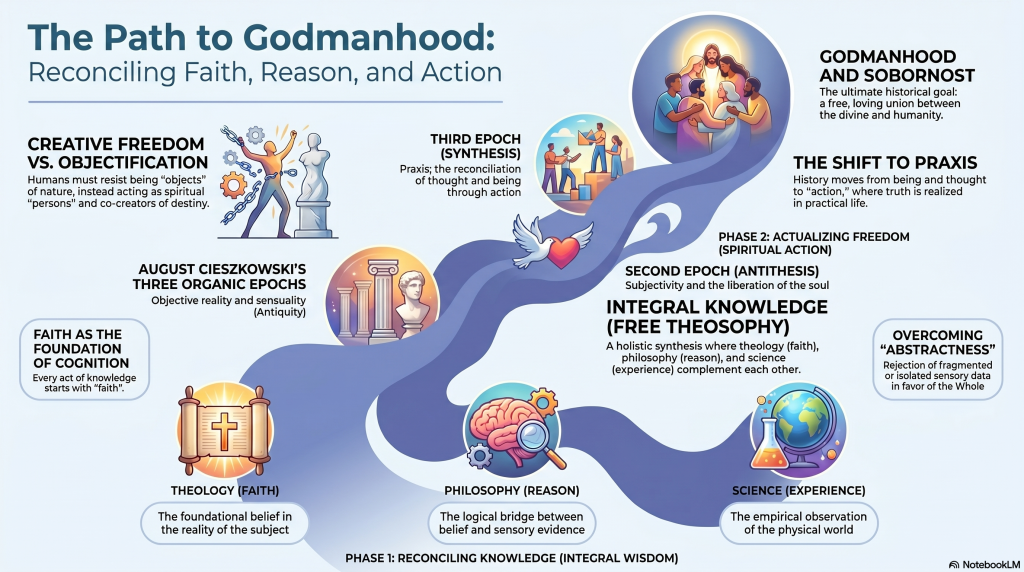
The intellectual landscape of Eastern and Central Europe during the nineteenth and early twentieth centuries was characterized by a profound struggle to reconcile the inherited structures of Christian revelation with the burgeoning demands of rationalist philosophy, the empirical rigors of modern science, and the urgent necessity for historical praxis. This intellectual ferment found its most sophisticated expressions in the work of Vladimir Solovyov, the foundational figure of the Russian religious-philosophical renaissance; Count August Cieszkowski, the Polish philosopher who transformed Hegelian dialectics into a philosophy of action; and Nikolai Berdyaev, the existentialist thinker who synthesized these traditions into a radical defense of creative freedom and personalism. These three figures, though rooted in distinct national contexts—Russian Orthodoxy and Polish Messianism—shared a common vision of history as a divinely-human process (Godmanhood) moving toward a definitive “Kingdom of God” or an “Epoch of the Holy Spirit.” Their philosophies represent an attempt to move beyond the “abstract principles” of Western metaphysics toward an “integral knowledge” where thought and action, the divine and the human, find their ultimate reconciliation.[1, 2]
The Foundation of All-Unity: Vladimir Solovyov’s Synthesis of Knowledge
Vladimir Solovyov is widely recognized as the first “professional” philosopher in Russia, a figure who elevated Russian thought from provincial debates between Westernizers and Slavophiles to a comprehensive metaphysical system.[3, 4] His philosophical journey began with a radical critique of the very foundations of Western intellectual history. In his seminal doctoral dissertation, The Crisis of Western Philosophy: Against the Positivists, Solovyov argued that the traditional dichotomy between “speculative” rationalism and “empirical” knowledge had reached a logical and spiritual dead end.[1] He contended that both schools of thought were guilty of “abstractness”—the isolation of a single aspect of reality (reason or sensory data) and its elevation to an absolute principle.[3] For Solovyov, the culmination of this process was positivism, which he viewed as a “crude form of materialism” that negated the spiritual foundation of existence in favor of a utilitarian focus on scientific truth.[3]
The Principles of Integral Knowledge
To overcome this crisis, Solovyov proposed a post-philosophical inquiry termed “Integral Knowledge” or “Free Theosophy”.[1, 4] This concept did not seek to abolish science or philosophy but to reintegrate them within a theological framework. Solovyov maintained that all branches of knowledge are complementary: theology addresses the realm of faith and absolute values, philosophy provides the rational structure for these values, and science explores the empirical manifestations of reality.[4] He argued that every cognitive act begins with an assertion of the object’s objective existence—a “faith” in the broad sense—which serves as the necessary precondition for all science and philosophy.[4] This “All-Unity” (Total-Unity) suggests that in the divine order, all elements positively supplement each other to form a harmonious organism, whereas in our “fallen” state of externality, elements exclude and displace one another.[5]
| Dimension of Knowledge | Philosophical Correlation | Cognition Mode | Objective Realm |
|---|---|---|---|
| Theology | Faith | Mystical Intuition | Uncreated Truth (God) [4] |
| Philosophy | Reason | Rational Reflection | Logical Principles [4] |
| Science | Experience | Empirical Observation | Created Reality (Nature) [4] |
The goal of Solovyov’s system was the realization of “Godmanhood”—the idea that the incarnation of Christ was not merely a historical event but a template for the cosmic and historical process of uniting God and the world.[5] This union cannot be a single act imposed by God; it requires the free choice of humanity to return to the divine source.[5] Consequently, history is viewed as a “developing totality” where humanity acts as the mediator, organizing the chaotic multiplicity of the natural universe into a spiritual whole.[5, 6]
Sophiology and the Eternal Feminine
A central and frequently contested aspect of Solovyov’s metaphysics is his concept of “Sophia,” or the Wisdom of God.[5] Sophia is described as the “Eternal Feminine,” the feminine soul of the world, and the “mysterious companion of God”.[5] She occupies a mediating position between the absolute unity of the Deity and the multiplicity of living entities.[5] In Solovyov’s organic theology, Sophia represents a passive force that unconsciously strives for unity, while the Logos (Christ) is the active, formative energy that possesses the conscious idea of total-unity.[5]
Solovyov’s focus on Sophia is intimately linked to his ethics of love, particularly “sexual love,” which he detailed in his work The Meaning of Love.[3, 5] He argued that sexual love is the primary mechanism for overcoming “egoism”—the state where a person opposes themselves to all other entities.[5] By recognizing the absolute significance of another personality, the individual achieves a “salvation of individuality through the sacrifice of egoism”.[5] Love, for Solovyov, is not merely a biological necessity for procreation but the transformation of mortal, divided beings into an “integral immortal being,” a higher union of the masculine and feminine principles that mirrors the relationship between God and Sophia.[5]
The Philosophy of Action: August Cieszkowski’s Revision of Hegel
While Solovyov was constructing a system of “All-Unity” in Russia, the Polish philosopher August Cieszkowski was radically transforming Hegelian philosophy in the context of Polish Messianism. In his 1838 work, Prolegomena do historiozofii (Prolegomena to a Historiosophy), Cieszkowski introduced the term “historiosophy” to describe a new science that would speculatively grasp the past to reach the essence of the future.[2] Cieszkowski argued that while Hegel’s philosophy was the pinnacle of human thought, it remained essentially “speculative” and retrospective—a philosophy of “being” and “thought” that failed to account for the future.[1, 2]
The Three Organic Epochs and Praxis
Cieszkowski applied the Hegelian triad to human history, but he shifted the culmination of the dialectic from the “absolute spirit’s self-reflection” to the realm of human action or “Praxis”.[2] He divided history into three distinct organic epochs:
| Epoch | Hegelian Principle | Characteristics | Core Orientation |
|---|---|---|---|
| First Epoch | Thesis | Being, externality, sensuality | Objective reality (Antiquity) [2] |
| Second Epoch | Antithesis | Thought, interiority, subjectivity | Liberation of the soul (Christianity) [2] |
| Third Epoch | Synthesis | Action, “self-doing,” praxis | Reconciliation of Being and Thought [2] |
The “Epoch of Action” represents the historical future where humanity moves from “intuition” to the “fulfillment of history”.[2] Cieszkowski’s most significant discovery was that the aim of history is “self-action”—a post-theoretical practice where the ideas of beauty and truth are realized in practical life.[2] In this third stage, humanity assumes mature responsibility for its own history, shaping reality consciously rather than being a passive subject of historical forces.[2]
Paracletism and the Social “Our Father”
The religious expression of this third epoch is “Paracletism,” the “religion of the Holy Spirit”.[2] Cieszkowski viewed Paracletism not as a replacement for Christianity but as its fulfillment, much as Christianity fulfilled the Law of the Jews.[2] In the Epoch of the Spirit, religion does not disappear but is transformed into a “religion of public life” identified with social praxis.[2] Cieszkowski famously used the “Our Father” prayer as a foundational text for this new era, arguing that its language possessed a mark of universality that could influence all social strata.[2] The petition “Thy Kingdom Come” was interpreted by Cieszkowski not as a hope for an otherworldly afterlife, but as a mandate for the building of the Kingdom of God on earth through human action grounded in knowledge.[2]
Polish and Russian Messianism: A Comparative Tension
The philosophies of Solovyov and Cieszkowski were deeply embedded in the “messianic” aspirations of their respective nations. However, their definitions of the national “mission” reveal fundamental differences in historical orientation and religious identity.[7]
Russian Messianism: Preservation and Antemurale
Russian Messianism in the nineteenth century, particularly among the Slavophiles, was strongly linked to the past and the preservation of an “ancestral purity”.[7] It sought a return to an “old Russian Orthodoxy” that remained uncontaminated by external Latin or Western influences, which were often characterized as the work of the “Antichrist”.[7] The mission of the Russian nation was conceived as the strict adherence to this pure faith to successfully oppose the spiritual decay of the West.[7] For Solovyov, this mission eventually evolved into a “universal Christianity” where Russia would act as the “bulwark” that unites the fragmented churches of the West and East under a revitalized theocracy.[3, 5]
Polish Messianism: The “Jesus of Nations”
In contrast, Polish Messianism—coined by Józef Maria Hoene-Wroński and further developed by Cieszkowski, Adam Mickiewicz, and Andrzej Towiański—was a millenarian structure focused almost exclusively on future eschatological goals.[7] Influenced by the tragedy of Poland’s partitions, this movement developed a “theory of expiatory sacrifice”.[7] The Poles saw a direct parallel between their nation’s suffering and the passion of Jesus on the cross.[7] The underlying logic was that while Jesus’s individual sacrifice saved individual souls, the collective sacrifice of the Polish nation would bring “salvation to the nations” and a complete renewal of international sociopolitical relations.[7]
| Feature | Russian Messianism (Slavophiles/Early Solovyov) | Polish Messianism (Mickiewicz/Cieszkowski) |
|---|---|---|
| Historical Anchor | The Past (Preservation of Orthodoxy) [7] | The Future (Millenarian Renewal) [7] |
| Role of the Nation | Bulwark against the Antichrist [7] | The “Jesus of Nations” (Expiatory Sacrifice) [7] |
| Religious Goal | Preservation of ancestral purity [7] | Establishment of the “Kingdom of God on Earth” [2, 7] |
| Spiritual Mediation | Emphasis on the Orthodox Church/Peasantry [7] | Anticipation of the end of spiritual intermediaries [7] |
Polish Messianists like Mickiewicz and Cieszkowski expected a new epoch where the mediation of earthly superiors and institutional spiritual intermediaries would become superfluous, as people followed the “Spirit” directly.[7] This “revolutionary messianism” contrasted sharply with the more static and preservation-focused view of the Russian Orthodox tradition, although Solovyov’s later “Godmanhood” project sought to bridge these two views by treating history itself as a dynamic, developing process.[5]
Nikolai Berdyaev: The Synthesis of Freedom and Personalism
Nikolai Berdyaev serves as the bridge between the nineteenth-century systems of Solovyov and Cieszkowski and the existentialist crises of the twentieth century. Berdyaev, a Russian philosopher and theologian who lived through the “Silver Age” and later the Russian Revolution, was one of the most prominent figures of the “religious renaissance”.[8] His philosophy was centered around the concept of “creative freedom” and a radical “personalism” that defended the individual against all totalizing systems.[8, 9]
The Influence of Solovyov and Cieszkowski on Berdyaev
Berdyaev’s work exhibits both synergies and divergences with his predecessors. From Solovyov, Berdyaev adopted the concept of “Godmanhood,” but he modified it into an “existential cooperation” between God and man where human creativity is indispensable for the divine life.[10] However, he critiqued Solovyov’s “All-Unity” for being too collective and spiritually “monistic”.[8, 9] Berdyaev openly declared himself a “dualist,” arguing that monism (the belief in a single absolute substance) was alien to him because it tended to swallow the individual.[9]
Berdyaev found a closer affinity in August Cieszkowski. In his later works, Berdyaev identified Cieszkowski as “the most noteworthy predecessor of the religion of the Holy Spirit”.[2] He believed that Cieszkowski had expressed the idea of the “religion of the Spirit” as a complete and ultimate revelation more clearly than Solovyov.[2] For Berdyaev, Cieszkowski’s “philosophy of action” provided the necessary link between abstract religious truth and the historical task of transforming the world.[2]
Creative Freedom and the “Ungrund”
At the heart of Berdyaev’s philosophy is the distinction between “freedom” and “nature.” He argued that man is a spiritual being (personhood) flung into a blind, mechanistic world of “fallen nature” or “necessity”.[9, 11] Berdyaev’s concept of freedom is “uncreated”—it is not something granted by God but exists in the “Ungrund” (the primal nothingness or freedom) that precedes even the creation of the world.[9] This “uncreated freedom” creates the possibility of evil, as freedom must include the choice between good and evil.[9, 12] Berdyaev rejected any “optimistic theodicy” that would make God responsible for evil; instead, he believed that God shares in the suffering of humanity that has evilly abused its freedom.[9]
Personalism vs. Objectification
Berdyaev’s “Personalism” is a radical defense of the “person” against the “individual.” In his terminology, the “individual” belongs to the natural, biological world and is subject to its laws of slavery and death.[9] The “person,” however, is a spiritual reality and the bearer of freedom.[9] Berdyaev criticized what he called “objectification”—the process by which spiritual realities are turned into things or objects (such as the state, the church as an institution, or economic systems).[9] He argued that liberation from the power of “things” constitutes the value of human life.[9]
| Concept | Definition in Berdyaev’s Thought | Relationship to the World |
|---|---|---|
| Personality (Person) | The spiritual essence; bearer of freedom [9] | Belongs to the Kingdom of God [9] |
| Individual | A combination of natural features; biological entity [9] | Enslaved by natural necessity and death [9] |
| Freedom | Uncreated; originates in the Ungrund [9] | The source of creativity and spirit [9] |
| Objectification | The turning of spirits into things [9] | An “evil nightmare” of fallen nature [9] |
Comparison of Philosophical Systems: Differences and Synergies
The philosophies of Solovyov, Berdyaev, and Cieszkowski form a complex dialogue regarding the nature of freedom, the role of history, and the ultimate destiny of humanity.
Synergies in Integral Knowledge and Creative Action
All three thinkers sought to move beyond the fragmentation of modern thought. Solovyov’s “Integral Knowledge” aligns with Cieszkowski’s “Praxis” in that both reject the separation of theory and life.[2, 8] For both, the individual’s pursuit of a higher existence is not a solitary mystical endeavor but a historical task to unite with the divine or the universal order.[8] There is a shared synergy in their elevation of individual agency: Solovyov sees man as the mediator of cosmic unity, Cieszkowski sees him as the architect of the third epoch, and Berdyaev sees him as the “co-creator” of destiny.[2, 5, 8]
Divergences on Collectivism and Individualism
The primary divergence lies in the emphasis on the collective versus the individual. Solovyov’s system is fundamentally “collective and spiritually oriented,” concentrating on the union with a greater cosmic and divine order (Sobornost).[8, 10] While Solovyov argued that “total-unity” does not diminish individuality but incorporates it fully, Berdyaev remained skeptical.[5] Berdyaev’s focus was more “existential and anthropocentric,” asserting that individual freedom and personal agency are the utmost values.[8] For Berdyaev, the “social” must never swallow the “personal”.[9]
Contrasting Views on the Dialectic
The use of the Hegelian dialectical method also serves as a point of comparison:
- Solovyov viewed the dialectic as a conceptual necessity that showed the internal contradictions of Western philosophy, requiring an “explosion” of the theory to reveal its divine foundation.[1, 13]
- Cieszkowski used the dialectic to “prophesy” the third epoch, transforming Hegel’s backward-looking “thought” into forward-looking “action”.[2]
- Berdyaev used the dialectic to explore the “formation of Sobornost” and the tension between the Divine and humanity, but he criticized Hegel for lacking a religious-eschatological dimension where the contradiction is resolved not in a logical synthesis but in the Kingdom of God.[10]
Positives and Negatives: An Evaluative Critique
The legacies of Solovyov, Cieszkowski, and Berdyaev are marked by brilliant insights and profound, sometimes problematic, implications.
Vladimir Solovyov: The Systematic Mystic
Positives:
- Synthesis of Science and Religion: Solovyov’s “integral knowledge” remains an influential model for reconciling different domains of human experience.[4, 14]
- Philosophical Originality: He is credited with creating the first original Russian philosophical system, influencing “Russian Cosmism” and religious thought for generations.[4, 14]
- Ethical Depth: His analysis of love as the way to overcome egoism provided a unique spiritual foundation for ethics.[5]
Negatives:
- Lack of Empirical Soundness: Critics often point out that Solovyov’s conclusions repeatedly rest on appeals to the “divine” or “spirit,” which can undermine the logical rigor of his arguments.[1]
- Utopianism: His vision of a global “Theocracy” and the immediate realization of “Total-Unity” was often criticized as an “impractical utopia”.[3, 5]
- Lack of Originality in Content: Some critics argue he merely employed the ideas of Hegel, Schelling, and Boehme without adding significant new content, though others defend his “classic” status.[13, 15]
August Cieszkowski: The Prophet of Praxis
Positives:
- Discovery of Praxis: His shift from speculative philosophy to action was a groundbreaking precursor to modern political and social philosophy.[2]
- Universal Religious Vision: By using the “Our Father” and the concept of “Paracletism,” he sought a religion that was accessible and transformative for all social strata.[2]
- Modernization of Consciousness: He offered a program for national rebirth that focused on revitalizing religious consciousness rather than secularization.[2]
Negatives:
- Romantic Nationalism: His ideas were part of the “political romanticism” critiqued by later realists for failing to understand material strength and the actual distribution of power.[7]
- Failure of Ideals: The events of the “Spring of Nations” demonstrated that states were guided by self-interest rather than the sacrificial ideals he proposed.[7]
- Ideological Aberration: Later Polish Positivists rejected his mysticism and “exaggerated religiosity” as a “shameful aberration” from scientific progress.[7]
Nikolai Berdyaev: The Defender of the Spirit
Positives:
- Champion of Freedom: Berdyaev’s radical defense of individual freedom against communism and fascism made him a crucial voice in the 20th century.[16]
- Personalist Insight: His distinction between “personality” and “individuality” provided a deep critique of both bourgeois individualism and collective tyranny.[9, 16]
- Existential Depth: He successfully brought the insights of Dostoevsky and the Russian religious renaissance into the broader Western existentialist movement.[5, 9]
Negatives:
- Lack of Precision: Berdyaev admitted he was not a “precise” philosopher; he was an “intuitionist” whose work favored reflective depth over technical accuracy.[12]
- Extreme Dualism: His radical separation of “Spirit” and “Nature” could lead to a type of “world-negativity” that devalues the physical world.[9]
- Ambiguity on Occultism: His “complex” and “ambiguous” attitude toward occult phenomena and esotericism was criticized for lacking “true freedom” and being spiritually dangerous.[12]
Socio-Political Implications: Communism and the State
Berdyaev’s analysis of Russian Communism provides a vital application of these philosophical themes to the political reality of the 20th century. In The Origin of Russian Communism, Berdyaev argued that Communism is not merely a political or economic system but a “world outlook” and a “totalitarian” religion.[16]
Communism as a “False Religion”
Berdyaev defined Russian Communism as a “Russian creation” that built its entire program on a defined, mandatory worldview.[16] Because it claimed the totality of human life, it was inherently incompatible with religious faith, particularly Christianity.[16] For the “real integral communist,” a merciless fight against religion was a social necessity.[16] Berdyaev saw Marxism as a “miracle” not of science, but of its social and institutional transformation into an “aggressive, universal religion of salvation” that offered deliverance from injustice but required the sacrifice of the person to the collective.[16]
The Totalitarian Challenge
Berdyaev’s struggle was against the “repressiveness of the regime,” which he saw as resulting from the very nature of one-party rule that objectively required the systematic repression of civil rights.[17] He believed that the despot persecutes the believer because the believer refuses to offer the “totality of his life” to the ruling power.[16] This insight into the “religious” nature of totalitarianism remains a cornerstone of Berdyaev’s contribution to political philosophy.[16]
Final Synthesis: The Horizon of the Spirit
The philosophies of Vladimir Solovyov, August Cieszkowski, and Nikolai Berdyaev represent a profound attempt to find meaning in the historical process through the lens of divine-human cooperation. While they differed in their emphasis—Solovyov on the unity of the whole, Cieszkowski on the power of action, and Berdyaev on the freedom of the person—they were united in their rejection of a “disenchanted” world of mere matter and necessity.
Solovyov’s “All-Unity” provides the ontological ground for a universe that is not a collection of accidental fragments but a developing organism.[5, 6] Cieszkowski’s “Praxis” provides the historical mechanism by which the ideas of that organism are realized in the social world.[2] Berdyaev’s “Creative Freedom” ensures that this process remains a “trial” and a choice, where the dignity of the person is never sacrificed to the logic of the system.[9, 10]
Together, these thinkers offer an alternative to the “modern positivist thought” that has dominated the last two centuries.[13, 18] They suggest that true “modernity” is not found in the linear accumulation of empirical data, but in the “revitalization of religion” as a living force in history.[2, 13] Their works continue to challenge the contemporary model of fragmented knowledge, calling for a return to a “holistic cognition” where science, philosophy, and religion are once again united in the pursuit of the Kingdom of the Spirit.[4, 13] In the historical fate of Godmanhood, their ideas remain “extremely modern” because they reveal the characteristic traits and contradictions of our time from a “different and more objective angle”.[13]
——————————————————————————–
- Solovyov, Vladimir | Internet Encyclopedia of Philosophy, https://iep.utm.edu/solovyov/
- The Alternative of Secularization? On the Political Theology of August Cieszkowski, https://deliberatio.eu/en/analyses/philosophy/the-alternative-of-secularization-on-the-political-theology-of-august-cieszkowski
- Vladimir Sergeyevich Solovyov | Mysticism, Neo-Kantianism, Idealism | Britannica, https://www.britannica.com/biography/Vladimir-Sergeyevich-Solovyov
- The significance of faith in the concept of integral knowledge of Vladimir Solovyov – Вестник Санкт-Петербургского университета. Философия и конфликтология, https://philosophyjournal.spbu.ru/article/download/9837/7206/28040
- The Basic Ideas of Four Russian Thinkers – Emory University, https://www.emory.edu/INTELNET/four_thinkers.html
- The Horizons of the Organic Vision of the Universe and Humanity: Vladimir Solovyev, https://www.religion-online.org/article/the-horizons-of-the-organic-vision-of-the-universe-and-humanity-vladimir-solovyev/
- Polish Messianism, https://www.repository.cam.ac.uk/bitstreams/103addbd-12db-4f6c-b7f0-2c5d40d7d77b/download
- Solovyov and Berdyaev: Russian Philosophers | PDF | Spirituality | Liberal Arts Education – Scribd, https://www.scribd.com/document/954238980/Russian-Philosophers
- Nikolai Berdyaev – Chebucto Community Net, http://www.chebucto.ns.ca/Philosophy/Sui-Generis/Berdyaev/essays/fetodov.htm
- NIKOLAY BERDYAEV: THE DIALECTICS OF SOBORNOST – SAV, https://www.sav.sk/journals/uploads/02202149filozofia.2022.77.2.4.pdf
- Unamuno, Berdyaev, Marcel: A Comparative Study in Christian Existentialism [1st ed. 2021] 3030819981, 9783030819989 – DOKUMEN.PUB, https://dokumen.pub/unamuno-berdyaev-marcel-a-comparative-study-in-christian-existentialism-1st-ed-2021-3030819981-9783030819989.html
- Occultism of the Silver Age of Russian Culture in the … – ejournals, https://ejournals.eu/pliki_artykulu_czasopisma/pelny_tekst/0194404b-887e-70cc-8bf4-6ed4b6cf3446/pobierz
- Progress and Modernity: Solovyov’s Reverse Philosophical Perspective Прогресс и современность, http://solovyov-studies.ispu.ru/files/published/str.26-29_84.pdf
- “An Artist of Unparallelled Originality”. ARKHIP KUINDZHI’S LATER SKETCHES REDISCOVERED | The Tretyakov Gallery Magazine, https://www.tretyakovgallerymagazine.com/articles/3-2018-60/artist-unparallelled-originality-arkhip-kuindzhi%E2%80%99s-later-sketches-rediscovered
- Alexandre Kojève: The Religious Metaphysics of Vladimir Solovyov, https://reviews.ophen.org/2019/04/11/alexandre-kojeve-the-religious-metaphysics-of-vladimir-solovyov/
- Repressions | Acton Institute, https://www.acton.org/repressions
- THE TOTALITARIAN PARADIGM AFTER THE END OF COMMUNISM – Brill, https://brill.com/downloadpdf/display/title/30508.pdf
- Alexei Khomiakov – ResearchGate, https://www.researchgate.net/profile/Teresa_Obolevitch/publication/343489270_Faith_and_Science_in_the_Thought_of_Khomiakov/links5fa18be2299bf1b53e5d18e6/Faith-and-Science-in-the-Thought-of-Khomiakov.pdf
