Tag: theology
The Teleology of Action and the Metaphysics of All-Unity: A Comparative Analysis of Vladimir Solovyov, August Cieszkowski, and Nikolai Berdyaev
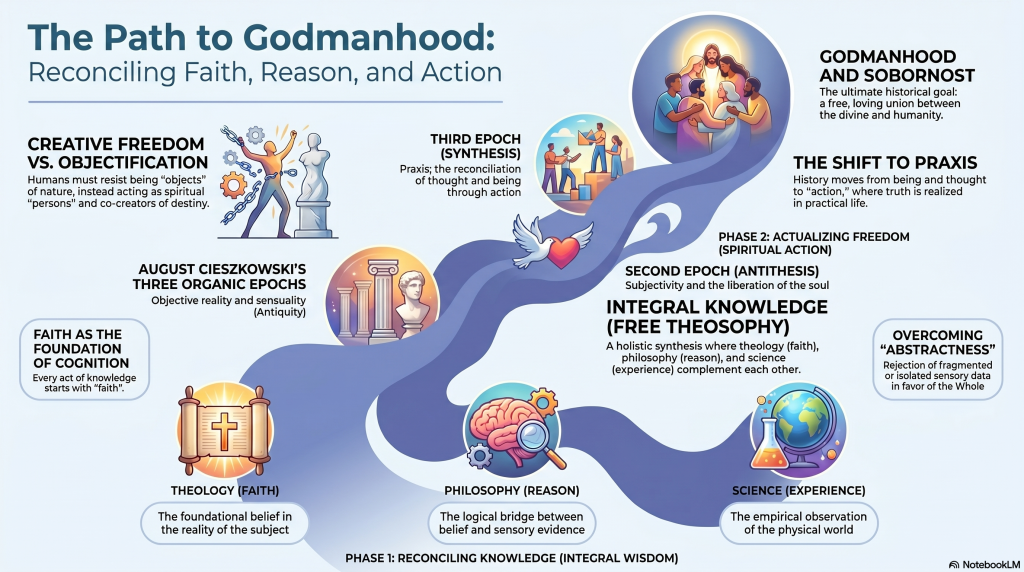
The intellectual landscape of Eastern and Central Europe during the nineteenth and early twentieth centuries was characterized by a profound struggle to reconcile the inherited structures of Christian revelation with the burgeoning demands of rationalist philosophy, the empirical rigors of modern science, and the urgent necessity for historical praxis. This intellectual ferment found its most sophisticated expressions in the work of Vladimir Solovyov, the foundational figure of the Russian religious-philosophical renaissance; Count August Cieszkowski, the Polish philosopher who transformed Hegelian dialectics into a philosophy of action; and Nikolai Berdyaev, the existentialist thinker who synthesized these traditions into a radical defense of creative freedom and personalism. These three figures, though rooted in distinct national contexts—Russian Orthodoxy and Polish Messianism—shared a common vision of history as a divinely-human process (Godmanhood) moving toward a definitive “Kingdom of God” or an “Epoch of the Holy Spirit.” Their philosophies represent an attempt to move beyond the “abstract principles” of Western metaphysics toward an “integral knowledge” where thought and action, the divine and the human, find their ultimate reconciliation.[1, 2]
Continue reading “The Teleology of Action and the Metaphysics of All-Unity: A Comparative Analysis of Vladimir Solovyov, August Cieszkowski, and Nikolai Berdyaev”

The Dhammapada: Canonical Verses on Buddhist Philosophy and Ethics

The Dhammapada is a foundational collection of Buddhist verses that outlines the psychological and ethical framework necessary for spiritual liberation. The central thesis is that human existence is fundamentally a product of thought; mental discipline is therefore the primary determinant of suffering or happiness. The text emphasizes earnestness (vigilance) as the path to immortality (Nirvana) and identifies thirst (desire/craving) as the root of all human bondage. To transcend the cycle of birth and decay, an individual must achieve absolute self-mastery, abandon worldly attachments, and follow the “Eightfold Way.” The document concludes that true holiness—exemplified by the Arhat or Brahmana—is defined not by birth or ritual, but by the complete extinction of passion and the attainment of profound inner quietude.
Continue reading “The Dhammapada: Canonical Verses on Buddhist Philosophy and Ethics”The Ecclesiastical Landscape of the United Kingdom: A Comprehensive Analysis of Christian Denominations, Traditions, and Trends

1. Introduction: The Transformation of British Christianity
The religious landscape of the United Kingdom has undergone a profound and irrevocable transformation over the last century, shifting from a monocultural Christendom dominated by state-established churches to a pluralistic, competitive, and highly fragmented spiritual marketplace. For over a millennium, the identity of the British nations was inextricably linked to their respective national churches, creating a society where religious affiliation was largely a matter of geography, birth, and civic obligation. However, the 21st century has witnessed the dissolution of this monolithic structure, replaced by a complex tapestry of faith that defies simple categorization.
The release of data from the 2021 Census for England and Wales marked a historic watershed in this evolution. For the first time in the history of the census, the proportion of the population identifying as “Christian” fell below the fiftieth percentile, settling at 46.2%, a precipitous drop from 59.3% just a decade prior.1 This statistical recession represents a seismic shift in the cultural self-understanding of the nation. It indicates that the era of “nominal” Christianity—where individuals identified with the church as a default cultural marker regardless of belief or practice—is rapidly drawing to a close. The rise of the “No Religion” category to 37.2% suggests that the British public is increasingly comfortable shedding religious labels that no longer correspond to their lived reality.2
However, to interpret these statistics merely as a narrative of secularization would be a simplification. While the “passive” adherence to historic institutions is collapsing, “active” Christianity is demonstrating remarkable resilience and, in specific sectors, vibrant growth. The landscape is characterized by a “mixed economy” of decline and renewal. On one hand, the historic denominations—Anglicanism, Catholicism, and traditional Non-Conformity—face the attrition of an aging membership and the loss of cultural privilege. On the other, the religious marketplace is being energized by the explosive growth of Pentecostalism, the establishment of independent “New Church” networks, and the arrival of global Christian diasporas who are reshaping the theological geography of the UK.3
This report provides an exhaustive examination of the Christian denominations currently operating within the United Kingdom. It aims to move beyond a mere cataloging of groups to analyze the theological DNA, governance structures, and practical lived realities that distinguish them. It explores how the “Parish” model of the Church of England differs from the “Gathered” model of the Baptists; how the ancient, sensory-rich liturgies of the Orthodox diaspora contrast with the informal, band-led worship of the Vineyard movement; and how the silence of the Quakers sits alongside the brass bands of the Salvation Army. By mapping the unity and diversity of British Christianity, this analysis reveals a faith tradition that is simultaneously contracting in its institutional forms and expanding in its grassroots expressions.
Continue reading “The Ecclesiastical Landscape of the United Kingdom: A Comprehensive Analysis of Christian Denominations, Traditions, and Trends”The Charioteer’s Guide to Radical Focus: 5 Timeless Lessons from the Bhagavad-Gita
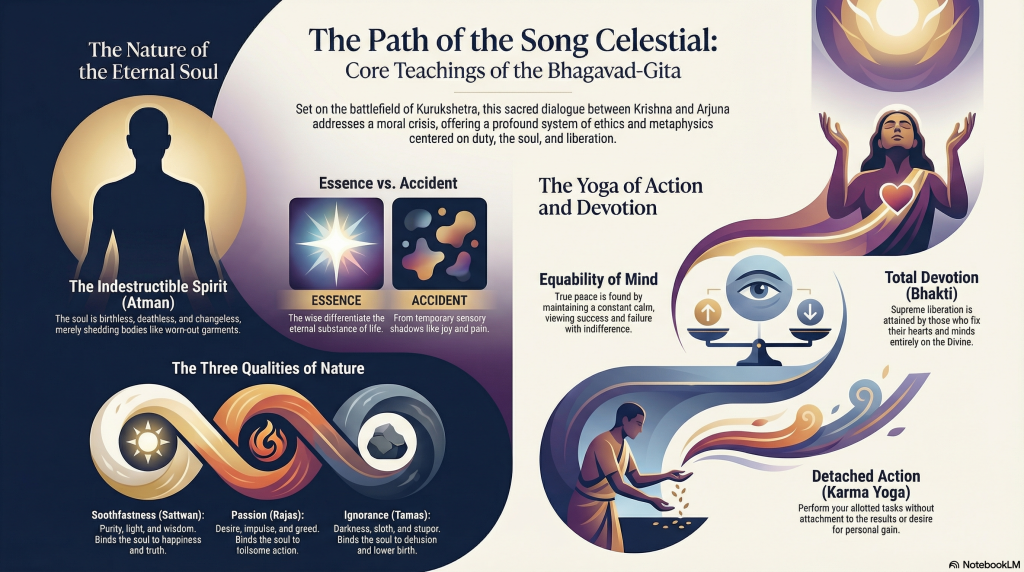
Introduction: The Battlefield of the Mind
In the modern era, we are frequently besieged by a “paralysis of choice.” We inhabit a world of infinite digital noise and existential overwhelm, where every decision feels weighted with the pressure of optimal outcomes and the crushing visibility of the “global village.” This internal friction is not a product of the internet age, but a fundamental human condition described vividly in the Bhagavad-Gita, a third-century dialogue set on the precipice of a great war.
The narrative opens on the battlefield of Kurukshetra, where the warrior-prince Arjuna stands paralyzed between two massive armies. Confronted with the prospect of fighting his own kinsmen, his “members fail” and his “life within seems to swim and faint.” Arjuna’s distress is a profound metaphor for our own inner conflicts—the moments when duty, desire, and doubt collide, leaving us frozen. His guide, the divine charioteer Krishna, responds not with simple platitudes, but with a rigorous philosophical framework for navigating life with clarity and a radical, detached focus.
Continue reading “The Charioteer’s Guide to Radical Focus: 5 Timeless Lessons from the Bhagavad-Gita”The Hidden Tapestry: An Exhaustive Investigation into Obscure Biblical Genealogies and Familial Links

1. Introduction: The Theological Architecture of Lineage
In the modern Western mind, genealogy is often relegated to the domain of hobbyists seeking ancestry or the legalities of probate. However, within the biblical corpus, genealogy is the primary skeleton of history. It serves functions far beyond the biological; these lists are political charters, maps of alliance, claims to priesthood, and definitions of inheritance. To read the biblical text without a robust understanding of these familial networks is to view a two-dimensional map of a three-dimensional terrain. The casual reader often skips the “begats,” seeing them as arid interruptions to the narrative flow. Yet, it is within these dry lists that the most profound motivations for biblical events are hidden.
When Abraham calls Lot his “brother,” or when Jesus creates an inner circle of three disciples, or when a civil war erupts between the generals of David and Absalom, the underlying dynamic is almost always one of blood and marriage. The Bible was written within high-context societies where kinship was the paramount social reality. An individual’s identity was inextricably bound to their bet av (house of the father). Therefore, when the text introduces a character, it often assumes the reader understands the tribal and familial baggage they carry.
This report conducts a forensic examination of these obscured relationships. By cross-referencing the Masoretic Text (Hebrew Bible), the Septuagint (Greek Old Testament), and the New Testament, and by analyzing the specific semantic ranges of kinship terms like ach (brother) and anepsios (cousin), we reconstruct the hidden family trees that shaped the history of redemption. We will investigate the Levitical purity of Moses, the Moabite blood in the Messiah, the internecine warfare of David’s nephews, and the cousin-consortium that formed the apostolic foundation of the Church.
Continue reading “The Hidden Tapestry: An Exhaustive Investigation into Obscure Biblical Genealogies and Familial Links”The Tower of Babel

* Image generated using Nano Banana Pro
The Tower of Babel story in Genesis 11:1–9 portrays humanity’s attempt to secure unity, security, and fame on its own terms, and God’s decisive action to limit that project by confusing language and scattering the people. The passage explores themes of pride, obedience, empire, language, and the tension between human self-exaltation and divine sovereignty.
Human unity and the “city project”
Several commentators note that the focal problem is not technology or architecture in itself, but the collective project to “build ourselves a city” and “make a name for ourselves,” rooted in anxiety about being scattered. This unity is presented as “the unity of unbelief”: people harness a single language and shared purpose not to seek God, but to secure autonomy and permanence apart from God’s command to fill the earth.
Pride, name, and self-exaltation
The builders’ desire to “make a name” is widely read as an expression of pride, a grasping for reputation and glory that belongs properly to God, prefiguring the promise in Genesis 12 where God, not humans, promises to make Abram’s name great. Expositors often stress that Babel continues the pattern of Adam’s sin—asserting human greatness over against God—and that God’s response exposes the futility of human projects that ignore or defy divine authority.
Disobedience to divine commission
After the Flood, God commands humanity to “fill the earth,” but at Shinar they deliberately choose to settle, centralise, and avoid dispersion. Many commentators therefore see the city and tower as an organised refusal of God’s mission for humanity, with the tower symbolising a kind of early “empire” that seeks control and refuses dependence.
Divine descent and ironic reversal
Commentators often point out the irony that, despite the builders’ ambition to reach “the heavens,” God must “come down” to see the city and the tower, underscoring the smallness of human achievements from a divine perspective. God’s confounding of language and scattering of the people reverses their stated aims: the project meant to prevent dispersion becomes the occasion for a divinely enforced dispersion, and their attempt to gain a great “name” leads only to a name associated with confusion.
Judgment as limitation and mercy
Some theological readings emphasise that God’s act is both judgment and restraint: by breaking up a unified but rebellious culture, God prevents a deeper, more destructive concentration of evil. Several modern expositors argue that the scattering is also a severe mercy—God curbs human hubris and reorients history toward his redemptive plan, rather than allowing an unchecked, totalising human system.
Language, nations, and mission
The confusion of languages provides a narrative explanation for the diversity of tongues and nations, linking Genesis 11 with the surrounding “table of nations” in Genesis 10. Homiletical and academic treatments frequently connect Babel to later biblical texts, especially Pentecost in Acts 2, viewing the gift of tongues and the multi-lingual church as a partial reversal or transformation of Babel’s division into a new, God-centred unity.
Idolatry, religion, and spiritual rebellion
Some contemporary commentators, drawing on a “divine council” worldview, suggest that the tower was not simply an attempt to climb to heaven but to create a ritual or political centre that brought God or the gods down to serve human purposes. In that reading, Babel marks both human rebellion and a concurrent spiritual rebellion, with the nations becoming associated with hostile spiritual powers, which is later addressed in Israel’s calling and, for Christian interpreters, in Christ’s universal lordship.
Empire criticism and modern application
Modern expositions often read Babel as a critique of empire-building: the drive to concentrate power, erase difference, and construct grand monuments becomes a warning against any system that seeks security and greatness without reference to God. Applications commonly highlight that technological progress and collective strength are morally ambiguous and can be turned either toward humble obedience or toward self-exalting projects that God will ultimately frustrate.
Genesis

* Graphic & Post generated using GeminiAI
Genesis, the first book of the Bible, introduces key themes of creation, covenant, sin, and blessing, and different online commentaries approach it with varying theological and literary emphases. Differences between Bible versions often show up in how key Hebrew terms in Genesis are rendered, which affects doctrine, tone, and perceived meaning.
Scope and structure of Genesis
Genesis is traditionally divided into primeval history (chapters 1–11: creation, fall, flood, Babel) and patriarchal history (chapters 12–50: Abraham, Isaac, Jacob, Joseph), giving a movement from universal origins to one covenant family. Many commentators stress that Genesis provides the “foundations” of doctrines such as creation, sin, redemption, covenant, and the promise of a Messiah, shaping the rest of the biblical narrative.
Creation narratives (Genesis 1–2)
Conservative devotional commentaries such as Matthew Henry and Enduring Word treat Genesis 1 as a straightforward, historical account of God creating everything ex nihilo by his word, emphasizing God’s sovereign power, order, and goodness. Reformed commentators like Calvin argue that Genesis 1 presents God fructifying an initially “formless and void” earth by successive commands, underscoring that creation depends entirely on God’s ongoing word, not on any natural inherent power.
Literary and scholarly studies often note the structured, repetitive style of Genesis 1 (days, refrains, parallelism) and propose that it functions as liturgical or poetic prose that also counters ancient Near Eastern chaos myths by portraying a single, good Creator. Academic work on Genesis 2–3 highlights that the Eden story has chiastic structure and may contain “hidden polemic” against royal ideology: by placing knowledge and life with God rather than with kings, it quietly critiques Near Eastern claims that kings uniquely mediate life and wisdom.
Fall, flood, and Babel (Genesis 3–11)
Devotional commentators usually read Genesis 3 as a historical fall that introduces sin, death, and the need for redemption, with the proto-gospel hinted in the promise that the woman’s seed will bruise the serpent’s head. Scholarly work tends to read the narrative also as wisdom-like reflection on human autonomy, desire and mortality, and in some cases as a political critique of human attempts at godlike status, especially when tied to royal claims.
Studies of Genesis 6–9 frequently compare its flood account with Mesopotamian texts such as the Gilgamesh epic, noting both shared motifs (divine judgment, ark, survivor) and theological differences (monotheism, moral framing, covenant sign). Commentators and modern introductions further treat Genesis 11 (Babel) as a theologically charged portrait of human pride and centralised power being scattered by God, preparing for God’s alternative plan through Abraham in Genesis 12.
Patriarchal narratives (Genesis 12–50)
Many Christian commentaries stress that Genesis 12–50 centers on the covenantal promises to Abraham—land, offspring, and blessing—and show how these promises persist despite human failures (deception, rivalry, violence). Historical and literary scholarship often analyses these stories in cycles (Abraham, Jacob, Joseph), noting recurring motifs (barrenness, younger-over-elder, dreams, exile and return) and how they articulate identity and hope for Israel in relation to surrounding nations and empires.
Within online commentaries, some emphasise spiritual and moral applications (e.g. Abraham’s faith, Joseph’s forgiveness), while others focus on historical-critical questions such as sources, redaction, and ancient Near Eastern parallels for customs like treaty-making, inheritance, and burial practices.
Key online commentary streams
Several major styles of online commentary on Genesis can be distinguished:
- Classic devotional: Matthew Henry reads Genesis as pastoral and doctrinal instruction, constantly drawing out moral applications and Christological connections.
- Reformed theological: Calvin’s commentary focuses on God’s sovereignty, providence, covenant, and the clarity and sufficiency of Scripture for faith, sometimes polemicising against philosophical speculation.
- Modern evangelical/pastoral: Enduring Word presents verse-by-verse exposition with doctrinal points, pastoral application, and engagement with other commentators and background material.
- Study tools and multi-commentary sites: platforms like BibleHub aggregate historical and modern comments (Calvin, Keil & Delitzsch, Pulpit Commentary, etc.), enabling comparison of theological emphases and exegesis.
Academic articles and theses (such as those on Genesis 2–3) use tools like literary criticism, ancient Near Eastern comparisons, and discourse analysis to argue for deeper structural patterns (chiasm, polemic, intertextuality) underlying the familiar stories. These approaches often coexist with confessional readings but sometimes reach different conclusions about authorship, composition, and original function.
Differences among Bible versions in Genesis
Major differences between biblical versions of Genesis arise from three things: (1) underlying textual traditions (Masoretic Hebrew, Septuagint Greek, Samaritan Pentateuch, Vulgate Latin), (2) translation philosophy (literal vs dynamic), and (3) theological or liturgical context. In technical terms, textual-variant lists show that some verses of Genesis differ in small but sometimes theologically significant ways between the Masoretic Text, Septuagint, Samaritan Pentateuch and Vulgate.
Examples of textual and translational variation
- Divine name: In places such as Genesis 2:9, the Masoretic Text has “Yahweh Elohim” (“the Lord God”), whereas the Septuagint has simply “the God” and the Vulgate “Dominus Deus”; English versions follow their base text and translation policy in deciding whether to render this as “the LORD God” (capital LORD signalling the divine name).
- Lexical differences: Lists of variants show, for example, differences over prepositions or verbs in specific verses (e.g. “divided” / “parted”; “to” / “towards”) between Hebrew manuscripts, Samaritan, Septuagint and Vulgate, reflecting either alternative Hebrew readings or translator choices. These can affect nuance—such as whether a statement is directed “to” someone, “against” them, or “towards” them—though most do not radically change the overall narrative.
Modern English versions of Genesis
Version guides explain that “essentially literal” translations (e.g. NASB, ESV, NRSVue) aim to stay close to the wording and structure of the Hebrew, including in Genesis, while “dynamic” translations (e.g. NLT, some paraphrases) prioritise clarity in contemporary English and may smooth over Hebrew idioms. Some modern translations of Genesis rely primarily on the Masoretic Text but consult the Septuagint, Samaritan and Dead Sea Scrolls when the Hebrew is difficult or apparently corrupt, occasionally preferring an alternative reading that seems more original or contextually appropriate.
Differences in Genesis across versions also relate to how translators handle gendered language, anthropomorphisms, and poetry-like passages; academic and church-oriented versions may diverge on how far to adapt the language while preserving perceived theological intent. In liturgical traditions, the continued use of the Septuagint in Eastern Orthodoxy or the Vulgate tradition in historical Roman Catholicism can mean that readings and emphases in Genesis differ slightly from those in Protestant translations based directly on the Masoretic Text.