
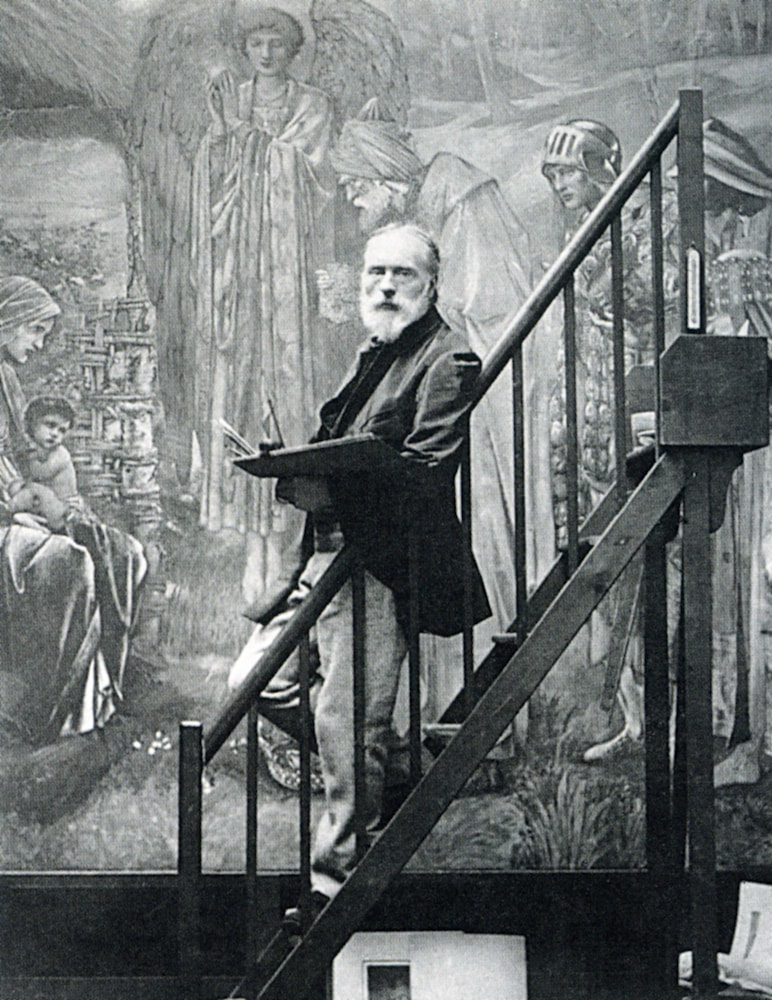
The Commission and Conception
The Architectural Context and Patronage of Arthur Balfour
In March 1875, Arthur James Balfour—a twenty-six-year-old Conservative Member of Parliament and future Prime Minister of the United Kingdom—commissioned Sir Edward Burne-Jones to design a decorative program for his London townhouse at 4 Carlton Gardens [cite: 1, 2, 3, 4]. The site for this scheme was the drawing room, which Balfour used as a music room [cite: 1, 2, 3, 4]. Balfour granted Burne-Jones creative autonomy, seeking an artistic ensemble that would express the aesthetic sensibilities of late Victorian art [cite: 2, 4].
Upon inspecting the room at 4 Carlton Gardens on March 27, 1875, Burne-Jones determined that the harsh natural daylight from the windows required architectural modifications [cite: 4]. He advised Balfour that the room’s walls should be clad in light English oak panelling, capped with an oak ceiling, and lit primarily by candles to create a softer, more contemplative atmosphere [cite: 4].
The original architectural concept was structured as a narrative frieze intended to run anti-clockwise around the room’s upper walls, set above the wainscoting and enclosed within carved acanthus scroll borders [cite: 3, 5]. The planned cycle comprised ten distinct narrative episodes: six large oil paintings on canvas interspersed with four low-relief panels carved in oak, modeled in gesso, and gilded with gold and silver leaf [cite: 3, 5]. By unifying architectural panelling, low-relief sculpture, gilded metalwork, and monumental painting, Burne-Jones sought to transform Balfour’s music room into an immersive decorative environment that integrated interior design with narrative art [cite: 3, 4].
Burne-Jones’s Career Trajectory and Aesthetic Philosophy
The Balfour commission arrived at an important point in Burne-Jones’s career. The early 1870s had been marked by personal and professional challenges, including the end of his affair with his model Maria Zambaco and his resignation from the Old Water-Colour Society in 1870 following criticism of his painting Phyllis and Demophoön [cite: 4, 5]. The 1875 Perseus project provided Burne-Jones an opportunity to re-establish his public reputation by shifting from the dense, Rossetti-influenced watercolors of his early period toward monumental classical narrative cycles [cite: 4, 5, 6].
Burne-Jones’s interest in the Perseus series extended beyond personal career goals; it offered a platform to realize his Aestheticist principles. Rejecting the demand for moralizing narrative, historical realism, or industrial utility common in mid-Victorian painting, Burne-Jones aimed to construct a self-contained, imaginative world [cite: 1, 6]. As the artist noted, his goal was to portray “a beautiful romantic dream of something that never was, never will be—in a light better than any light that ever shone in a land no one can define or remember, only desire” [cite: 6]. The Perseus myth served as a literary framework for this objective, allowing him to represent scenes suspended in an arcadian timelessness [cite: 6].
Literary and Mythological Mapping
From Classical Myth to Medievalized Romance
The ancient myth of Perseus—the son of Danaë and Zeus who slays the Gorgon Medusa and rescues Andromeda from a sea monster—has a literary tradition extending from Hesiod and Pindar to Ovid’s Metamorphoses and Apollodorus’s Bibliotheca [cite: 3, 7, 8, 9]. However, Burne-Jones did not depict the narrative through neoclassical conventions or classicizing physical idealism. He altered the ancient sources by emphasizing medieval, chivalric elements over classical heroic traditions [cite: 1, 10, 11, 12].
In Burne-Jones’s visual formulation, Perseus is represented as a slender knight clad in dark 15th-century plate-and-mail armor rather than an athletic, heroic nude [cite: 1, 10, 11]. Stylistically, the series draws upon Italian Renaissance artists, notably Andrea Mantegna’s defined linework, Sandro Botticelli’s linear rhythms, and Albrecht Dürer’s printmaking techniques [cite: 1, 5]. By framing the classical story as a medieval knightly quest, Burne-Jones aligned the Greek myth with Arthurian romance, depicting Perseus’s journey as an internal, psychological trial through quiet landscapes [cite: 1, 10, 12].
The Influence of William Morris’s “The Doom of King Acrisius”
The textual source for Burne-Jones’s cycle was William Morris’s poem “The Doom of King Acrisius,” published in The Earthly Paradise (1868–1870) [cite: 2, 3, 7, 13]. The collaboration between Burne-Jones and Morris on this subject began in the mid-1860s, when they planned an illustrated edition of The Earthly Paradise containing over two hundred woodcuts designed by Burne-Jones and engraved by Morris [cite: 14, 15]. Although that publication was not realized, Burne-Jones executed forty-eight detailed drawings for “The Doom of King Acrisius” [cite: 14, 15].
When Balfour requested the decorative cycle for his home, Burne-Jones returned to these earlier compositions, adapting twenty-eight sketchbook concepts into the ten-panel program [cite: 12, 14].
Morris’s poetic retelling altered the classical narrative by introducing themes of fate, melancholy, and psychological complexity [cite: 6, 14, 15]. Morris structured the story around inescapable destiny, highlighting Medusa’s sorrow, Andromeda’s vulnerability, and Perseus’s anxieties [cite: 6, 15, 16]. Burne-Jones reflected Morris’s poetic rhythm in his compositions by replacing energetic physical action with quiet moments of suspense, presenting what contemporary art critics described as the spirit of action rather than violent exertion [cite: 6].
| Sequence No. | Panel Title | Intended Medium | Narrative Focus & Mythological Episode |
|---|---|---|---|
| Panel 1 | The Calling of Perseus | Oil on Canvas | Pallas Athena approaches the dejected hero, revealing her divine nature and commanding him to seek and slay Medusa [cite: 12, 17]. |
| Panel 2 | Perseus and the Graiae | Low-Relief Gesso on Oak / Oil | Perseus ambushes the three Graiae, taking their single shared eye to compel them to reveal the location of the Sea Nymphs [cite: 3, 9]. |
| Panel 3 | The Arming of Perseus (Perseus and the Sea Nymphs) | Oil on Canvas | The Sea Nymphs equip Perseus with the winged sandals (talaria), magic pouch (kibisis), and the cap of darkness [cite: 2, 18]. |
| Panel 4 | The Finding of Medusa | Oil on Canvas | Perseus enters the cavernous lair of the Gorgons, locating the sleeping sisters while avoiding Medusa’s fatal gaze [cite: 2, 19]. |
| Panel 5 | The Death of Medusa (Birth of Pegasus) | Oil on Canvas | Perseus decapitates Medusa, giving rise to Pegasus and Chrysaor from her blood while her sisters react [cite: 2, 12, 18]. |
| Panel 6 | Atlas Turned to Stone | Low-Relief Gesso on Oak / Gouache | Perseus displays Medusa’s head to the Titan Atlas, transforming him into stone and ending his burden of supporting the sky [cite: 2, 5, 13]. |
| Panel 7 | The Rock of Doom | Oil on Canvas | Flying over the coast of Joppa, Perseus discovers Andromeda bound to a rock as an expiatory sacrifice to Poseidon’s sea monster [cite: 1, 5, 13]. |
| Panel 8 | The Doom Fulfilled | Oil on Canvas | Perseus battles the sea monster Cetus, entangling himself in its coils to slay the beast and liberate Andromeda [cite: 1, 5, 13, 16]. |
| Panel 9 | The Baleful Head | Oil on Canvas | In a walled garden, Perseus shows Andromeda the reflection of Medusa’s head in a water basin to demonstrate his divine lineage [cite: 4, 5, 7, 13]. |
| Panel 10 | Phineus Turned to Stone / The Prophecy Accomplished | Low-Relief Gesso on Oak / Watercolor | The narrative concludes as Perseus turns Phineus and his hostile courtiers to stone, fulfilling the prophecy before returning to Argos [cite: 5, 12, 20]. |
Deep Visual and Symbolic Analysis
Panel 1: The Call of Perseus
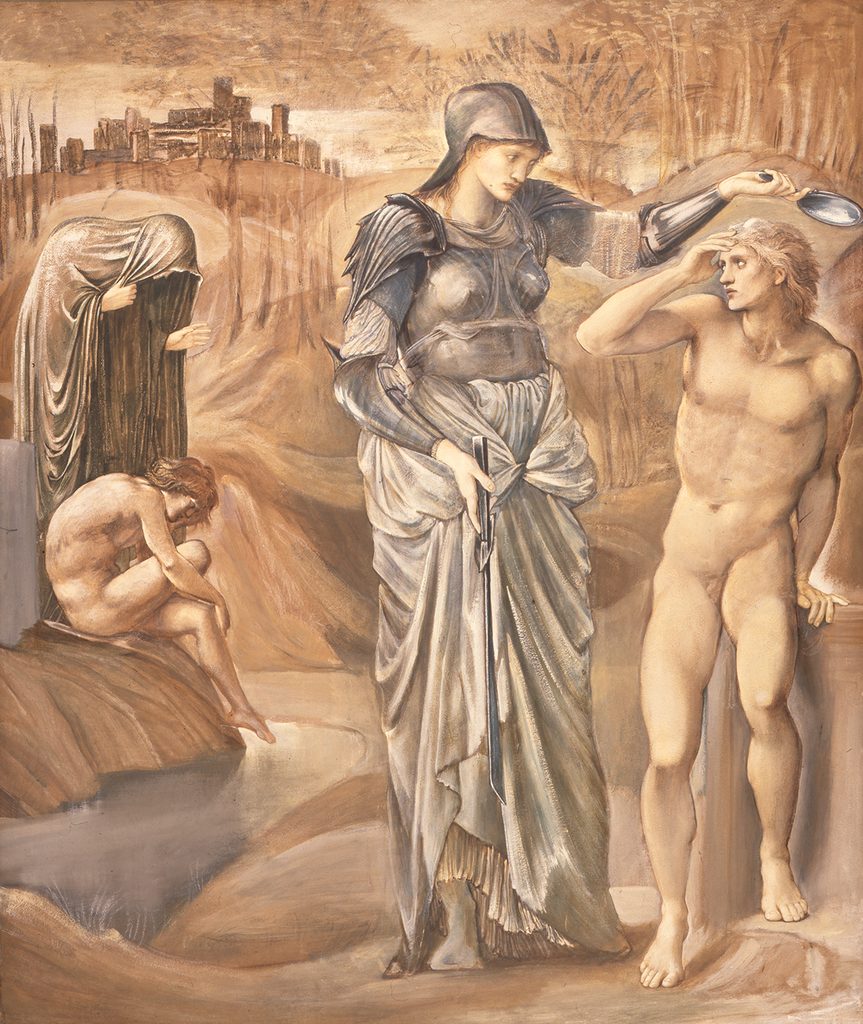
The cycle opens in Seriphos, where Polydectes, King of the island, seeks to remove young Perseus in order to pursue Perseus’s mother, Danaë. Tricking Perseus into an impossible vow, Polydectes demands the head of Medusa—the mortal Gorgon whose terrifying gaze instantly turns any living creature to stone. Burne-Jones uses a dual composition (a proto-cinematic technique) that compresses two sequential moments from William Morris’s poem into a single space. In the background, the goddess Minerva (Pallas Athena) approaches disguised as a hooded old woman; in the foreground, she reveals her glorious divine identity to the startled, dejected hero.
Minerva offers Perseus divine assistance, presenting him with a sword to slay the monster and a small hand mirror. In classical myth, Athena gives Perseus a polished bronze shield, but Burne-Jones intentionally replaces it with an ordinary hand mirror. This shift establishes the central theme of the entire series: indirect, mediated vision. Rather than portraying Athena as an armored, warlike deity, Burne-Jones strips her of heavy martial breastplates, clothing her in sheer, deep-blue drapery. Perseus is depicted not as an aggressive slayer, but as an introspective, slender knight slumped on a bank in classical melancholy.
Visual Breakdown
- Composition: Divided into two distinct temporal planes. In the distant left, Minerva approaches in disguise; in the foreground, she towers over the seated Perseus as she unveils her goddess form.
- Color Palette: Muted slate blues, cool greys, and somber dark greens, evoking a nocturnal, atmospheric gloom that mirrors Perseus’s internal doubt.
- Key Figures & Attributes: Minerva wears soft, translucent dark drapery and holds out a small hand mirror. Perseus rests his chin on his hand in a classical posture of sorrow and hesitation.
- Symbolic Motifs: The hand mirror symbolizes art as a protective barrier—a core Aestheticist principle that raw, unmediated experience is deadly, but life filtered through reflection becomes manageable and beautiful.
William Morris Poem Excerpt
“Then uttered Pallas: ‘Perseus, look on me, For I may help thee; art thou come to see Thy journey’s end before the end be institute? … She raised her hand, and straightway from her face She drew the hood, and showed a heavenly face, Glowing with divine light beneath the moon; And Perseus dropped his eyes, abashed full soon.”
Panel 2: Perseus and the Graiae
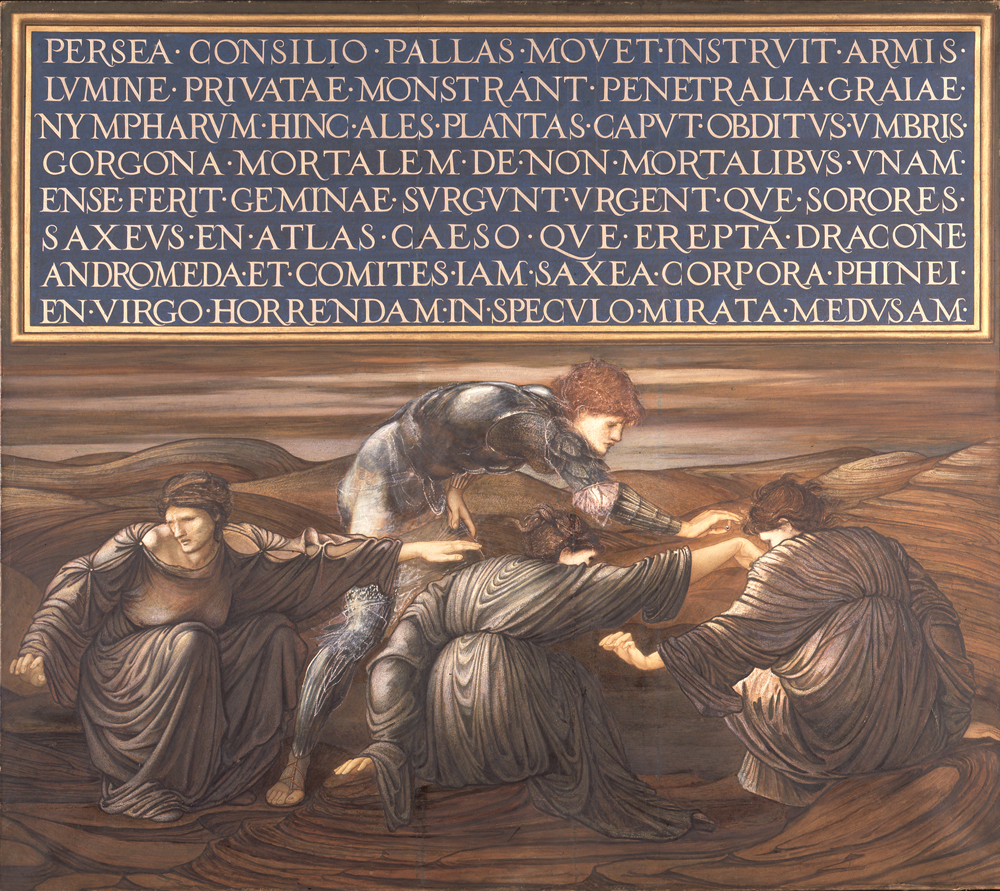
To find Medusa’s secret subterranean lair, Perseus must first consult the Sea Nymphs (Nereids). However, their location is known only to the Graiae—three perpetually aged sisters who live at the icy edge of the world and share among themselves a single eye and a single tooth. In this second scene, Perseus travels to their bleak, frozen abode and ambushes the sisters while they pass their solitary eye from one to another. Intercepting the eye mid-exchange, Perseus holds it hostage, forcing the Graiae to divulge the secret path to the Sea Nymphs.
Burne-Jones drastically alters William Morris’s poetic description of the Graiae. While Morris depicts them as dreadful crones with wrinkled faces and straight white hair, Burne-Jones presents them as graceful, youthful maidens huddled together in classicizing poses, their faces hidden or cast downward in reverie. This scene holds a unique technical place in the series: it was the only relief panel completed in its intended physical medium—a low-relief gesso sculpture built up with rabbit-skin glue and chalk over an oak panel, finished with silver and gold leaf and incised Latin text translated from Morris’s narrative.
Visual Breakdown
- Composition: Frieze-like horizontal arrangement reminiscent of early Renaissance bas-reliefs and the Parthenon metopes. The three sisters crouch in a tight, rhythmic cluster on the right while Perseus steps forward quietly from the left.
- Color Palette: Chalky white, metallic silver, deep gold over red clay bole, and unpainted dark oak wood grain background.
- Key Figures & Attributes: Perseus delicately pinches the single eye between his fingertips while the blind sisters reach out in helpless desperation.
- Symbolic Motifs: The shared eye represents limited, communal perception, while Perseus’s interception represents gaining control over hidden knowledge through quiet strategy rather than violence.
William Morris Poem Excerpt
“There sat the crones that had the single eye, Clad in blue sweeping cloak and snow-white gown; While o’er their backs their straight white hair hung down In long thin locks; dreadful their faces were, Carved all about with wrinkles of despair; … And singing, still they rocked their bodies bent, And ever each to each the eye they sent.”
Panel 3: The Arming of Perseus (Perseus and the Sea Nymphs)
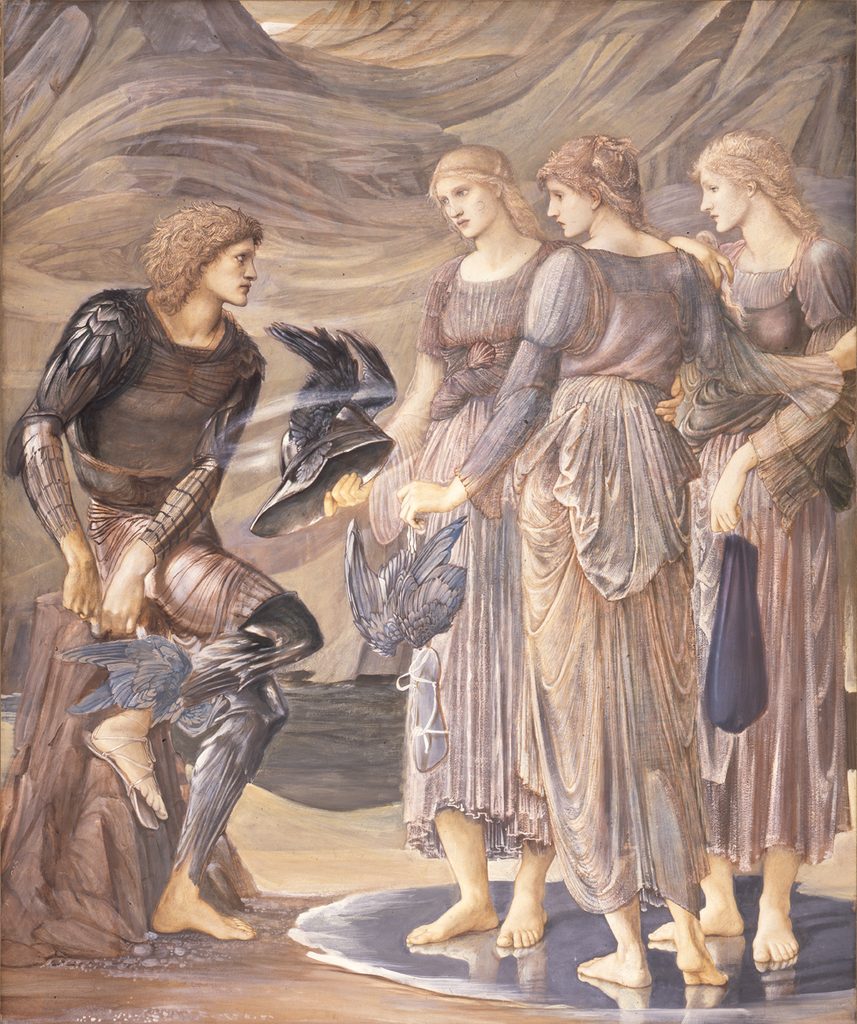
Having compelled the Graiae to reveal the secret path, Perseus arrives in the tranquil, underwater realm of the Sea Nymphs (Nereids). This panel represents a scene created entirely by Burne-Jones that does not appear in William Morris’s text. In a tableau of absolute stillness and harmony, three graceful nymphs assist the hero by equipping him with three divine gifts essential for his quest: the winged sandals (talaria) granted by Hermes to enable flight, the helmet of darkness (Hades’ helmet) to render him invisible, and the woven magic pouch (kibisis) to safely contain Medusa’s severed head.
The nymphs adopt attitudes reminiscent of the classical Three Graces, surrounding the seated hero with protective feminine nurture. Perseus sits passively in their midst as they fasten his equipment, emphasizing his dependence on divine aid rather than self-reliant mortal brawn. The figures of the nymphs share identical, generalized features—a hallmark of Burne-Jones’s dreamworld figures—and the model for the nymph on the far right was Frances Graham, daughter of Burne-Jones’s primary patron, William Graham.
Visual Breakdown
- Composition: An intimate, serpentine grouping of four figures. The three standing nymphs frame Perseus, creating a harmonious wave-like flow of drapery around his central seated form.
- Color Palette: Warm amber yellows, pale marine greens, muted slate greys, and metallic bronzes, echoing the aesthetic palette of Morris & Co. tapestries and wallpaper.
- Key Figures & Attributes: One nymph offers a winged sandal for Perseus’s feet; another cradles the folded helmet of darkness; the third holds the woven magic pouch.
- Symbolic Motifs: The trio of nymphs represents protective spiritual grace, converting the hesitant mortal knight into an empowered, supernatural agent through ritual care.
Panel 4: The Finding of Medusa
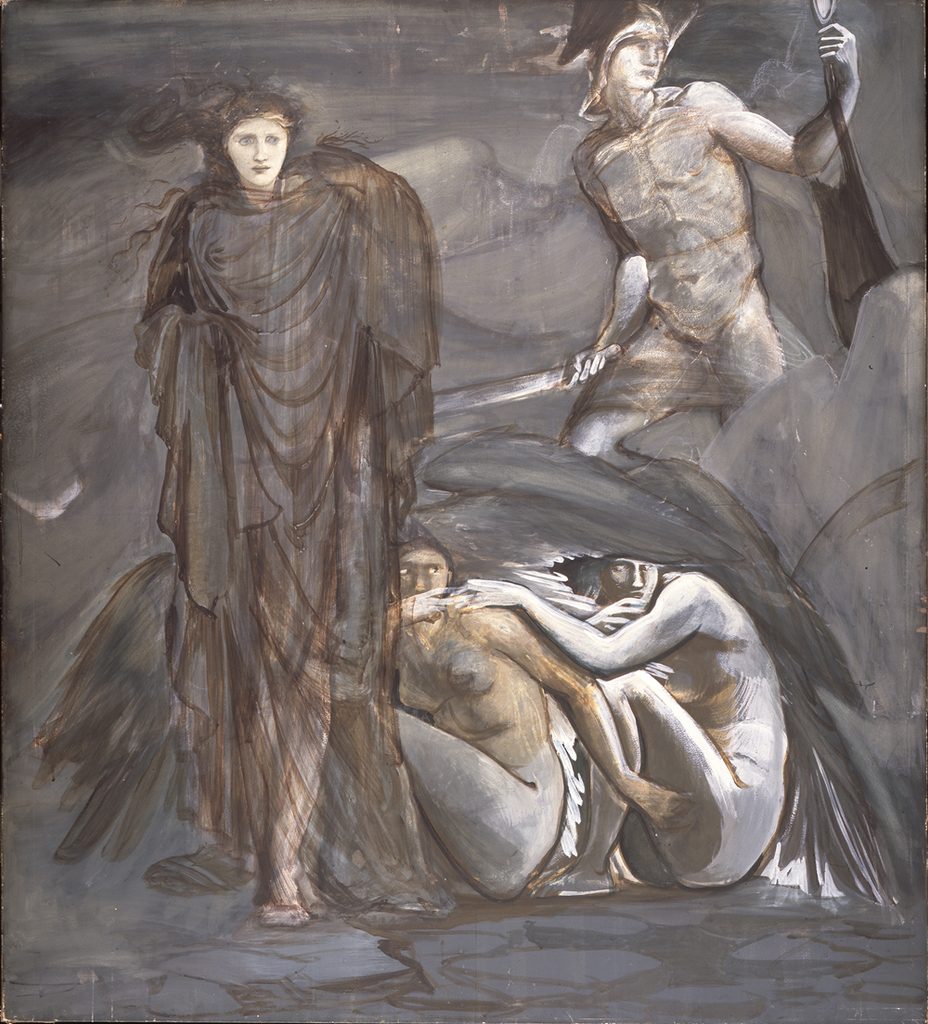
Equipped with his divine weapons, Perseus descends into the dark, cavernous lair of the Gorgons. Here he discovers Medusa and her two immortal sisters, Stheno and Euryale. Medusa stands tall in the center of the scene, staring mournfully out toward the viewer with a haunted expression, fully aware of her tragic curse and impending doom. Her sisters crouch in terror at her feet, attempting to hide themselves beneath their dark, bat-like wings. Perseus enters cautiously in the background margin, clad in dark armor, shielding his eyes and looking only at Medusa’s reflection in his mirror.
Burne-Jones humanizes Medusa, transforming her from a monstrous beast into a tragic femme fatale. Rather than evoking revulsion, her coiling snake-hair frames a face of profound sorrow and suffering. In Morris’s poem, Medusa’s curse is described as an unbearable agony from which death is the only release. By placing Medusa at the exact center of the composition and diminishing Perseus to an entering background figure, Burne-Jones shifts the emotional weight of the narrative onto the victim-monster’s internal plight.
Visual Breakdown
- Composition: Centered on the standing, monumental figure of Medusa. Her crouching sisters form a triangular base, while the armored figure of Perseus enters quietly from the background edge.
- Color Palette: Subdued subterranean tones—gunmetal grey, slate blue, murky brown, and ghostly alabaster skin tones.
- Key Figures & Attributes: Medusa’s golden tresses are entwined with coiling serpents, yet her countenance remains beautiful and sad. Perseus wears 15th-century plate armor made from models designed by William Benson.
- Symbolic Motifs: Medusa embodies the fatal intersection of beauty, power, and suffering. Her direct gaze petrifies, reinforcing the necessity of Perseus’s mediated, reflected vision.
William Morris Poem Excerpt
“But a third woman paced about the hall, And ever turned her head from wall to wall And moaned aloud, and shrieked in her despair; Because the golden tresses of her hair Were moved by writhing snakes from side to side, That in their writhing oftentimes would glide On to her breast, or shuddering shoulders white…”
Panel 5: The Death of Medusa I (The Birth of Pegasus and Chrysaor)
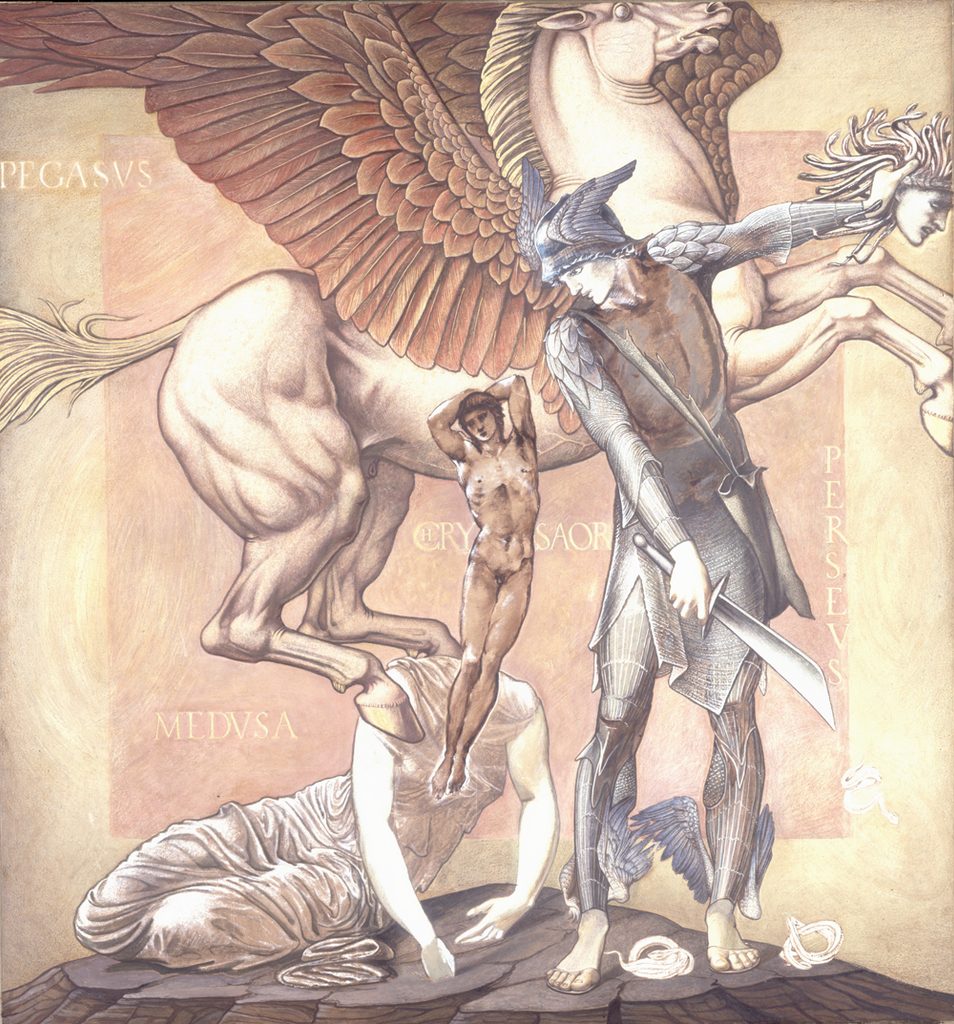
In this dramatic scene, Perseus strikes his fatal blow, decapitating Medusa with his sword while viewing her strictly through his mirror. Unbeknownst to Perseus, Medusa was pregnant by the sea god Poseidon; as her severed torso collapses, her offspring instantly spring forth from her blood: Pegasus, the winged horse, and Chrysaor, the warrior with the golden sword. This miraculous birth fulfills Minerva’s divine vengeance for the ancient desecration of her temple where Medusa had conceived them.
Burne-Jones draws heavy inspiration from classical sculpture for this panel, particularly the Parthenon frieze at the British Museum, which he studied extensively. Pegasus is depicted as a sleek, powerful white steed leaping upward, while Chrysaor emerges as a youthful nude warrior. The scene balances the horror of decapitation with the poetic creation of new life, exemplifying the Aestheticist belief that beauty and art can emerge from destruction.
Visual Breakdown
- Composition: Dynamic, diagonal flow. Medusa’s headless body lies collapsing on the lower plane, while Pegasus and Chrysaor leap dramatically upward into the upper right.
- Color Palette: Murky brown subterranean rock tones contrasted with bright white highlights along Pegasus’s wings and golden pigment on Chrysaor.
- Key Figures & Attributes: Medusa’s lifeless torso lies in the foreground; Pegasus rears up with massive feathered wings; Perseus rapidly thrusts Medusa’s severed head into his kibisis.
- Symbolic Motifs: Blood as a generative, creative force—death gives birth to poetic inspiration (Pegasus) and martial strength (Chrysaor).
William Morris Poem Excerpt
“Then Perseus reached out, and the sword drawn back Smote off her head, and from her neck all black Ran out the blood, and therewithal sprang forth Pegasus winged, and Chrysaor of great worth, Unto the wonder of the hero’s eyes.”
Panel 6: The Death of Medusa II (Perseus Pursued by the Gorgons)
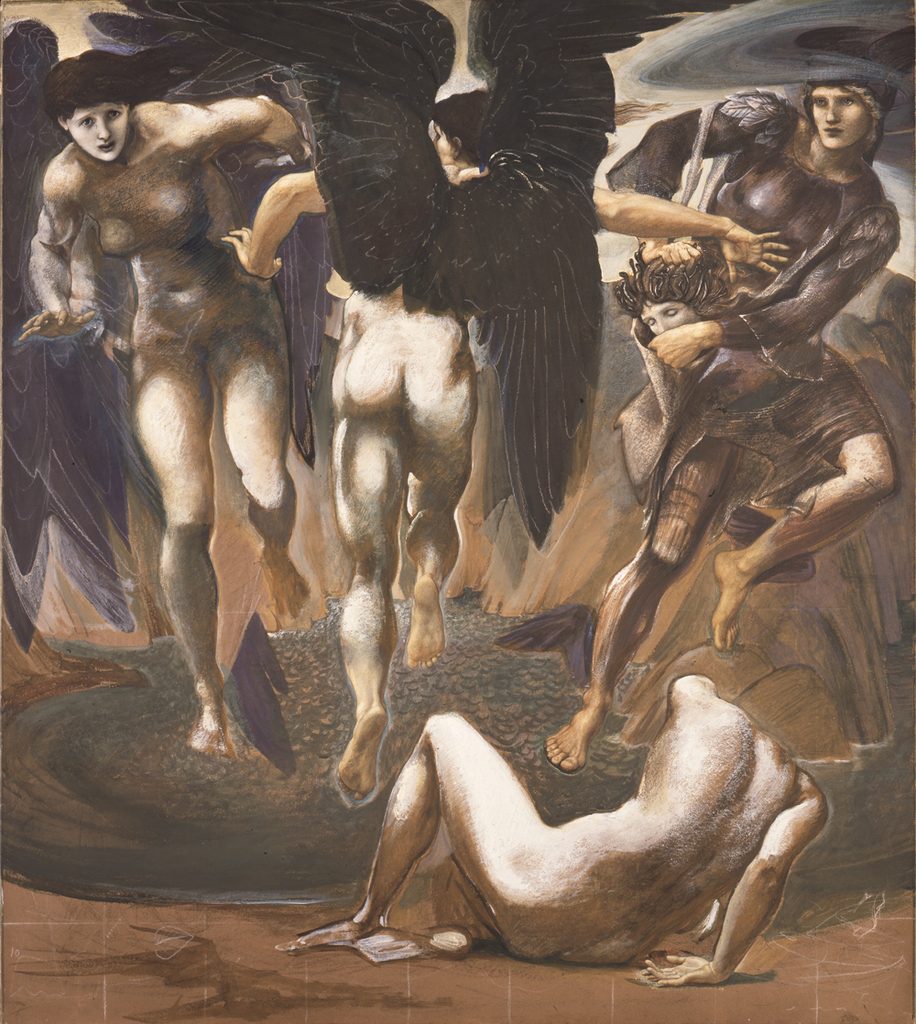
Following the decapitation, Medusa’s immortal sisters, Stheno and Euryale, awaken in fury and discover her slain body. As Perseus thrusts Medusa’s severed head securely into his magic pouch, the enraged Gorgons take flight in frantic pursuit. Donning the helmet of darkness to render himself invisible and wearing Hermes’ winged sandals, Perseus flees across a stormy, turbulent sea. Burne-Jones captures a rare sense of airborne motion and suspense, contrasting the furious, serpentine flight of the Gorgon sisters with Perseus’s swift, invisible escape.
This composition represents a significant revision by Burne-Jones. In an earlier version, the scene was static; here, he introduces swirling, rhythmic movement as the sisters swoop through the air with outstretched wings and coiling hair. The white lines visible along the bottom of the gouache cartoon in Southampton show the traditional technique of ‘squaring up’ used by the artist and his assistants to enlarge the paper study onto a full-size oil canvas.
Visual Breakdown
- Composition: Soaring, airborne diagonal composition. The two Gorgons swoop through the stormy sky with outstretched wings, hunting the unseen hero who flies near the frame’s edge.
- Color Palette: Whirling slate greys, storm clouds, dark sea-green ocean waters, and white foam splashes.
- Key Figures & Attributes: The Gorgon sisters fly with wide feathered wings and writhing serpentine hair, their faces contorted in grief and rage. Perseus clutches his bulging kibisis as he hovers invisibly.
- Symbolic Motifs: The airborne chase highlights the invisible threshold between divine protection and chaotic mortal peril.
William Morris Poem Excerpt
“Up sprang the Gorgons then with dreadful yell, And sought the slayer through the shadows fell; But invisible he flew upon the wind, And left their shrieks and wild rage far behind.”
Panel 7: Atlas Turned to Stone
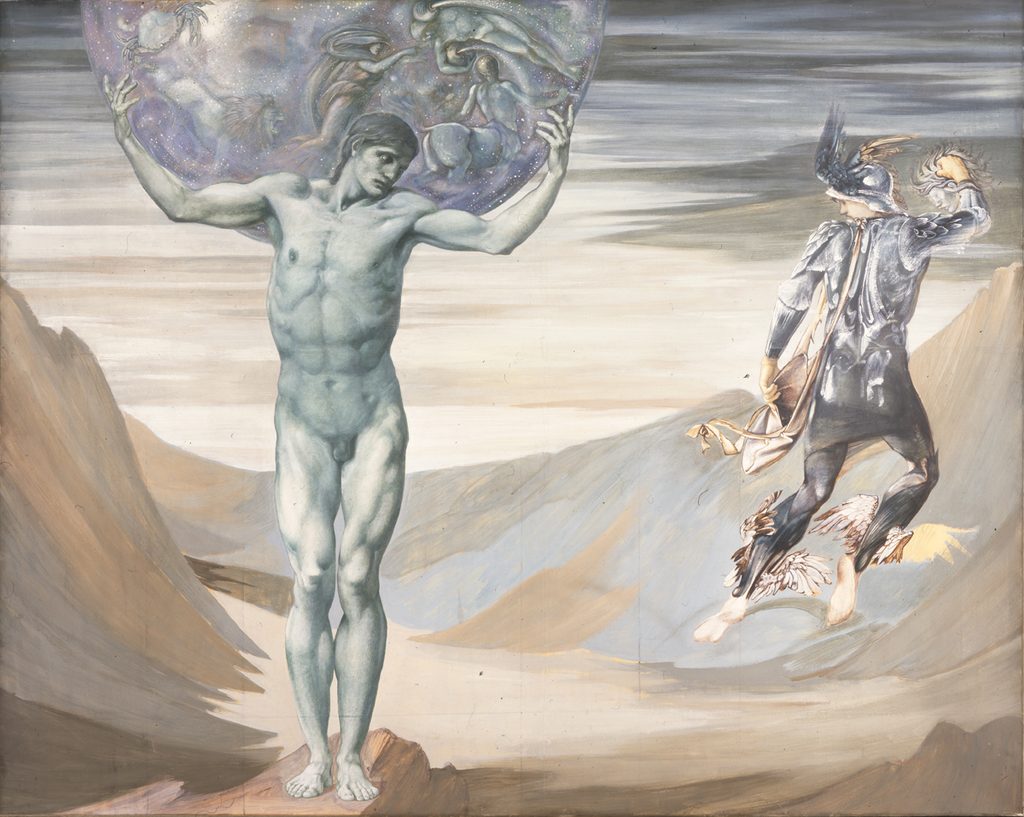
Continuing his airborne flight across the western edge of the world, Perseus arrives at the realm of Atlas, the giant Titan condemned by Zeus to support the weight of the heavens upon his shoulders. Seeking rest, Perseus requests hospitality, claiming noble descent from Zeus. However, Atlas—remembering an ancient prophecy that a son of Zeus would one day steal his golden apples from the garden of the Hesperides—refuses him entry and attempts to drive him away by force.
Realizing he cannot physically overpower the giant, Perseus draws Medusa’s severed head from his pouch and holds it aloft. Beholding the Gorgon’s face, Atlas is instantly petrified, his body transforming into the massive Atlas Mountain range of North Africa, ending his eternal suffering. Burne-Jones represents the sky as a translucent, misty globe resting on Atlas’s shoulders, painted with delicate gold zodiacal signs. This scene was originally designed as the third low-relief panel for Arthur Balfour’s music room.
Visual Breakdown
- Composition: Monumental vertical structure. The giant form of Atlas dominates the central axis, supporting a celestial sphere, while Perseus hovers on the upper right in mid-flight.
- Color Palette: Deep mineral blues, stony greys, metallic bronzes, and luminous gold accents on the zodiac sphere.
- Key Figures & Attributes: Atlas is rendered as an agonized, muscular nude whose flesh is visibly hardening into stone. Perseus turns his face away as he extends the Gorgon’s head.
- Symbolic Motifs: The petrification of Atlas represents turning human physical suffering into permanent, majestic landscape architecture—a literal transformation of tragedy into art.
William Morris Poem Excerpt
“Then Perseus held the Gorgon’s head on high; And Atlas looked thereon with weary eye, And straight became a mountain huge and steep, Whose snowy brow the heavens forever keep.”
Panel 8: The Rock of Doom
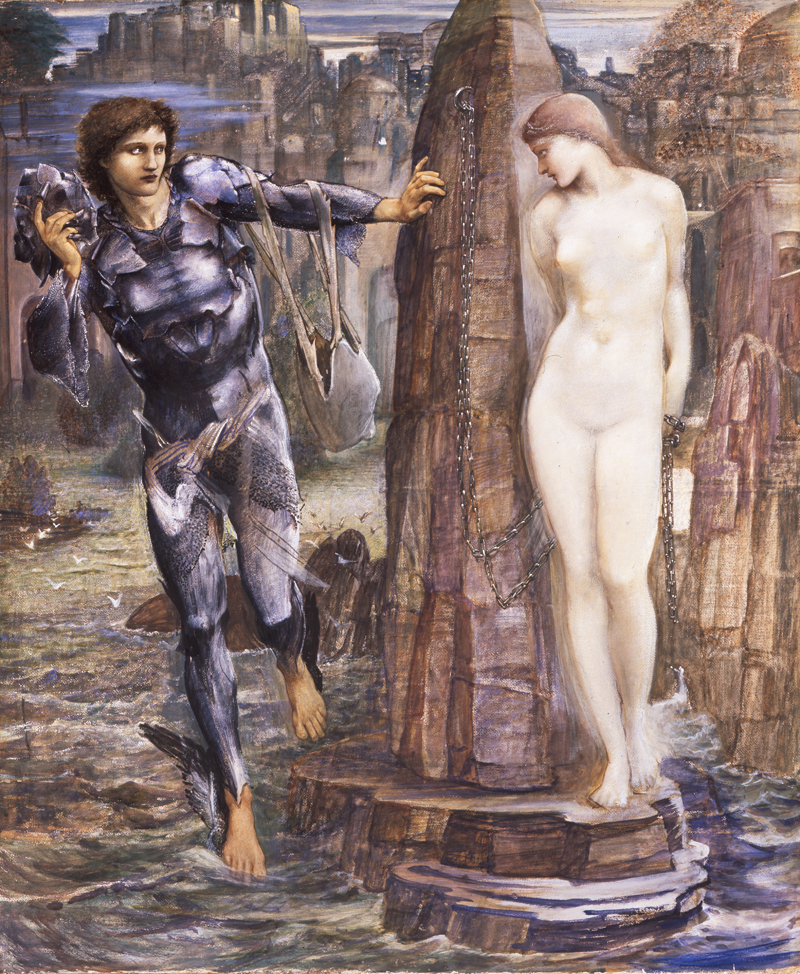
Flying over the coast of Joppa in Aethiopia, Perseus beholds a tragic sight: Princess Andromeda, daughter of King Cepheus and Queen Cassiopeia, chained nude to a barren rock in the ocean. Her mother had enraged Poseidon by boasting that Andromeda was more beautiful than the Nereids. To appease the sea god and save their kingdom from destruction by the sea monster Cetus, Cepheus was forced by an oracle to offer his daughter as an expiatory sacrifice.
Perseus alights beside the rock, removing his helmet of darkness to reveal himself to the bound maiden. Andromeda looks away shyly and fearfully, her pale, luminous skin standing out in stark contrast against the dark, basaltic rock face. Perseus comforts her, promising to slay the monster and rescue her on the condition that her parents grant her hand in marriage. This panel, exhibited alongside The Doom Fulfilled at the New Gallery in 1888, forms the emotional heart of the rescue narrative.
Visual Breakdown
- Composition: Strong vertical opposition. Andromeda’s pale, statuesque nude form is bound in profile on the left rock face, while Perseus hovers gracefully on the right.
- Color Palette: Cold basaltic greys, deep ocean indigo, slate blues, contrasted with Andromeda’s alabaster skin tones.
- Key Figures & Attributes: Andromeda stands in classical contrapposto with her wrists chained behind her back. Perseus wears dark plate armor and holds his removed helmet.
- Symbolic Motifs: The bound, passive female awaiting deliverance—a central Pre-Raphaelite motif reflecting Victorian notions of gender, vulnerability, and chivalric rescue.
William Morris Poem Excerpt
“Bound to a rock she saw the maiden stand, White as a lily in a darksome land… And Perseus stayed his flight and off him took The helmet of grey dark, and gently spoke: ‘O maid, fear not, for I am come to save Thy tender body from the watery grave.'”
Panel 9: The Doom Fulfilled
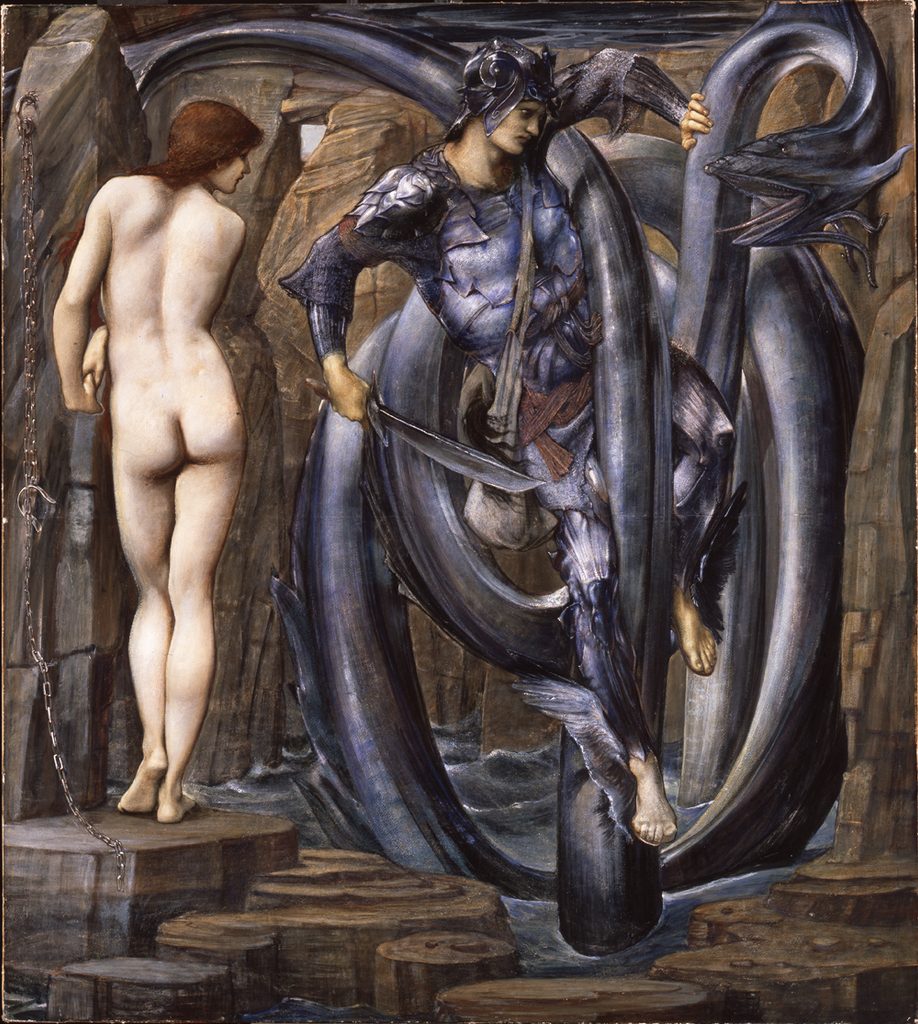
Immediately following his promise to Andromeda, the sea monster Cetus emerges from the ocean depths to devour the princess. Perseus swoops into combat, engaging the beast in a fierce duel. Burne-Jones depicts Cetus not as a conventional winged dragon, but as a massive, blue-black serpentine sea-dragon coiling in loops through the water. Perseus becomes physically entwined within the creature’s dark coils, raising his sword (Herpe) to deliver a fatal blow to its head.
In the background, Andromeda stands bound against the rock, watching the combat in static, frozen suspense rather than violent panic. Burne-Jones minimizes visceral blood and gore, treating the battle as a stylized, rhythmic dance between dark armor, serpent scales, and sea foam. The painting highlights the contrast between the chaotic, coiling monster and the disciplined, heroic grace of Perseus.
Visual Breakdown
- Composition: Interlaced serpentine structure. The coiling body of Cetus wraps around Perseus in dark loops that mirror the metal plates of his armor.
- Color Palette: Aquatic palette of indigo blue, gunmetal grey, dark sea-green, and highlighted white water foam.
- Key Figures & Attributes: Cetus is a smooth, multi-coiled sea serpent. Perseus raises his curved sword to strike, his magic pouch slung at his side.
- Symbolic Motifs: The coiling serpent represents oppressive fate and chaos, while Perseus’s blade represents order, liberation, and knightly triumph.
William Morris Poem Excerpt
“The wind in answer brought loud wails adown. Then Perseus gently put the maid from him, Who sank down shivering in her every limb, Silent despite herself for fear and woe, As down the beach he ran to meet the foe… And with great shouting smote the monster dread.”
Panel 10: The Baleful Head
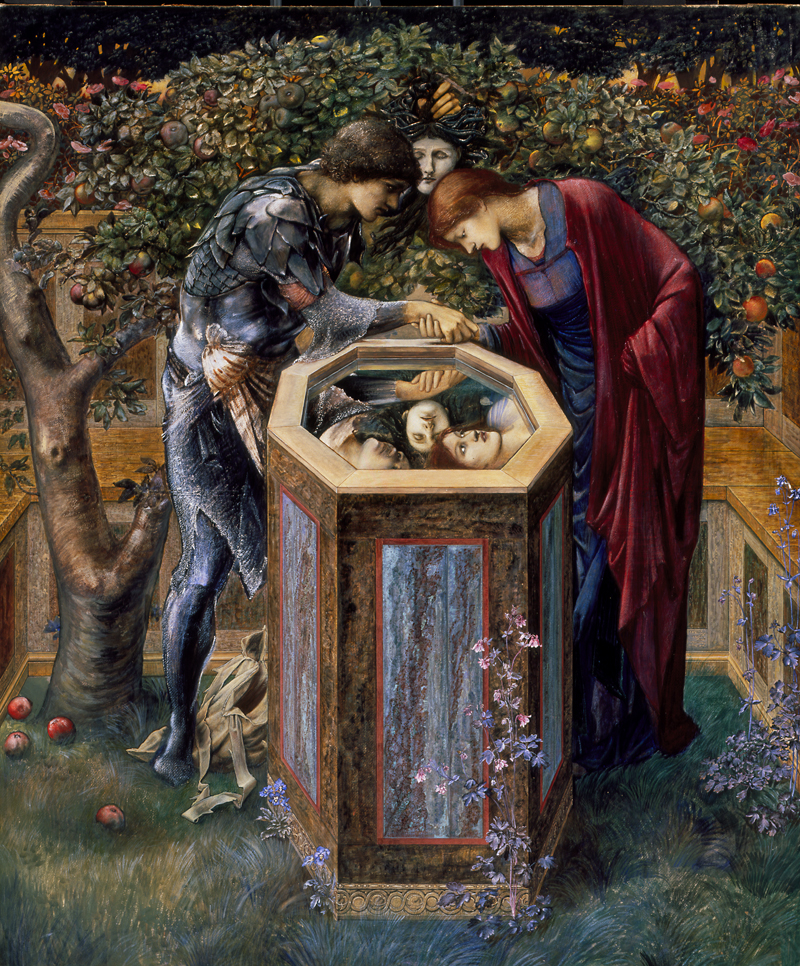
Having slain Cetus and liberated Andromeda, Perseus leads his bride to an enclosed, tranquil garden filled with fruit-laden apple trees and carved marble walls. To convince Andromeda of his divine lineage (as the son of Zeus) without exposing her to Medusa’s fatal gaze, Perseus holds the severed head of the Gorgon above a clear, still water basin. Hand in hand, the lovers lean over the font, safely gazing down at the Gorgon’s reflection mirrored in the water.
Completed in 1887, The Baleful Head serves as the quiet, harmonious epilogue to the entire series. The setting shifts from desolate coasts and subterranean caves to an arcadian garden reminiscent of Eden. Three heads are unified in a triangular composition centered on the water: Perseus, Andromeda, and Medusa’s reflected image. This scene encapsulates the central philosophical message of Aestheticism: that life’s terrors, when mediated through the reflective mirror of art, are rendered safe, beautiful, and transcendent.
Visual Breakdown
- Composition: Balanced triangular grouping centered on the circular marble basin. Perseus stands on the left holding the head aloft, Andromeda stands on the right, and both look down toward the water.
- Color Palette: Warm, glowing tones—olive greens, terra-cotta hues, polished white marble, and golden drapery, bathed in soft sunlight.
- Key Figures & Attributes: Three faces are visible: Perseus, Andromeda, and Medusa’s mirrored reflection. The backdrop features fruit-laden apple branches.
- Symbolic Motifs: The water reflection represents art as mediation—transforming raw terror into aesthetic harmony and peaceful contemplation.
William Morris Poem Excerpt
“Midmost the garden was a basin fair, Of marble white, and pure water there… And Perseus held above the water bright The Gorgon’s head, and turned it to the light; And down into the dark font Andromeda Looked longing, and saw the fearsome face far down…”
Summary
Sir Edward Burne-Jones’s Perseus Series stands as a triumph of late Victorian Aestheticism, converting an ancient tale of monster-slaying into a quiet, introspective journey of fate, craft, and artistic reflection.
Key Takeaways
- Patronage & Scope: Commissioned in 1875 by Arthur Balfour for his London music room, the scheme comprised ten full-size gouache cartoons (Southampton City Art Gallery) and oil paintings (Staatsgalerie Stuttgart).
- Literary Source: Based on William Morris’s poem “The Doom of King Acrisius” from The Earthly Paradise, blending classical myth with Arthurian medieval chivalry.
- Subversion of Heroism: Replaces traditional athletic heroism with a melancholic, slender knight who relies on divine aid and strategy rather than brute force.
- Core Aesthetic Motif: The mirror and water reflection symbolize art’s ability to filter life’s terrors, rendering tragedy harmoniously beautiful and safe for contemplation.
Materiality, Gesso, and Metallics
A major technical aspect of the Perseus Cycle is Burne-Jones’s integration of three-dimensional decorative craft into two-dimensional pictorial space [cite: 3]. Seeking alternatives to standard oil painting techniques, he worked to revive historic media, specifically Renaissance gesso work (pastiglia) and gold and silver leafing [cite: 3, 9].
In collaboration with Osmund Weeks, Burne-Jones built up multiple layers of rabbit-skin glue and chalk gesso onto quarter-sawn oak panels [cite: 3, 9]. Once dry, the raised surfaces were carved and incised to define the contours of drapery, limbs, and armor [cite: 3].
The application of metal leaf followed established historic methods. Gold leaf was laid over a bole of red clay, giving a warm under-glow to gilded garments and architectural elements [cite: 3]. Silver leaf was placed over a dark grey bole, creating deep, cool reflections across Perseus’s armor [cite: 3]. Even in his pure oil canvases, such as The Doom Fulfilled, Burne-Jones emulated these sculptural textures by applying translucent glazes over thick underpaintings to capture the metallic sheen of polished steel and dark scales [cite: 1, 21]. This material experimentation reflected Aestheticism’s focus on surface texture, craftsmanship, and decorative unity [cite: 3, 6].
Visual Motifs and Victorian Anxieties
The Subversion of Heroism
Burne-Jones’s representation of Perseus differed from prevailing mid-Victorian ideals of masculinity, which frequently emphasized physical strength and active, commanding virility [cite: 1, 6, 17]. In contrast, Burne-Jones depicts Perseus as a slender, smooth-featured, and introspective figure whose facial features mirror those of the women around him [cite: 1, 17, 22].
Throughout the cycle, Perseus moves hesitantly and appears burdened by his task [cite: 17]. His poses are passive and contemplative; in The Calling of Perseus, he sits doubled over in melancholy, while his fight with Cetus in The Doom Fulfilled resembles a stylized, deliberate dance [cite: 6, 17]. Burne-Jones reframed classical heroism into a quiet, internal struggle, reflecting late-Victorian anxieties regarding duty, fate, and modern psychological fatigue [cite: 5, 6, 14].
Gender Dynamics and the Aestheticization of Passivity
The depiction of female figures across the cycle illustrates Victorian ideas regarding female agency, dividing women into terrifying threats or static, idealized forms [cite: 6, 17, 22]. Medusa embodies dangerous power, as her direct gaze paralyzes men and transforms them into stone [cite: 6, 7, 12]. Rather than portraying her as a monster, Burne-Jones depicts Medusa as a tragic, beautiful figure whose destructive power stems from her own suffering—a detail that aligns with Morris’s poem [cite: 6, 22]. To overcome her, Perseus avoids direct contact, relying on mirrors and reflections [cite: 6, 7, 17].
Conversely, Andromeda represents an ideal of passive, static beauty [cite: 6]. Bound to the rock in The Rock of Doom, she is isolated from active involvement in her rescue [cite: 6]. She exhibits resignation rather than visible panic [cite: 6]. By depicting Andromeda as a statuesque figure, Burne-Jones reflects Aestheticism’s tendency to transform emotional drama into timeless artistic forms [cite: 6].
Reflected Vision and Mediated Experience
The recurring motif of mirrors, polished surfaces, and reflections highlights a key aesthetic concept: that reality is best experienced when mediated by art [cite: 6, 7, 17]. Direct sight of Medusa brings death, suggesting that direct engagement with raw, unmediated life can be overwhelming [cite: 6, 7].
In The Calling of Perseus, Athena presents the hero with a mirror; in The Baleful Head, the lovers view the Gorgon’s reflection safely in a quiet well [cite: 5, 7, 17]. The reflected image acts as a protective barrier [cite: 7, 17]. For Burne-Jones, art itself functions like this reflection, offering a transformed view of tragedy and conflict that allows viewers to contemplate difficult themes safely [cite: 6, 7].
Synthesis and Legacy
Subversion of Classical Heroism
Sir Edward Burne-Jones’s Perseus Cycle reinterprets classical mythology through the lens of Victorian Aestheticism [cite: 1, 6]. By prioritizing reflection over action, slender introspection over physical strength, and stylized craft over narrative realism, Burne-Jones transformed a narrative of dragon-slaying into a quiet meditation on fate, art, and human vulnerability [cite: 1, 6, 14].
The cycle suggests that art offers a refuge from the conflicts of existence [cite: 6]. Perseus fulfills his quest through ritual, divine gifts, and indirect vision rather than sheer force [cite: 6, 12, 17]. Even in the final scene of The Baleful Head, the tone remains subdued [cite: 4, 5, 7]. The lovers do not look at each other, but gaze quietly at the reflection in the water, contemplating the past with calm resignation [cite: 7]. In Burne-Jones’s vision, victory brings no loud celebration, but a quiet acceptance of beauty and mortality [cite: 5, 6, 7].
Completion Status and Institutional Dispersion
Although Burne-Jones worked on the commission periodically for over twenty years, the cycle was never installed in Arthur Balfour’s music room at 4 Carlton Gardens [cite: 1, 2, 3, 4]. Several factors contributed to the project remaining uninstalled:
First, when the single completed gesso relief, Perseus and the Graiae, was exhibited at the Grosvenor Gallery in 1878, its unconventional combination of carved plaster, gilding, and unpainted wood received mixed reviews, leading Burne-Jones to stop work on the remaining relief panels [cite: 3]. Second, the immense labor required to paint large oil canvases while executing delicate gesso reliefs placed significant physical strain on the artist [cite: 1, 2, 3, 9]. Finally, as Arthur Balfour’s political career expanded—culminating in his appointment as Prime Minister in 1902—the domestic project at 4 Carlton Gardens became a lower priority [cite: 4].
Despite remaining uninstalled in its original setting, the Perseus Cycle survives as a comprehensive decorative scheme preserved across public collections [cite: 1, 2, 3, 11, 19]. Between 1877 and 1885, Burne-Jones executed a complete series of ten full-scale cartoons in gouache and bodycolour on canvas, which hung framed in his studio and preserve his full decorative vision [cite: 1, 2].
| Category / Version | Medium & Technique | Primary Works Included | Current Institution / Location |
|---|---|---|---|
| Full-Scale Cartoons | Gouache and bodycolour on paper/canvas | Complete set of 10 full-sized narrative cartoons (1877–1885) [cite: 1, 2] | Southampton City Art Gallery, Southampton, United Kingdom [cite: 1, 2, 10, 11, 19] |
| Completed & Unfinished Oils | Oil paint on canvas | 4 finished master oils (Perseus and the Graiae, The Rock of Doom, The Doom Fulfilled, The Baleful Head) and unfinished oil variants [cite: 1, 5, 13, 19] | Staatsgalerie Stuttgart, Stuttgart, Germany [cite: 1, 5, 13, 19] |
| Gesso & Metallic Relief | Silver and gold leaf, gesso, oil on oak panel | 1 finished monumental relief panel (Perseus and the Graiae, 1875–1878) [cite: 3, 4, 9] | National Museum Wales, Cardiff, Wales [cite: 3, 4, 9] |
| Preparatory Studies | Pencil, charcoal, wash, and gouache on paper | Anatomical, drapery, head, and armor studies [cite: 1, 19, 20, 21] | Fitzwilliam Museum (Cambridge), British Museum (London), J. Paul Getty Museum (Los Angeles) [cite: 19, 20, 21] |
The Perseus Cycle remains an important achievement of late 19th-century British art [cite: 1, 6, 10]. Through its synthesis of classical myth, William Morris’s poetry, Renaissance design, and innovative craft techniques, the series converted an ancient tale of heroism into a central work of the Aesthetic movement [cite: 1, 3, 6, 7].
——————————————————————————–
- Edward Coley BURNE-JONES | Study for the Head of a Youth (Perseus), https://www.stephenongpin.com/object/791243/0/study-for-the-head-of-a-youth-perseus
- The Perseus Series – Southampton City Art Gallery, https://southamptoncityartgallery.com/collection/the-perseus-series/
- Perseus and the Graiae: Explore the Painting – Amgueddfa Cymru | Museum Wales, https://museum.wales/articles/1425/Perseus-and-the-Graiae-Explore-the-Painting/
- The Prime Minister’s Music Room, Perseus and Andromeda – The Eclectic Light Company, https://eclecticlight.co/2020/05/20/the-prime-ministers-music-room-perseus-and-andromeda/
- EDWARD BURNE–JONES – Tate, https://www.tate.org.uk/documents/1441/tb_exh_0052_burne-jones_-lpg-_aw.pdf
- Rescue and Creation Myths: Expressions of Gender and Power in the Works of Burne-Jones, https://victorianweb.org/painting/bj/paintings/byecroft12.html
- the various battlefields and in the destroyed villages throughout France. A few ghosts are celebrated, but many are simply, in o, http://www.eb-j.org/pdfViewer/articles/MjA2Mg==
- the classic myths in english literature and in art based originally on bulfinch’s “age of fable” (1855) accompanied by an interpretative and illustrative commentary – Project Gutenberg, https://www.gutenberg.org/files/46063/46063-h/46063-h.htm
- The Story in Paintings: Perseus and Edward Burne-Jones 1 – The Eclectic Light Company, https://eclecticlight.co/2016/04/20/the-story-in-paintings-perseus-and-edward-burne-jones-1/
- The Perseus Series by Edward Burne-Jones – Tru Vue, https://tru-vue.com/knowledge-hub/case-studies/the-perseus-series/
- Perseus series by Burne-Jones re-glazed for Southampton City Art Gallery with support from the Andrew Lloyd Webber Foundation | Tru Vue®, https://tru-vue.com/knowledge-hub/articles/perseus-series-by-burne-jones-re-glazed-for-southampton-city-art-gallery-with-support-from-the-andrew-lloyd-webber-foundation/
- The Birth of Pegasus and Chrysaor from the Blood of Medusa, The Perseus Series – Burne-Jones Catalogue Raisonné, https://www.eb-j.org/browse-artwork-detail/ODM1
- Edward Burne-Jones – The Perseus Series – Pre Raphaelite Influenced Art, http://preraphaelitepaintings.blogspot.com/2011/08/edward-burne-jones-perseus-series.html
- General Introduction to The Earthly Paradise – William Morris Archive, https://morrisarchive.lib.uiowa.edu/general-introduction-to-the-earthly-paradise
- The Collected Works of William Morris, Volume 3 – Marxists Internet Archive, https://www.marxists.org/archive/morris/collected/The_collected_works_of_William_Morris_vol03.pdf
- Edward Burne-Jones, The Doom Fulfilled, 1885 – Narrative Painting, https://narrativepainting.net/edward-burne-jones-the-doom-fulfilled-1885%E2%81%A0/
- From Unearthly to Earthly: The First and Last Paintings of Edward Burne-Jones’s Perseus Series – The Victorian Web, https://victorianweb.org/painting/bj/paintings/carter.html
- Perseus Series – Rossetti Archive, https://rossettiarchive.iath.virginia.edu/docs/op51.rap.html
- The Finding of Medusa, the Perseus series – Burne-Jones Catalogue Raisonné, https://www.eb-j.org/browse-artwork-detail/MjIwMDE=
- Sir Edward Coley Burne-Jones, Bt., A.R.A., R.W.S. | Phineus and his – Sotheby’s, https://www.sothebys.com/en/buy/auction/2026/master-drawings-from-the-collection-of-diane-a-nixon/phineus-and-his-courtiers-turned-to-stone
- Study for Perseus | Museum Collection | Getty, https://www.getty.edu/art/collection/object/10P97Q
- Edward Burne-Jones’ “Andromeda”: Transformation of Historical and Mythological Sources | Request PDF – ResearchGate, https://www.researchgate.net/publication/270456922_Edward_Burne-Jones’_Andromeda_Transformation_of_Historical_and_Mythological_Sources
