Category: Art
Realism, surrealism, impressionism, etc
The Architecture of Infinity: A Comprehensive Analysis of the Life, Art, and Mathematical Legacy of M.C. Escher
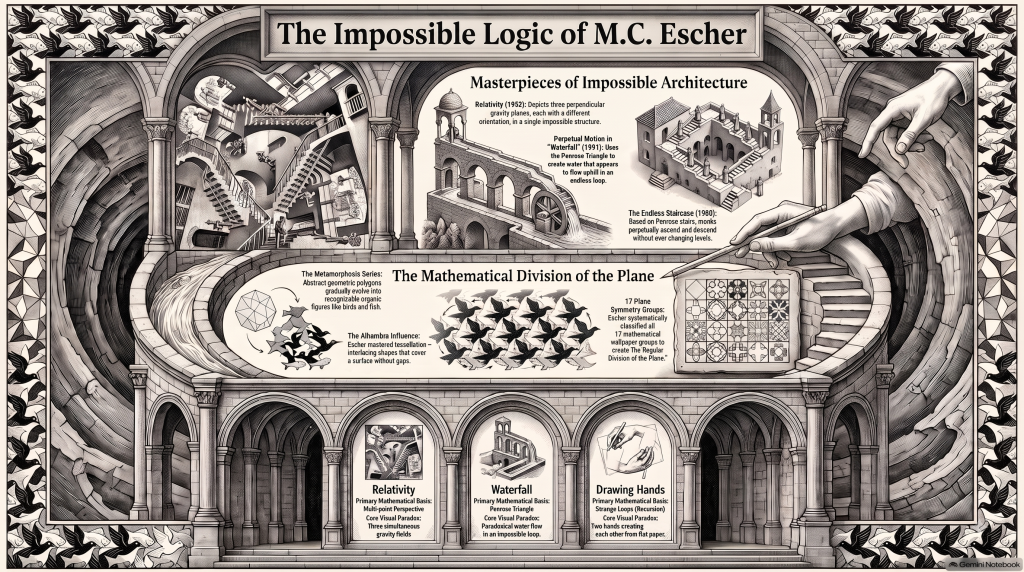
1. Background and Early Life
Maurits Cornelis Escher (1898–1972) occupies a distinct and somewhat paradoxical position in the history of twentieth-century visual culture. Born on June 17, 1898, in Leeuwarden, the capital of the Dutch province of Friesland, Escher was the youngest son of George Arnold Escher and his second wife, Sara Gleichman1. His father was a prominent civil and hydro-mechanical engineer who had spent years working on harbors and dams in Japan at the behest of the emperor1. Raised in a stately city palace known as the Princessehof, the young Escher—affectionately nicknamed “Mauk” by his family—grew up in an environment characterized by intellectual rigor, discipline, and upper-middle-class comfort1. It is highly probable that the influence of his father, whose profession required structural logic and precise drafting, laid the earliest subconscious foundations for Escher’s later obsession with spatial geometry.
Despite this privileged upbringing, Escher’s childhood was marked by physical fragility. A sickly constitution frequently kept him indoors, and in 1905, at the age of seven, he was sent to a children’s convalescent home in Zandvoort for an extended period to recover his strength1. This physical isolation forced the young boy to entertain himself through acute observation of his immediate surroundings, cultivating a meticulous eye for the structural anomalies of the physical world. His family encouraged a broad education; he took carpentry and piano lessons, and frequently used a telescope mounted on the flat roof of his home to observe the stars with his father1.
Academically, Escher struggled profoundly. After the family relocated to Arnhem in 1903, he attended secondary school but proved to be an unexceptional student. He was left-handed, highly intelligent, but socially perceived as an outsider3. Ultimately, he failed his final secondary school examinations in 19181. A persistent lack of aptitude for formal mathematics was particularly notable; Escher would later famously confess to having never received a passing grade in the subject4. Hoping to channel his son’s undeniable talent for drawing into a respectable profession, George Escher leveraged his connections to enroll Maurits at the Technical College of Delft in 1918 to study architecture1. However, recurring illness and a lack of passion for the rigid curriculum led to his swift departure before completing his first year1.
The pivotal turning point in Escher’s early development occurred in the autumn of 1919 when he transferred to the Haarlem School of Architecture and Decorative Arts. Although he initially enrolled in the architecture department to placate his parents, his graphic experiments caught the eye of Samuel Jessurun de Mesquita, a highly regarded graphic arts instructor and Jewish artist known for his bold, definitive style2. Recognizing an innate genius for printmaking, de Mesquita persuaded both Escher and his skeptical parents that the young man was “too good to waste his time on architectural drawings”1. Under de Mesquita’s mentorship, Escher mastered the unforgiving techniques of woodcut and linocut. These mediums require absolute precision, a flawless understanding of positive and negative space, and a high degree of forethought—skills that became the cornerstone of his mature aesthetic3. In 1922, he produced an early masterpiece of interconnectivity, Eight Heads, signaling his burgeoning interest in tessellating forms10.
Following his graduation in 1922, Escher embarked on extensive recuperative and educational travels through Italy and Spain. The Mediterranean landscape, with its intense light, dramatic coastal cliffs, and cascading hilltop towns, captivated him8. Settling in Rome in 1923, he met Jetta Umiker, whom he married in 1924, and the couple subsequently had three sons6. For the next decade, Escher operated primarily as an observational landscape artist. He spent his springs hiking through the desolate, rugged terrains of Tuscany, Calabria, and the Amalfi Coast, executing meticulously detailed sketches that he later transformed into lithographs and woodcuts in his studio3. These early works, though lacking the impossible geometry of his later output, demonstrate an emerging fascination with unusual perspectives, plunging viewpoints, and the structural interplay between natural rock formations and human architecture8.
The trajectory of Escher’s art was forcibly altered by geopolitical instability. The rise of Benito Mussolini’s fascist regime in Italy created a stifling and increasingly dangerous atmosphere, prompting the Escher family to flee to Château-d’Oex, Switzerland, in 19357. Denied the beloved Italian landscapes that had fueled his inspiration, and finding the Swiss snowscapes visually unstimulating, Escher turned his creative gaze inward. To escape the high cost of living and the unfavorable climate, Escher brokered a deal with the Adria shipping company, trading original prints for passage on a Mediterranean freighter, allowing him to revisit Southern Europe and Spain7. Following this, the family moved to Belgium in 1937, and finally, driven by the German invasion during World War II, settled permanently in Baarn, the Netherlands, in 19416.
This period of geographical dislocation and eventual internal exile forced him to transition from observing the external world to exploring the “landscapes of the mind,” marking the genesis of his signature style: the exploration of mathematical theory, rational symmetry, and impossible architectures6.
Continue reading “The Architecture of Infinity: A Comprehensive Analysis of the Life, Art, and Mathematical Legacy of M.C. Escher”William Blake – The First Book of Urizen
As you begin your reading, it is helpful to view the narrative as a battle between Vision and Measurement. Urizen, whose name likely plays on “Your Reason” or the “Horizon” that limits our sight, seeks to impose a “solid without fluctuation” upon the void. He is the architect of the “Mathematical Form” you may have encountered in Blake’s other philosophies, arming himself with compasses and scales to quantify an existence that was once boundless. This process of categorization and law-making is depicted not as enlightenment, but as the construction of a “stony sleep,” where the human soul is gradually petrified by its own logical structures.
To truly experience this book, you must engage with it as a Prophetic Book, where text and hand-etched illustrations are inseparable. Blake’s vivid, haunting imagery, of bodies bound in chains, weeping giants, and constricting webs, is designed to provoke a physical reaction in the reader. He wants you to feel the claustrophobia of a world governed solely by rules and “one command, one joy, one desire.” As you turn the pages, watch for the moment the “Living Form” of the spirit begins to struggle against the “Mathematical” cage Urizen builds, setting the stage for a rebellion that is as much about your own imagination as it is about Blake’s mythology.
A Quick “Who’s Who” in The Book of Urizen
To navigate Blake’s complex mythology, it helps to see these characters not as literal people, but as psychological forces battling within the human mind.
1. Urizen: The Architect of Constraint
- The Concept: Cold Reason, Law, and Memory.
- The Role: He is the “Ancient of Days” who seeks to impose “One command, one joy, one desire” upon the universe. He represents the Mathematical Form, the part of us that wants to measure, categorize, and control everything to avoid the “terrible” chaos of pure creativity.
- Key Imagery: An old man with a long white beard, often shown clutching books of laws or reaching down with a giant compass to “limit” the infinite.
2. Los: The Blacksmith of Imagination
- The Concept: Creative Energy, Time, and the “Living Form.”
- The Role: When Urizen’s cold logic shatters the original unity of existence, Los is the one who tries to forge a new world out of the wreckage. He is a blacksmith who beats red-hot iron on an anvil, trying to give “shape” to the abstract ideas of Urizen so they don’t remain purely destructive.
- Key Imagery: A powerful, muscular figure working at a flaming forge with a hammer and tongs. He represents the artist’s struggle to make sense of a broken world.
3. Enitharmon: The First Shadow
- The Concept: Pity, Space, and the “Vegetated” (Material) World.
- The Role: In the trauma of creation, Los “splits” into two, and Enitharmon emerges as his female counterpart. She represents the birth of Space and the beginning of biological life. In Blake’s myth, her separation from Los marks the moment humanity becomes divided against itself, the start of “gender” and “mortality” as we know them.
- Key Imagery: Often depicted as a soft, ethereal figure, she represents the “Pity” that Los feels for Urizen’s suffering, which eventually crystallizes into the physical world.
4. Orc: The Fire of Revolution
- The Concept: Rebellion, Youth, and Energy.
- The Role: The child of Los and Enitharmon, Orc is the first “human” born into this new, restricted world. He is pure, unbridled energy, the spirit of revolution that naturally rises up against Urizen’s suffocating laws.
- Key Imagery: A youth wrapped in flames or struggling against “The Chain of Jealousy” that Los uses to bind him to a mountain.
The “Seven Deadly Sins” of Urizen, it’s important to understand that Blake isn’t talking about the traditional biblical sins like gluttony or sloth. Instead, he is describing the seven stages of the “Stony Sleep”, the process by which the human spirit is trapped inside a physical body and a logical mind.
In Chapter IV of the book, as Urizen hides in his “holiness,” his body begins to manifest as a series of restrictive “changes.” Here is how the “Mathematical Form” binds the “Living Form” into a prison of flesh:
Continue reading “William Blake – The First Book of Urizen”The Mystery of the Missing Arms: A Deep Dive into the Venus de Milo
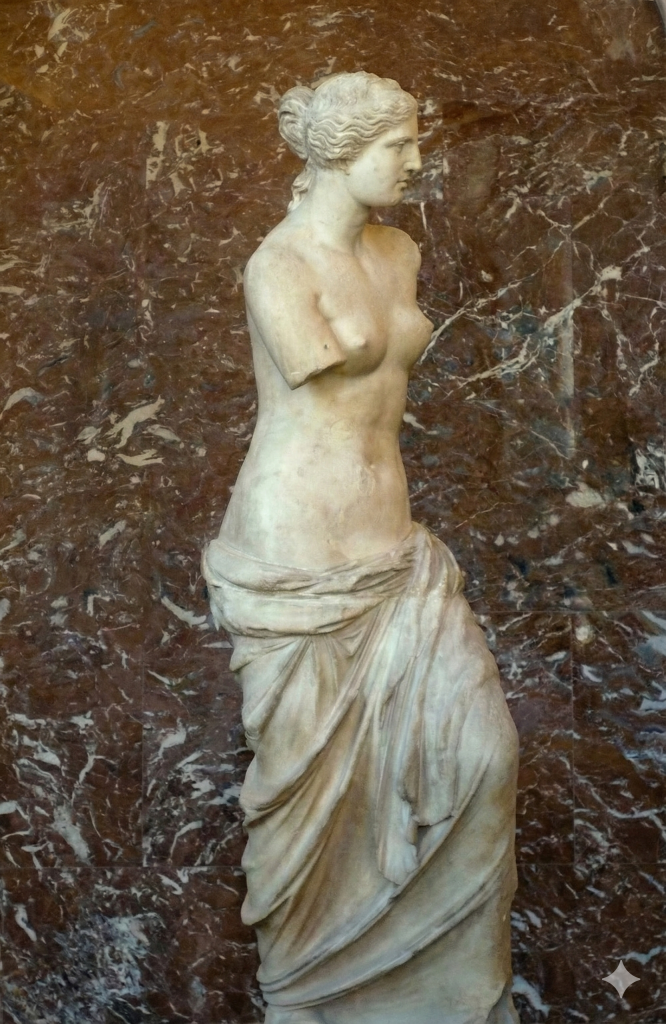
Discovered in 1820 on the Greek island of Milos, the Venus de Milo is arguably the most famous example of Hellenistic sculpture in the world. Carved from Parian marble around 100 BCE, she is widely believed to represent Aphrodite, the Greek goddess of love and beauty (known as Venus to the Romans). However, her identity remains a subject of scholarly debate; some suggest she might actually be Amphitrite, the sea goddess worshipped on Milos.
The sculpture is a masterclass in Hellenistic aesthetics, characterized by a shift away from the stiff, idealistic poses of earlier eras toward more dynamic, human-like movement. Venus is captured in a contrapposto stance—her weight shifted onto one foot, creating a subtle “S-curve” in her torso. This technique gives the heavy stone a sense of fluidity and life.
But what about those famous missing arms? When she was unearthed by a peasant named Yorgos Kentrotas, fragments of a hand holding an apple and a left upper arm were reportedly found nearby. These fragments suggested she was originally holding the “Apple of Discord” from the Judgment of Paris. However, during the journey to France and subsequent restoration, these pieces were separated or lost, and the Louvre eventually decided to display her as she was found to avoid inaccurate reconstructions.
Interestingly, Venus wasn’t always the “plain” white marble we see today. Like most classical statues, she was likely originally polychromed (painted in vibrant colors) and adorned with metal jewelry. Holes in her ears, head, and arms indicate she once wore earrings, a headband, and armbands.
Today, she stands as a symbol of classical perfection, proving that even a “fragmented” masterpiece can possess a timeless, complete beauty.
Édouard Manet – Un Bar aux Folies-Bergère
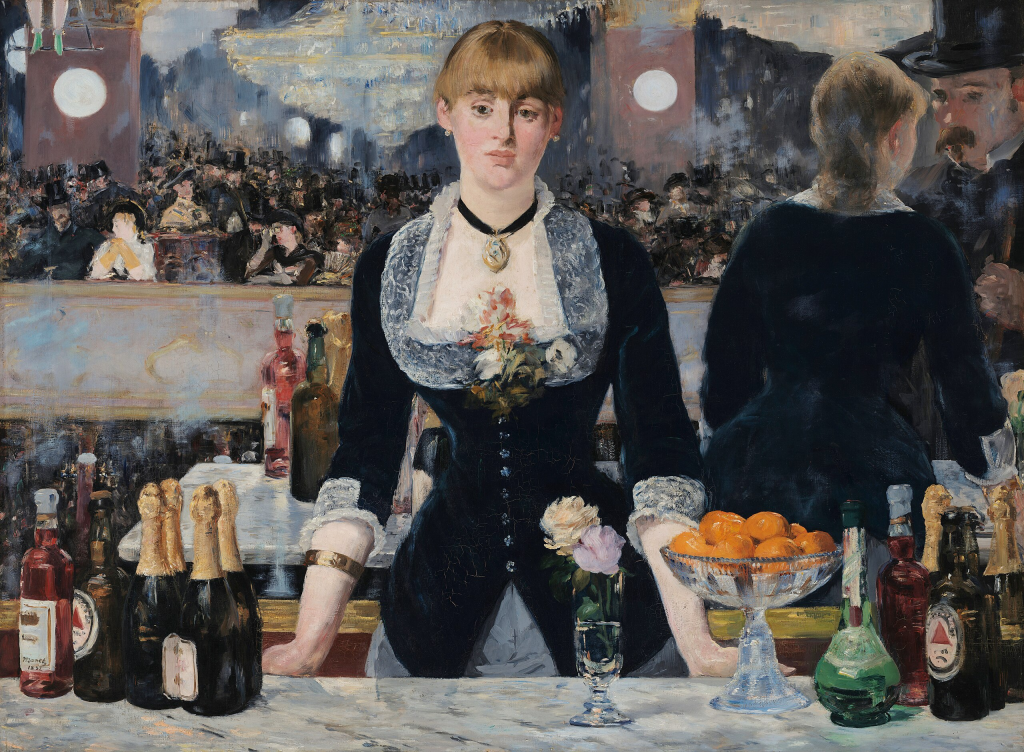
A Bar at the Folies-Bergère (French: Un bar aux Folies Bergère) is a painting by Édouard Manet, considered to be his last major work. It was painted in 1882 and exhibited at the Paris Salon of that year. It depicts a scene in the Folies Bergère nightclub in Paris. The painting originally belonged to the composer Emmanuel Chabrier, a close friend of Manet, and hung over his piano. It is now in the Courtauld Gallery in London.
https://en.wikipedia.org/wiki/A_Bar_at_the_Folies-Berg%C3%A8re
The Courtauld Gallery: A Treasure Trove of Impressionist and Post-Impressionist Art
* Post generated using Gemini AI
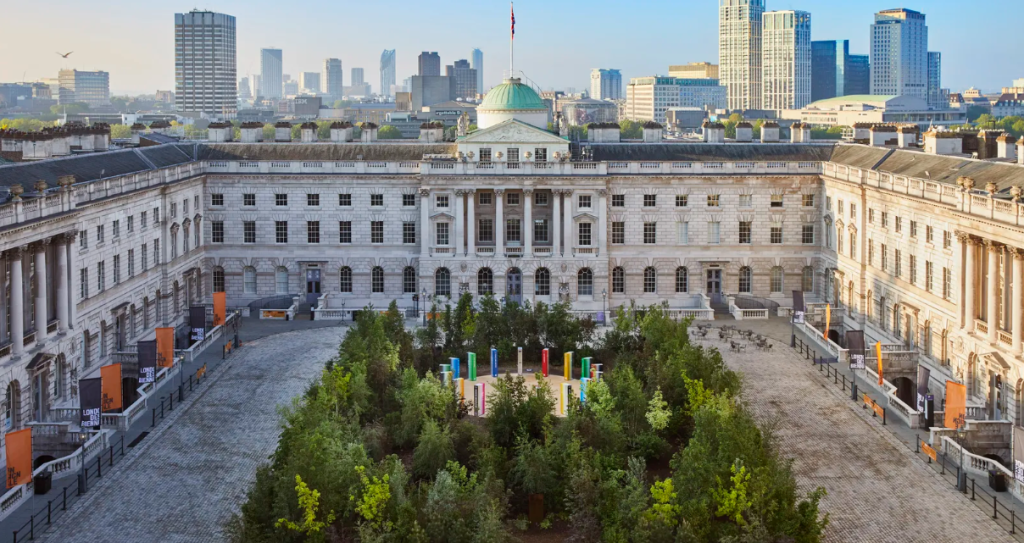
The Courtauld Gallery is one of London’s must-visit art museums, renowned for its exceptional collection of Impressionist and Post-Impressionist paintings. Located in the heart of London at Somerset House, the gallery is housed in a magnificent 18th-century building. It is a part of The Courtauld Institute of Art, a self-governing college of the University of London specializing in the study of the history of art and conservation.
At the heart of the Courtauld’s collection are its masterpieces of Impressionism. The gallery holds an unparalleled selection of works by artists who defined the movement. A prime example is Édouard Manet’s enigmatic final major work, A Bar at the Folies-Bergère. This painting is famous for its complex composition, including a barmaid whose reflection in the mirror behind her seems to contradict her real-world presence, offering a fascinating glimpse into the Parisian nightlife of the era.
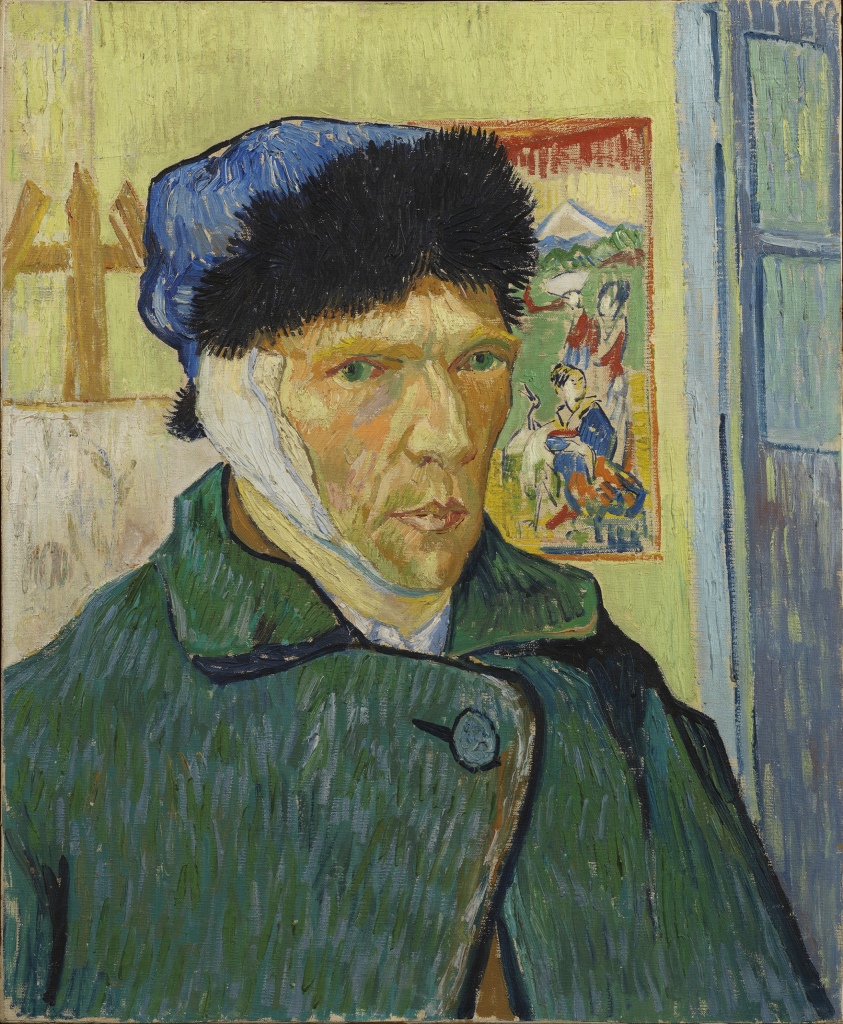
Moving beyond Impressionism, the gallery’s Post-Impressionist collection is equally significant, featuring iconic works that paved the way for modern art. Among the most powerful pieces is Vincent van Gogh’s Self-Portrait with Bandaged Ear. Painted shortly after he tragically severed a part of his own ear, this intense and deeply personal portrait is a testament to the artist’s emotional turmoil and his unique, expressive style.
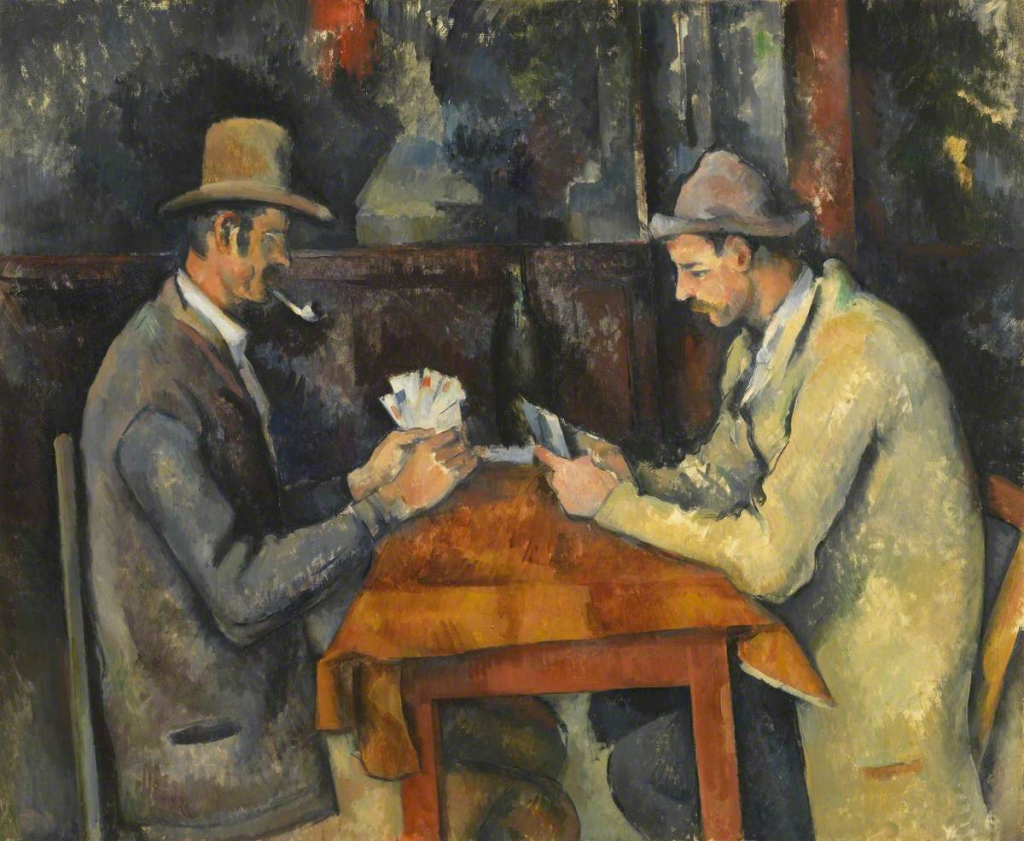
The gallery’s collection is not limited to these two movements, but they form its core. Another highlight is the work of Paul Cézanne, often called the “father of modern art”. The Courtauld holds the finest collection of his work in the UK, including one of the famous paintings from his The Card Players series. These works, with their geometric forms and structural brushwork, were instrumental in the development of Cubism.
In addition to its painting collection, the Courtauld Gallery also holds an impressive array of drawings, prints, and sculpture, from the Renaissance to the 20th century. Its commitment to education and research makes it a vital center for the study and appreciation of art history, offering a rich experience for visitors and scholars alike.
The Lewis Chessmen – British Museum
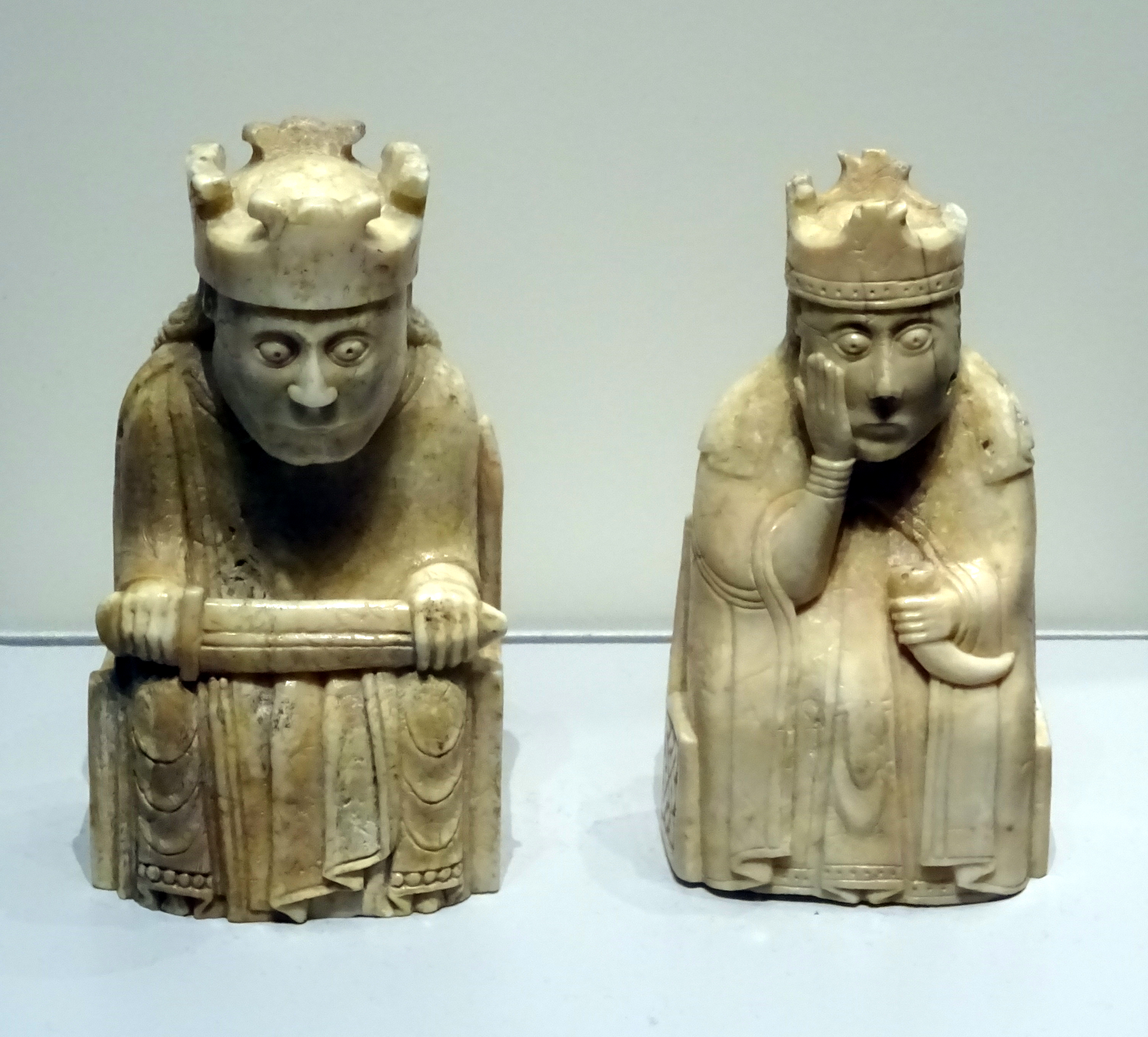
Also known as the UIG chessmen, these pieces date back to the 12th Century.
https://en.wikipedia.org/wiki/Lewis_chessmen
The Mystery of the Sands: The 12th-Century Lewis Chessmen
In 1831, a hoard emerged from a sandbank on the Isle of Lewis in the Outer Hebrides of Scotland that would change our understanding of medieval gaming and artistry.
The Lewis Chessmen are perhaps the most famous chess pieces in the world. Comprising 93 artifacts (mostly chess pieces, but also some other gaming counters), the hoard dates back to the late 12th or early 13th century.
The Norse Connection While found in Scotland, analysis suggests they were carved in Trondheim, Norway. During this period, the Outer Hebrides were under Norse rule. The pieces are intricately carved from walrus ivory and sperm whale tooth, materials highly valued in the medieval trade networks.
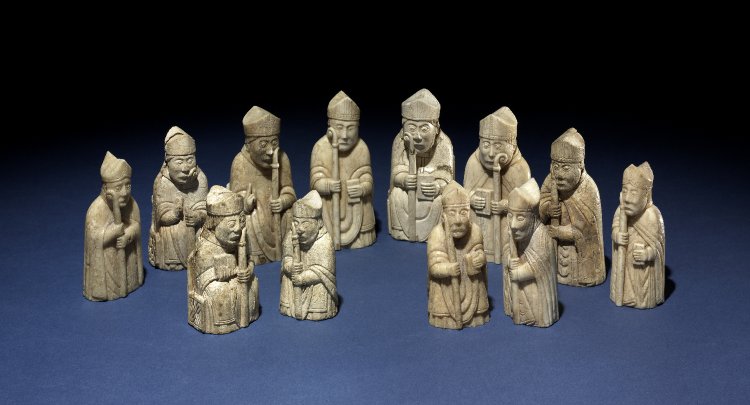
A Window into the Medieval Mind Beyond their age, the pieces are beloved for their distinct human characteristics. Unlike abstract modern pieces, these are caricatures of medieval society. The Kings are seated with swords across their knees; Bishops are robed and contemplative; Knights are mounted on diminutive horses.
Most famous are the Rooks—depicted as fierce Norse “berserkers” biting their shields—and the Queens, who hold their hands to their faces in a gesture of contemplation or dismay.
Today, the hoard is divided between the British Museum in London and the National Museum of Scotland in Edinburgh. They remain a stunning testament to the craftsmanship and complex cultural connections of the Viking Age.
#History #Archaeology #MedievalStudies #VikingAge #Art andCulture #Museums
Achilles Shield – British Gallery “Troy” Exhibition

A representation of Achilles Shield, this exhibit was included in the recent “Troy” exhibition at the British Gallery, 2020.