
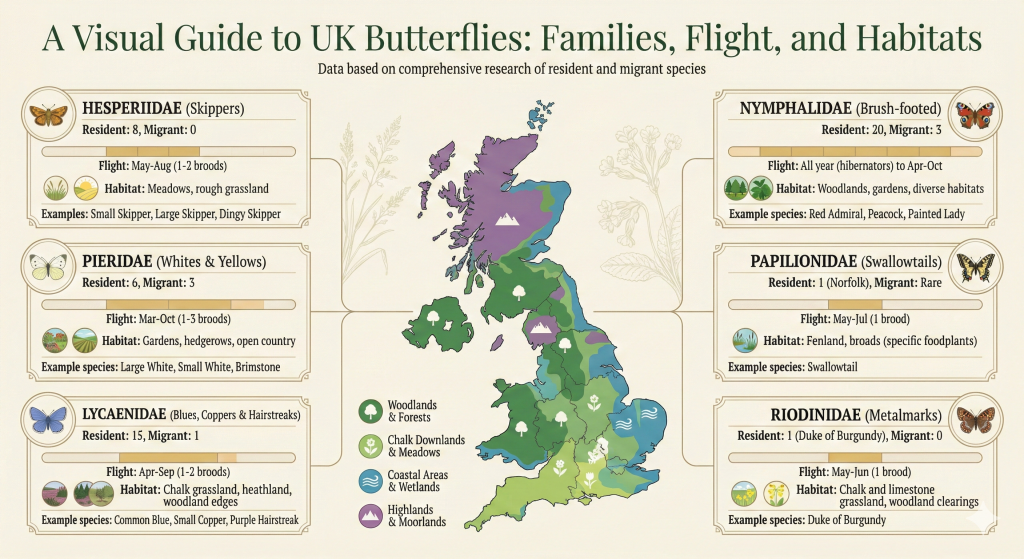
1. Introduction: The State of British Lepidoptera
The butterfly fauna of the United Kingdom, comprising 59 resident and regularly breeding migrant species, serves as one of the most significant biological barometers for the health of the temperate terrestrial environment. While the total species count is modest compared to the high-diversity regions of southern Europe or the tropics, the British Isles host a unique assemblage of populations often existing at the extreme northwestern limits of their global ranges.1 These edge-of-range populations exhibit heightened sensitivity to environmental variables, making them critical indicators of climatic shifts, habitat fragmentation, and the ecological consequences of land-use change.
Long-term monitoring data, derived from the UK Butterfly Monitoring Scheme (UKBMS) and the Butterflies for the New Millennium (BNM) recording project, reveals a landscape of stark contrasts.3 The data indicates a distinct bifurcation in the fortunes of British butterflies. On one trajectory, generalist species—those capable of utilizing ubiquitous larval foodplants and tolerating the resource-poor matrix of the modern agricultural landscape—are largely stable or expanding their ranges northward in response to a warming climate.5 Conversely, habitat specialists—species inextricably linked to specific seral stages of woodland, precise sward heights of calcareous grassland, or complex symbiotic relationships with other invertebrates—are facing precipitous declines in both abundance and distribution.7
The ecological requirements of these species act as a lens through which the history of the British landscape can be viewed. The decline of the Pearl-bordered Fritillary tracks the cessation of traditional coppicing in ancient woodlands; the retreat of the Large Heath mirrors the drainage of peatlands; and the resurgence of the Adonis Blue reflects the successes of targeted conservation grazing on chalk downlands.
This report provides an exhaustive analysis of the 59 species currently recognized as part of the UK’s breeding fauna. Organized by biological family, the report synthesizes data on phenology (flight periods), voltinism (brood cycles), and geographical distribution. It integrates recent taxonomic revisions, such as the specific distinction of the Cryptic Wood White in Northern Ireland, and evaluates the resilience of these populations in an era of unprecedented environmental flux.
2. Family Hesperiidae (Skippers)
The Hesperiidae family, colloquially known as Skippers, represents an evolutionary lineage distinct from other butterflies, possessing characteristics that often lead to their confusion with moths. They are defined by their broad, muscular thoraxes, widely set eyes, and antennae tips that are modified into a recurved hook or “apiculus”.8 In the United Kingdom, this family comprises eight resident species, which ecological analysis divides into two functional groups: the “Primitive” or “Spread-winged” Skippers (Subfamily Pyrginae) and the “Grass” or “Golden” Skippers (Subfamily Hesperiinae).
2.1 Subfamily Pyrginae (Spread-winged Skippers)
The subfamily Pyrginae includes species that typically rest with their wings held flat or slightly tented, distinct from the angled posture of the grass skippers. These species are among the most habitat-specific butterflies in the UK, often requiring early successional stages of vegetation that are transient in the landscape.
Dingy Skipper (Erynnis tages)
The Dingy Skipper is arguably the most perfectly camouflaged butterfly in the British fauna. Its mottled grey-brown wings allow it to vanish against the bare earth, dead flower heads, and stones that characterize its preferred habitat. This cryptic coloration is an adaptation to its thermal requirements; by basking on bare ground, it absorbs conductive heat, enabling activity in cooler spring temperatures.
Phenology and Voltinism: The species is primarily univoltine, with the main flight period occurring from late April through to mid-June.9 The peak emergence typically aligns with the flowering of its primary nectar sources, such as Bird’s-foot Trefoil and Horseshoe Vetch. In years of exceptional warmth, particularly in the southern counties of England, a partial second brood may emerge in August. Evidence suggests that the frequency of this second brood is increasing, a likely symptom of climate warming extending the growing season for the larvae.11
Habitat and Distribution: The Dingy Skipper is a butterfly of “waste” ground. It thrives in open, sunny habitats where vegetation is sparse and interspersed with bare soil. Key habitats include chalk downland, coastal dunes, disused railway lines, and brownfield sites (e.g., old quarries and spoil heaps).12 It is widely distributed across England and Wales but has suffered significant local extinctions due to the “tidying up” of marginal lands and the natural succession of scrub encroachment. In Scotland, it is rare and confined to specific coastal localities in the southwest and around the Moray Firth.13
Conservation Status: Classed as a UK BAP Priority Species, its decline is driven by the loss of early-successional habitats. The larvae construct hibernacula from the leaves of their foodplant, Bird’s-foot Trefoil (Lotus corniculatus), making them vulnerable to winter grazing or mechanical clearance if not carefully managed.12
Grizzled Skipper (Pyrgus malvae)
Small, energetic, and easily overlooked, the Grizzled Skipper is a species of intricate beauty when viewed closely, with a checkerboard pattern of black and white scales. Like the Dingy Skipper, it is a thermal specialist, requiring warm microclimates near the ground.
Phenology and Voltinism: This is a spring specialist, strictly univoltine in the majority of its range, flying from late April to June.9 It is often one of the first non-hibernating butterflies to emerge, signaling the transition from early to mid-spring.
Habitat and Distribution: The Grizzled Skipper requires a mosaic of short vegetation (5–10 cm) for breeding and taller vegetation for shelter. It is strongly associated with chalk downland, unimproved woodland rides, and heavy clay grasslands. Its larval foodplants—Wild Strawberry (Fragaria vesca), Agrimony (Agrimonia eupatoria), and Creeping Cinquefoil (Potentilla reptans)—must grow in warm, sheltered positions.2 The species has retreated from much of its former range and is now largely restricted to central and southern England and the south coast of Wales.
Chequered Skipper (Carterocephalus palaemon)
The Chequered Skipper presents one of the most fascinating biogeographical case studies in UK lepidoptery. Historically found in the woodlands of the East Midlands, it went extinct in England in 1976, only to persist in a totally distinct habitat in western Scotland.
Phenology and Voltinism: Univoltine, flying for a short window between late May and late June.2
Habitat and Distribution:
- Scottish Population: Native. Restricted to a small area of Argyll and Lochaber (approx. 50 km radius around Fort William). Here, it inhabits damp, sheltered grassland and woodland edges, often on purple moor-grass (Molinia caerulea) tussocks.2
- English Population: Reintroduced. Following feasibility studies, the species was reintroduced to Rockingham Forest in Northamptonshire in 2018 using stock from Belgium.2 These populations inhabit wide, sunny woodland rides dominated by False Brome (Brachypodium sylvaticum).
Ecological Nuance:
The dichotomy between the Scottish and English populations highlights the concept of local adaptation. The Scottish race is adapted to a cooler, wetter, Atlantic climate and uses Molinia, while the extinct English race (and the reintroduced stock) is adapted to warmer, drier woodland microclimates. This differentiation necessitates distinct management strategies for the two populations.
2.2 Subfamily Hesperiinae (Grass Skippers)
The Grass Skippers are characterized by their resting posture, holding their forewings at a 45-degree angle while the hindwings lie flat. This “jet-fighter” pose is unique to the group.
Small Skipper (Thymelicus sylvestris) & Essex Skipper (Thymelicus lineola)
These two species are often discussed in tandem due to their remarkable morphological similarity; they are cryptic sibling species that can only be reliably distinguished in the field by the color of the antennae tips (orange in the Small Skipper, glossy black in the Essex Skipper).6
Phenology: Both are univoltine. The Small Skipper typically emerges first, flying from late June to August. The Essex Skipper follows slightly later, peaking in July and August.9
Habitat and Distribution: Both species inhabit tall, lush grasslands, including road verges, field margins, and woodland rides. The Small Skipper feeds primarily on Yorkshire-fog (Holcus lanatus), while the Essex Skipper favors Cock’s-foot (Dactylis glomerata). Historically, the Essex Skipper was restricted to the marshes of Essex and the southeast. However, in recent decades, it has undergone a rapid range expansion, moving north and west to colonize much of England and Wales, mirroring the distribution of the Small Skipper.9
Ecological Mechanism:
The key biological difference lies in their overwintering strategy. The Small Skipper overwinters as a young caterpillar spun into a cocoon of grass, while the Essex Skipper overwinters as an egg inside the grass sheath. This difference in life history may influence their respective resilience to changing winter conditions and agricultural practices like hay cutting.
Lulworth Skipper (Thymelicus acteon)
The Lulworth Skipper is the UK’s most localized resident butterfly, a true endemic of the southern coast.
Phenology: Univoltine, flying from July to August.9
Habitat and Distribution: This species is strictly confined to the Dorset coast, specifically the limestone cliffs and undercliffs around Lulworth Cove and the Isle of Purbeck.14 It has a rigid requirement for tall swards (30–50 cm) of Tor-grass (Brachypodium pinnatum) growing in warm, sheltered, south-facing positions. It does not tolerate grazing that reduces the sward height below this threshold. Despite its restricted range, population densities within its narrow strip of habitat can be remarkably high, sometimes numbering in the thousands per hectare.15
Silver-spotted Skipper (Hesperia comma)
Once on the brink of extinction in the UK, the Silver-spotted Skipper has become a “climate change winner” in the context of chalk grassland conservation.
Phenology: Univoltine, occupying a late summer niche, flying from late July to September.9
Habitat and Distribution: Strictly associated with short-turf chalk downland in southern England (North and South Downs, Chilterns, Dorset). It requires hot, bare ground for basking and egg development, relying on Sheep’s-fescue (Festuca ovina) as the sole larval foodplant.16
Ecological Recovery: In the late 20th century, the cessation of rabbit grazing due to myxomatosis caused swards to grow too tall, cooling the microclimate and driving the skipper to near extinction. The recovery of rabbit populations, combined with conservation grazing and a warming climate, has allowed the butterfly to expand. Notably, it is now colonizing north-facing slopes and taller swards that were previously thermally unsuitable, demonstrating a clear response to rising ambient temperatures.16
Large Skipper (Ochlodes sylvanus)
The Large Skipper is the most widespread and robust member of the family, often serving as a common sight in summer hedgerows.
Phenology: Univoltine, usually the first of the grass skippers to appear, flying from late May to August.9
Habitat and Distribution: Unlike its more specialized cousins, the Large Skipper tolerates a wide range of habitats, including woodland rides, hedgerows, scrub, and urban parks. It prefers damper, shadier conditions than the Silver-spotted or Lulworth Skippers. It is widespread across England and Wales and has been steadily expanding its range into southern Scotland.13
Table 1: Summary of UK Hesperiidae (Skippers) Phenology and Status
| Species | Scientific Name | Status | Flight Period | Broods | Primary Habitat |
| Dingy Skipper | Erynnis tages | Resident | May – June | 1 (partial 2) | Brownfield, Chalk Downland, Dunes |
| Grizzled Skipper | Pyrgus malvae | Resident | April – June | 1 (partial 2) | Chalk Downland, Woodland Rides |
| Chequered Skipper | Carterocephalus palaemon | Resident | May – June | 1 | Damp Grassland (Scotland), Rides (England) |
| Small Skipper | Thymelicus sylvestris | Resident | June – August | 1 | Tall Grassland, Verges |
| Essex Skipper | Thymelicus lineola | Resident | July – August | 1 | Tall Grassland, Verges |
| Lulworth Skipper | Thymelicus acteon | Resident | July – August | 1 | Coastal Limestone Cliffs (Tor-grass) |
| Silver-spotted Skipper | Hesperia comma | Resident | July – September | 1 | Short Chalk Turf (South-facing) |
| Large Skipper | Ochlodes sylvanus | Resident | May – August | 1 | Hedgerows, Woodland Rides |
3. Family Papilionidae (Swallowtails)
The Papilionidae are globally renowned for their size and vibrancy. In the UK, this family is represented by a single species, Papilio machaon, but the ecological story of this butterfly in Britain is one of uniqueness and isolation.
Swallowtail (Papilio machaon)
The British Swallowtail is distinct from its continental counterparts. The resident subspecies, Papilio machaon britannicus, is endemic to the UK and exhibits a life history completely different from the widespread subspecies Papilio machaon gorganus found across Europe.
Phenology and Voltinism:
- Resident (britannicus): Primarily univoltine, flying from late May to July.9 In favorable years with warm springs, a small second brood may emerge in August, but this is less reliable than in continental populations.
- Migrant (gorganus): Occasional migrants arrive from France and the Low Countries, typically later in the summer. These vagrants may breed, but long-term establishment has historically been prevented by winter conditions, though this is changing.1
Habitat and Distribution:
- Britannicus: This subspecies is an obligate wetland specialist. It is entirely restricted to the fenlands of the Norfolk Broads (e.g., Hickling Broad, Ranworth Broad, Catfield Fen). Its survival depends solely on Milk Parsley (Thysselinum palustre), a plant that requires specific water levels and management of fen vegetation (sedge cutting) to persist.1
- Gorganus: The continental migrants are generalists, breeding on Wild Carrot (Daucus carota), Fennel (Foeniculum vulgare), and other umbellifers in dry habitats like gardens and chalk downland.1
Conservation Implications:
The restriction of the britannicus subspecies to the Norfolk Broads renders it uniquely vulnerable to climate change. Rising sea levels and the salinization of the freshwater broads pose an existential threat to Milk Parsley, which cannot tolerate brackish water. Conservation strategies are currently exploring the potential translocation of the species to new, inland fen sites (e.g., in Somerset or East Anglia) to “future-proof” the subspecies against coastal inundation.
4. Family Pieridae (Whites and Yellows)
The Pieridae are often dismissed as “cabbage whites,” yet this family contains species of profound conservation concern and complex taxonomic history. The group includes both the most common garden pests and some of the most specialized woodland butterflies.
4.1 Subfamily Dismorphiinae (Wood Whites)
This subfamily contains the most delicate of the British butterflies, known for their slow, flopping flight. Recent genetic research has split the UK’s “Wood White” into two cryptic species.
Wood White (Leptidea sinapis)
Phenology: In southern England, the species is bivoltine, flying in May–June and again in July–August. In the cooler northern parts of its range (and in Ireland), it is strictly univoltine, flying in May and June.9
Habitat and Distribution: The Wood White is a habitat specialist of the “woodland edge.” It requires rides and clearings with dappled shade where its larval foodplants—various vetches such as Meadow Vetchling (Lathyrus pratensis) and Tufted Vetch (Vicia cracca)—grow in abundance. It is highly sensitive to the shading out of rides; once a canopy closes, the colony dies. Strongholds remain in the West Midlands (e.g., Wyre Forest, Haugh Wood), Northamptonshire, and the Surrey/Sussex border (e.g., Chiddingfold Forest).19
Cryptic Wood White (Leptidea juvernica)
Phenology: Univoltine, flying from May to July.21
Habitat and Distribution: This species is not found in Great Britain (England, Scotland, Wales) but is widespread in Northern Ireland. Crucially, unlike L. sinapis, the Cryptic Wood White is not restricted to woodland. It inhabits open, flower-rich grasslands, road verges, and scrubby meadows.21
Taxonomic Context: For decades, these two species were considered identical. It was only through chromosomal analysis in 2001 (and subsequent DNA work) that the Irish population was confirmed as distinct. This has profound implications for conservation; preserving “Wood Whites” in Northern Ireland requires grassland management, whereas in England, it requires woodland forestry management.22
4.2 Subfamily Coliadinae (Yellows)
Clouded Yellow (Colias croceus)
The Clouded Yellow is one of the UK’s most famous migrants.
Phenology: Multivoltine. Migrants typically arrive in May or June, producing successive broods throughout the summer and autumn. In “Clouded Yellow Years” (e.g., 1947, 1983, 2022), millions may arrive.9
Habitat and Distribution: It is a butterfly of open country, particularly favoring clover-rich ley fields, coastal cliffs, and chalk downland. The larvae feed on legumes like Lucerne (Medicago sativa) and Red Clover (Trifolium pratense). While historically unable to survive UK winters, recent mild winters have allowed larvae to successfully overwinter on the sheltered south coast of England, marking a transition from “regular migrant” to “tentative resident”.18
Brimstone (Gonepteryx rhamni)
The Brimstone is widely believed to be the original “butter-coloured fly.” It is unique in its longevity.
Phenology: Univoltine. The adult butterfly has an extraordinarily long lifespan, up to 10–11 months. Adults emerge in July, feed, and then enter hibernation (often hiding in Ivy or Bramble thickets) weeks later. They re-emerge in early spring (February–April) to mate and lay eggs, often being the first sign of spring.9
Habitat and Distribution: Widespread in England and Wales, but distribution is tied strictly to the presence of the larval foodplants: Purging Buckthorn (Rhamnus cathartica) on calcareous soils and Alder Buckthorn (Frangula alnus) on acidic, wet soils.23
4.3 Subfamily Pierinae (Whites)
Large White (Pieris brassicae) & Small White (Pieris rapae)
Status: Residents reinforced by massive migration. Phenology: Bivoltine or Trivoltine (April–October). Habitat: Ubiquitous. These are the only two species classified as agricultural pests in the UK, feeding on cultivated Brassica crops (cabbages, oilseed rape). Their populations are highly mobile and resilient.18
Green-veined White (Pieris napi)
Status: Resident. Phenology: Bivoltine (April–June, July–September).9 Habitat: Unlike its “cabbage” cousins, this species prefers damp, lush habitats—riverbanks, wet woodland rides, and ditches. It feeds on wild crucifers like Cuckooflower (Cardamine pratensis) and Garlic Mustard (Alliaria petiolata), never on crops. It is widespread across the entire UK, including the highlands and islands of Scotland.24
Orange-tip (Anthocharis cardamines)
Status: Resident. Phenology: Strictly Univoltine. A true harbinger of spring, flying from mid-April to June.9 Habitat: Damp meadows, hedgerows, and gardens. Ecological Insight: The female lays eggs singly on the flower stalks of Garlic Mustard or Cuckooflower. The larvae are cannibalistic; if two meet on the same plant, the larger will eat the smaller. This ensures the survivor has enough food resource on a single plant to reach pupation.
Table 2: Summary of UK Pieridae (Whites/Yellows) Phenology and Status
| Species | Scientific Name | Status | Flight Period | Broods | Primary Habitat |
| Wood White | Leptidea sinapis | Resident | May – June (Aug) | 1-2 | Woodland Rides (Dappled Shade) |
| Cryptic Wood White | Leptidea juvernica | Resident (NI) | May – July | 1 | Open Grassland (Northern Ireland) |
| Clouded Yellow | Colias croceus | Migrant/Res | May – Oct | Multi | Clover Fields, Coast |
| Brimstone | Gonepteryx rhamni | Resident | Feb–May (Hibernators) July–Sept (New) | 1 | Scrub, Woodland (Buckthorn) |
| Large White | Pieris brassicae | Res/Migrant | April – Oct | 2-3 | Gardens, Farmland |
| Small White | Pieris rapae | Res/Migrant | April – Oct | 2-3 | Gardens, Farmland |
| Green-veined White | Pieris napi | Resident | April – Sept | 2 | Damp Grassland, Riverbanks |
| Orange-tip | Anthocharis cardamines | Resident | April – June | 1 | Damp Meadows, Hedgerows |
5. Family Riodinidae (Metalmarks)
The Riodinidae are a vast family in the Neotropics (over 1,000 species), but the UK possesses only one outlier representative.
Duke of Burgundy (Hamearis lucina)
Often mistaken for a Fritillary due to its chequered orange and brown pattern, the Duke of Burgundy is behaviorally and structurally distinct (males have reduced forelegs, but females have full use of all six).
Phenology: Univoltine. The flight period is relatively short, typically spanning May and early June.1
Habitat and Distribution: The Duke is a butterfly of the “scrubby edge.” It is found on chalk downland and in coppiced woodlands. Crucially, it requires large, lush Primula plants—Cowslip (Primula veris) on grassland and Primrose (Primula vulgaris) in woodland. These plants must grow in a “Goldilocks” zone: not too shaded (or the plants won’t grow large enough), but not too exposed (or the plants desiccate in summer). The species has declined severely and is now restricted to scattered colonies in southern England (e.g., Hampshire, Sussex Downs) and limestone districts in the north (e.g., Morecambe Bay).26
Conservation Management:
Conservation of this species has been a recent success story. Through the implementation of “rotational scrubbing,” where patches of scrub are cleared on a cycle to create fresh, sheltered glades with lush Cowslips, populations in the South Downs have stabilized and locally increased.
6. Family Lycaenidae (Hairstreaks, Coppers, and Blues)
The Lycaenidae are biologically fascinating for their intricate associations with ants (myrmecophily). Many UK species cannot survive without the presence of specific ant genera (e.g., Lasius, Myrmica), which protect their larvae in exchange for sugary secretions.
6.1 Subfamily Theclinae (Hairstreaks)
The Hairstreaks are elusive, canopy-dwelling butterflies that are often significantly under-recorded.
Brown Hairstreak (Thecla betulae)
Phenology: Univoltine, flying late in the season (August–September).28 Habitat: Hedgerows and woodland edges containing Blackthorn (Prunus spinosa). Ecological Insight: Adult butterflies are rarely seen as they spend most of their time assembling in the canopy of “Master Trees” (often Ash) to mate. The most effective way to monitor them is by counting their white eggs laid on young Blackthorn shoots in winter. The species is threatened by annual hedgerow flailing, which destroys the eggs.29
Purple Hairstreak (Favonius quercus)
Phenology: Univoltine (July–August).13 Habitat: Oak woodland (both Pedunculate and Sessile Oak). Ecological Insight: This species is almost entirely arboreal, feeding on aphid honeydew on oak leaves. It is widespread but often invisible to observers on the ground. It is best viewed in the evening when males perform agile display flights over the canopy.30
White-letter Hairstreak (Satyrium w-album)
Phenology: Univoltine (July–August).31 Habitat: Elm trees (Ulmus spp.). Ecological Insight: This species faced catastrophe in the 1970s due to Dutch Elm Disease. It has survived by utilizing Wych Elm (which is more resistant) and the sucker regrowth of English Elm in hedgerows. It remains widespread but local.31
Black Hairstreak (Satyrium pruni)
Phenology: Univoltine (June–July).33 Habitat: Dense, mature Blackthorn thickets in ancient woodlands. Distribution: One of the UK’s rarest species, restricted to a narrow band of clay soils between Oxford and Peterborough.33 Conservation: Unlike the Brown Hairstreak, which uses young growth, the Black Hairstreak requires mature Blackthorn (20+ years old). This puts it at odds with modern forestry practices that often clear scrub too frequently.
Green Hairstreak (Callophrys rubi)
Phenology: Univoltine (April–June).2 Habitat: Diverse: chalk downland, heathland, and moorland edges. Ecological Insight: The UK’s only green butterfly. It is unique among hairstreaks in being a ground/shrub dweller rather than a canopy dweller. Males are territorial, perching on hawthorn or gorse bushes to intercept mates.
6.2 Subfamily Lycaeninae (Coppers)
Small Copper (Lycaena phlaeas)
Phenology: Multivoltine (2–3 broods: May–June, July–Aug, Sept–Oct).13 Habitat: Open, dry habitats including heathland, wasteland, and downland. Ecological Insight: Males are notoriously pugnacious, defending territories of bare ground against any intruder, including much larger insects. The larvae feed on Sorrels (Rumex acetosa/acetosella).
6.3 Subfamily Polyommatinae (Blues)
Large Blue (Phengaris arion)
The Large Blue is the icon of science-based conservation in the UK.
Status: Reintroduced (Extinct 1979; Reintroduced 1983). Phenology: Univoltine (June–July).7 Habitat: South-facing, grazed pasture with Wild Thyme (Thymus polytrichus). Ecological Mechanism: The Large Blue is a social parasite. Its larvae feed briefly on Thyme, then drop to the ground to be adopted by red ants of the species Myrmica sabuleti. The ants carry the caterpillar into their nest, where it feeds on ant grubs for 10 months. The species went extinct because conservationists fenced off sites, removing grazing. This caused the turf to grow too tall, cooling the soil and replacing the heat-loving M. sabuleti ants with M. scabrinodis, which cannot survive the butterfly’s predation. Reintroduction efforts focused on restoring grazing to maintain short, hot turf have resulted in a 1,883% population increase.7
Small Blue (Cupido minimus)
Phenology: Mostly Univoltine (May–June), partial second brood in south.34 Habitat: Chalk grassland, quarries, sea cliffs. Restricted to Kidney Vetch (Anthyllis vulneraria). Distribution: Localized colonies, mainly in the south and coastally in Scotland.36
Silver-studded Blue (Plebejus argus)
Phenology: Univoltine (June–August).37 Habitat: Heathland (Heather/Gorse) and Calcareous Grassland. Ecological Insight: Obligate myrmecophile. It is never found without the black ants Lasius niger or Lasius alienus. The butterfly’s distribution is limited not just by foodplants but by the thermal niche of the host ants.
Common Blue (Polyommatus icarus)
Phenology: Bivoltine in south, Univoltine in north.1 Habitat: Ubiquitous in grassy habitats. Ecological Insight: The most widespread blue. In western Scotland and Ireland, females are often bright blue (like males), whereas in southern England, they are predominantly brown.
Chalkhill Blue (Polyommatus coridon) & Adonis Blue (Polyommatus bellargus)
These two species are the jewels of the chalk downland.
- Chalkhill Blue: Univoltine (July–Sept). Requires Horseshoe Vetch in well-grazed swards. Can form massive populations (“milky ways”).1
- Adonis Blue: Bivoltine (May–June, Aug–Sept). Requires even shorter, hotter turf than the Chalkhill. It crashed in the 1970s following the loss of rabbits (myxomatosis) but has recovered spectacularly due to conservation grazing and climate warming.38
Holly Blue (Celastrina argiolus)
Phenology: Bivoltine (April–May, July–August).
Habitat: Gardens, woodland.
Ecological Insight: Unique host switch: Spring generation feeds on Holly (Ilex); Summer generation feeds on Ivy (Hedera). Populations cycle boom-and-bust every few years due to the parasitic wasp Listrodomus nycthemerus.
Brown Argus (Aricia agestis) & Northern Brown Argus (Aricia artaxerxes)
Taxonomy: Recently confirmed as distinct species, though they hybridize in northern England.39
- Brown Argus: Southern. Bivoltine. Expanding rapidly northwards by switching foodplant from Rock-rose to Geraniums (Geranium molle), a rare example of climate-driven host shift facilitating range expansion.40
- Northern Brown Argus: Northern (Scotland/N. England). Univoltine. Strictly associated with Rock-rose (Helianthemum nummularium).41
Table 3: Summary of UK Lycaenidae (Blues/Coppers/Hairstreaks)
| Species | Scientific Name | Status | Flight Period | Broods | Primary Habitat |
| Small Blue | Cupido minimus | Resident | May – June | 1-2 | Kidney Vetch patches |
| Silver-studded Blue | Plebejus argus | Resident | June – Aug | 1 | Heathland (Ant associated) |
| Brown Argus | Aricia agestis | Resident | May–Jun / Aug–Sep | 2 | Downland, Set-aside |
| Northern Brown Argus | Aricia artaxerxes | Resident | June – July | 1 | Limestone/Coastal Grassland |
| Common Blue | Polyommatus icarus | Resident | May – Sept | 1-2 | General Grassland |
| Chalkhill Blue | Polyommatus coridon | Resident | July – Sept | 1 | Chalk Downland |
| Adonis Blue | Polyommatus bellargus | Resident | May–Jun / Aug–Sep | 2 | Short Chalk Turf |
| Holly Blue | Celastrina argiolus | Resident | April – Sept | 2 | Gardens (Holly/Ivy) |
| Large Blue | Phengaris arion | Resident (Reintro) | June – July | 1 | Thyme/Ant Nests |
| Small Copper | Lycaena phlaeas | Resident | May – Oct | 2-3 | Heath, Waste Ground |
| Green Hairstreak | Callophrys rubi | Resident | April – June | 1 | Scrub, Moorland Edge |
| Brown Hairstreak | Thecla betulae | Resident | Aug – Sept | 1 | Blackthorn Hedgerows |
| Purple Hairstreak | Favonius quercus | Resident | July – Aug | 1 | Oak Woodland Canopy |
| White-letter Hairstreak | Satyrium w-album | Resident | July – Aug | 1 | Elm Trees |
| Black Hairstreak | Satyrium pruni | Resident | June – July | 1 | Mature Blackthorn Thickets |
7. Family Nymphalidae (The Brush-footed Butterflies)
This is the largest and most diverse family, containing the Fritillaries, the Aristocrats, and the Browns (Satyrinae).
7.1 Subfamily Heliconiinae (Fritillaries)
The Fritillaries are largely woodland and bracken specialists that have suffered the steepest declines of any group due to the cessation of traditional woodland management (coppicing).
Pearl-bordered Fritillary (Boloria euphrosyne)
Phenology: Univoltine (April–June).7 Habitat: Bracken slopes and coppiced woodland. Ecological Insight: Requires abundant Violets (Viola) growing in warm microclimates created by dead bracken litter or bare ground. It has declined by 64% in abundance (1976–2019) as woodlands have become shaded and overgrown.7
Small Pearl-bordered Fritillary (Boloria selene)
Phenology: Bivoltine in south, Univoltine in north.
Habitat: Damp grassland, moorland flushes, and woodland.
Distribution: More widespread than euphrosyne, especially in the wetter west and north (Scotland/Wales).
High Brown Fritillary (Fabriciana adippe)
Phenology: Univoltine (June–August).43 Habitat: Bracken-dominated limestone pavement (Morecambe Bay) and bracken slopes (Dartmoor/Glamorgan). Status: The UK’s most threatened butterfly. It requires the “hottest” microclimate of all fritillaries, often breeding on violets growing under a canopy of dead bracken.44
Marsh Fritillary (Euphydryas aurinia)
Phenology: Univoltine (May–June).45 Habitat: Damp tussocky grassland (Rhôs pasture) or Chalk grassland. Foodplant: Devil’s-bit Scabious (Succisa pratensis). Ecological Insight: This species exists in “metapopulations”—networks of colonies that are connected by dispersal. Individual colonies blink on and off; survival depends on the landscape being porous enough for recolonization. It is highly protected under European law.45
Glanville Fritillary (Melitaea cinxia)
Phenology: Univoltine (May–June).46 Habitat: Soft rock cliffs and landslips. Distribution: Almost entirely restricted to the southern undercliffs of the Isle of Wight. It relies on the instability of the cliffs to create bare ground for Ribwort Plantain (Plantago lanceolata).46
Heath Fritillary (Melitaea athalia)
Phenology: Univoltine (May–July).46 Habitat: Coppiced woodland (feeding on Common Cow-wheat) or Heathland (feeding on Foxglove). Distribution: Extremely local: Blean Woods (Kent), Essex, and Exmoor. Historically known as the “Woodman’s Follower” because it followed the cycle of coppice cutting.
7.2 Subfamily Nymphalinae (Vanessids & Emperors)
Painted Lady (Vanessa cardui)
Status: Regular Migrant. Phenology: Multivoltine. Ecological Insight: A global nomad. Radar studies have proven it undertakes a massive high-altitude return migration to Africa and the Middle East in autumn, utilizing high-altitude winds. It breeds on Thistles (Cirsium).18
Red Admiral (Vanessa atalanta)
Status: Resident & Migrant. Phenology: Multivoltine. Visible year-round. Ecological Insight: Historically a summer visitor, it now successfully hibernates in the UK in increasing numbers. In the south, it is arguably becoming continuously brooded, with larvae active in winter.47
Purple Emperor (Apatura iris)
Status: Resident. Phenology: Univoltine (July).48 Habitat: Large woodlands with Sallow (Salix). Ecological Insight: The elusive “His Imperial Majesty.” Males defend territories in the high canopy of “Master Trees” (often Oaks). They do not visit flowers, feeding instead on aphid honeydew, animal dung, and carrion.
White Admiral (Limenitis camilla)
Status: Resident.
Phenology: Univoltine (June–August).
Habitat: Shady woodland with Honeysuckle (Lonicera).
Ecological Insight: The larvae require honeysuckle trailing in dappled shade. It is highly sensitive to the closing of woodland canopies; populations crash when woods become too dark.
7.3 Subfamily Satyrinae (Browns)
Speckled Wood (Pararge aegeria)
Phenology: Multivoltine (April–October).23 Ecological Insight: Unique among UK butterflies, it can overwinter as either a larva or a pupa. This staggered development leads to a continuous emergence of adults throughout the summer.
Wall (Lasiommata megera)
Phenology: Bivoltine/Trivoltine. Habitat: Hot, dry, stony places (walls, rocks). Distribution: Coastal. Extinct in much of inland southern England. Ecological Insight: The “Inland Wall Decline” is attributed to a “developmental trap.” Climate warming induces a third brood in autumn, but the offspring of this brood often freeze or starve in winter, leading to population collapse.9
Mountain Ringlet (Erebia epiphron)
Phenology: Univoltine (June–July).49 Habitat: Montane grassland (Nardus/Mat-grass) above 350m–900m. Distribution: Lake District (Cumbria) and Scottish Highlands (Grampians). Ecological Insight: The UK’s only true alpine butterfly. It is highly vulnerable to climate change pushing its “climate envelope” up the mountains until it runs out of habitat.50
Large Heath (Coenonympha tullia)
Phenology: Univoltine (June–August). Habitat: Wet, acidic peat bogs. Ecological Insight: Dependent on Hare’s-tail Cottongrass (Eriophorum vaginatum). Its decline tracks the destruction and drainage of lowland peat bogs for agriculture and forestry.13
Table 4: Summary of UK Nymphalidae (Selected Species)
| Species | Scientific Name | Status | Flight Period | Primary Habitat |
| Pearl-bordered Fritillary | Boloria euphrosyne | Resident | April – June | Bracken/Coppice |
| High Brown Fritillary | Fabriciana adippe | Resident | June – Aug | Limestone/Bracken |
| Marsh Fritillary | Euphydryas aurinia | Resident | May – June | Damp Grassland |
| Glanville Fritillary | Melitaea cinxia | Resident | May – June | Soft Cliffs (IoW) |
| Purple Emperor | Apatura iris | Resident | July | Woodland Canopy |
| Mountain Ringlet | Erebia epiphron | Resident | June – July | Montane Grassland |
| Scotch Argus | Erebia aethiops | Resident | July – Sept | Damp Grassland (North) |
| Large Heath | Coenonympha tullia | Resident | June – Aug | Peat Bogs |
| Wall | Lasiommata megera | Resident | May–Jun / Aug | Coastal/Rocky |
| Marbled White | Melanargia galathea | Resident | June – Aug | Unimproved Grassland |
8. Conclusion and Future Outlook
The 59 butterfly species of the United Kingdom form a complex tapestry of generalists and specialists. The overarching trend is clear: Generalists (like the Comma and Speckled Wood) are thriving, expanding their ranges as the climate warms. Specialists (like the High Brown Fritillary and Wood White) are contracting, locked into fragmented habitats that prevent them from tracking their climatic niches.
However, conservation works. The spectacular recovery of the Large Blue, the stabilization of the Duke of Burgundy, and the spread of the Silver-spotted Skipper prove that with precise, science-led management—focusing on larval microclimates and landscape connectivity—declines can be reversed. The future of UK butterflies depends on “Landscape Scale Conservation,” moving beyond isolated reserves to create a connected countryside that allows these sensitive insects to move and adapt in a changing world.
Works cited
- ID Guide Butterflies – British Naturalists’ Association, accessed February 5, 2026, https://bna-naturalists.org/id-guide-butterflies/
- List of butterflies of Great Britain – Wikipedia, accessed February 5, 2026, https://en.wikipedia.org/wiki/List_of_butterflies_of_Great_Britain
- Key Findings | UKBMS, accessed February 5, 2026, https://ukbms.org/key-findings
- UK Butterfly Monitoring Scheme (UKBMS) – UK Centre for Ecology & Hydrology, accessed February 5, 2026, https://www.ceh.ac.uk/our-science/projects/uk-butterfly-monitoring-scheme
- Insects of the wider countryside (butterflies) | Advisor to Government on Nature Conservation, accessed February 5, 2026, https://jncc.gov.uk/our-work/ukbi-insects-of-the-wider-countryside-butterflies/
- Insects of the wider countryside (butterflies) – GOV.UK, accessed February 5, 2026, https://www.gov.uk/government/statistics/england-biodiversity-indicators/insects-of-the-wider-countryside-butterflies
- The State of the UK’s Butterflies 2022, accessed February 5, 2026, https://butterfly-conservation.org/sites/default/files/2023-01/State%20of%20UK%20Butterflies%202022%20Report.pdf
- Hesperiidae – UK Butterflies, accessed February 5, 2026, https://www.ukbutterflies.co.uk/family.php?name=Hesperiidae
- First butterfly sightings 2025, accessed February 5, 2026, https://butterfly-conservation.org/butterflies/first-butterfly-sightings-2026/first-butterfly-sightings-2025
- United Kingdom Butterfly Monitoring Scheme: phenology 2021 – data.gov.uk, accessed February 5, 2026, https://www.data.gov.uk/dataset/afe23b0c-ab3f-442f-92a5-e7656a2991ad/united-kingdom-butterfly-monitoring-scheme-phenology-2021
- Flight Periods – The Deskbound Birder, accessed February 5, 2026, http://thedeskboundbirder.blogspot.com/p/flight-periods.html
- Species Action Plan – Butterfly Conservation, accessed February 5, 2026, https://butterfly-conservation.org/sites/default/files/dingy-skipper-action-plan.doc
- Butterflies and day-flying moths of the Lothians & the Scottish …, accessed February 5, 2026, https://butterfly-conservation.org/sites/default/files/lothians-an-borders-id-guide-downloadable.pdf
- Lulworth Skipper – Butterfly Conservation, accessed February 5, 2026, https://butterfly-conservation.org/butterflies/lulworth-skipper
- Lulworth skipper – Wikipedia, accessed February 5, 2026, https://en.wikipedia.org/wiki/Lulworth_skipper
- Silver-spotted Skipper – Butterfly Conservation, accessed February 5, 2026, https://butterfly-conservation.org/butterflies/silver-spotted-skipper
- Silver-spotted Skipper – Learn Butterflies, accessed February 5, 2026, https://learnbutterflies.com/silver-spotted-skipper/
- They are highly sensitive indicators of the health of the environment and play crucial roles in the food chain as well as being pollinators of plants. – Butterfly Conservation, accessed February 5, 2026, https://butterfly-conservation.org/butterflies
- Managing for bespoke species/assemblages within Countryside Stewardship – guidance template – Butterfly Conservation, accessed February 5, 2026, https://butterfly-conservation.org/sites/default/files/wood-white-cs-template.pdf
- Wood White – Butterfly Conservation, accessed February 5, 2026, https://butterfly-conservation.org/butterflies/wood-white
- Cryptic Wood White – Butterfly Conservation, accessed February 5, 2026, https://butterfly-conservation.org/butterflies/cryptic-wood-white
- Cryptic Wood White – Craigavon Lakes, Northern Ireland – DrPerdixButterflies, accessed February 5, 2026, https://mrperdixwildlife.wordpress.com/2022/05/18/cryptic-wood-white-craigavon-lakes-northern-ireland/
- Common UK Butterfly Identification and Facts – Woodland Trust, accessed February 5, 2026, https://www.woodlandtrust.org.uk/blog/2019/07/butterfly-identification/
- The NHBS Guide to UK Butterfly Identification, accessed February 5, 2026, https://www.nhbs.com/blog/uk-butterfly-identification
- Species of the month: Duke of Burgundy | Butterfly Conservation, accessed February 5, 2026, https://butterfly-conservation.org/news-and-blog/species-of-the-month-duke-of-burgundy
- Species results – UKBMS, accessed February 5, 2026, https://ukbms.org/species
- Duke of Burgundy Butterfly – FWAG SW, accessed February 5, 2026, https://fwagsw.org.uk/duke-of-burgundy-butterfly/
- Brown Hairstreak – Learn Butterflies, accessed February 5, 2026, https://learnbutterflies.com/brown-hairstreak/
- Brown Hairstreak Obsession – Butterfly Conservation Ireland, accessed February 5, 2026, https://butterflyconservation.ie/wp/2017/11/01/brown-hairstreak-obsession/
- Hairstreak Hide and Seek | Butterfly Conservation, accessed February 5, 2026, https://butterfly-conservation.org/news-and-blog/hairstreak-hide-and-seek
- White-letter Hairstreak – Butterfly Conservation, accessed February 5, 2026, https://butterfly-conservation.org/butterflies/white-letter-hairstreak
- White-letter Hairstreak – East Midlands Butterfly Conservation, accessed February 5, 2026, https://www.eastmidlands-butterflies.org.uk/species_accounts/white-letter_hairstreak.html
- Black Hairstreak – Butterfly Conservation, accessed February 5, 2026, https://butterfly-conservation.org/butterflies/black-hairstreak
- Species Action Plan – Butterfly Conservation, accessed February 5, 2026, https://butterfly-conservation.org/sites/default/files/small-blue-action-plan.doc
- Oviposition behaviour and emergence through time of the small blue butterfly (Cupido minimus) in a nature reserve in Bedfordshire, UK – ResearchGate, accessed February 5, 2026, https://www.researchgate.net/publication/356818193_Oviposition_behaviour_and_emergence_through_time_of_the_small_blue_butterfly_Cupido_minimus_in_a_nature_reserve_in_Bedfordshire_UK
- ANNUAL REPORT 2011 – UKBMS, accessed February 5, 2026, https://ukbms.org/sites/default/files/downloads/BFly%20Ann%20Report%202011%20LowRes.pdf
- Variation in British Butterflies – dispar, accessed February 5, 2026, https://www.dispar.org/reference.php?id=17
- BUTTERFLY MONITORING SCHEME – UKBMS, accessed February 5, 2026, https://ukbms.org/sites/default/files/downloads/BMSRpt0203.pdf
- On the origin of an insular hybrid butterfly lineage – bioRxiv, accessed February 5, 2026, https://www.biorxiv.org/content/10.1101/2024.10.17.618839v1.full.pdf
- climate change and habitat associations at species’ range boundaries – White Rose eTheses Online, accessed February 5, 2026, https://etheses.whiterose.ac.uk/id/eprint/2910/1/Thesis_RM_Pateman_2012.pdf
- Northern brown argus | Species On The Edge – Wildlife & Habitat Conservation, accessed February 5, 2026, https://speciesontheedge.co.uk/northern-brown-argus/
- Northern Brown Argus factsheet – Butterfly Conservation, accessed February 5, 2026, https://butterfly-conservation.org/sites/default/files/northern-brown-argus-factsheet-2017.pdf
- Dark green fritillary | The Wildlife Trusts, accessed February 5, 2026, https://www.wildlifetrusts.org/wildlife-explorer/invertebrates/butterflies/dark-green-fritillary
- High Brown Fritilary – Vale of Glamorgan Council, accessed February 5, 2026, https://www.valeofglamorgan.gov.uk/en/enjoying/Coast-and-Countryside/Habitats-and-Wildlife/High-Brown-Fritilary.aspx
- Marsh Fritillary – Butterfly Conservation, accessed February 5, 2026, https://butterfly-conservation.org/butterflies/marsh-fritillary
- Fritillaries – loveofwildlife, accessed February 5, 2026, https://www.loveofwildlife.co.uk/fritillaries
- Butterflies of the UK: common species to see, how to submit sightings, and how they’re being helped – BBC Wildlife Magazine, accessed February 5, 2026, https://www.discoverwildlife.com/animal-facts/insects-invertebrates/facts-about-butterflies-uk
- A-Z of butterflies | Butterfly Conservation, accessed February 5, 2026, https://butterfly-conservation.org/uk-butterflies/a-to-z
- Mountain Ringlet – Butterfly Conservation, accessed February 5, 2026, https://butterfly-conservation.org/butterflies/mountain-ringlet
- Help find new colonies of rare butterfly in the Lake District this summer!, accessed February 5, 2026, https://butterfly-conservation.org/news-and-blog/help-find-new-colonies-of-rare-butterfly-in-the-lake-district-this-summer
