Tag: nature-butterflies
The Butterflies of the United Kingdom: A Comprehensive Ecological and Phenological Audit
1. Introduction: The State of British Lepidoptera
The butterfly fauna of the United Kingdom, comprising 59 resident and regularly breeding migrant species, serves as one of the most significant biological barometers for the health of the temperate terrestrial environment. While the total species count is modest compared to the high-diversity regions of southern Europe or the tropics, the British Isles host a unique assemblage of populations often existing at the extreme northwestern limits of their global ranges.1 These edge-of-range populations exhibit heightened sensitivity to environmental variables, making them critical indicators of climatic shifts, habitat fragmentation, and the ecological consequences of land-use change.
Long-term monitoring data, derived from the UK Butterfly Monitoring Scheme (UKBMS) and the Butterflies for the New Millennium (BNM) recording project, reveals a landscape of stark contrasts.3 The data indicates a distinct bifurcation in the fortunes of British butterflies. On one trajectory, generalist species—those capable of utilizing ubiquitous larval foodplants and tolerating the resource-poor matrix of the modern agricultural landscape—are largely stable or expanding their ranges northward in response to a warming climate.5 Conversely, habitat specialists—species inextricably linked to specific seral stages of woodland, precise sward heights of calcareous grassland, or complex symbiotic relationships with other invertebrates—are facing precipitous declines in both abundance and distribution.7
The ecological requirements of these species act as a lens through which the history of the British landscape can be viewed. The decline of the Pearl-bordered Fritillary tracks the cessation of traditional coppicing in ancient woodlands; the retreat of the Large Heath mirrors the drainage of peatlands; and the resurgence of the Adonis Blue reflects the successes of targeted conservation grazing on chalk downlands.
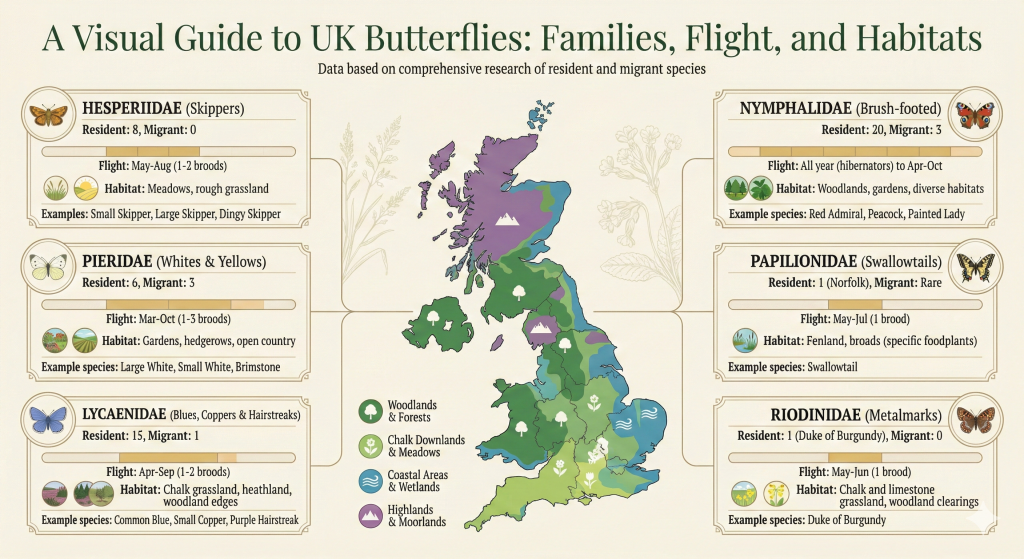
This report provides an exhaustive analysis of the 59 species currently recognized as part of the UK’s breeding fauna. Organized by biological family, the report synthesizes data on phenology (flight periods), voltinism (brood cycles), and geographical distribution. It integrates recent taxonomic revisions, such as the specific distinction of the Cryptic Wood White in Northern Ireland, and evaluates the resilience of these populations in an era of unprecedented environmental flux.
Continue reading “The Butterflies of the United Kingdom: A Comprehensive Ecological and Phenological Audit”