Tag: theology-hinduism


The Dhammapada: Canonical Verses on Buddhist Philosophy and Ethics

The Dhammapada is a foundational collection of Buddhist verses that outlines the psychological and ethical framework necessary for spiritual liberation. The central thesis is that human existence is fundamentally a product of thought; mental discipline is therefore the primary determinant of suffering or happiness. The text emphasizes earnestness (vigilance) as the path to immortality (Nirvana) and identifies thirst (desire/craving) as the root of all human bondage. To transcend the cycle of birth and decay, an individual must achieve absolute self-mastery, abandon worldly attachments, and follow the “Eightfold Way.” The document concludes that true holiness—exemplified by the Arhat or Brahmana—is defined not by birth or ritual, but by the complete extinction of passion and the attainment of profound inner quietude.
Continue reading “The Dhammapada: Canonical Verses on Buddhist Philosophy and Ethics”The Charioteer’s Guide to Radical Focus: 5 Timeless Lessons from the Bhagavad-Gita
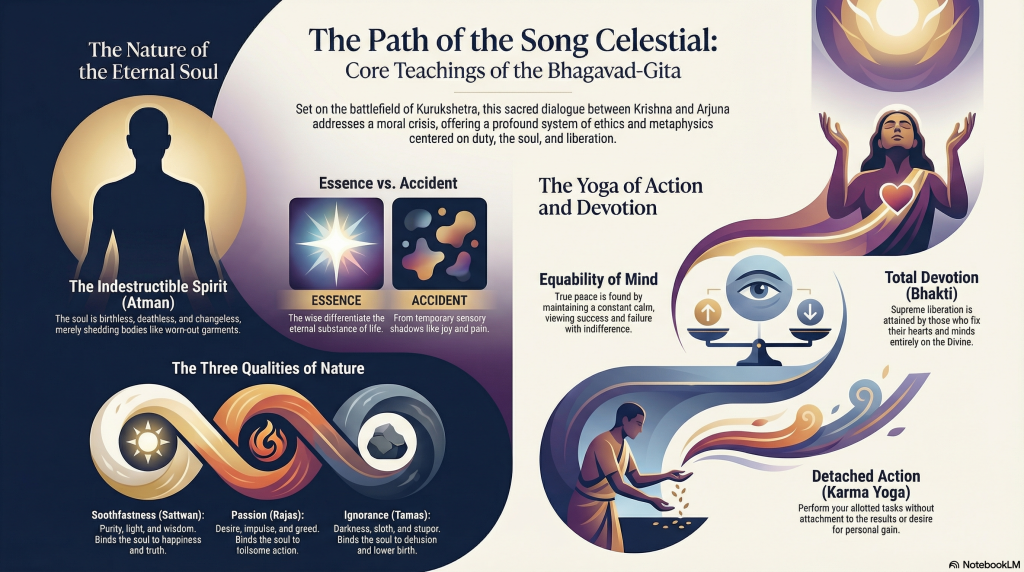
Introduction: The Battlefield of the Mind
In the modern era, we are frequently besieged by a “paralysis of choice.” We inhabit a world of infinite digital noise and existential overwhelm, where every decision feels weighted with the pressure of optimal outcomes and the crushing visibility of the “global village.” This internal friction is not a product of the internet age, but a fundamental human condition described vividly in the Bhagavad-Gita, a third-century dialogue set on the precipice of a great war.
The narrative opens on the battlefield of Kurukshetra, where the warrior-prince Arjuna stands paralyzed between two massive armies. Confronted with the prospect of fighting his own kinsmen, his “members fail” and his “life within seems to swim and faint.” Arjuna’s distress is a profound metaphor for our own inner conflicts—the moments when duty, desire, and doubt collide, leaving us frozen. His guide, the divine charioteer Krishna, responds not with simple platitudes, but with a rigorous philosophical framework for navigating life with clarity and a radical, detached focus.
Continue reading “The Charioteer’s Guide to Radical Focus: 5 Timeless Lessons from the Bhagavad-Gita”