
1. Background and Early Life
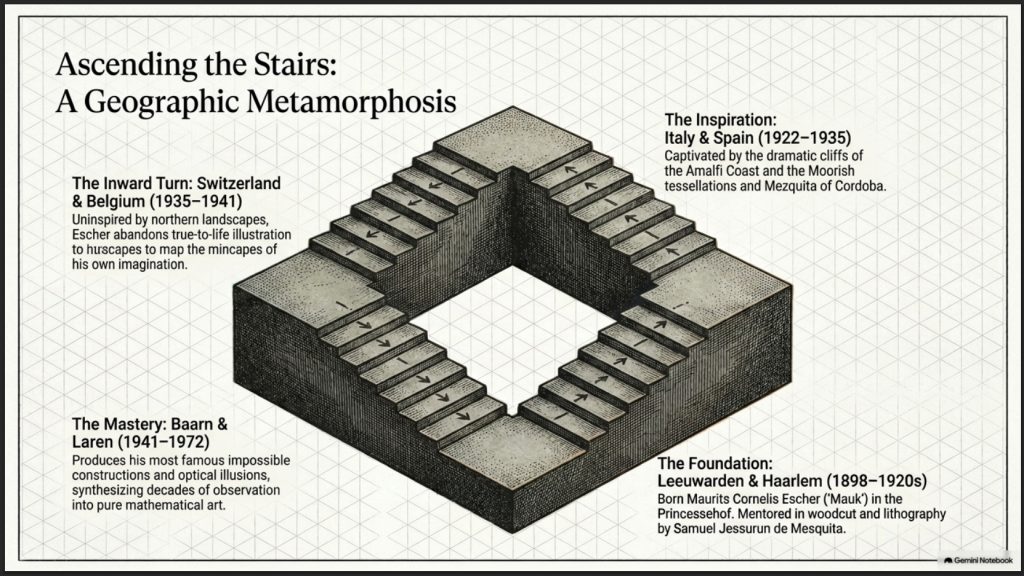
Maurits Cornelis Escher (1898–1972) occupies a distinct and somewhat paradoxical position in the history of twentieth-century visual culture. Born on June 17, 1898, in Leeuwarden, the capital of the Dutch province of Friesland, Escher was the youngest son of George Arnold Escher and his second wife, Sara Gleichman1. His father was a prominent civil and hydro-mechanical engineer who had spent years working on harbors and dams in Japan at the behest of the emperor1. Raised in a stately city palace known as the Princessehof, the young Escher—affectionately nicknamed “Mauk” by his family—grew up in an environment characterized by intellectual rigor, discipline, and upper-middle-class comfort1. It is highly probable that the influence of his father, whose profession required structural logic and precise drafting, laid the earliest subconscious foundations for Escher’s later obsession with spatial geometry.
Despite this privileged upbringing, Escher’s childhood was marked by physical fragility. A sickly constitution frequently kept him indoors, and in 1905, at the age of seven, he was sent to a children’s convalescent home in Zandvoort for an extended period to recover his strength1. This physical isolation forced the young boy to entertain himself through acute observation of his immediate surroundings, cultivating a meticulous eye for the structural anomalies of the physical world. His family encouraged a broad education; he took carpentry and piano lessons, and frequently used a telescope mounted on the flat roof of his home to observe the stars with his father1.
Academically, Escher struggled profoundly. After the family relocated to Arnhem in 1903, he attended secondary school but proved to be an unexceptional student. He was left-handed, highly intelligent, but socially perceived as an outsider3. Ultimately, he failed his final secondary school examinations in 19181. A persistent lack of aptitude for formal mathematics was particularly notable; Escher would later famously confess to having never received a passing grade in the subject4. Hoping to channel his son’s undeniable talent for drawing into a respectable profession, George Escher leveraged his connections to enroll Maurits at the Technical College of Delft in 1918 to study architecture1. However, recurring illness and a lack of passion for the rigid curriculum led to his swift departure before completing his first year1.
The pivotal turning point in Escher’s early development occurred in the autumn of 1919 when he transferred to the Haarlem School of Architecture and Decorative Arts. Although he initially enrolled in the architecture department to placate his parents, his graphic experiments caught the eye of Samuel Jessurun de Mesquita, a highly regarded graphic arts instructor and Jewish artist known for his bold, definitive style2. Recognizing an innate genius for printmaking, de Mesquita persuaded both Escher and his skeptical parents that the young man was “too good to waste his time on architectural drawings”1. Under de Mesquita’s mentorship, Escher mastered the unforgiving techniques of woodcut and linocut. These mediums require absolute precision, a flawless understanding of positive and negative space, and a high degree of forethought—skills that became the cornerstone of his mature aesthetic3. In 1922, he produced an early masterpiece of interconnectivity, Eight Heads, signaling his burgeoning interest in tessellating forms10.
Following his graduation in 1922, Escher embarked on extensive recuperative and educational travels through Italy and Spain. The Mediterranean landscape, with its intense light, dramatic coastal cliffs, and cascading hilltop towns, captivated him8. Settling in Rome in 1923, he met Jetta Umiker, whom he married in 1924, and the couple subsequently had three sons6. For the next decade, Escher operated primarily as an observational landscape artist. He spent his springs hiking through the desolate, rugged terrains of Tuscany, Calabria, and the Amalfi Coast, executing meticulously detailed sketches that he later transformed into lithographs and woodcuts in his studio3. These early works, though lacking the impossible geometry of his later output, demonstrate an emerging fascination with unusual perspectives, plunging viewpoints, and the structural interplay between natural rock formations and human architecture8.
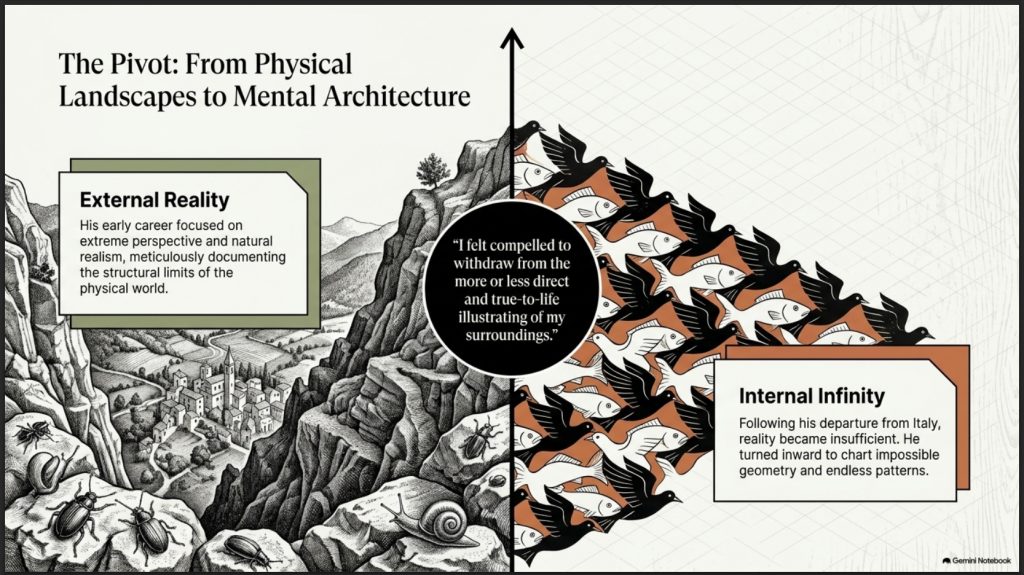
The trajectory of Escher’s art was forcibly altered by geopolitical instability. The rise of Benito Mussolini’s fascist regime in Italy created a stifling and increasingly dangerous atmosphere, prompting the Escher family to flee to Château-d’Oex, Switzerland, in 19357. Denied the beloved Italian landscapes that had fueled his inspiration, and finding the Swiss snowscapes visually unstimulating, Escher turned his creative gaze inward. To escape the high cost of living and the unfavorable climate, Escher brokered a deal with the Adria shipping company, trading original prints for passage on a Mediterranean freighter, allowing him to revisit Southern Europe and Spain7. Following this, the family moved to Belgium in 1937, and finally, driven by the German invasion during World War II, settled permanently in Baarn, the Netherlands, in 19416.
This period of geographical dislocation and eventual internal exile forced him to transition from observing the external world to exploring the “landscapes of the mind,” marking the genesis of his signature style: the exploration of mathematical theory, rational symmetry, and impossible architectures6.
2. Core Beliefs and Philosophy
To analyze Escher’s oeuvre is to deconstruct a worldview predicated on the tension between order and chaos, reality and illusion, and the empirical versus the intuitive. At the heart of Escher’s philosophy was a profound reverence for the underlying laws of the universe, which he viewed not as human inventions, but as eternal truths waiting to be perceived by a receptive mind.
Order, Chaos, and the Jigsaw Puzzle of Existence
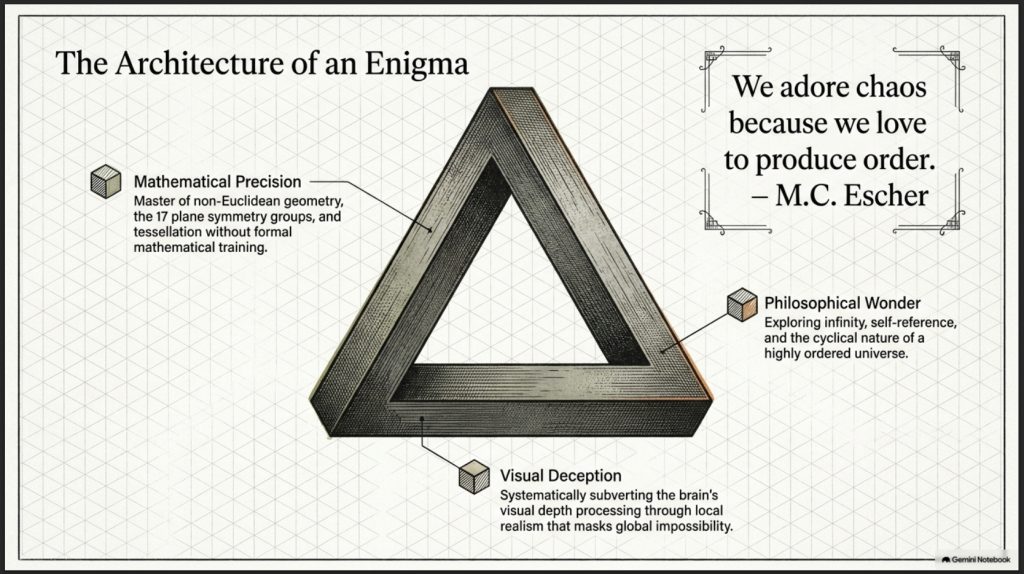
Escher’s graphic output was driven by a deep-seated psychological need to impose structure on a seemingly entropic universe. He viewed his art as a means of testifying that “we live in a beautiful and orderly world, and not in a formless chaos, as it sometimes seems”4. He articulated this binary relationship succinctly: “We adore chaos because we love to produce order”13.
His fascination with paradoxes and infinity was not merely an exercise in clever optical trickery; it was a rigorous philosophical inquiry into the limitations of human perception. Escher was deeply skeptical of sensory data, constantly questioning the epistemological foundations of reality. “As far as I know, there is no proof whatever of the existence of an objective reality apart from our senses, and I do not see why we should accept the outside world as such solely by virtue of our senses,” he wrote15. This inherent skepticism allowed him to manipulate the “irrefutable certainties” of the physical world, playfully mixing two- and three-dimensionality and mocking the laws of gravity15. If reality is merely a construct of the senses, Escher posited, then a two-dimensional representation of a three-dimensional impossibility is just as valid a construct. He famously stated, “Are you really sure that a floor can’t also be a ceiling?”13.
The Mathematician vs. The Artist: A Crisis of Categorization
Perhaps the most enduring paradox of Escher’s life was his self-perception. He was an artist who felt profoundly alienated from the contemporary art world, yet he became an icon of the exact sciences despite lacking formal mathematical training. Escher constantly grappled with the classification of his own work, admitting, “For me it remains an open question whether [this work] pertains to the realm of mathematics or to that of art”4.
He openly acknowledged his scientific shortcomings, stating, “By keenly confronting the enigmas that surround us, and by considering and analyzing the observations that I had made, I ended up in the domain of mathematics. Although I am absolutely without training in the exact sciences, I often seem to have more in common with mathematicians than with my fellow artists”4. Escher viewed mathematicians as individuals who had “opened the gate leading to an extensive domain,” but criticized them for being more interested in the mechanics of the gate than the beauty of the garden that lay behind it5. Where mathematicians used abstract formulas and notebooks, Escher preferred to use a canvas to find solutions visually, translating the geometry of space into aesthetic experiences16. He likened science and art to two pieces of a jigsaw puzzle representing human life, suggesting that true clarity is achieved only when contact is made across the borderline of those respective domains4.
Despite his intellectual detachment and the cerebral nature of his prints, Escher approached his work with intense emotional devotion and a childlike sense of wonder. He did not view his prints as sterile geometric proofs, but as expressions of profound beauty. “The things I want to express are so beautiful and pure,” he stated, driven by a desire to communicate his internal wonder to the outside world13. He viewed his meticulous, exhaustive labor as a “very serious game”13. His philosophy was ultimately one of humble curiosity and cosmic aspiration, summarizing his drive by stating, “So let us then try to climb the mountain, not by stepping on what is below us, but to pull us up at what is above us, for my part at the stars; amen”13.
3. Influences
Escher’s artistic evolution was catalyzed by a unique confluence of geographical, historical, and intellectual influences. Because his work straddled multiple disciplines, his primary inspirations were distinctly unmoored from the prevailing artistic movements of his time.
The following primary influences fundamentally shaped his output:
- Moorish Architecture and the Alhambra: The single most transformative experience in Escher’s artistic development was his exposure to Moorish architecture during his travels in Spain. He first visited the Alhambra in Granada in 1922 and returned for an extended, obsessive study in 1936 alongside his wife7. Escher was mesmerized by the intricate majolica tiles and the complex, interlocking geometric patterns that adorned the walls and ceilings7. Because Islamic artistic tradition prohibited the depiction of sentient beings in architectural decoration, the Moors relied exclusively on abstract geometric polygons to achieve the “regular division of the plane”11. Escher recognized the structural genius of these tessellations but felt a driving need to push the concept further. “What a pity the Moors didn’t use figures derived from nature,” he lamented11. Using the Moorish grids as a foundational blueprint, Escher began substituting abstract polygons with recognizable motifs: birds, fish, reptiles, and human figures, marking the birth of his signature animate tessellations10.
- George Pólya and Mathematical Symmetry Groups: While Escher claimed ignorance of theoretical mathematics, his work was heavily shaped by scientific literature passed to him by his half-brother, Berend George Escher, a professor of geology and crystallography at the University of Leiden1. Berend directed Escher toward an academic paper published in 1924 by the Hungarian mathematician George Pólya17. Pólya’s paper on plane symmetry groups contained illustrations of the 17 possible “wallpaper groups”—the mathematical classification of all possible two-dimensional repeating patterns based on their symmetries, rotations, reflections, and glide reflections18. Although Escher could not comprehend the dense algebraic formulas, he intuitively grasped the geometric principles depicted in the illustrations.
- Friedrich Haag and Heinrich Heesch: Through crystallographic literature, Escher was also exposed to the work of Friedrich Haag and later paralleled the discoveries of German mathematician Heinrich Heesch20. Heesch proved in 1932 that there are exactly 28 ways to tile a plane using asymmetric tiles (now known as Heesch types)21. Escher, working in isolation, independently deduced many of these rules. Between 1941 and 1942, Escher produced exhaustive notebooks in which he systematically codified his own empirical theory of the regular division of the plane, effectively mirroring the discoveries of academic crystallographers and creating his own classification system for periodic drawings17.
- The Natural World and Macro/Micro Observation: Early in his career, Escher drew profound inspiration from nature, making intense studies of insects, landscapes, and plants such as lichens20. He possessed a hyper-focused ability to observe the structural architecture of biological forms. “I want to enjoy the tiniest details… With your nose right on top of [a small plant] you see all of its beauty and all of its simplicity. But when you start drawing only then do you realise how terribly complicated and shapeless that beauty really is,” he noted11. This macro/micro observation informed his later morphological transformations, where geometric grids seamlessly evolve into biological entities.
- Isolation from Contemporary Art Movements: It is equally important to define Escher by what did not influence him. Operating in the early to mid-twentieth century, Escher lived through the avant-garde explosions of Cubism, Surrealism, and Abstract Expressionism. Yet, he remained entirely insulated from these currents22. While a superficial viewing of Escher’s impossible architectures might suggest an affinity with Surrealism—which also manipulated reality—the underlying philosophies were diametrically opposed. Surrealists like Salvador Dalí and René Magritte sought to liberate the subconscious, embracing irrationality, dreams, and psychological automatism. Escher, conversely, was singularly focused on hyper-rationality, mathematical necessity, and rigid geometric logic22. His refusal to align with any manifesto or movement left him isolated, but it ensured his visual language remained entirely idiosyncratic22.
4. Significant Works
Escher’s mature output is characterized by explorations of infinity, strange loops, non-Euclidean geometry, and spatial paradoxes. His prints are meticulously constructed visual arguments that force the viewer’s brain to reconcile the impossible. During his lifetime, he produced 448 lithographs, woodcuts, and wood engravings, alongside over 2,000 drawings and sketches7.
The table below outlines a selection of his most critical works, categorized by their primary themes and structural mechanics.
| Title | Year | Primary Theme | Brief Analytical Description |
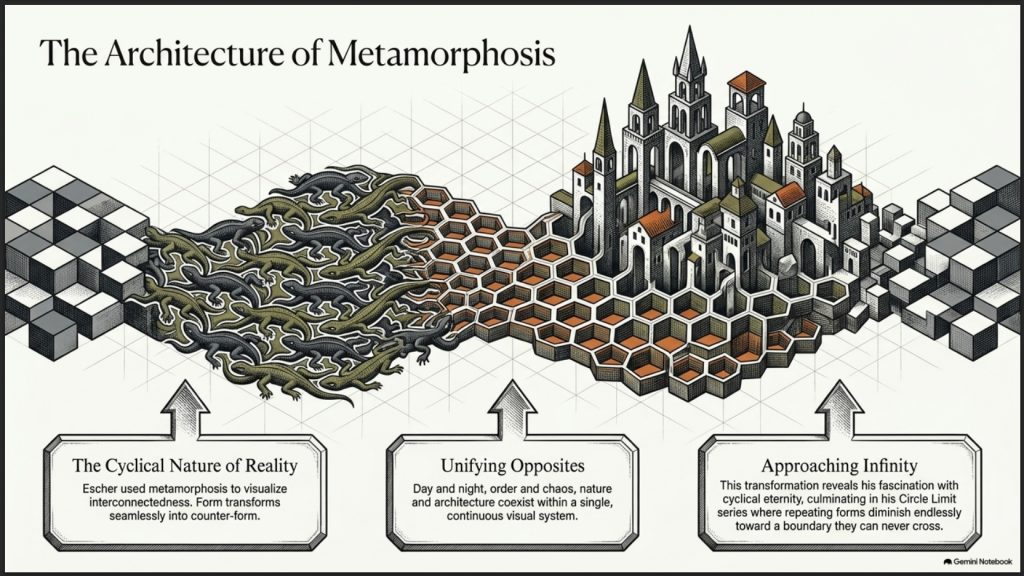
| Sky and Water I | 1938 | Tessellation / Figure-Ground Reversal | A masterful woodcut illustrating the regular division of the plane. Birds in the sky morph seamlessly into fish in the water. The transition relies on figure-ground organization; as the eye moves vertically, the negative space defining the birds solidifies to become the positive space of the fish, and vice versa. It represents the interconnectedness of opposing natural elements22. |
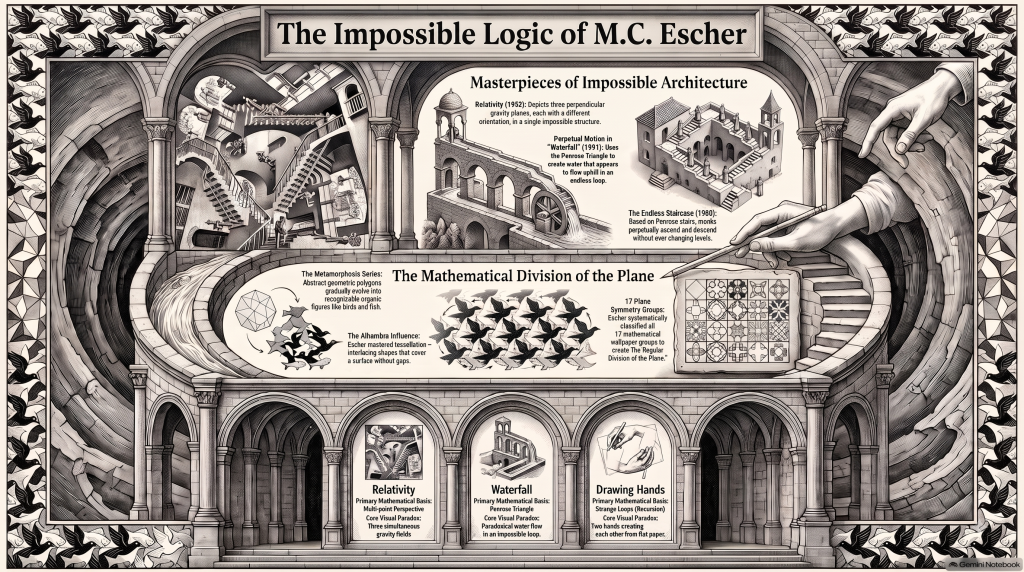
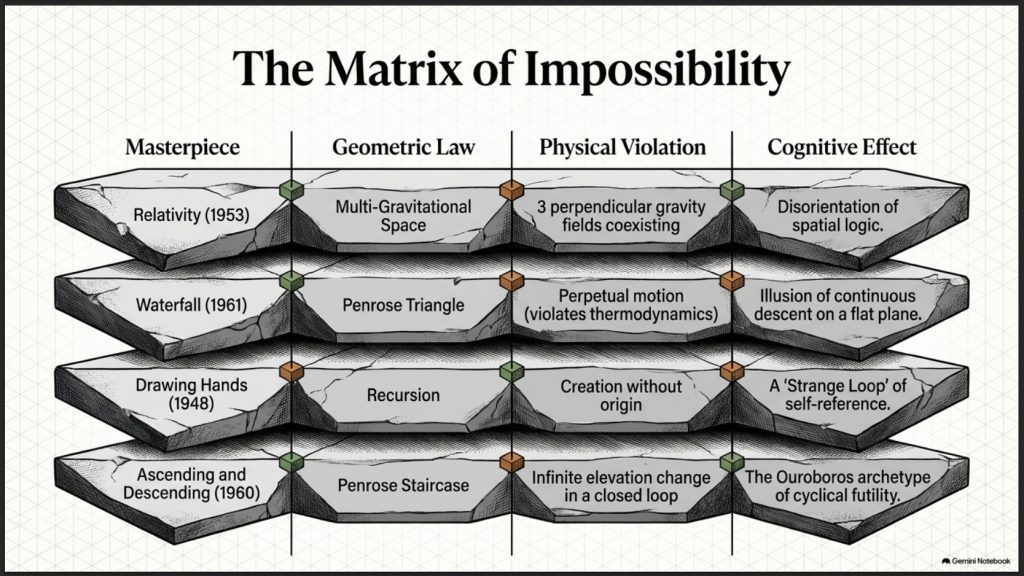
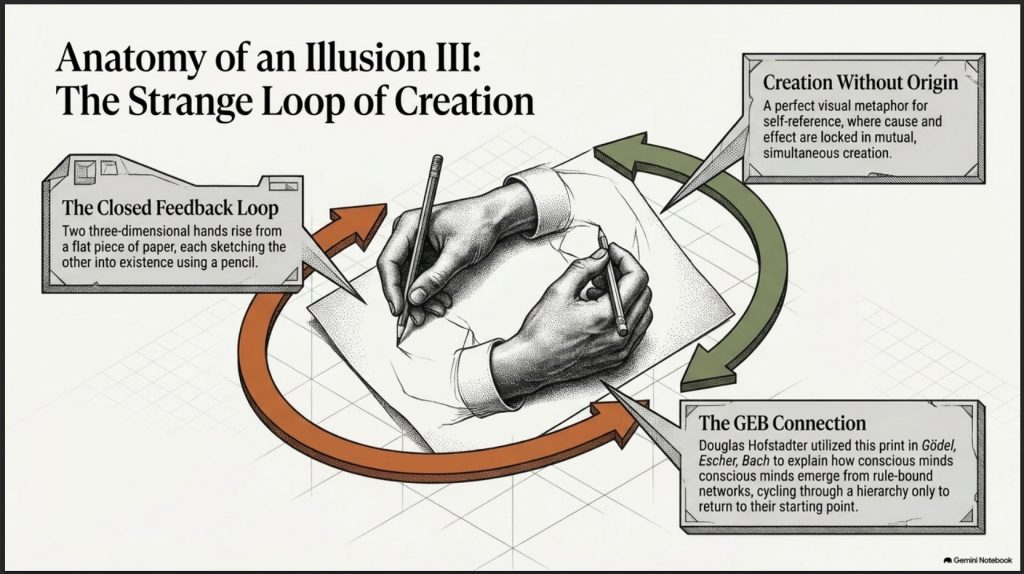
| Drawing Hands | 1948 | Strange Loops / Ontological Paradox | A lithograph depicting a sheet of paper from which two hyper-realistic, three-dimensional hands emerge. The left hand draws the right hand, while the right hand draws the left. The piece visually manifests a “strange loop” or infinite regress, challenging the hierarchy of creator and creation. The sleeves remain two-dimensional, anchoring the illusion to the flat surface of the paper5. |
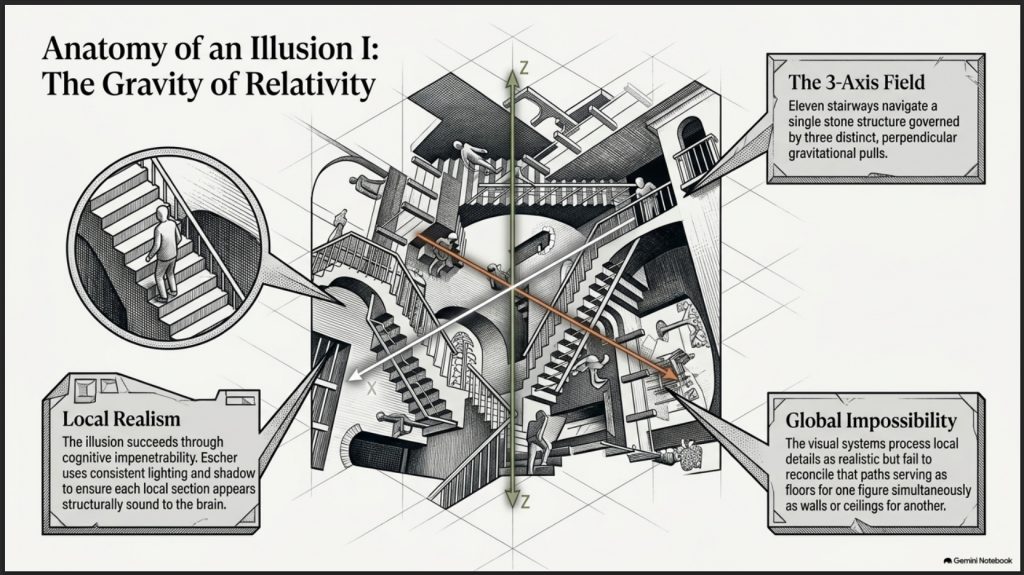
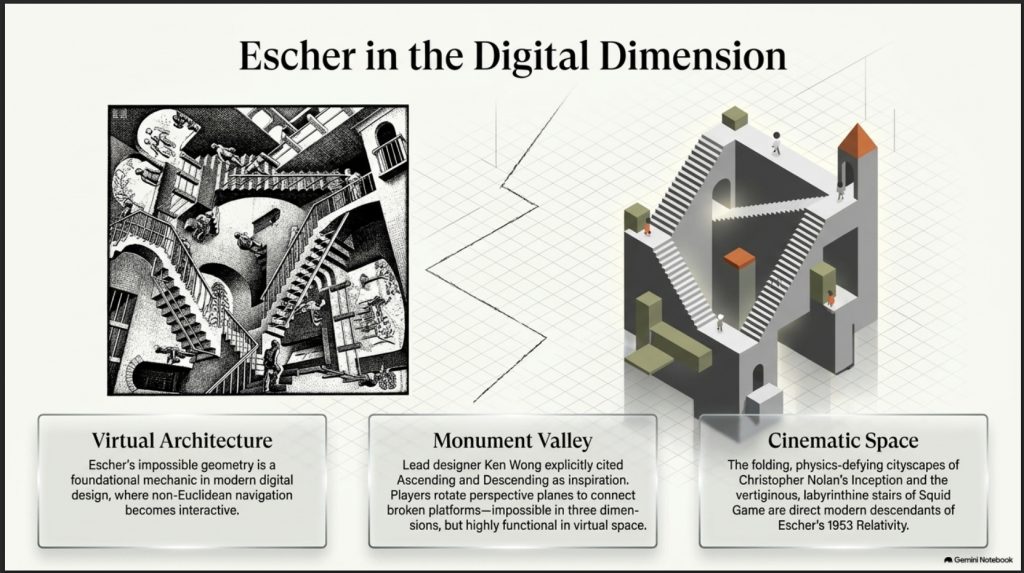
| Relativity | 1953 | Impossible Geometry / Polycentric Gravity | A lithograph presenting a world where normal laws of gravity do not apply. The architectural structure features three distinct sources of gravity, occupied by faceless inhabitants going about mundane tasks. Characters on the same staircase may be walking on different planes of existence (one on the top of the step, another on the underside), completely unaware of each other due to their differing orientations5. |
| Print Gallery | 1956 | Droste Effect / Conformal Mapping | A lithograph showing a young man in a gallery looking at a print of a seaport. The seaport expands to contain the very gallery the man is standing in, creating an infinite, self-referential loop (the Droste effect). Escher achieved this by drawing the image on a grid that undergoes a continuous circular expansion. He left a blank white void in the center, struggling to resolve the singularity27. |
| Circle Limit III | 1959 | Hyperbolic Geometry / Infinity | A colored woodcut based on the Poincaré disk model of the hyperbolic plane. Strings of fish shrink infinitely as they approach the outer boundary of the circle, yet in hyperbolic space, they are all mathematically identical in size. The lines along which the fish swim meet the boundary at approximately 80-degree angles, demonstrating equidistant curves rather than straight hyperbolic lines29. |
| Ascending and Descending | 1960 | Impossible Staircase / Visual Paradox | Based on the “Penrose stairs,” this lithograph depicts a monastery where two lines of monks walk perpetually on a closed-loop staircase. One row ascends eternally while the other descends, yet they never elevate or lower in actual vertical space. The image exploits local perspective consistency to mask a global structural impossibility23. |
Deep Analytical Review: The Mathematical Rigor of Escher’s Art
The depth of Escher’s intuitive mathematical grasp is best illustrated by the retroactive academic analysis applied to his works, particularly Print Gallery and Circle Limit III.
Conformal Mapping in Print Gallery (1956)
In Print Gallery, Escher sought to create an annular bulge—a cyclic expansion without beginning or end27. To achieve this, he intuitively mapped a straight Cartesian grid onto a spiraling, curved grid to prevent the buildings from becoming overly distorted, a process mathematicians recognize as a “conformal map” (a transformation that locally preserves angles)28. Because Escher could not resolve the infinite spiral at the absolute center where the mathematical singularity occurs, he left a blank white spot bearing his signature27.
For decades, the void remained a mystery, until 2003 when mathematicians Hendrik Lenstra and Bart de Smit utilized the theory of elliptic curves over the field of complex numbers to solve Escher’s puzzle27. They recognized that the Escher picture is periodic with a period “g”, living on the mathematical structure C*/g(z) . By applying a complex logarithm, they transformed the underlying multiplicative groups into additive ones. Through this complex geometric analysis, they determined that the image contains a perfect copy of itself (the Droste effect) rotated clockwise by precisely 157.63 degrees and shrunk by a factor of 22.5827. This discovery allowed them to write a computer algorithm to digitally “complete” the void Escher left behind, proving that the artist’s visual intuition had perfectly executed a highly advanced mathematical theorem33.
Hyperbolic Geometry in Circle Limit III (1959)
Circle Limit III represents Escher’s mastery of non-Euclidean geometry. Using the Poincaré disk model—where the entire infinite hyperbolic plane is mapped inside a finite circle—Escher drew strings of fish that shoot up from the boundary and fall back again, shrinking infinitely as they approach the edge29. While the fish appear to change size to the Euclidean observer, in the hyperbolic plane, they are all mathematically identical in size30.
Escher executed this woodcut with agonizing precision. The work required five distinct wood blocks to produce four separate colors (plus black outlines), requiring 20 total impressions per print to ensure that each string of fish maintained a single color and that no two adjacent fish shared the same color29. Escher believed the white backbones of the fish represented straight hyperbolic lines. However, straight lines in the Poincaré model must meet the bounding circle orthogonally (at 90 degrees)30. The mathematician H.S.M. Coxeter later proved that Escher had intuitively drawn hypercycles (equidistant curves, the hyperbolic analog of small circles of latitude in spherical geometry), which meet the boundary at approximately 80 degrees—specifically, “cos(-1)((2(1/4)-2(-1/4))/2) 29. The precision of Escher’s woodcut was so exact that it provided a visually flawless representation of a mathematical model that he only understood on a purely aesthetic and empirical level.
5. Collaborations and Correspondences
Though socially reticent and entirely unaligned with the fine art establishment, Escher engaged in rich, symbiotic correspondences with some of the leading mathematical and scientific minds of the 20th century. These relationships elevated his work from clever illustration to profound geometric visualization.
H.S.M. Coxeter and the Visualization of Infinity
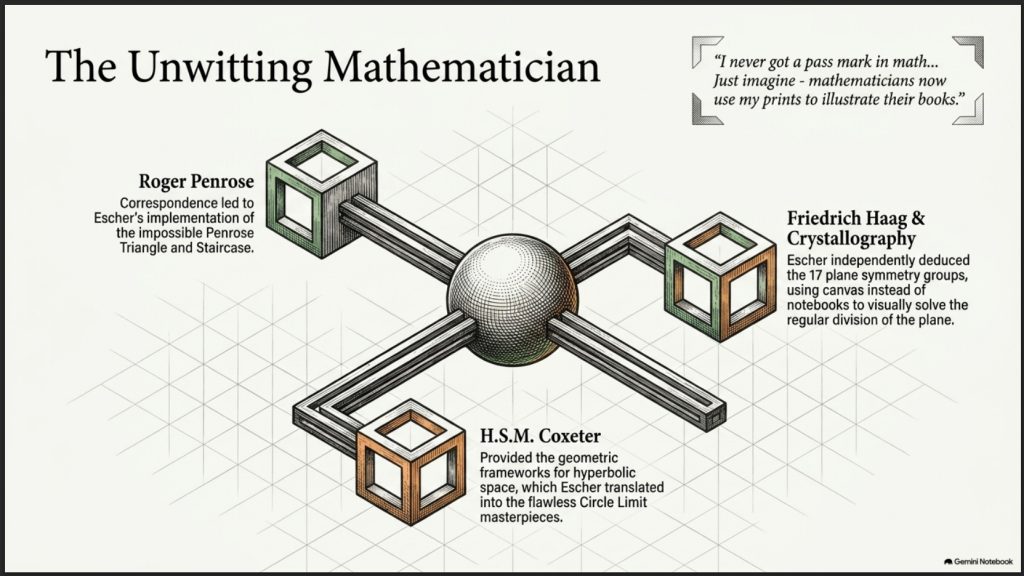
The relationship between Escher and the Canadian geometer Donald (H.S.M.) Coxeter was highly mutually beneficial. After meeting at the International Congress of Mathematicians in Amsterdam in 1954, Coxeter sent Escher a reprint of his paper, “Crystal Symmetry and its Generalizations,” in 195829. The paper contained an illustration of a tessellation of the hyperbolic plane by right triangles with angles of 30°, 45°, and 90°—a geometric impossibility in Euclidean space29.
Escher later wrote to Coxeter that the figure “gave me quite a shock,” as it provided the exact framework he needed to depict infinity within a finite boundary39. This single academic paper inspired Escher’s four Circle Limit works30. Escher sent his first attempt, Circle Limit I, to Coxeter, harshly criticizing his own work for lacking “continuity,” “traffic flow,” and “unity of colour in each row”35. Coxeter responded with encouragement and further mathematical insights regarding systems denoted by [p,q], which Escher utilized to perfect the mechanics in Circle Limit III, a piece the Dutch physicist Bruno Ernst later called “the best of the four”29. In a striking reversal of roles, Coxeter subsequently authored multiple academic papers analyzing the mathematics underlying Escher’s Circle Limit III, demonstrating how the artist’s visual intuition had perfectly captured the complexities of hyperbolic tessellation30.
Roger Penrose and Impossible Objects
In the 1950s, the British mathematician (and future Nobel laureate) Roger Penrose attended an exhibition of Escher’s work. Inspired by Escher’s manipulation of space, Penrose and his father, the geneticist Lionel Penrose, formulated and published a paper in the British Journal of Psychology detailing “impossible objects”—specifically, the Penrose triangle (or tribar, constructed from three 90-degree angles in an impossible configuration) and the Penrose stairs (a continuously ascending/descending loop)23.
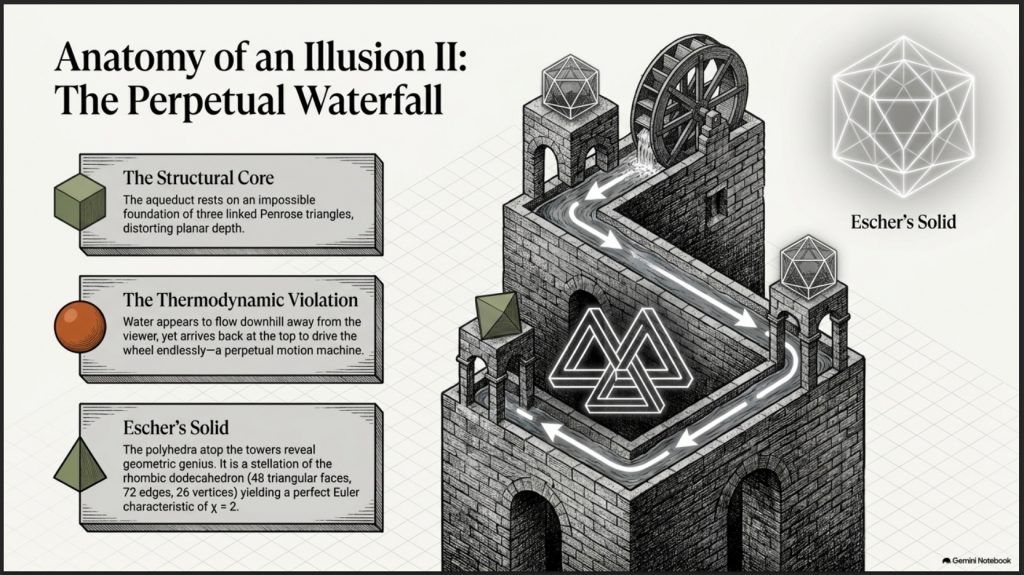
Penrose sent a copy of the paper to Escher, sparking a wave of inspiration in the artist. The collaboration resulted directly in two of Escher’s most famous impossible architectures. Ascending and Descending (1960) explicitly utilizes the Penrose stairs to depict monks trapped in an infinite loop of labor23. Waterfall (1961) stacks three Penrose triangles to create a closed system where water seemingly flows uphill to turn a mill wheel20. Escher’s genius lay in hiding the geometric impossibility within a highly realistic, heavily textured rendering of masonry and water, forcing the brain to accept the illusion as reality through localized perspective tricks12.
Caroline MacGillavry and the Bridge to Crystallography
The formal integration of Escher’s work into the scientific community was solidified by the Dutch crystallographer Caroline H. MacGillavry. Upon meeting Escher in 1959, she recognized that his periodic drawings were a perfect visual analog for crystal symmetry and the 17 wallpaper groups40. She arranged for him to exhibit his lithographic works at the International Union of Crystallography (IUCr) Congress in Cambridge in 196040.
The exhibition was a massive success, leading the IUCr to commission MacGillavry to author the book Symmetry Aspects of M.C. Escher’s Periodic Drawings, published in 196540. The text rigorously analyzed 41 of Escher’s tessellations using international crystallographic notation, assigning symbols like “p3m1” or “p4g” to his artworks21. She demonstrated how Escher had exploited extensions to color symmetry long before mathematicians had officially recognized and classified them40. MacGillavry’s book bridged the gap between Escher’s isolated studio and the global scientific academy, ensuring his enshrinement as a pioneer of visual mathematics and providing an invaluable pedagogical tool for chemistry and physics students42.
6. Legacy and Influence
For the majority of his life, Escher was systematically ignored or derided by the fine art establishment. Mid-century art criticism, dominated by figures like Clement Greenberg, championed the raw, emotional abstraction of artists like Jackson Pollock and Mark Rothko, prizing physical gestural brushstrokes over rigid design24. In this climate, Escher’s calculated, narrative, and highly structured prints were dismissed as sterile, old-fashioned “illustrations” or the mere “result of a game of tic-tac-toe”24. Because he operated in the mass-produced mediums of lithography and woodcut rather than the prestigious medium of oil paint, art historians frequently omitted him from canonical texts24. He did not receive a major retrospective exhibition in his native Netherlands until 1968, when he was seventy years old20.
Yet, Escher’s insistence on operating outside the traditional art historical canon secured him a legacy that is arguably broader and more interdisciplinary than any of his contemporaries. His impact spans multiple domains:
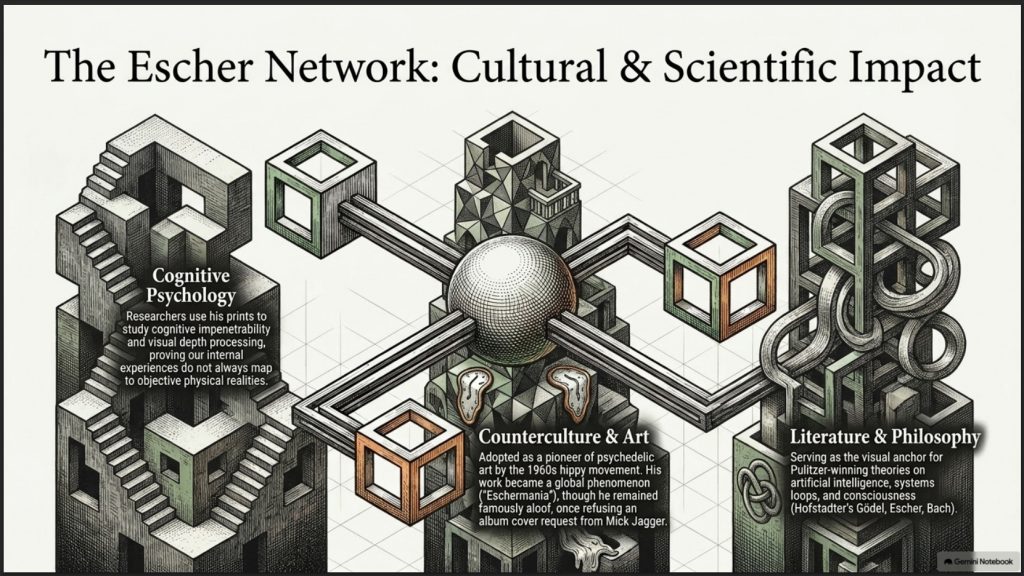
- Mathematics and Crystallography: Escher’s empirical explorations of the regular division of the plane predated or paralleled several mathematical discoveries regarding color symmetry. Following MacGillavry’s seminal text, mathematician Doris Schattschneider published M.C. Escher: Visions of Symmetry in 1990, exhaustively analyzing Escher’s 1941–1942 notebooks and securing his status as a pioneer in geometry17. His artworks remain ubiquitous in mathematics and physics textbooks worldwide as the premier visual aids for teaching the 17 wallpaper groups, non-Euclidean geometry, and transformational isometries (translations, reflections, glide reflections, and rotations)4.
- Cognitive Psychology and Visual Perception: Psychologists and neuroscientists heavily utilize Escher’s impossible figures and figure-ground reversals (such as Sky and Water I) to study how the human visual system processes depth, perspective, and edge-detection. His work vividly demonstrates the brain’s hard-wired tendency to impose three-dimensional coherence on two-dimensional data, even when that coherence is logically impossible22.
- Computer Science and Algorithmic Art: Long before the advent of computer graphics, Escher was essentially functioning as a human algorithm, applying strict, rule-based transformations to generate visual outputs. Today, his principles are foundational in computer-aided design (CAD), procedural generation, fractal exploration, and digital tessellation software (such as Artlandia and TesselManiac)21.
- Graphic Design and Architecture: Escher’s seamless tiling and manipulation of vanishing points have profoundly influenced modern architectural renderings, textile design, and typography. His ability to fuse decorative art with rigid geometry established a template for commercial graphic design, proving that logical constraints could yield endless creative variations22.
- Modern Pop Culture: In the late 1960s, Escher was unexpectedly embraced by the counterculture, hippie, and psychedelic movements, much to his own bemusement3. His prints were published in fluorescent versions on the American market, though he rejected the characterization of his work as “Op Art” and famously declined a request from Mick Jagger to design a Rolling Stones album cover3. His visual language continues to permeate pop culture, most notably inspiring the folding cityscapes and infinite Penrose staircases in Christopher Nolan’s film Inception, the puzzle mechanics of video games like Monument Valley, and countless homage pieces in graphic novels and animation31.
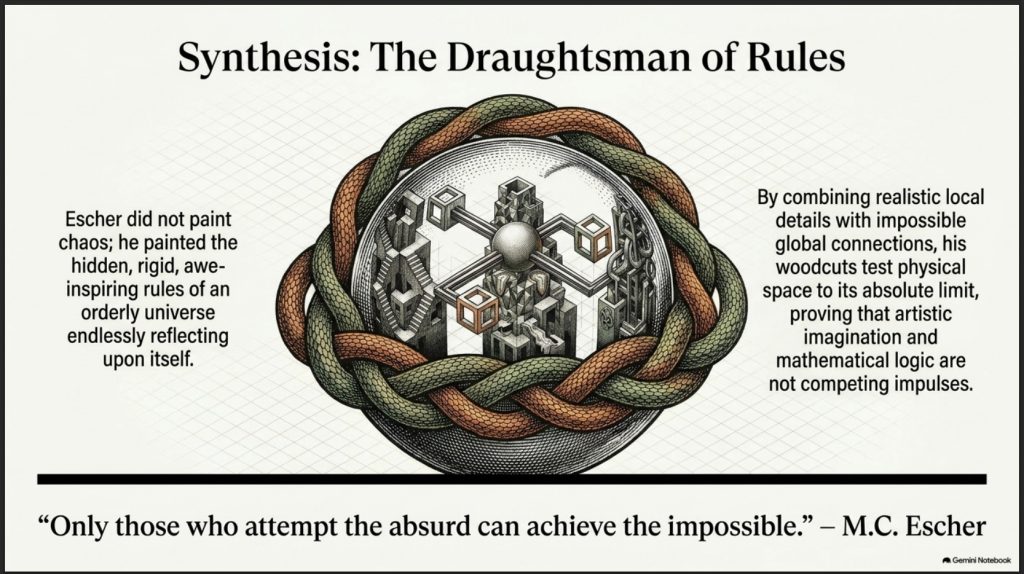
Maurits Cornelis Escher stands as a singular figure who successfully dismantled the artificial boundary between the subjective beauty of art and the objective rigor of mathematics. While art critics of his era penalized him for his intellectualism, history has vindicated his approach. By rendering the abstract laws of the universe into tangible, breathtaking visual paradoxes, Escher provided humanity with a new vocabulary for seeing, comprehending, and wondering at the architecture of infinity.

Works cited
- The life of Escher, https://escherinhetpaleis.nl/en/about-escher/the-life-of-escher
- Early Years – Find out about Maurits Cornelis Escher, his live and his works., https://mcescher.com/about/biography/
- Timeline | Museum Escher in The Palace, https://escherinhetpaleis.nl/en/about-escher/timeline
- M. C. Escher Quotes About Mathematics, https://www.azquotes.com/author/4555-M_C_Escher/tag/mathematics
- Maurits Cornelis Escher’s quotes about order and chaos, wonders and boundaries, art and science | Arthive, https://arthive.com/publications/3464~Maurits_Cornelis_Eschers_quotes_about_order_and_chaos_wonders_and_boundaries_art_and_science
- M.C. Escher Biography | Annex Galleries Fine Prints, https://www.annexgalleries.com/artists/biography/3377
- M. C. Escher | History | Research Starters – EBSCO, https://www.ebsco.com/research-starters/history/m-c-escher
- M.C. Escher: a guide to the ‘mindscapes’ of the artist – Christie’s, https://www.christies.com/en/stories/m-c-escher-collecting-guide-0801512f6553478fa0404f6ae511d5bf
- Maurits Escher (1889-1972) – CODART, https://www.codart.nl/guide/agenda/maurits-escher-1889-1972/
- Maurits Escher: Learn About His Childhood, Artistic Formation, and Early Works, https://arteeartistas.com.br/biography-of-maurits-cornelis-escher-childhood-education-and-the-quest-for-infinity-en
- MC Escher: ‘Only Those Who Attempt the Absurd will Achieve the Impossible – Jim Carroll’s Blog, https://www.jimcarrollsblog.com/blog/2022/5/26/85fxsaxe7usqe5vmgqsthzm4gfzecw
- The Influence of the Perspectives of M.C. Escher | by Vinayaka Sanganeria – Medium, https://vinsmusings.medium.com/the-influence-of-the-perspectives-of-m-c-escher-38bd8160a6
- M. C. Escher – Quote Unquote – WordPress.com, https://quoteunquote2016.wordpress.com/2016/06/18/m-c-escher/
- Quotes M.C. Escher, https://mcescher.com/about/quotes/
- M. C. Escher – Wikiquote, https://en.wikiquote.org/wiki/M._C._Escher
- M.C. Escher: Math Quotes. Elearning – GoGeometry, https://gogeometry.com/math_geometry_quotes/escher_math_quote.html
- M. C. Escher: Visions of Symmetry – Wikipedia, https://en.wikipedia.org/wiki/M._C._Escher:_Visions_of_Symmetry
- Wallpaper Groups | Diagonal Argument, https://diagonalargument.com/2020/04/26/wallpaper-groups/
- (PDF) Frieze and Wallpaper Symmetry Groups Classification under Affine and Perspective Distortion – ResearchGate, https://www.researchgate.net/publication/2596375_Frieze_and_Wallpaper_Symmetry_Groups_Classification_under_Affine_and_Perspective_Distortion
- M. C. Escher – Wikipedia, https://en.wikipedia.org/wiki/M._C._Escher
- Tessellation Classification – Tiled.art, https://tiled.art/en/symmetryClassification/
- M. C. Escher: The Artist Who Redefined Perception – Squint Magazine, https://www.squintmagazine.com/post/m-c-escher-the-artist-who-redefined-perception
- The impossible world of MC Escher | Art and design – The Guardian, https://www.theguardian.com/artanddesign/2015/jun/20/the-impossible-world-of-mc-escher
- Why is MC Escher absent from so many art history books? – Quora, https://www.quora.com/Why-is-MC-Escher-absent-from-so-many-art-history-books
- M.C. Escher: Life and Art Insights | PDF – Scribd, https://www.scribd.com/document/875855993/Chapter-22-the-London-Eye-Mystery
- Drawing Hands | Museum Escher in The Palace, https://escherinhetpaleis.nl/en/about-escher/masterpieces/drawing-hands
- Print Gallery (M. C. Escher) – Wikipedia, https://en.wikipedia.org/wiki/Print_Gallery_(M._C._Escher)
- M.C. Escher: More Mathematics Than Meets the Eye – Impossible world, https://im-possible.info/english/articles/escher_printgallery/
- Circle Limit III – Wikipedia, https://en.wikipedia.org/wiki/Circle_Limit_III
- A “Circle Limit III” Calculation – University of Minnesota Duluth, https://www.d.umn.edu/~ddunham/dunbrid07.pdf
- Impossible staircase – Sketchplanations, https://sketchplanations.com/impossible-staircase
- Tententoon — Project | Code Myriad, http://codemyriad.io/projects/05-tententoon
- How mathematician Hendrik Lenstra completed an unfinished artwork by Escher – Universiteit Leiden, https://www.universiteitleiden.nl/en/news/2020/04/how-mathematician-hendrik-lenstra-completed-an-unfinished-artwork-by-escher
- The mathematics behind the Droste effect. This article uses jsMath which requires Java., https://www.josleys.com/article_show.php?id=82
- The Non-Euclidean Symmetry of Escher’s Picture ‘Circle Limit III, https://alfa.im.pwr.edu.pl/~zak/Coxeter_about_Escher.pdf
- Gallery : Hyperbolic Escher, https://www.josleys.com/show_gallery.php?galid=325
- The Geometric Viewpoint | Tessellations of the Hyperbolic Plane and M.C. Escher, https://web.colby.edu/thegeometricviewpoint/2016/12/21/tessellations-of-the-hyperbolic-plane-and-m-c-escher/
- M. C. Escher’s Association with Scientists – The Bridges Archive, https://archive.bridgesmathart.org/2000/bridges2000-45.pdf
- More “Circle Limit III” Patterns – The Bridges Archive, https://archive.bridgesmathart.org/2006/bridges2006-451.pdf
- Symmetry aspects of M. C. Escher’s periodic drawings – Wikipedia, https://en.wikipedia.org/wiki/Symmetry_aspects_of_M._C._Escher%27s_periodic_drawings
- Symmetry Aspects of M. C. Escher’s Periodic Drawings by Caroline H. Macgillavry (review) – Project MUSE, https://muse.jhu.edu/article/596738/summary
- (IUCr) Symmetry Aspects of M.C.Escher’s Periodic Drawings, https://journals.iucr.org/paper?S0567740876008753
- (IUCr) Symmetry aspects of M. C. Escher’s periodic drawings, https://www.iucr.org/publications/iucr/escherbook
- Escher versus art criticism, https://escherinhetpaleis.nl/en/about-escher/escher-today/escher-versus-art-criticism
- The Plane Symmetry Groups: Their Recognition and Notation – University of York, https://www.york.ac.uk/depts/maths/histstat/symmetry/schattschneider.pdf
- Wallpaper Groups — from Wolfram MathWorld, https://mathworld.wolfram.com/WallpaperGroups.html
