
Petrochemical Genesis and Thermodynamics of Volcanic Amorphous Materials
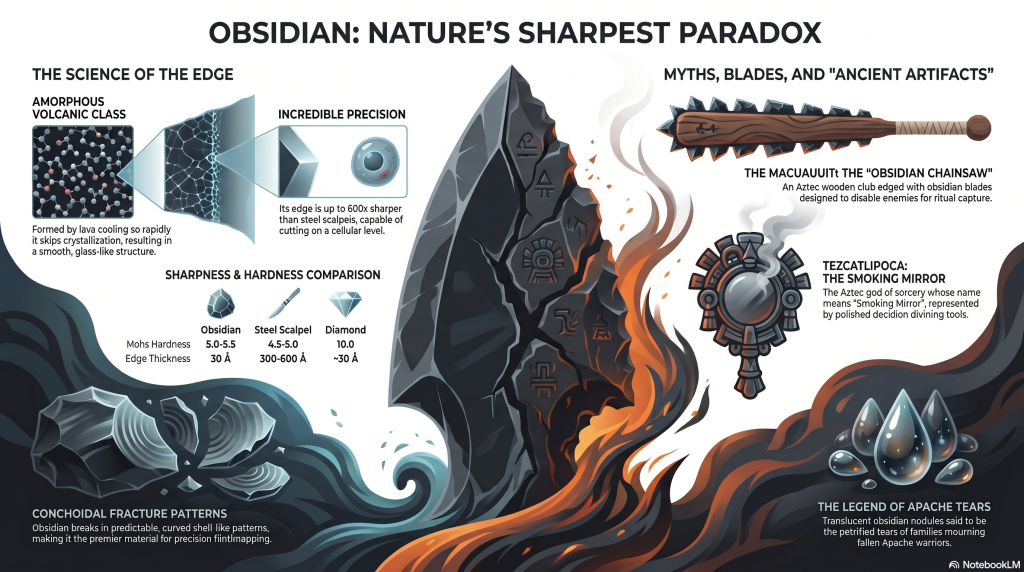
Obsidian is an igneous rock and a volcanic glass mineraloid that does not crystallize under the slow, rhythmic conditions of ordinary geological time.[1, 2, 3] Instead, it is forged in rapid thermal events, quenched so fast that its constituent atoms have no opportunity to organize into a structured crystalline lattice.[2, 3, 4] Chemically, obsidian is classified as a highly felsic volcanic glass, dominated by silicon dioxide (SiO2), which typically makes up 70% to 75%—and occasionally more than 80%—of its total weight.[1, 2, 5] It is the chemical analogue of granite and rhyolite, sharing an identical chemical composition but differing entirely in structural organization due to disparate cooling rates.[1, 6]
The genesis of obsidian requires specific environmental and chemical criteria.[2] It forms from felsic, silica-rich lavas, most commonly rhyolitic and dacitic volcanic melts.[1, 2] Because silica-rich lava is highly viscous, it forms thick, slow-moving flows, volcanic domes, or conduit margins.[1, 2] Under the high lithostatic pressures found at depth, these magmas can retain up to 10% dissolved water by weight, keeping the melt relatively fluid at lower temperatures.[5] As the magma ascends and pressure decreases, this volatile water is rapidly lost as steam.[5, 6] The resulting dehydrated, silica-saturated melt becomes extremely viscous, inhibiting the diffusion of atoms and preventing nucleation, which is the crucial first step in mineral crystal growth.[1, 5]
This volcanic glass forms when the viscous magma undergoes rapid cooling, or quenching, at temperatures ranging between 700 °C and 1,050 °C (1,292 °F to 1,922 °F).[1] This process can occur extrusively when lava contacts air or water at flow margins, or intrusively when the magma cools along the margins of subterranean dikes.[1] Because obsidian is thermodynamically metastable at the Earth’s surface, its constituent silica molecules slowly and spontaneously reorganize into stable crystalline patterns over geological time.[1, 5, 6] This process, known as devitrification, typically begins along hairline fractures or around pre-existing crystal nuclei, converting the glass into a dull, stony mass of fine-grained quartz, tridymite, and alkali feldspar.[5, 6]
The presence of groundwater significantly accelerates this transformation, hydrating the glass to form perlite.[1, 4] Due to this thermodynamic instability, geologically ancient obsidians are exceptionally rare.[1, 5] While most surviving deposits are of Paleogene or younger age (less than 65 million years old), exceptionally rare exceptions include a Cretaceous welded tuff and a partially devitrified Ordovician perlite.[1, 5]
| Physical Property | Geological and Petrographic Value |
|---|---|
| Geological Category | Volcanic Glass / Mineraloid (Amorphous Solid) [1, 2, 3] |
| Dominant Chemical Composition | Silicon Dioxide (SiO2), ≥70% by weight [1, 3, 6] |
| Minor Oxide Inclusions | Oxides of Aluminium, Iron, Potassium, Sodium, and Calcium [1] |
| Water Content | Usually <1% by weight initially, progressing up to 3.5% at saturation [1, 5, 7] |
| Mohs Scale Hardness | 5.0 to 6.0 [1, 3, 6, 8] |
| Specific Gravity | Approximately 2.4 to 2.6 [1, 9] |
| Melting Point Range | 700 °C to 1,050 °C (1,292 °F to 1,922 °F) [1] |
| Fracture Type | Conchoidal (producing sharp, shell-like curved surfaces) [1, 3] |
| Luster and Optical State | Vitreous; Translucent to opaque [1, 5] |
Structural Varieties, Mineral Inclusions, and Mechanical Properties
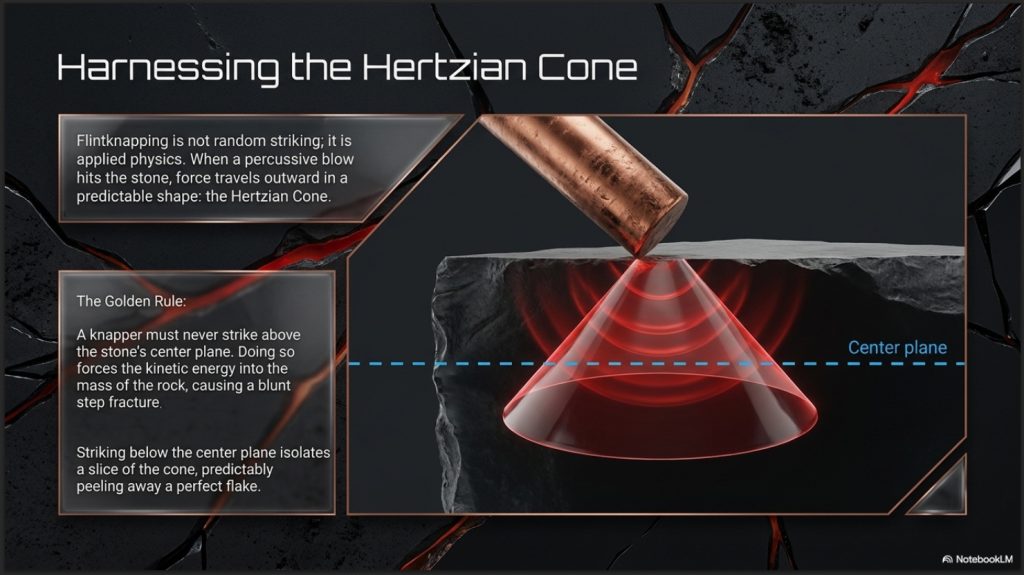
Pure, unadulterated obsidian is rare, with most specimens displaying distinctive colors, patterns, and optical phenomena driven by microscopic inclusions.[1, 2, 6] Due to its lack of crystalline cleavage planes, obsidian fractures in a highly predictable, conchoidal fashion.[1, 6] This causes impact energy to travel through the material as a wave, detaching smooth, curved flakes with edges that can approach molecular sharpness.[3, 6, 10]
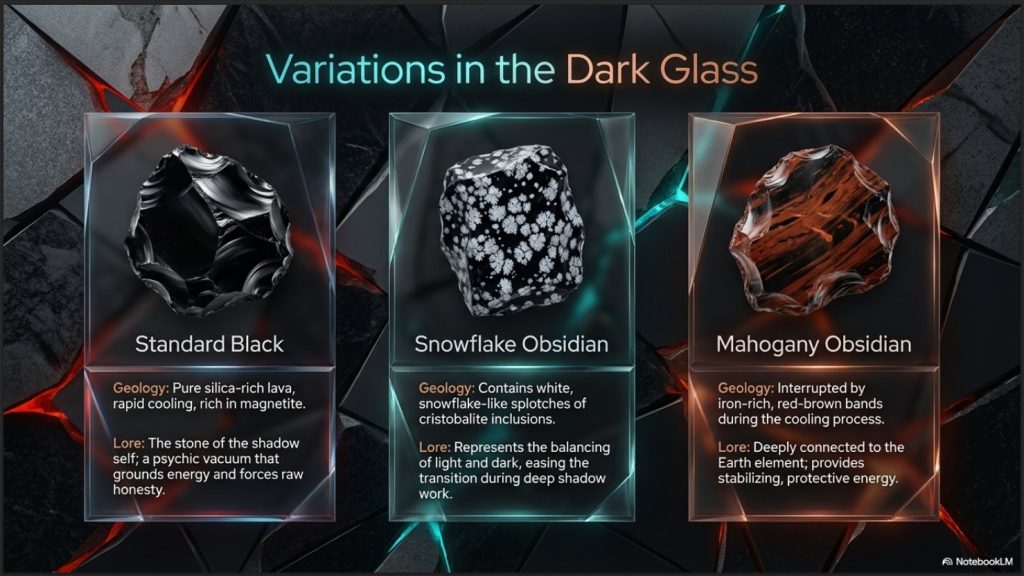
The incorporation of trace minerals, water vapor, and gas bubbles during cooling yields several distinct structural varieties of obsidian:
Snowflake Obsidian
This variety is characterized by white, radial, flower-like clusters set against a dark glass background.[2, 3] These “snowflakes” are clusters of cristobalite, a high-temperature polymorph of silica.[2] Their formation requires a rare, two-stage cooling history: the melt must first cool rapidly enough to form obsidian, but then linger at temperatures of 700–900 °C long enough for cristobalite crystals to grow in spherulitic bursts within the viscous glass.[2] This represents a state of partial devitrification, typically occurring in the thick, insulated interiors of volcanic domes where heat dissipates slowly and unevenly.[2] Primary deposits are found in Millard County (Utah), California, Wyoming, Mexico, Turkey, and Japan.[2]
Mahogany Obsidian
Defined by rich, swirled bands of reddish-brown and black, mahogany obsidian forms under dynamic flow conditions.[2] While pure black obsidian forms from instant, uniform quenching, mahogany obsidian captures the stretching, folding, and shearing of viscous lava before it solidifies.[2] The reddish-brown bands are colored by hematite or magnetite-leaning iron oxide nanoinclusions that oxidize in localized, oxygen-exposed zones within the moving melt.[2, 6] This variety is widely collected in Oregon (where it is occasionally called “Cinnamon Obsidian”), Arizona, California, Nevada, Colorado, Utah, Mexico, Iceland, Indonesia, and Turkey.[2]
Rainbow and Peacock Obsidian
This rare variety displays shifting, iridescent bands of green, gold, purple, and blue when polished and exposed to direct light.[2, 3, 11] This optical phenomenon is caused by thin-film interference rather than chemical pigments.[2] As silica-rich lava continues to flow after its outer crust has quenched, internal pressure gradients create parallel, layered horizons of flattened microscopic gas bubbles or oriented nanorods of hedenbergite.[1, 2] When light enters these nano-scale layers, it refracts across surfaces spaced at near-wavelength distances, flashing brilliant colors that shift with the viewing angle.[2, 6] Major deposits occur in Jalisco (Mexico), Oregon, and California.[2]
Sheen Obsidian (Gold and Silver)
Similar to rainbow obsidian, sheen obsidian exhibits a uniform, metallic golden or silver shimmer across its surface.[3, 6] This effect is caused by tiny, microscopic gas bubbles trapped within the molten glass.[6] When the viscous lava flows away from its vent, these bubbles stretch into flat, reflective planes along the internal flow lines, reflecting light back in a unified direction.[6]
Midnight Lace Obsidian
This variety features contorted, thread-like black streaks running through a translucent or smoky glass matrix.[6] These patterns are created when layered or streaked obsidian flows are stretched, folded, and rolled by the slow, grinding movement of viscous magma before solidification.[6]
Apache Tears
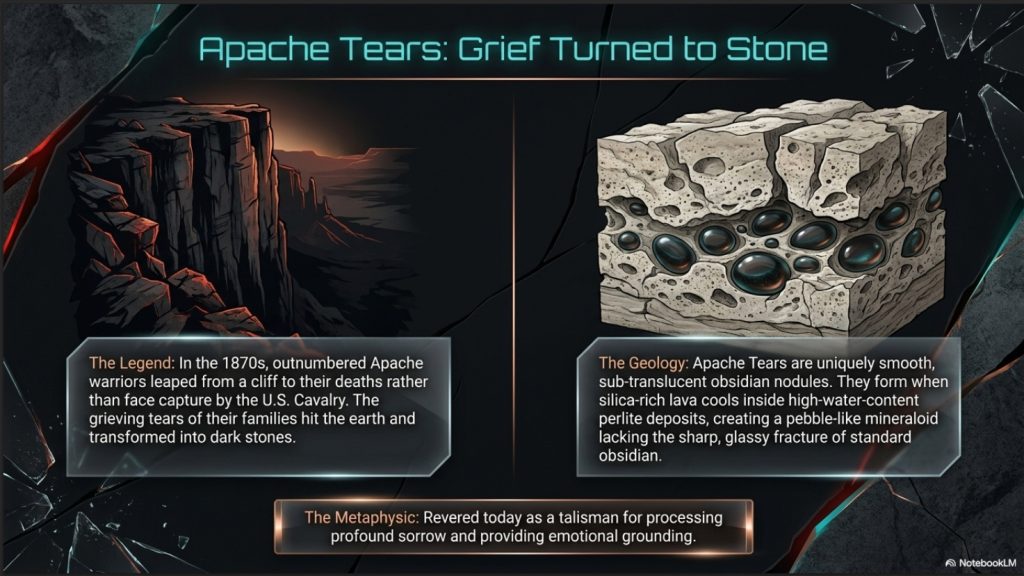
These are small, rounded, sub-spherical nodules of translucent black obsidian embedded within rough, grey perlite deposits.[4, 12] They form during sub-surface volcanic processes where silica-rich nodules cool within perlite flows that contain high amounts of water.[4, 12] Over time, water absorption causes the surrounding perlite to develop onion-skin fractures, leaving behind the hard, rounded obsidian cores.[4, 12] They are famously sourced from volcanic fields in Superior (Arizona), Nevada, and Utah.[4, 12]
Sacred Metallurgy: Mythology, Religion, and Ancient Warfare
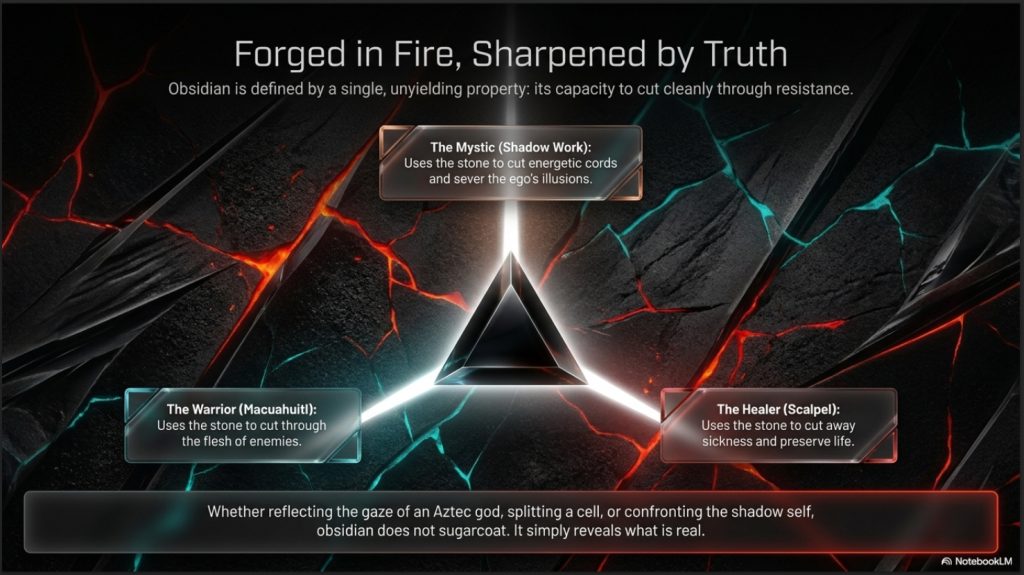
The physical properties of obsidian—its deep, mirror-like reflectivity, its razor-sharp edges, and its dark appearance—made it a potent symbol of power, divinity, and sacrifice in ancient civilizations.[3, 13, 14]
Mesoamerican Cosmography and the Smoking Mirror
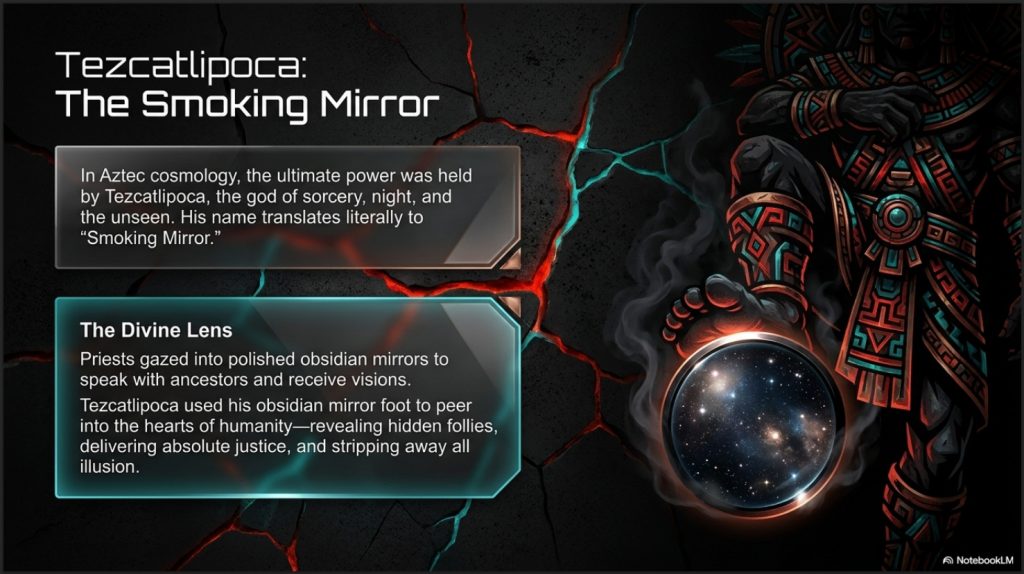
In pre-Columbian Mesoamerica, obsidian (known to the Aztecs as itzli) was a sacred material associated with death, sorcery, and the creation of the cosmos.[13] It was the primary symbol of Tezcatlipoca, a central Aztec deity whose name translates from Classical Nahuatl as “Smoking Mirror”.[13, 15, 16] Tezcatlipoca was the lord of the night sky, hurricanes, conflict, divination, and the unseen.[13, 15] He was depicted with a polished obsidian mirror replacing his right foot, which had been bitten off by the primeval earth monster Tlalteotl when he and his brother Quetzalcoatl tore her in two to create the world.[16]
Aztec shamans and priests used polished obsidian mirrors for scrying, gazing into their dark surfaces to receive prophecies, reveal human secrets, and speak with ancestors.[13, 15] The shadowy, distorted reflections cast by the dark, vitreous material symbolized the mysterious nature of the gods.[13, 17]
In the Maya highlands, the patron deity Tohil was associated with sacrifice and obsidian.[15] Similarly, the Classic Maya god of thunder and royal lineage, K’awiil, was depicted with a smoking obsidian knife in his forehead.[15]
Obsidian was also central to the Aztec sacrificial economy.[18, 19] Sacrificial priests used the tecpatl, a double-edged knife made of flint or obsidian, to cut open the chest cavities of victims.[19, 20] In Aztec mythology, the tecpatl was a divine child born in the heavens and thrown down to Earth, shattering into 1,600 pieces at Chicomoztoc (the Place of the Seven Caves) and spawning the first gods of the Earth.[20]
Rituals also involved the goddess Cihuacoatl, whose priests placed a sacrificial knife into a child’s cradle to represent her child.[20] Obsidian was also used for self-sacrifice; citizens sliced their tongues and ears on ritual occasions, flipping the caught blood toward the sun and moon.[19] As a form of capital punishment, emperors placed failed priests in cages containing sharp obsidian shards, where they would sleep until they died.[19]
The Macuahuitl: Combat Engineering of the Aztec Empire
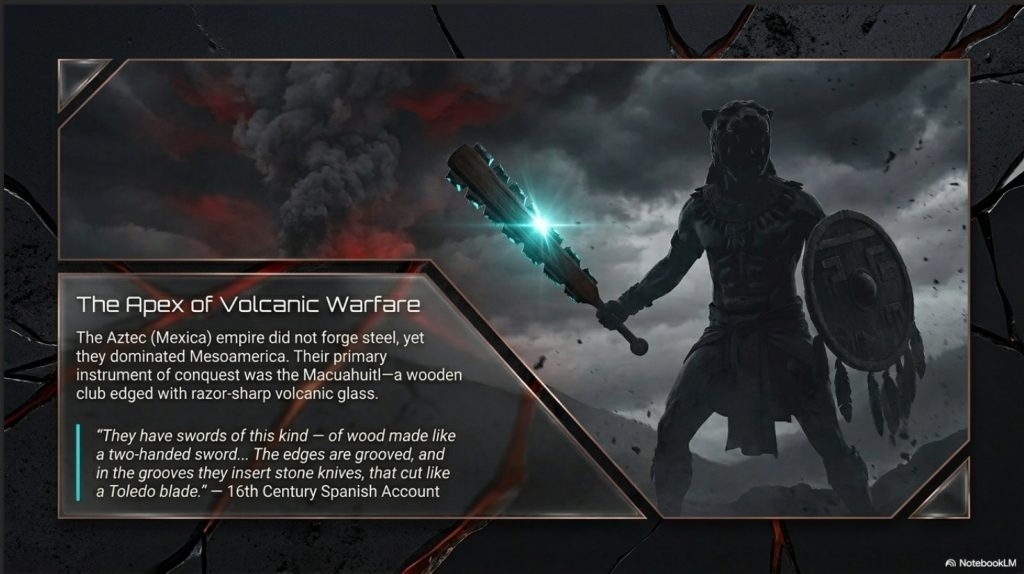
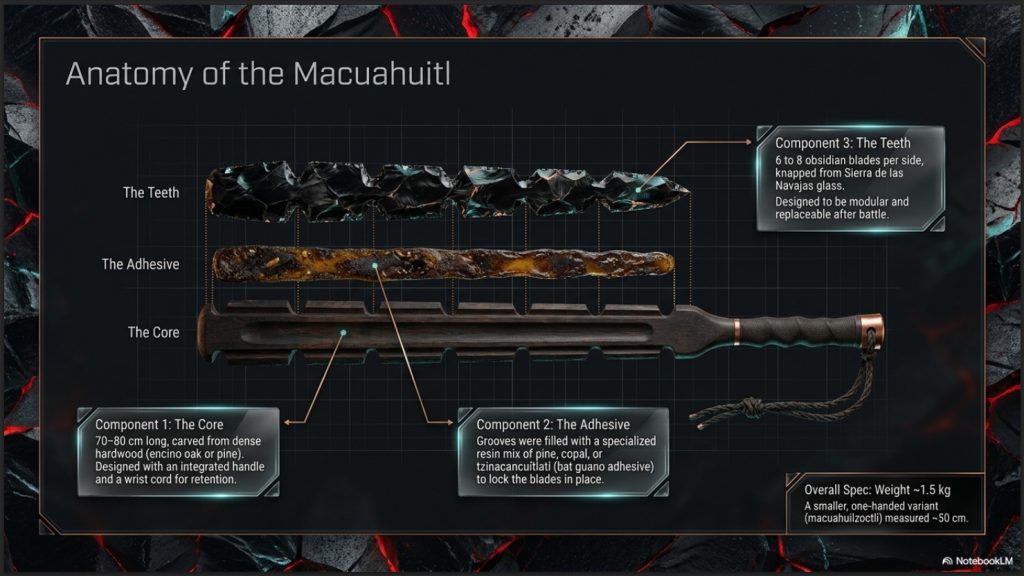
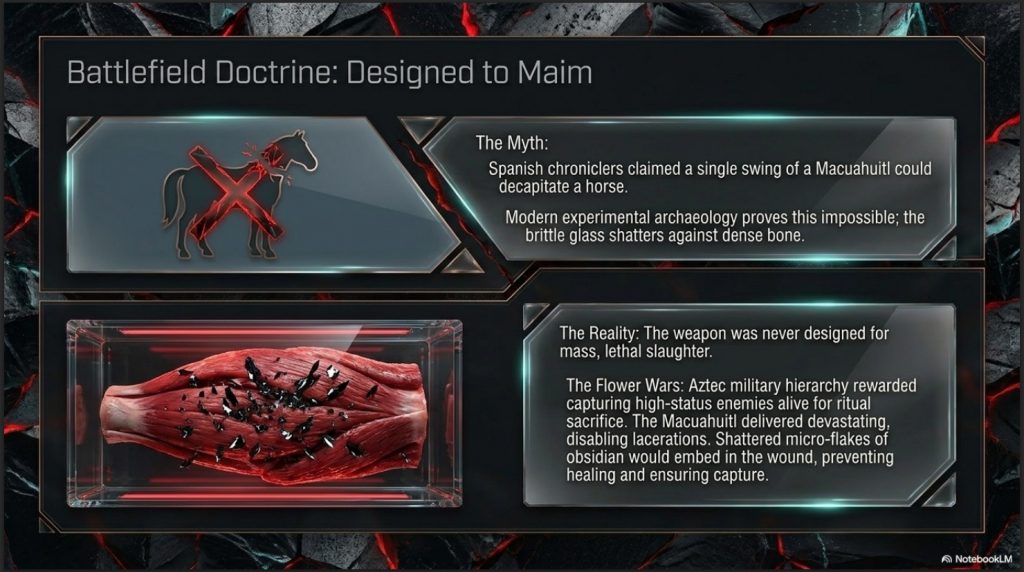
For warfare, Mesoamerican craftsmen developed the macuahuitl, a wooden sword-like club fitted with sharp obsidian blades.[10, 21] Carved from heavy hardwoods like encino oak, the macuahuitl measured about 70 to 100 centimeters long and 7 to 10 centimeters wide.[10, 18] Its lateral edges were grooved to receive pressure-flaked obsidian blades, which were secured using a natural adhesive made of copal and pine resin.[10, 18]
The weapon was designed to capture rather than kill outright, aligning with the Aztec military focus on taking prisoners for ritual sacrifice.[10, 18] The spaced obsidian blades caused wide, bleeding wounds that disabled opponents without structural penetration.[18, 19] While Spanish conquistadors claimed a macuahuitl could decapitate a horse in a single swing, modern experimental archaeology on animal carcasses suggests that full decapitation was unlikely; instead, the weapon caused deep muscle lacerations and embedded tiny glass fragments in wounds to induce infection.[10, 21] Despite its extreme sharpness, the brittleness of the obsidian blades meant they easily shattered against steel armor, giving Spanish weapons a decisive advantage in prolonged combat.[10, 19]
Greco-Roman Accounts, Antique Trade, and Regional Folklore
In Europe, the name “obsidian” is attributed to Pliny the Elder, who wrote in his Natural History that a dark, glassy stone was discovered in Ethiopia by a Roman explorer named Obsidius.[1, 9] Known as lapis obsidianus, this material became a fashionable luxury item in Rome, where it was carved into mirrors, gemstones, and solid statues.[17, 22] Augustus dedicated four obsidian statues of elephants in the Temple of Concord, and Tiberius restored an obsidian statue of Menelaus to Heliopolis in Egypt.[17]
An alternative etymological theory links the name to the Greek word opsi (meaning “sight”), referencing its use as a mirror.[14] In the Aegean, the island of Milos was a major source of obsidian, where tools were manufactured as early as 10,000 BCE.[14] These bladelets were used in ritual circumcisions and for cutting newborn umbilical cords.[1]
In the American West, the rounded obsidian pebbles known as “Apache Tears” are tied to a poignant legend from the 1870s.[4, 12] During the American Indian Wars, a band of 75 Apache warriors was trapped on a cliff at Big Piacho by the U.S. Cavalry.[12, 23] Refusing capture, the warriors rode their horses over the precipice to their deaths.[4, 12] The weeping families of the fallen gathered at the base of the cliff for a moon; their tears were said to have been turned to stone by the Great Father, creating the dark, translucent obsidian nodules found in the region.[23]
Modern Scientific Methodology: Geochemical Sourcing, Chronometry, and Surgery
Today, the physical properties of obsidian are utilized in archaeology, geology, and advanced medical procedures.[3]
EDXRF Provenance Sourcing
Because every volcanic eruption has a distinct chemical composition, the resulting obsidian contains a unique “fingerprint” of trace elements.[1] Using energy-dispersive X-ray fluorescence (EDXRF), archaeologists can measure trace elements—such as rubidium (Rb), strontium (Sr), yttrium (Y), zirconium (Zr), and titanium (Ti)—to trace the geological origin of ancient artifacts.[1] This non-destructive technique has reconstructed prehistoric trade routes across Europe and the Mediterranean, showing that Neolithic communities on mainland Greece sourced their obsidian from Milos, Nisyros, and Gyali, while Central European cultures traded with sources in Hungary and Slovakia.[1]
Obsidian Hydration Dating (OHD)
When obsidian is fractured, its fresh surface contains very little water (typically under 1%).[1, 7] Exposed to air or buried in soil, the surface absorbs environmental moisture, forming a hydrated layer with a different density and refractive index.[24, 25] This layer thickens over time, creating a natural geological clock.[24]
To date an artifact, scientists cut a thin section (under 30 micrometers) and measure the hydration rind under a high-power microscope.[7, 26] The age is calculated using Friedman’s empirical equation:
x2=kt
where x is the rind thickness, k is the diffusion coefficient, and t is the elapsed time.[26]
Because the diffusion coefficient k is highly sensitive to temperature and soil humidity, archaeologists must calibrate this rate using local environmental data, often burying thermal capsules at archaeological sites to monitor conditions.[7, 24]
Nanoscale Surgical Scalpels
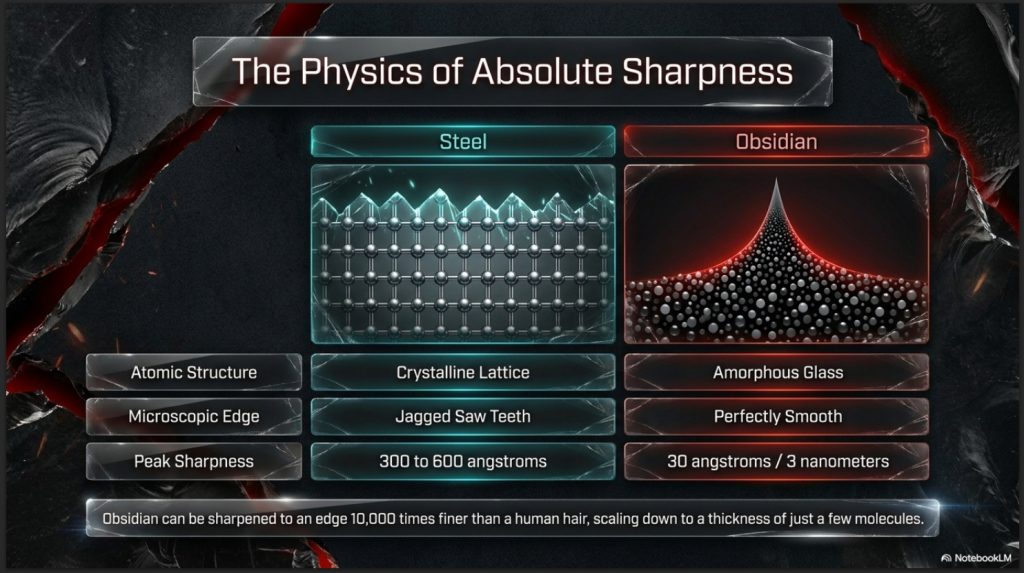
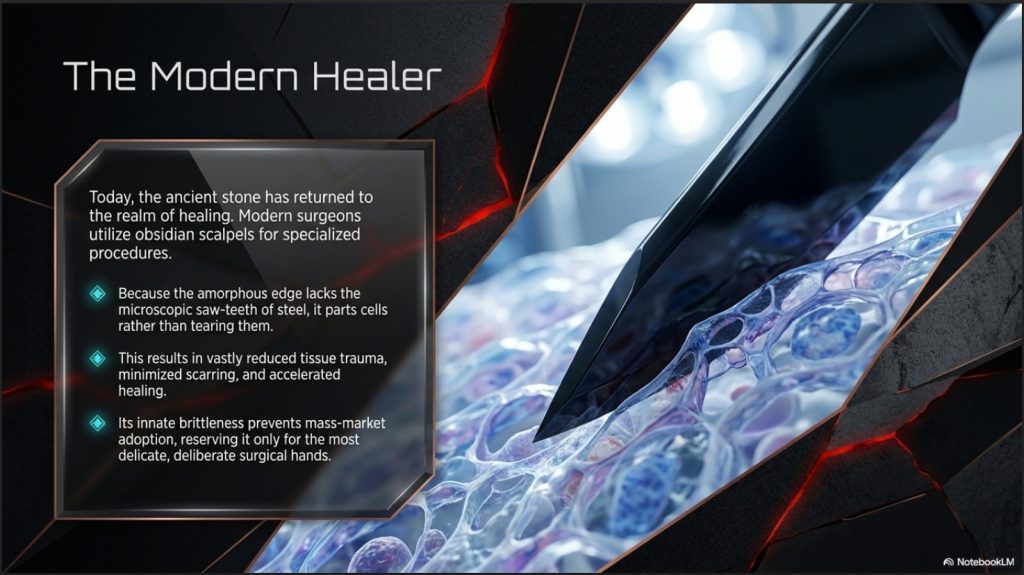
In modern surgery, hand-crafted obsidian scalpels are utilized for their extreme sharpness.[10, 27] By pressure-flaking volcanic glass, craftsmen can produce blades with an edge apex measuring only 30 Ångströms (3 nanometers) thick—roughly 100 times sharper than commercial steel scalpels.[10, 27]
Under a microscope, standard steel blades act like microscopic saws, tearing through tissue and causing localized cellular trauma.[27, 28] Obsidian blades cut cleanly between cells, reducing inflammation, swelling, and scar tissue.[27, 29] While highly effective in plastic and ophthalmic surgeries, obsidian scalpels are extremely brittle and can easily shatter under lateral pressure, leaving glass fragments in wounds.[28, 30] Consequently, they are not approved by the FDA for human surgery, but are widely used in animal research and preclinical studies.[28, 30, 31]
| Operational Parameter | Modern Steel Scalpel | Natural Obsidian Scalpel | High-End Diamond Scalpel |
|---|---|---|---|
| Edge Thickness at Apex | ~300 to 500 nm [10, 27] | ~3 nm (30 Ångströms) [10, 27] | ~1 to 2 nm [30] |
| Tissue Cutting Action | Cellular tearing (“chainsaw” effect) [27, 28] | Clean, molecular-level splitting [27, 29] | Clean, molecular-level splitting [30] |
| Material Toughness | High; ductile and resistant to bending [8, 19] | Extremely low; brittle and fragile [28, 30, 32] | Moderate; brittle but structurally stable [30] |
| Lateral Pressure Resistance | Excellent [8, 19] | Extremely poor; shatters easily [28, 30, 32] | Poor; prone to edge chipping [30] |
| Trace Metal Contamination | Yes (sheds microscopic metal particles) [30, 31] | None [30, 31] | None [30] |
| Regulatory Approval Status | Fully approved for human use [28] | Restricted to preclinical/animal research [28, 30, 31] | Fully approved for human use [30] |
| Average Unit Cost | Low (~$1 to $5) [27, 30] | Moderate (~$85 to €100) [27, 30] | High (~$1,000+) [30] |
The Craft of Lithic Technology: Percussion and Pressure Flaking
The manufacture of sharp tools from obsidian relies on the practice of knapping.[1, 33] Knappers utilize two primary methods to shape volcanic glass:
Percussion Flaking
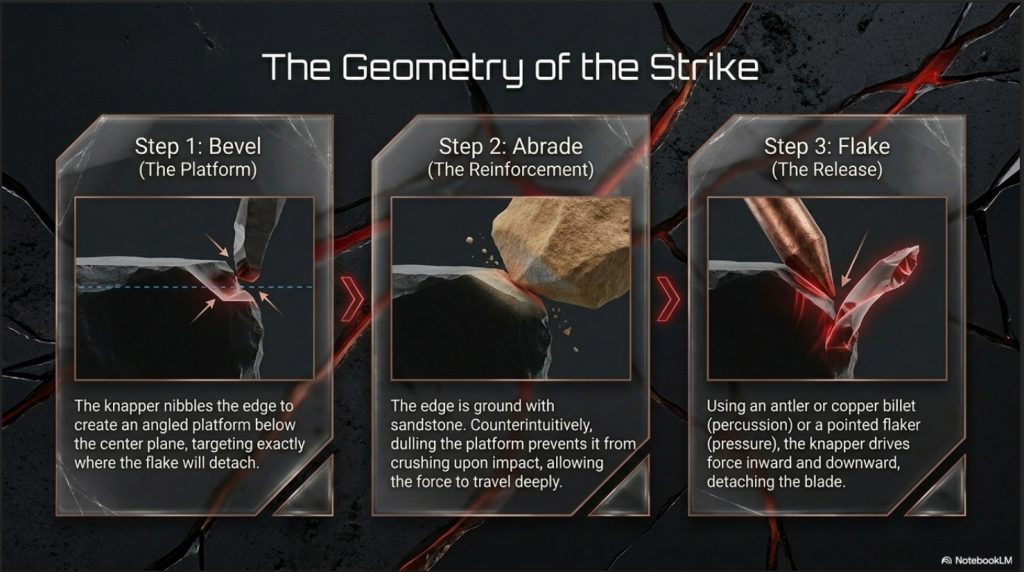
This is a dynamic process used to remove large to medium flakes from a core.[34] The knapper strikes a prepared platform on the stone with a hammerstone or soft billet (such as antler or copper) at an angle of 60 to 70 degrees.[34] This initiates a conchoidal fracture that propagates a predictable wave through the glass.[34]
Pressure Flaking
This is a static method used for fine shaping, thinning, and sharpening.[33, 34] The knapper presses a pointed tool made of antler, bone, or copper against the platform of the stone, applying steady pressure until a small chip pops off.[33, 34]
Historical accounts of the Native American knapper Ishi describe him holding the obsidian in his left palm, protected by a thick buckskin pad, and using a long wooden rod tipped with antler to press off flakes with leverage from his upper body.[35]
In pressure flaking, knappers utilize several styles:
- Collateral Pressure Flaking: Flakes are removed parallel to each other at right angles to the edge, meeting at a central ridge.[33]
- Transverse-Parallel Pressure Flaking: Flakes are removed at an oblique angle, driving completely across the tool’s face to thin it without reducing its width.[33]
- Pressure Blade Making: The obsidian core is secured in a wooden vise, allowing the knapper to remove a series of uniform blades from a single core, leaving a fluted, bullet-shaped core.[33]
Knapping presents several safety hazards.[34, 36] The tiny flakes removed during knapping are sharp enough to cut skin painlessly, and breathing in the fine silica dust can cause lung damage.[36] Knappers must work in well-ventilated areas or wear masks.[36] If glass shards enter the eye, knappers are advised not to rub the eye, but to blink repeatedly to allow natural tears to wash the fragment out safely.[34, 36]
The Glass Paradox: Pop-Cultural Mythologies and Mechanical Reality
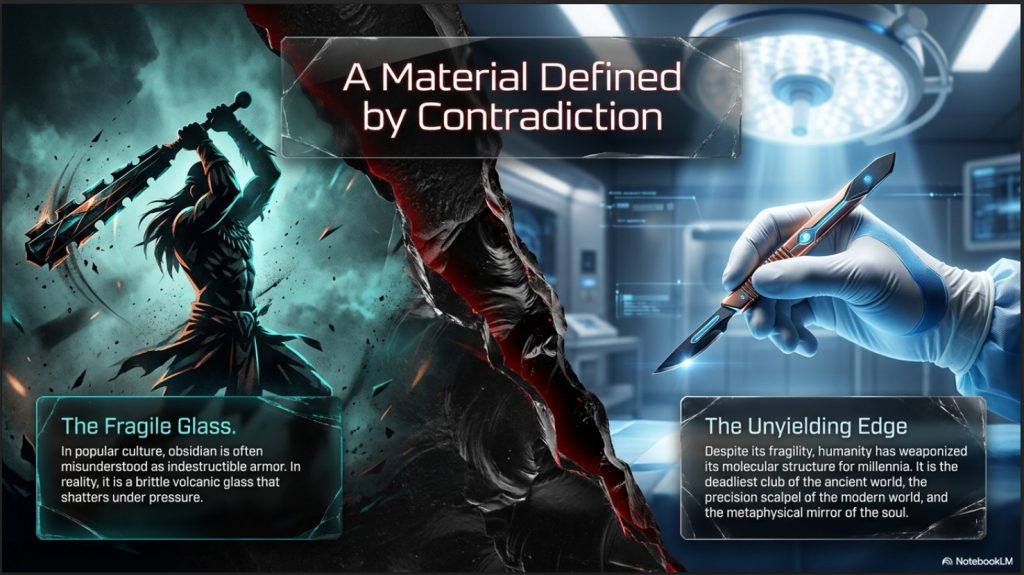
In modern media, obsidian is frequently depicted as an indestructible material.[8] In the video game Minecraft, obsidian is formed when flowing water meets a lava source, and it is portrayed as one of the hardest, most durable blocks, immune to explosions and mineable only with a diamond pickaxe.[8, 37, 38] Similarly, in George R.R. Martin’s A Song of Ice and Fire (and its television adaptation), obsidian is known as “dragonglass”—a highly valued material capable of slaying supernatural White Walkers.[8, 11]
This depiction represents a physical paradox.[8] In materials science, hardness is defined as a material’s resistance to scratching.[8] On the Mohs scale, obsidian rates at a moderate 5 to 6, meaning it can be scratched by quartz or hard steel.[6, 8]
Furthermore, high hardness does not equal impact toughness.[8] Because obsidian is an amorphous glass lacking crystalline grain boundaries, it cannot deform plastically to absorb energy.[1, 8] When struck with a hammer, real-world obsidian shatters easily into tiny shards.[8, 28] The popular depiction of obsidian as an indestructible material conflates scratch resistance with impact toughness, transforming a fragile, glassy mineraloid into a fictional, metal-like stone.[8]
- Obsidian – Wikipedia, https://en.wikipedia.org/wiki/Obsidian
- Obsidian — Nature’s Volcanic Glass – FossilEra.com, https://www.fossilera.com/pages/obsidian-nature-s-volcanic-glass
- Obsidian: The Geology and Legacy of Volcanic Glass – Crystal World Wholesale Group, https://www.crystalworldwholesalegroup.com.au/blogs/news/obsidian-the-geology-and-legacy-of-volcanic-glass
- Apache Tears Meaning: Unveiling The Symbolism and Origins – Kumi Oils, https://www.kumioils.com/blogs/news/apache-tears-meaning
- Volcanic glass | Obsidian, Pumice & Scoria | Britannica, https://www.britannica.com/science/volcanic-glass
- Obsidian | Volcano World | Oregon State University, https://volcano.oregonstate.edu/volcanic-minerals/obsidian
- Obsidian Hydration Dating, https://stsmith.faculty.anth.ucsb.edu/classes/anth3/courseware/Chronology/10_Obsidian_Hydration.html
- In real life, obsidian is as fragile as ordinary glass, but in Minecraft it’s one of the hardest and most durable blocks. That’s why it’s hilarious that Mojang is now giving real-world materials properties closer to reality, instead of making them more fantastical like before. : r/MinecraftMemes – Reddit, https://www.reddit.com/r/MinecraftMemes/comments/1tmv83f/in_real_life_obsidian_is_as_fragile_as_ordinary/
- Obsidian: history, benefits and healing properties – Emmanuelle Guyon, https://www.en.emmanuelleguyon.com/vertus_obsidienne_en
- Macuahuitl: Complete Guide to the Aztec Obsidian Sword – Noblie Custom Knives, https://nobliecustomknives.com/macuahuitl-the-complete-guide-to-the-aztec-obsidian-sword/
- Obsidian, AKA Dragonglass – Dorothy A. Winsor, https://dawinsor.com/2023/05/03/obsidian-aka-dragonglass/
- Apache Tears Meanings and Crystal Properties, https://thecrystalcouncil.com/crystals/apache-tears
- 3 Myths and Lore Behind the Stones | Obsidian Edition – Unearthed Crystals, https://www.unearthedcrystals.com.au/blogs/all-blogs/myths-obsidian
- The Obsidian – The glass of nature in the land of Milos – Milos Cove, https://www.miloscove.com/the-obsidian-the-glass-of-nature-in-the-land-of-milos
- Tezcatlipoca – Wikipedia, https://en.wikipedia.org/wiki/Tezcatlipoca
- God of the Month: Tezcatlipoca – Mexicolore, https://www.mexicolore.co.uk/aztecs/gods/god-of-the-month-tezcatlipoca
- PLINY THE ELDER, Natural History | Loeb Classical Library, https://www.loebclassics.com/view/pliny_elder-natural_history/1938/pb_LCL419.155.xml?readMode=recto
- Macuahuitl: The Legendary Obsidian Sword of the Aztecs – Fire and Steel, https://fireandsteel.ca/blogs/blogs/macuahuitl
- Black Steel: Obsidian and Aztec Death Culture, https://armstronghistoryjournal.wordpress.com/2022/01/07/black-steel-obsidian-and-aztec-death-culture/
- Tecpatl – Wikipedia, https://en.wikipedia.org/wiki/Tecpatl
- Macuahuitl: The Aztec Obsidian Chainsaw Of Your Nightmares – All That’s Interesting, https://allthatsinteresting.com/aztec-macuahuitl
- Opsidia gens – Wikipedia, https://en.wikipedia.org/wiki/Opsidia_gens
- The legend of the Apache Tears. – YouTube, https://www.youtube.com/watch?v=WzpzQUnS3R0
- Obsidian Hydration Dating: Work & Limitations | Vaia, https://www.vaia.com/en-us/explanations/archaeology/dating-and-chronology/obsidian-hydration-dating/
- Obsidian–hydration–rind dating | Archaeology, Volcanic Glass, Chronology | Britannica, https://www.britannica.com/science/obsidian-hydration-rind-dating
- Obsidian hydration dating – Wikipedia, https://en.wikipedia.org/wiki/Obsidian_hydration_dating
- Sharpest Surgical Blade on Earth #obsidian #goodtoknow #vet #medicine #surgicalskills #scalpel #hack – YouTube, https://www.youtube.com/shorts/mKuK5dftEjg
- ELI5: What property of obsidian knives causes them to cut on a cellular level? – Reddit, https://www.reddit.com/r/explainlikeimfive/comments/58ejt3/eli5_what_property_of_obsidian_knives_causes_them/
- TIL That obsidian knives are so sharp they cut on a cellular level. Due to this, when used in the medical field, incisions made with the blade heal faster with less scarring. : r/todayilearned – Reddit, https://www.reddit.com/r/todayilearned/comments/54made/til_that_obsidian_knives_are_so_sharp_they_cut_on/
- Obsidian Scalpel Wood Handle | 6 mm | 13 cm | 10110-01 – Fine Science Tools, https://finescience.com/en-US/obsidian-scalpel-wood-handle/10110-01
- Obsidian scalpels – straight – Animalab, https://animalab.eu/obsidian-scalpels-straight
- OBSIDIAN KNIVES Cautionary note: Obsidian Stone Age Scalpels, https://muromachi.com/wp-content/uploads/pdf/FST2023/FST_CATALOG_2023_p055.pdf
- Pressure Flaking – Museum of Stone Tools, https://stonetoolsmuseum.com/technique/pressure-flaking/
- Flint Knapping Arrowheads – Alderleaf Wilderness College, https://www.wildernesscollege.com/flint-knapping-arrowheads.html
- California Knapping – Primitive ways, https://www.primitiveways.com/knapping2.html
- Basic Flintknapping Techniques & Tips – GoKnapping, https://goknapping.com/pages/basic-flintknapping-techniques-tips
- Minecraft obsidian vs real life obsidian – YouTube, https://www.youtube.com/shorts/oFqyJZQc5lM
- Hey Minecrafters, do you the history of obsidian? – YouTube, https://www.youtube.com/shorts/4fHWXlTLhj0
