
Ideological Framework and Philosophical Foundations
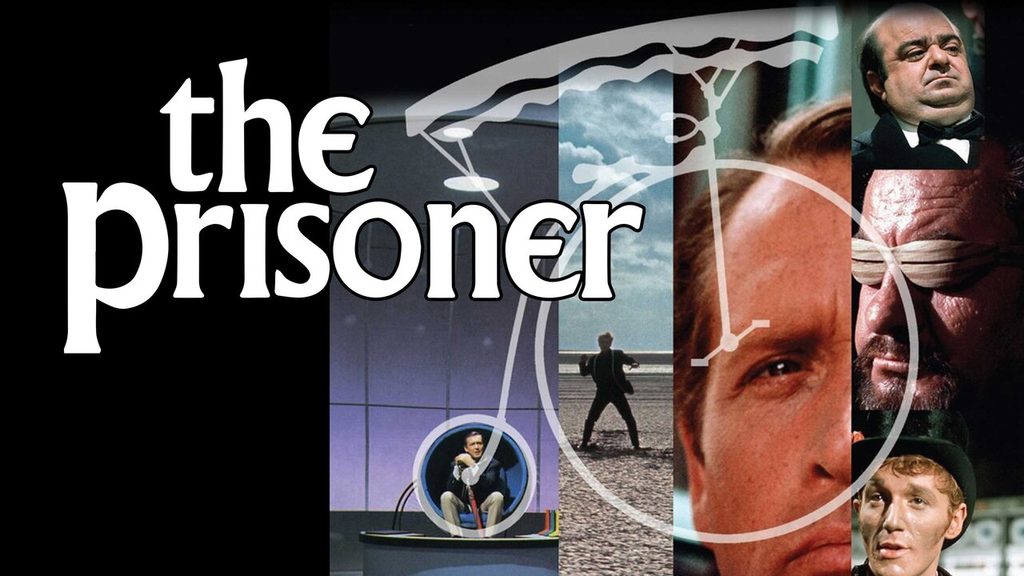
First broadcast in 1967, The Prisoner stands as a seminal monument in television history, transcending the conventions of Cold War spy fiction to deliver an allegorical critique of modern technocracy, state surveillance, and the erosion of individual identity [cite: 1, 2, 3]. Created by Patrick McGoohan in collaboration with script editor George Markstein, the series uses a surreal, Kafkaesque narrative framework to interrogate the fundamental conflict between individual liberty and institutional control [cite: 1, 2, 4].
At its core, the series operates as a philosophical treatise on the mechanisms of societal coercion [cite: 3, 5]. The protagonist, designated merely as Number Six, is an unnamed British intelligence agent who abruptly resigns from his post, only to be abducted and incarcerated in “The Village”—an idyllic yet totalitarian coastal enclave [cite: 1, 2, 4]. The Village functions as a microcosm of the modern bureaucratic state, where physical coercion is largely replaced by psychological manipulation, pervasive surveillance, and subtle social conditioning [cite: 1, 3]. In this environment, the individual is stripped of personal identity—symbolized by the replacement of names with numeric designations—and subjected to relentless demands for conformity [cite: 3, 4, 5].
| Core Dimension | The Village (Institutional Hegemony) | Number Six (Individual Resistance) |
|---|---|---|
| Identity & Naming | Numeric designation (Number Six); destruction of personal history [cite: 2, 4] | Rejection of numbers; absolute assertion of individual identity [cite: 4, 6] |
| Societal Structure | Collectivist, paternalistic democracy with totalitarian underpinnings [cite: 3, 6] | Uncompromising individual sovereignty and anti-collectivism [cite: 5, 6] |
| Epistemology & Truth | Controlled institutional narrative and rapid subconscious conditioning [cite: 3, 6] | Empirical skepticism, moral resistance, and critical thought [cite: 3, 6] |
| Power Mechanism | Omnipresent surveillance, psychological coercion, and drug-induced reconditioning [cite: 3, 6] | Non-cooperation, psychological counter-sabotage, and ideological defiance [cite: 6, 7] |
| Ultimate Goal | Complete mental assimilation and curing of “unmutuality” [cite: 6, 8] | Unconditional self-determination and destruction of the panoptic structure [cite: 8, 9] |
The ideological framework of The Prisoner synthesizes existentialist philosophy with post-war sociopolitical anxieties [cite: 2, 3, 5]. Influenced by thinkers such as Jean-Paul Sartre and Michel Foucault, the series portrays captivity not merely as a physical enclosure, but as a mental state enforced by self-surveillance and social pressure [cite: 3, 9]. The Village authorities, led by a rotating succession of chief administrators known as Number Two, do not merely seek tactical intelligence—specifically, the reason for Number Six’s sudden resignation—but total ideological surrender [cite: 1, 4, 10]. They require Number Six to concede that the collective interest supersedes individual autonomy [cite: 8]. His iconic refusal—”I am not a number! I am a free man!”—serves as the thesis of human resistance against technocratic dehumanization [cite: 6].
Furthermore, the series critiques Cold War dualism [cite: 2, 11]. By intentionally keeping the geopolitical allegiance of the Village ambiguous—refusing to clarify whether it is run by East, West, or a cartel of global power brokers—McGoohan and Markstein suggested that Eastern totalitarianism and Western consumer democracy were converging into an identical system of mass control [cite: 3, 4, 11].
Production Background, Creative Figures, and Filming Locations
Creative Genesis and the McGoohan–Markstein Schism
The inception of The Prisoner occurred during the final production stages of Danger Man (broadcast in the United States as Secret Agent), the highly successful ITC Entertainment spy series starring Patrick McGoohan [cite: 1, 2, 12]. As the highest-paid television actor in the United Kingdom, McGoohan decided to leave Danger Man, seeking a creative vehicle that moved beyond procedural espionage into philosophical allegory [cite: 1, 12]. He pitched the concept to Sir Lew Grade, the head of ITC Entertainment, who approved a run of episodes based on a verbal agreement [cite: 1, 12].
| Creative Figure | Primary Production Role | Key Creative Contribution to the Series |
|---|---|---|
| Patrick McGoohan | Executive Producer / Creator / Star | Devised allegorical framework, directed key episodes, and portrayed Number Six [cite: 1, 2, 12] |
| George Markstein | Script Editor / Co-Creator | Originated military isolation camp concept; brought grounded intelligence realism [cite: 1, 4, 13] |
| David Tomblin | Producer / Writer / Director | Co-founded Everyman Films; wrote and directed pivotal surrealist episodes [cite: 1, 2, 12] |
| Sir Lew Grade | Executive Producer (ITC Chief) | Financed production; pushed for expanded episode count for US distribution [cite: 1, 12, 13] |
| Don Chaffey | Director | Directed core initial episodes, establishing the distinct visual grammar of the Village [cite: 2, 6] |
| Pat Jackson | Director | Directed major psychological episodes emphasizing internal conflict and delusion [cite: 2, 6] |
| Peter Graham Scott | Director | Directed technocratic episodes focusing on systemic indoctrination [cite: 2, 6] |
| Ron Grainer | Theme Music Composer | Composed the iconic, driving brass theme denoting individualism and pursuit [cite: 2] |
A foundational rift emerged early in production between McGoohan and script editor George Markstein [cite: 7, 13, 14]. Markstein, drawing on his background in military intelligence, derived the idea of the Village from real-world World War II holding facilities—such as Inverlair Lodge in Scotland—where military personnel with sensitive knowledge were isolated to prevent security breaches [cite: 1, 4]. Markstein envisioned the show as a literal, grounded sequel to Danger Man, with Number Six explicitly being John Drake held in a secure facility [cite: 1, 13, 14].
McGoohan, however, envisioned a far more avant-garde, surreal, and existential narrative [cite: 13]. He resisted tying Number Six to any specific backstory or previous character identity, intending the protagonist to represent a universal figure standing against societal coercion [cite: 4]. This philosophical conflict, compounded by mounting production delays and budgetary overruns, led to Markstein’s departure halfway through the filming schedule [cite: 7, 13]. Following Markstein’s exit, producer David Tomblin and McGoohan assumed complete creative oversight through their production company, Everyman Films, shifting the series into increasingly surreal and psychodramatic territory [cite: 2, 7, 12].
Principal Locations and Visual Architecture
The visual identity of The Prisoner relies on its primary exterior filming location: Portmeirion, an eclectic resort village in Gwynedd, North Wales, designed by architect Sir Clough Williams-Ellis between 1925 and 1975 [cite: 1, 2, 4]. Williams-Ellis constructed Portmeirion using architectural fragments salvaged from demolished historic sites across Europe, resulting in an intentionally disorienting blend of Mediterranean, Baroque, and Neoclassical styles [cite: 1, 4].
| Location Name | Real-World Geographic Site | Narrative & Production Function |
|---|---|---|
| The Village | Portmeirion, Gwynedd, North Wales | Exterior setting; architectural collage serving as an idyllic open-air prison [cite: 1, 2, 4] |
| Interiors & Underground | MGM-British Studios, Borehamwood | Soundstage sets for the Green Dome, subterranean Control Room, and Embryo Room [cite: 2, 7] |
| London Streets | Buckingham Gate & Westminster | Exterior locations for Number Six’s pre-resignation life and final return [cite: 2, 6, 9] |
| Coastal & Field Locations | Beachy Head Lighthouse & Eltisley Green | Specific location shooting for secondary narrative sequences [cite: 6] |
McGoohan selected Portmeirion because its idyllic, postcard-perfect aesthetics starkly contrasted with the oppressive surveillance state operating beneath its surface [cite: 1]. Under an agreement between McGoohan and Clough Williams-Ellis, the specific location of Portmeirion was withheld from the show’s promotional material and opening credits, remaining uncredited until the broadcast of the series finale [cite: 7, 9]. Interior filming was conducted at MGM-British Studios in Borehamwood, Hertfordshire, where elaborate sets were constructed for the Green Dome office of Number Two, the subterranean Control Room, and the technological interrogation centers [cite: 2, 7].
——————————————————————————–
Complete Episode Synopses and Narrative Arc
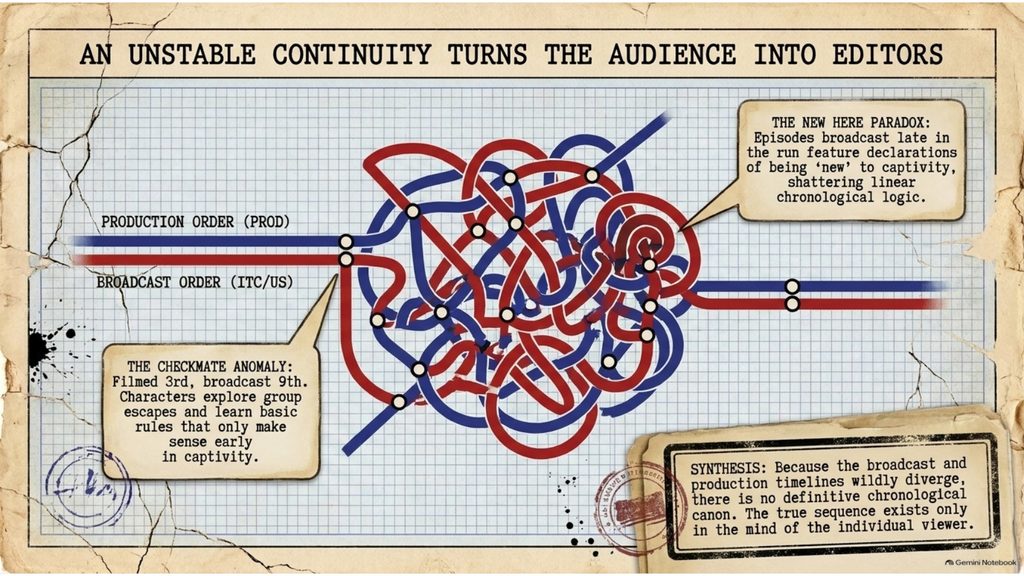
The 17-episode run of The Prisoner follows a non-linear yet progressive psychological trajectory [cite: 2, 6]. The table below outlines the basic production and broadcast parameters of the entire series, followed by detailed narrative synopses for each episode in original UK ITV broadcast order [cite: 6].
| Episode Title | Prod Code | Primary Writer(s) | Director | Number Two Actor(s) | Original Airdate |
|---|---|---|---|---|---|
| Arrival | 1 | George Markstein & David Tomblin | Don Chaffey | Guy Doleman / George Baker | 29 Sept 1967 |
| The Chimes of Big Ben | 5 | Vincent Tilsley | Don Chaffey | Leo McKern | 06 Oct 1967 |
| A. B. and C. | 10 | Anthony Skene | Pat Jackson | Colin Gordon | 13 Oct 1967 |
| Free for All | 2 | Patrick McGoohan | Patrick McGoohan | Eric Portman / Rachel Herbert | 20 Oct 1967 |
| The Schizoid Man | 7 | Terence Feely | Pat Jackson | Anton Rodgers | 27 Oct 1967 |
| The General | 11 | Lewis Greifer | Peter Graham Scott | Colin Gordon | 03 Nov 1967 |
| Many Happy Returns | 13 | Anthony Skene | Patrick McGoohan | Georgina Cookson | 10 Nov 1967 |
| Dance of the Dead | 4 | Anthony Skene | Don Chaffey | Mary Morris | 17 Nov 1967 |
| Checkmate | 3 | Gerald Kelsey | Don Chaffey | Peter Wyngarde | 24 Nov 1967 |
| Hammer into Anvil | 12 | Roger Woddis | Pat Jackson | Patrick Cargill | 01 Dec 1967 |
| It’s Your Funeral | 8 | Michael Cramoy | Robert Asher | Derren Nesbitt / André van Gyseghem | 08 Dec 1967 |
| A Change of Mind | 9 | Roger Parkes | Patrick McGoohan | John Sharp | 15 Dec 1967 |
| Do Not Forsake Me Oh My Darling | 14 | Vincent Tilsley | Pat Jackson | Clifford Evans | 22 Dec 1967 |
| Living in Harmony | 15 | David Tomblin & Ian L. Rakoff | David Tomblin | David Bauer | 29 Dec 1967 |
| The Girl Who Was Death | 16 | Terence Feely | David Tomblin | Kenneth Griffith | 18 Jan 1968 |
| Once Upon a Time | 6 | Patrick McGoohan | Patrick McGoohan | Leo McKern | 25 Jan 1968 |
| Fall Out | 17 | Patrick McGoohan | Patrick McGoohan | Leo McKern / Kenneth Griffith | 01 Feb 1968 |
Episode 1: “Arrival”
- Writer: George Markstein and David Tomblin | Director: Don Chaffey | Original UK Airdate: 29 September 1967 [cite: 6]
- Number Two: Guy Doleman / George Baker [cite: 6]
Following an explosive argument in a government office where he slams down his resignation letter, a secret agent returns to his London apartment to pack his belongings [cite: 6, 15]. As he packs, a sedative gas is flooded into his room through the keyhole by a driver, rendering him unconscious [cite: 6]. He wakes up inside an exact replica of his apartment, but upon stepping outside, he discovers he is trapped in “The Village”—a self-contained coastal resort inhabited by people wearing colorful uniforms and tagged with numeric identification badges [cite: 1, 2, 6].
He is summoned to the Green Dome, where the community administrator, Number Two (Guy Doleman), explains that he is now “Number Six” [cite: 6]. The authorities demand to know why he resigned, suspecting he may sell his state secrets [cite: 1, 6]. Number Six refuses to yield and makes his first escape attempt, only to be chased and subdued on the beach by “Rover”—a roiling, white spherical defense apparatus that smothers captives [cite: 6, 15, 16]. Later, Number Six encounters Cobb, a former colleague who appears to jump to his death from the hospital window [cite: 6]. Number Six meets Cobb’s handler, a woman claiming to be a fellow prisoner, who provides him with a tracking device to coordinate an escape via a rescue helicopter [cite: 6]. However, the escape is revealed to be an elaborate sting; the pilot is a Village operative, and the original Number Two is replaced by a successor (George Baker), establishing that authority in the Village is fluid and systemic rather than personal [cite: 6].
Episode 2: “The Chimes of Big Ben”
- Writer: Vincent Tilsley | Director: Don Chaffey | Original UK Airdate: 6 October 1967 [cite: 6]
- Number Two: Leo McKern [cite: 6]
A new prisoner, designated as Number Eight (Nadia Gray), arrives in the Village after being brought in on a stretcher [cite: 6]. She claims to be an Eastern Bloc agent who also attempted to defect [cite: 6]. After witnessing Nadia being tortured in the hospital, Number Six intervenes and slowly forms a bond of trust with her [cite: 6]. Together, they devise an escape plan utilizing the upcoming Village Arts and Crafts Exhibition [cite: 6]. Number Six constructs a piece of abstract wood sculpture titled “Escape”, which secretly conceals the components of a small boat [cite: 6].
Winning first prize in the exhibition, Number Six uses his awarded “work unit” tokens to purchase a heavy tapestry, which they repurpose as a sail [cite: 6]. Under cover of night, Number Six and Nadia sail across the open sea, reaching a point where they are retrieved by Nadia’s contacts [cite: 6]. Sealed inside wooden crates, they are transported via cargo truck and plane back to intelligence headquarters in London [cite: 6]. Upon arriving at his old superior’s office, Number Six is interrogated about his resignation before he will be granted protection [cite: 6]. Just as he is about to speak, he hears the distant chimes of Big Ben and checks his wristwatch [cite: 6]. He notices that his watch matches the exact chime time of Big Ben, failing to show the expected one-hour time difference between Central Europe and London [cite: 6]. Realizing the entire London office is a mock-up set built within the Village, Number Six steps outside to find Number Two (Leo McKern) and Nadia waiting for him, revealing her escape to have been an elaborate psychological trap [cite: 6].
Episode 3: “A. B. and C.”
- Writer: Anthony Skene | Director: Pat Jackson | Original UK Airdate: 13 October 1967 [cite: 6]
- Number Two: Colin Gordon [cite: 6]
Desperate to extract the cause of Number Six’s resignation under pressure from Number One, Number Two (Colin Gordon) utilizes an experimental mind-manipulation apparatus designed by Number Fourteen (Sheila Allen) [cite: 6]. The machine hooks into Number Six’s neural pathways while he sleeps, injecting drugs to manipulate his dream state while projecting the visual feed onto monitors for observation [cite: 6]. Number Two runs three potential resignation scenarios based on files labeled “A” (a defecting colleague), “B” (a female operative), and “C” (a mysterious party hostess named Madame Engadine) [cite: 6].
Over two successive nights, Number Six is subjected to simulated dream encounters with “A” and “B” at a lavish party hosted by Madame Engadine [cite: 6]. In both dreams, Six resists selling his intelligence or revealing his motives [cite: 6]. Through residual physical fatigue and drug side-effects, Six realizes his mind is being tampered with [cite: 6]. He tails Number Fourteen to her hidden laboratory, uncovers dossier “C”, and secretly replaces the experimental drug with distilled water [cite: 6]. On the third night, Six fakes his unconscious state [cite: 6]. During the simulation of dossier “C”, Six assumes total conscious control over his dream [cite: 6]. He reveals that the ultimate contact “D”—to whom he was allegedly selling his secrets—is actually Number Two himself [cite: 6]. Within the dream, Six hands Number Two an envelope containing ordinary travel brochures, proving he resigned for personal reasons rather than treason, leaving Number Two broken as the phone to Number One rings ominously [cite: 6].
Episode 4: “Free for All”
- Writer: Patrick McGoohan (credited as “Paddy Fitz”) | Director: Patrick McGoohan | Original UK Airdate: 20 October 1967 [cite: 6]
- Number Two: Eric Portman / Rachel Herbert [cite: 6, 17]
Number Two (Eric Portman) invites Number Six to stand as a candidate in the upcoming democratic election for the post of Number Two [cite: 6, 17]. Skeptical of the Village’s democratic facade, Number Six initially refuses, but realizes that winning the election could grant him access to the master control facilities and the freedom to leave [cite: 6]. Assigned a press aide, Number Fifty-Eight (Rachel Herbert), Six launches an aggressively satirical political campaign, promising the electorate total freedom, the abolition of numeric identities, and the destruction of the Village [cite: 6].
His speeches are met with mindless, synchronized applause from the conditioned populace [cite: 6]. As his popularity grows, the authorities subject Six to severe psychological reconditioning, drug therapy, and sensory deprivation to break his independent will [cite: 6]. Broken and pliable, Number Six wins the election in a landslide [cite: 6]. Dressed in the robes of Number Two, he is brought to the central control room, where he attempts to use the public address system to announce the release of all prisoners [cite: 6]. However, his speech devolves into babbling gibberish as the reconditioning takes full effect [cite: 6]. Number Fifty-Eight steps forward, slaps him, and reveals herself to be the actual incoming Number Two, exposing the entire electoral process as a cathartic illusion designed to purge revolutionary impulses [cite: 6].
Episode 5: “The Schizoid Man”
- Writer: Terence Feely | Director: Pat Jackson | Original UK Airdate: 27 October 1967 [cite: 6]
- Number Two: Anton Rodgers [cite: 6]
Number Two (Anton Rodgers) implements a sophisticated gaslighting operation aimed at fracturing Number Six’s sense of personal identity [cite: 6]. After being subjected to a night-time medical procedure, Six awakens in his cottage to discover that his physical appearance has been subtly altered: he now sports a mustache, parts his hair on the opposite side, wears a dark suit labeled “Number Twelve,” and is left-handed [cite: 6]. Furthermore, another man who looks and sounds identical to Number Six (played also by McGoohan) moves into the Village, inhabiting Six’s original home and asserting that he is the real Number Six [cite: 6].
The duplicate (designated as Number Twelve) acts with aggressive arrogance, attempting to provoke the real Number Six into losing his self-control [cite: 6]. The Village staff and residents completely disavow Number Six’s identity, treating him exclusively as Number Twelve [cite: 6]. To preserve his sanity, Number Six secretly practices left-handed dexterity tricks and trains himself to notice subtle behavioral errors in his duplicate [cite: 6]. He discovers that Twelve has a hidden physical reaction to a specific conditioning trigger [cite: 6]. Exploiting this, Six forces a physical altercation, defeats the duplicate, and assumes Twelve’s persona to fool Number Two [cite: 6]. However, when Six attempts to escape via the duplicate’s departure helicopter, he uses a personal password phrase known only to Twelve, accidentally revealing his trick to Number Two and causing Rover to intercept the helicopter [cite: 6].
Episode 6: “The General”
- Writer: Lewis Greifer (credited as “Joshua Adam”) | Director: Peter Graham Scott | Original UK Airdate: 3 November 1967 [cite: 6]
- Number Two: Colin Gordon [cite: 6]
The Village introduces “Speed Learn,” a revolutionary educational technique developed by a brilliant, hidden figure known only as “The General” [cite: 6]. The process allows complex academic courses, such as university-level history, to be beamed directly into the subconscious minds of the populace via television screens in a matter of seconds [cite: 6]. Number Six tests the system and confirms that while facts are absorbed instantaneously, the process eliminates critical thinking, converting the citizenry into homogenized, compliant subjects [cite: 6].
Number Six makes contact with Professor Elroy, the inventor of Speed Learn, who confesses that his technology has been hijacked by Number Two (Colin Gordon) to enforce total ideological indoctrination [cite: 6]. Six collaborates with the Professor and a rogue operative to sabotage the upcoming broadcast [cite: 6]. Infiltrating the underground bunker housing the central processing unit, Six discovers that “The General” is not a human being, but an advanced supercomputer [cite: 6]. Confronted by Number Two and armed guards, Six is challenged to destroy the machine using its own logic [cite: 6]. Six types a single, three-word existential question into the terminal: “Why?” [cite: 6]. Unable to compute a logical, ultimate purpose for existence, the supercomputer overheats, bursts into flames, and explodes, killing Professor Elroy and destroying the Speed Learn apparatus [cite: 6].
Episode 7: “Many Happy Returns”
- Writer: Anthony Skene | Director: Patrick McGoohan (credited as “Joseph Serf”) | Original UK Airdate: 10 November 1967 [cite: 6]
- Number Two: Georgina Cookson [cite: 6]
Number Six awakens to find the Village completely deserted [cite: 6]. The shops, control rooms, and cottages are empty, and all power and surveillance systems are shut down [cite: 6]. Cautious of a potential trick, Six systematically searches the area, gathers supplies, constructs a makeshift raft from wooden shutters and barrels, and sets sail into the open ocean [cite: 6].
His journey across the sea lasts for twenty-five days, during which he battles storms, shark attacks, and thirst, before washing ashore on a desolate beach [cite: 6]. He encounters a group of hostile gun-smugglers, steals their boat, and successfully navigates back to England [cite: 6]. Arriving in London, he makes his way to his former apartment, which is now occupied by a woman named Mrs. Butterworth [cite: 6]. He contacts his old intelligence superiors, Sir Charles and Colonel Thorpe, who remain skeptical of his claims regarding the Village [cite: 6]. Using precise navigational logs and time-distance calculations he made during his raft voyage, Six helps the military calculate the probable location of the Village [cite: 6]. Flying back to the location in an RAF military reconnaissance plane, Six’s pilot ejects him via remote control [cite: 6]. Parachuting back down, Six lands directly in the Village, which has been fully repopulated [cite: 6]. Entering his cottage, he is greeted by Mrs. Butterworth, who reveals herself to be the new Number Two [cite: 6].
Episode 8: “Dance of the Dead”
- Writer: Anthony Skene | Director: Don Chaffey | Original UK Airdate: 17 November 1967 [cite: 6]
- Number Two: Mary Morris [cite: 6]
An autocratic, aristocratic female Number Two (Mary Morris) presides over the Village as it prepares for a formal costume ball [cite: 6]. Number Six refuses to adopt a disguised persona, opting to wear his traditional attire, but finds a tailored 18th-century suit placed in his room [cite: 6]. Exploring the beach at night, Six discovers the washed-up body of a dead man carrying an active radio transmitter in his pocket [cite: 6]. Recognizing an opportunity to send a signal to the outside world, Six retrieves the radio before the authorities arrive [cite: 6].
He encounters Roland Dutton, an old friend and former fellow agent, who has been reduced to a broken, whimpering husk dressed as a court jester [cite: 6]. At the costume ball, Six attempts to use the radio, but discovers the signal is blocked [cite: 6]. He is put on trial before a surreal, masked kangaroo court presided over by Number Two and the Villagers [cite: 6]. Charged with possessing an unassigned radio, Six argues that the court is an absurdist sham [cite: 6]. Number Two leads Six into a subterranean corridor, showing him that the dead man on the beach was intentionally placed there by the authorities, loaded with false information to mislead outside intelligence agencies [cite: 6]. Showing Six the lobotomized Dutton, Number Two warns Six that if he continues his resistance, he will suffer an identical fate [cite: 6].
Episode 9: “Checkmate”
- Writer: Gerald Kelsey | Director: Don Chaffey | Original UK Airdate: 24 November 1967 [cite: 6]
- Number Two: Peter Wyngarde [cite: 6]
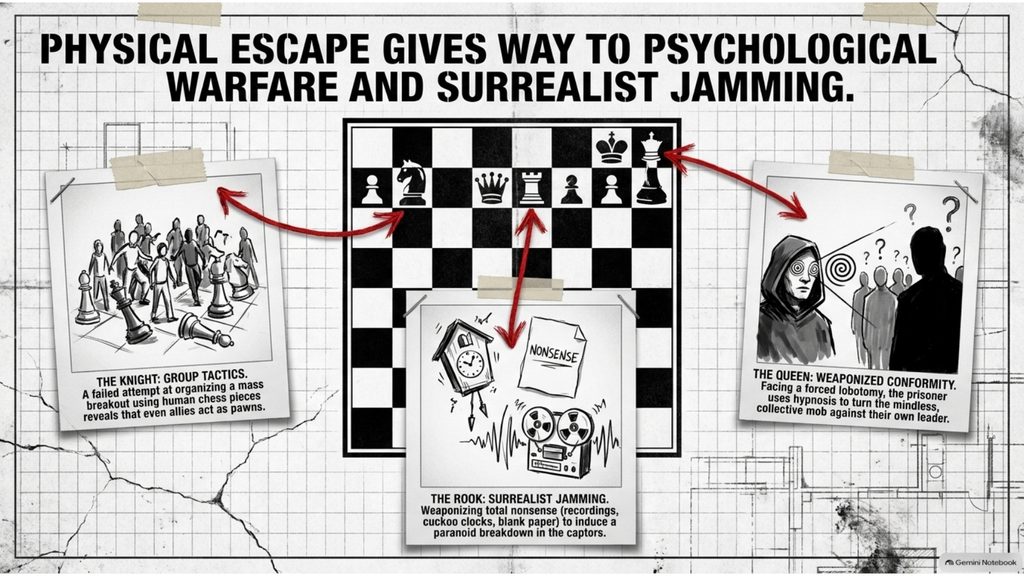
Number Six participates in a game of human chess played on a giant lawn chessboard, where human prisoners serve as pieces under the direction of two grandmasters [cite: 6, 15]. Six observes that one of the players, an old man acting as a Rook, becomes overly immersed in his role and is dragged away to the hospital for displaying “individualistic” behavior [cite: 6]. This inspires Six to formulate a psychological method for distinguishing genuine prisoners from hidden Village warders: warders exhibit an innate habit of giving orders and asserting authority, whereas real prisoners demonstrate submissive, obedient reflexes [cite: 6].
Six systematically recruits a group of verified prisoners to mount a coordinated escape attempt [cite: 6]. They construct a radio transmitter to jam the Village radar systems and seize control of a coastal patrol boat [cite: 6]. The plan proceeds with precision; the radar is disabled, and Six reaches the patrol vessel [cite: 6]. However, just as they prepare to sail out of range, the Rook—whom Six had recruited as a key co-conspirator—becomes overwhelmed by his re-conditioned fear of authority [cite: 6]. Believing Number Six to be an undercover warder testing his loyalty, the Rook signals Number Two (Peter Wyngarde) and disables the boat, sabotaging the escape and demonstrating how systemic psychological conditioning leads captives to police themselves [cite: 6].
Episode 10: “Hammer into Anvil”
- Writer: Roger Woddis | Director: Pat Jackson | Original UK Airdate: 1 December 1967 [cite: 6]
- Number Two: Patrick Cargill [cite: 6, 7]
A sadistic, militaristic Number Two (Patrick Cargill) brutally torments a young female prisoner, Number Seventy-Three, attempting to force her to betray her husband [cite: 6]. Driven to despair by Number Two’s cruelty, Number Seventy-Three commits suicide by throwing herself out of a hospital window [cite: 6]. Outraged, Number Six directly threatens Number Two, quoting Goethe: “You must be anvil or hammer” [cite: 6]. Number Two arrogantly promises to hammer Six into submission, prompting Six to launch a campaign of pure psychological warfare designed to turn Number Two’s intense paranoia against himself [cite: 6, 7].
Six executes a series of seemingly meaningless, highly suspicious acts [cite: 6, 7]. He buys six copies of a Bizet record at the music shop, places a classified ad in the Tally Ho newspaper featuring a quote from Don Quixote, leaves blank sheets of paper hidden in a stone boat, and flashes arbitrary Morse code signals out to sea with a flashlight [cite: 6]. Convinced that these actions represent the operations of a high-level internal security inspector sent by central command (“XO4”) to evaluate his administration, Number Two begins suspecting his own staff of treason [cite: 6]. As Number Two’s paranoia escalates, he orders the arrest of his own loyal subordinates [cite: 6]. Finally, Six confronts the shattered administrator, who begs Six not to report his failures to Number One, leading Number Two to resign in terror [cite: 6].
Episode 11: “It’s Your Funeral”
- Writer: Michael Cramoy | Director: Robert Asher | Original UK Airdate: 8 December 1967 [cite: 6]
- Number Two: Derren Nesbitt (New) / André van Gyseghem (Retiring) [cite: 6]
A young woman, Number Fifty (Annette Andre), approaches Number Six with a frantic warning that an assassination attempt is being planned against the retiring Number Two (André van Gyseghem) [cite: 6]. Initially suspecting a trap, Six investigates and learns that the assassination is being staged by the incoming, ambitious young successor (Derren Nesbitt) [cite: 6]. The new Number Two intends to detonate an explosive hidden inside the ceremonial Great Seal of Office during the public Appreciation Day ceremony, frame a non-compliant prisoner for the murder, and use the crisis to assume absolute power [cite: 6].
Six discovers that Number Fifty’s father, an elderly watchmaker (Martin Miller), is being manipulated into constructing the detonator mechanism under the belief that he is aiding a revolutionary escape group [cite: 6]. Realizing that a successful political assassination will result in mass reprisals and severe collective punishment across the entire Village, Six intervenes [cite: 6]. He manages to reach the retiring Number Two, showing him edited video footage proving that his ambitious successor is setting him up [cite: 6]. During the Appreciation Day ceremony, Six intercepts the assassin in the clock tower, secures the detonator, and transfers the explosive Seal of Office to the neck of the new Number Two [cite: 6]. Handing the detonator to the retiring administrator as his “passport out of the Village,” Six watches the old man depart by helicopter, dryly warning the panicked new Number Two that a similar retirement ceremony awaits him [cite: 6].
Episode 12: “A Change of Mind”
- Writer: Roger Parkes | Director: Patrick McGoohan (credited as “Joseph Serf”) | Original UK Airdate: 15 December 1967 [cite: 6]
- Number Two: John Sharp [cite: 6]
Number Two (John Sharp) targets Number Six’s non-conformity by turning the Village population against him through organized social ostracization [cite: 6]. After Six fights off two Village thugs in the woods, the local newspaper, the Tally Ho, officially brands him as “Unmutual” [cite: 6]. The citizenry instantly shuns Six, turning away in silence whenever he approaches [cite: 6]. A hostile mob marches him to the Village hospital, where Number Two announces that Six will be subjected to “Instant Social Conversion”—a surgical lobotomy procedure using ultrasonic waves to sever his aggressive impulses [cite: 6].
Six is strapped down and undergoes the procedure under the supervision of a female technician, Number Eighty-Six (Angela Browne) [cite: 6]. Returning to the Village, Six displays a placid, submissive demeanor [cite: 6]. However, upon returning to his flat, he discovers that the lobotomy was a complete sham; the procedure was faked, relying on a powerful drug slipped into his tea to make him believe he had been lobotomized [cite: 6]. Six pours out the drugged tea, switches cups during Number Eighty-Six’s next visit, and tricks her into drinking her own sedative [cite: 6]. Using hypnotism on the drugged technician, Six instructs her to publicly turn the conditioning process against Number Two [cite: 6]. At a public assembly, Number Eighty-Six steps forward and declares Number Two to be “Unmutual,” causing the mob to turn on Number Two and chase him through the streets [cite: 6].
Episode 13: “Do Not Forsake Me Oh My Darling”
- Writer: Vincent Tilsley | Director: Pat Jackson | Original UK Airdate: 22 December 1967 [cite: 6]
- Number Two: Clifford Evans [cite: 6]
To retrieve the location of a missing scientist named Professor Seltzman—who has developed mind-transference technology—the Village authorities utilize Seltzman’s device to swap the mind of Number Six into the physical body of another man, an operative named the Colonel (Nigel Stock) [cite: 6]. (This episode was specifically written to accommodate Patrick McGoohan’s temporary absence while filming the feature film Ice Station Zebra in Hollywood) [cite: 6].
Awakening in his former London apartment in an unfamiliar body, Number Six retains his memories but finds that his fiancée, Janet Portland (Zena Walker), and his former superiors refuse to recognize his identity [cite: 6]. Determined to reverse the process, Six uses an alphanumeric cipher hidden within a collection of slide photographs to track Professor Seltzman (Hugo Schuster) to Kandersfeld, Austria [cite: 6]. Village operatives tail Six, capture both men, and bring them back to the Village to force Seltzman to perform a permanent mind-reversal procedure [cite: 6]. Seltzman agrees, but secretly modifies the apparatus: he restores Number Six’s mind back into his original physical body (Patrick McGoohan), transfers the Colonel’s mind into his own old body (which promptly dies), and implants his own mind into the Colonel’s youthful body, escaping the Village in a helicopter before Number Two realizes the deception [cite: 6].
Episode 14: “Living in Harmony”
- Writer: David Tomblin and Ian L. Rakoff | Director: David Tomblin | Original UK Airdate: 29 December 1967 [cite: 6, 18]
- Number Two: David Bauer [cite: 6, 18]
In an episode framed entirely as an American Wild West melodrama, a lawman (Patrick McGoohan) turns in his badge and gun, resigning from his position [cite: 6, 18]. Ambushed in the desert, he wakes up in a dusty frontier town named “Harmony” [cite: 6, 18]. The town judge, Judge Mears (David Bauer), offers him the job of town Sheriff, but he steadfastly refuses to carry a firearm or wear a badge [cite: 6, 18].
The Judge subjects the former Sheriff to physical provocations, using an unhinged gunslinger named The Kid (Alexis Kanner) to intimidate him [cite: 6, 18]. When a saloon woman named Kathy (Valerie French) attempts to help the Sheriff escape, she is strangled by The Kid [cite: 6, 18]. Driven to action by Kathy’s murder, the Sheriff straps on his guns, shoots The Kid dead, and confronts the Judge [cite: 6, 18]. At that moment, the Western reality shatters: the Sheriff wakes up in a modern Village laboratory [cite: 6, 18]. The entire Wild West scenario was an elaborate, drug-induced psychodrama enacted on a cardboard set designed to test whether Number Six could be forced to abandon his pacifist principles and pick up a gun [cite: 6, 18]. Stepping outside the set, Six finds the dead bodies of the actors who played The Kid and Kathy, killed in real life by the psychological trauma of the experiment [cite: 6, 18].
Episode 15: “The Girl Who Was Death”
- Writer: Terence Feely | Director: David Tomblin | Original UK Airdate: 18 January 1968 [cite: 6]
- Number Two: Kenneth Griffith [cite: 6]
In a high-camp parody of James Bond-style spy thrillers (adapted from an unused script originally written for Danger Man), Number Six investigates the assassination of a British military officer killed by an explosive cricket ball [cite: 6]. Six assumes the officer’s place and is targeted by a seductive female assassin named Sonia (Justine Lord), who calls herself “Death” [cite: 6].
Six evades a series of surreal murder attempts engineered by Sonia: poison served at a pub, a lethal steam trap in a Turkish bath, an explosive boat in a fairground tunnel of love, and a bazooka attack in a deserted village [cite: 6]. Six tracks Sonia to a coastal lighthouse, which serves as the secret headquarters for her father, Professor Schnipps (Kenneth Griffith), a megalomaniac dressed as Napoleon who plans to destroy London with a giant rocket [cite: 6]. Six infiltrates the lighthouse, sabotages the weaponry of Schnipps’s uniformed henchmen, converts the launch system to detonate the missile on the pad, and escapes by sea as the base explodes [cite: 6].
The entire story is abruptly revealed to be a whimsical bedtime story being read by Number Six to children in the Village nursery [cite: 6]. Number Two (Kenneth Griffith) and his assistant (Justine Lord) had been monitoring the story, hoping Six would drop his guard and reveal classified information during the narration [cite: 6]. Realizing he has frustrated their plan once again, Six looks directly into the surveillance camera and smiles [cite: 6].
Episode 16: “Once Upon a Time”
- Writer: Patrick McGoohan | Director: Patrick McGoohan | Original UK Airdate: 25 January 1968 [cite: 6, 10, 19]
- Number Two: Leo McKern [cite: 6, 9, 10, 19]
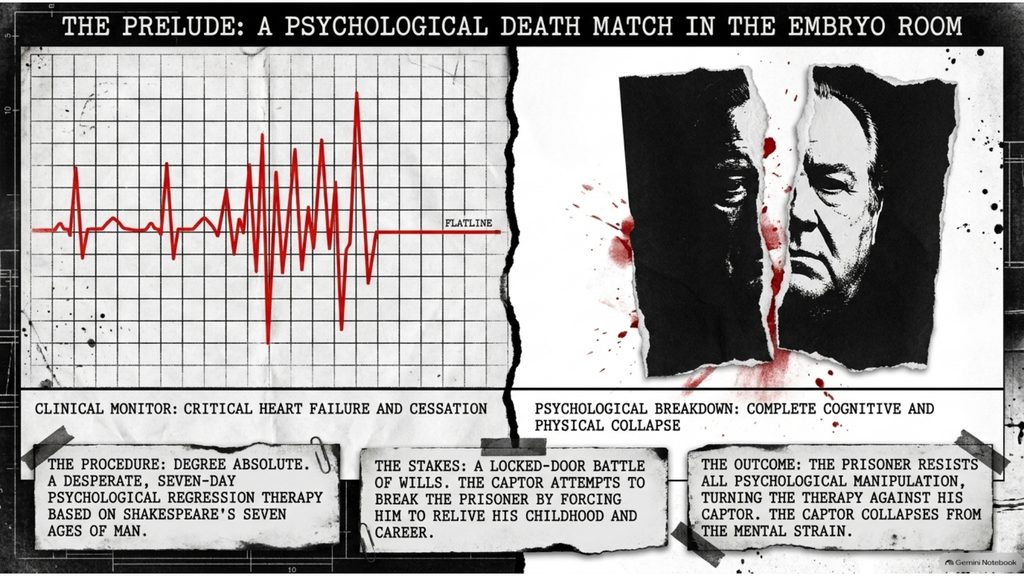
Faced with repeated failure to break Number Six, the Village authorities recall the Number Two from “The Chimes of Big Ben” (Leo McKern) [cite: 10, 19]. Apoplectic and desperate, Number Two receives permission to initiate “Degree Absolute”—an extreme, lethal psychiatric technique that reverts the subject to an infantile mental state, forcing captor and captive into a closed psychodramatic duel to the death [cite: 8, 10, 19]. Number Six is drugged and locked inside a subterranean bunker known as the “Embryo Room” alongside Number Two and the silent Butler (Angelo Muscat) [cite: 10, 19]. The room is sealed by a master timer for a duration of seven days; only one man is expected to emerge alive [cite: 10, 19].
Over the course of the week, Number Two forces Six through Shakespeare’s Seven Ages of Man, acting as various authoritarian figures in Six’s life: father, headmaster, military commander, and employer [cite: 10, 19]. During these dramatic enactments, Six resists admitting why he resigned, stubbornly refusing even to utter the word “six” [cite: 8, 19, 20]. As the days progress, the intense physical and emotional strain takes a severe toll on Number Two, who suffers a near-total mental breakdown [cite: 8, 19, 21]. On the final day, playing a military interrogator holding Six as a prisoner of war, Number Two demands total submission [cite: 10, 19].
Six suddenly breaks out of his regressive trance, taking control of the psychodrama [cite: 10]. Turning the interrogation back on his captor, Six asks Number Two a devastating, simple question: “Why don’t you resign?” [cite: 10]. Exhausted, mentally broken, and overwhelmed by the psychological duel, Number Two suffers a fatal heart attack and collapses dead just as the seven-day timer expires [cite: 8, 10, 21]. The doors to the Embryo Room open, and the Supervisor (Peter Swanwick) enters [cite: 10, 21]. Surveying the corpse, the Supervisor asks Number Six what he requires [cite: 10, 21]. Six calmly replies: “Number One” [cite: 10, 21]. The Supervisor agrees to lead him to the central authority, setting the stage for the final confrontation [cite: 10, 21].
——————————————————————————–
Detailed Breakdown of the Series Finale: “Fall Out”
Comprehensive Plot Narrative and Visual Structure
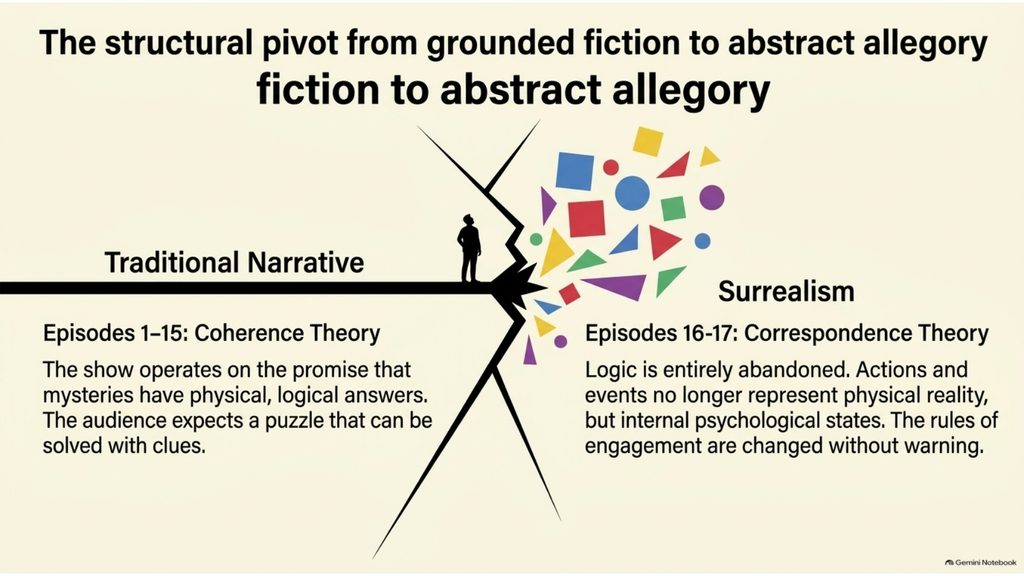
Written and directed by Patrick McGoohan, the finale episode, “Fall Out” (broadcast on 1 February 1968), abandons traditional television narrative logic in favor of avant-garde, theatrical symbolism [cite: 9, 19]. The episode omits the iconic opening title sequence, replacing it with a recap of the climax of “Once Upon a Time” [cite: 7, 9].
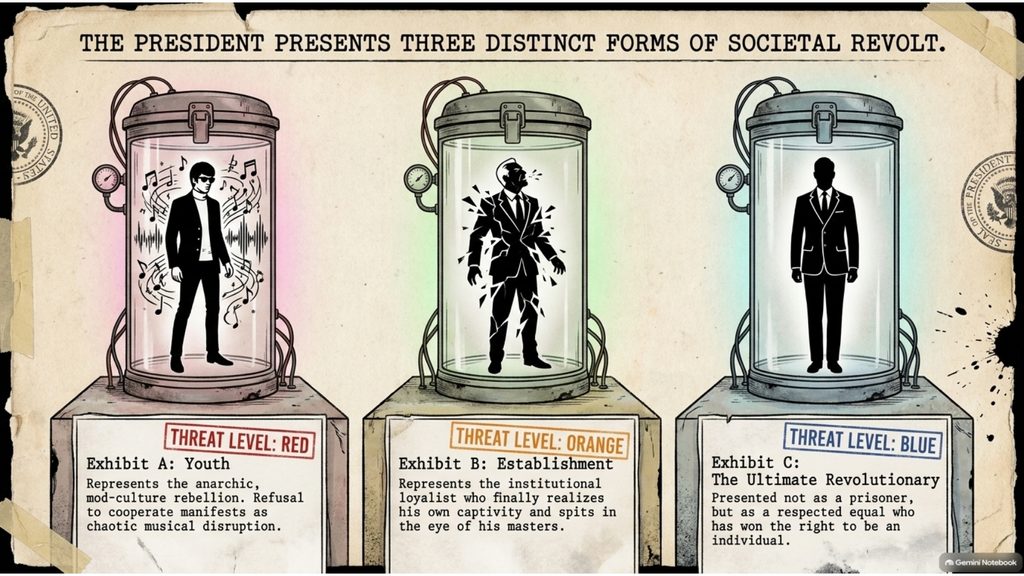
Following his victory in the Embryo Room, Number Six is escorted by the Supervisor and the Butler down a subterranean tunnel into a vast, cavernous hall built beneath a nuclear missile silo [cite: 7, 9]. The hall is filled with rows of masked delegates wearing black-and-white hooded robes representing various facets of global society [cite: 9]. At the center sits a judge known as the President (Kenneth Griffith), flanked by an armed guard [cite: 9]. The President formally welcomes Number Six, announcing that by surviving the ordeal of Degree Absolute, Six has won the ultimate right: “the right to be an individual” [cite: 9].
Before Six can be granted his freedom, he is forced to observe the judicial processing of two other rebellious figures [cite: 9]:
- Number Forty-Eight (Alexis Kanner): Representing unbridled, nihilistic youth culture, Number Forty-Eight refuses to recognize the authority of the court, speaks in nonsensical 1960s beatnik slang, and leads the hooded delegates in a chaotic, rowdy rendition of the spiritual song “Dem Bones” [cite: 7, 9]. The court convicts him of mindless rebellion and seals him inside an underground “orbit” tube [cite: 9].
- Resuscitated Number Two (Leo McKern): Revived through medical technology, the former administrator is brought before the assembly [cite: 9]. Stripped of his authority, Number Two defies the system, declaring his independence and spitting at the central surveillance eye of Number One [cite: 9]. He is likewise sentenced and locked into an orbit tube [cite: 9].
Number Six is elevated to an ornate throne, dressed in fine robes, and offered ultimate power, vast financial wealth, or complete freedom to leave [cite: 9, 13]. He steps up to a podium to deliver his final address to the assembly [cite: 9]. However, every time he utters the word “I…”, his voice is instantly drowned out by the synchronized, deafening chants of the hooded delegates yelling “Aye! Aye! Aye!…”, demonstrating that collective political structures inherently suppress individual expression [cite: 9].
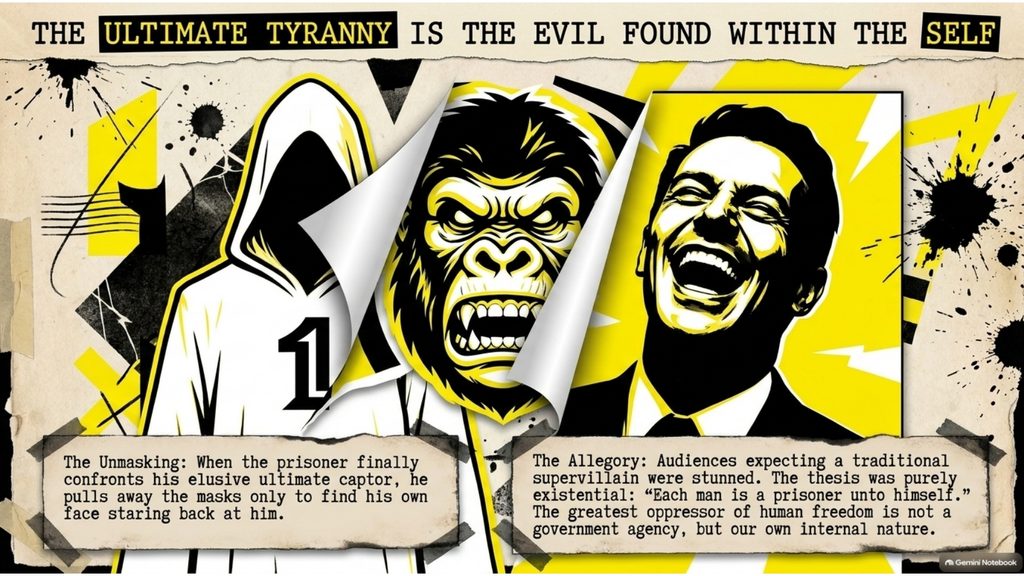
Abandoning the speech, Six enters the central metallic cylinder containing the nuclear missile [cite: 9]. He descends past the orbit tubes housing Number Two and Number Forty-Eight, climbing an iron ladder into the apex of the rocket control chamber [cite: 7, 9]. There, he encounters a robed figure holding a crystal globe, watching surveillance monitors [cite: 9]. Six pulls off the figure’s white hood, revealing a furred gorilla mask beneath [cite: 9]. Six tears off the gorilla mask, revealing the ultimate horror beneath: an exact, manic duplicate of Number Six’s own face, laughing hysterically and chattering like a maniac [cite: 9, 13].
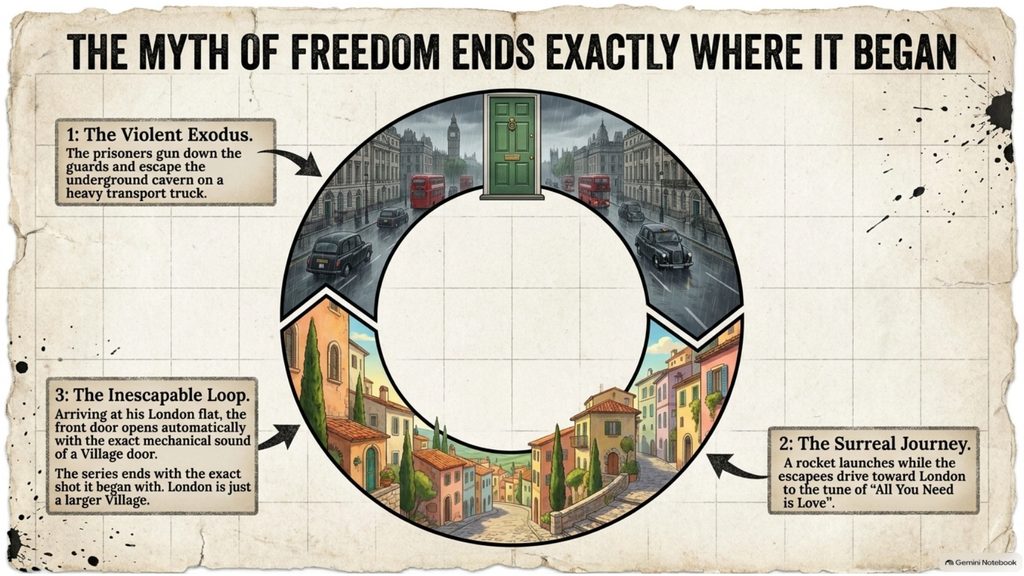
The duplicate flees up an escape ladder, and Number Six initiates the countdown sequence for the nuclear missile [cite: 9]. The missile ignition triggers a panic and complete evacuation of the Village [cite: 9]. Six releases Number Two, Number Forty-Eight, and the Butler from their holding cells [cite: 9]. Armed with submachine guns, the four men engage in a wild, chaotic gunfight against the Village security forces, set to the tune of The Beatles’ “All You Need Is Love” [cite: 9].
They escape the burning Village aboard a Scammell mechanical horse low-loader truck carrying a wooden trailer house [cite: 9]. As the rocket launches, Rover is destroyed by the heat exhaust, dissolving into a harmless blob of foam [cite: 9]. The truck travels across the English countryside to London [cite: 9]. Upon reaching the city, the escapees disperse [cite: 9]: Number Forty-Eight hitches a ride on a rural road, wandering off into the world; Number Two enters the Houses of Parliament, reassuming his place within the British political establishment; and the Butler escorts Number Six back to his original apartment building at Buckingham Gate [cite: 9].
Number Six steps into his Lotus Seven sports car and drives away down the highway [cite: 2, 9]. Back at his residence, the front door shuts automatically with the exact pneumatic sound effect used throughout the Village [cite: 9]. The frame freezes, accompanied by the thunderclap sound effect from the series’ opening sequence, directly looping the viewer back to the beginning of the series [cite: 9].
Allegorical Meaning and Philosophical Breakdown of Number One
The revelation that Number One is a duplicate of Number Six himself represents one of the most radical narrative resolutions in television history [cite: 9, 22]. This visual metaphor yields multiple layers of philosophical and psychological interpretation:
| Philosophical Dimension | Analytical Interpretation of “Fall Out” |
|---|---|
| Existential Self-Captivity | Number One represents the internal ego and human dark side; as McGoohan noted, “Each man is a prisoner unto himself” [cite: 9, 13]. |
| The Illusion of Resistance | Rebellion against institutional power is cyclical; revolutionaries often unconsciously reproduce the structures they seek to destroy [cite: 9]. |
| Political Hypocrisy | The extreme individualist’s desire for absolute autonomy is functionally identical to the desire to exert total control over others [cite: 9, 13]. |
| The Universal Loop | Society itself is an inescapable enclosure; physical escape from one system merely transitions the individual to a broader macro-prison [cite: 4, 9]. |
In contemporary interviews, Patrick McGoohan stated that Number One represents the dark, irrational, and authoritarian impulses inherent within every human being [cite: 9, 13]. As McGoohan noted: “The most evil force driving humanity is within ourselves. We are constantly fighting that evil part of our nature. That is why I made Number One an image of Number Six” [cite: 9, 13]. The ultimate antagonist is not an external government or foreign power, but the individual’s own ego and capacity for self-destruction [cite: 9, 13].
The automated closing of Six’s London front door and the structural looping back to the opening shot of the series signifies that absolute freedom is an illusion [cite: 9]. Society itself is a vast, interconnected Village [cite: 4, 9]. Escaping one physical enclosure merely returns the individual to the macro-prison of conventional civil society [cite: 4, 9]. By showing Number Six facing his own face beneath the mask of Number One, the narrative implies that supreme individualism, carried to its extreme conclusion, leads to megalomania and totalitarianism [cite: 9, 13].
The following table categorizes the episodes by these thematic phases, outlining the core psychological or physical mechanisms deployed against Number Six.
| Episode Title | Thematic Phase | Core Mechanism of Control/Torture |
| Arrival | Introduction & Rebellion | Deprivation of liberty and establishment of total surveillance. |
| Free For All | Introduction & Rebellion | The illusion of democracy; the manufacturing of electoral consent. |
| Checkmate | Introduction & Rebellion | Psychological profiling; weaponizing paranoia among peers. |
| Dance of the Dead | Introduction & Rebellion | Legal erasure; the absurdity of bureaucratic tribunals. |
| The Chimes of Big Ben | Introduction & Rebellion | The weaponization of hope; betrayal by simulated allies. |
| A, B and C | Torture & Probation | Pharmacological manipulation; invasion of the subconscious mind. |
| The Schizoid Man | Torture & Probation | Epistemological warfare; doppelgängers and the theft of identity. |
| The General | Torture & Probation | Subliminal indoctrination; technological idolatry and mass education. |
| Many Happy Returns | Torture & Probation | Geographic disorientation; the illusion of the physical escape. |
| Hammer Into Anvil | Torture & Probation | Counter-insurgency; Number Six utilizes paranoia against his captors. |
| It’s Your Funeral | Torture & Probation | False flag operations; manipulating the populace to justify martial law. |
| A Change of Mind | Torture & Probation | Social ostracization; the pathologization of political dissent. |
| Do Not Forsake Me Oh My Darling | Torture & Probation | Mind-body separation; the ultimate violation of the physical self. |
| Living in Harmony | Surreal Climax | Hallucinogenic virtual reality; the allegory of pacifism vs. systemic violence. |
| The Girl Who Was Death | Surreal Climax | Satirical deconstruction; confronting the absurdity of the espionage genre. |
| Once Upon a Time | Surreal Climax | Regressive psychotherapy (“Degree Absolute”); the lethal psychological duel. |
| Fall Out | Surreal Climax | Absurdist theater; confronting the Shadow self and the illusion of freedom. |
Production Constraints, Crisis, and Behind-the-Scenes Realities
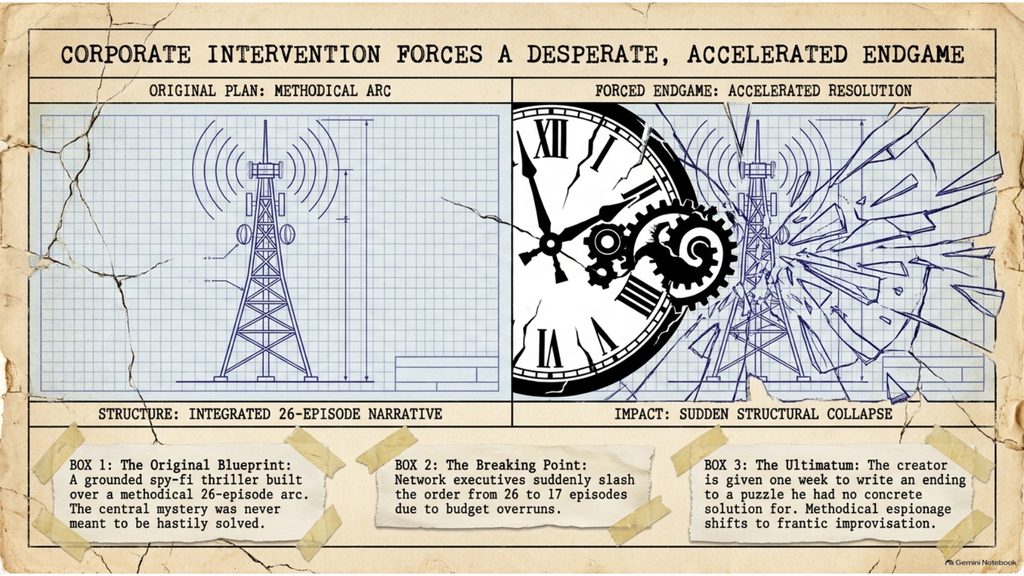
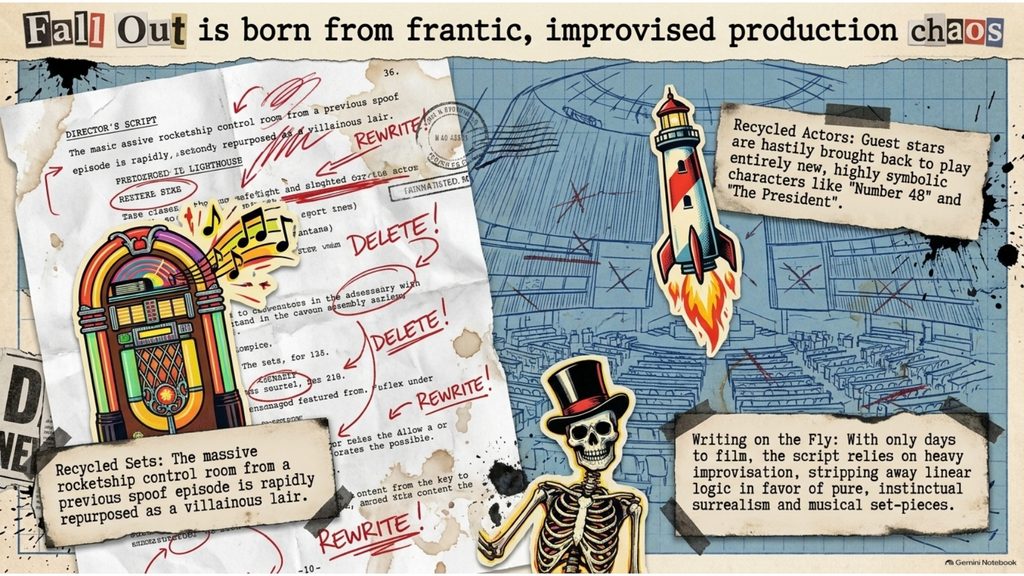
The radical, surreal nature of “Fall Out” was heavily shaped by sudden production crises and severe financial limitations [cite: 7, 13, 23]. Lew Grade had originally intended for the series to run for a full two seasons comprising 26 or 30 episodes [cite: 12, 13]. However, escalating production delays, budget overruns, and McGoohan’s exhaustion led Grade to cancel the series after 17 episodes [cite: 12, 13, 23]. Word reached McGoohan during the shooting of episode 15 (“The Girl Who Was Death”) that he had only two weeks to script and film a series conclusion [cite: 7, 23].
McGoohan wrote the entire script for “Fall Out” over a single weekend in a feverish rush, having had no pre-planned resolution for who or what Number One would be [cite: 7, 9, 23]. To save money, production repurposed sets constructed for “The Girl Who Was Death”, transforming Professor Schnipps’s lighthouse rocket room into the subterranean silo of Number One [cite: 7, 9]. Guest actors Kenneth Griffith and Alexis Kanner were brought back immediately to play completely different roles (the President and Number Forty-Eight, respectively) [cite: 7, 9]. Griffith was even asked by McGoohan to write his own trial dialogue due to time constraints [cite: 9]. Demonstrating his total control and auteur stance, McGoohan stripped his executive producer and lead actor credits from the opening and closing billing of “Fall Out”, crediting himself solely as writer and director [cite: 9].
Public Backlash, Critical Reception, and Cultural Legacy
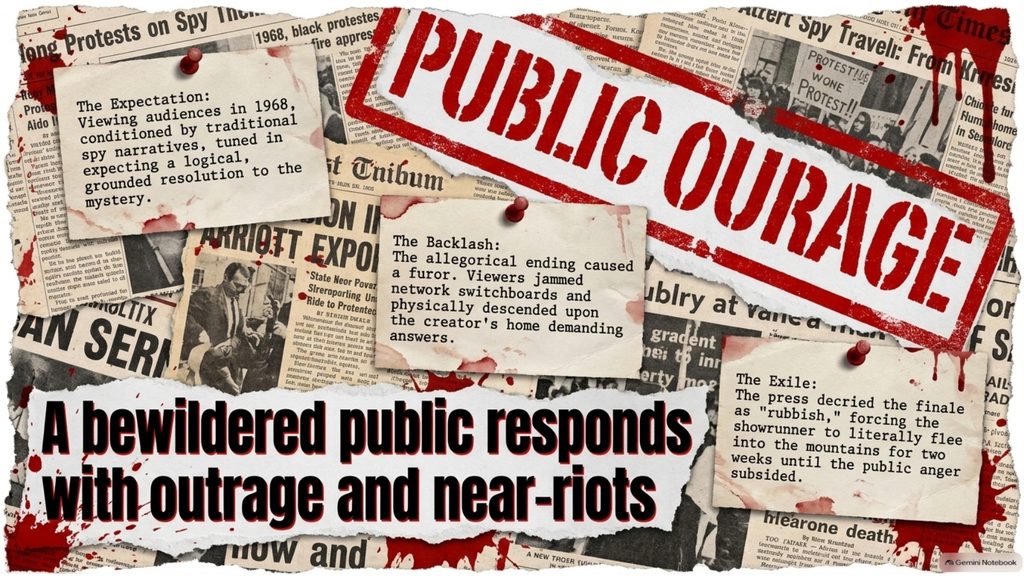
The broadcast of “Fall Out” on ITV on 1 February 1968 generated immediate, unprecedented public outrage across the United Kingdom [cite: 9, 23]. Expecting a straightforward espionage resolution—such as the destruction of a foreign spy ring, a clear political revelation, or a physical escape—viewers were deeply baffled and angered by the episode’s surreal, allegorical, and open-ended nature [cite: 9, 12, 23].
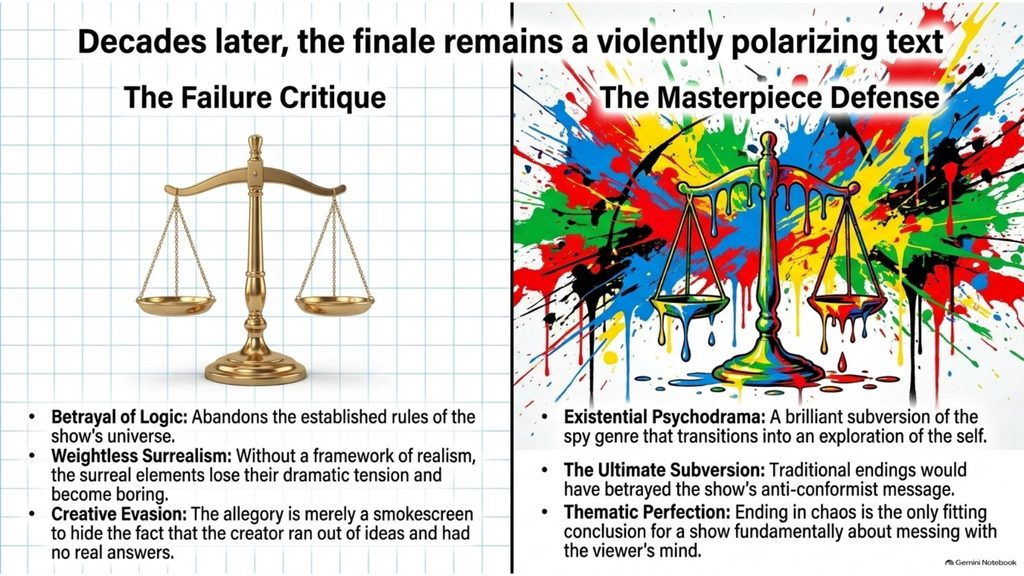
Thousands of angry callers jammed the switchboards of ITV regional stations and national newspapers [cite: 23]. The public backlash was so severe that Patrick McGoohan was ambushed outside his London home by irate viewers, forcing him to temporarily flee with his family to his cottage in Wales before permanently relocating to the United States shortly thereafter [cite: 9]. Script editor George Markstein publicly dismissed the finale as an “absurd pantomime” that abandoned the series’ original premise [cite: 12].
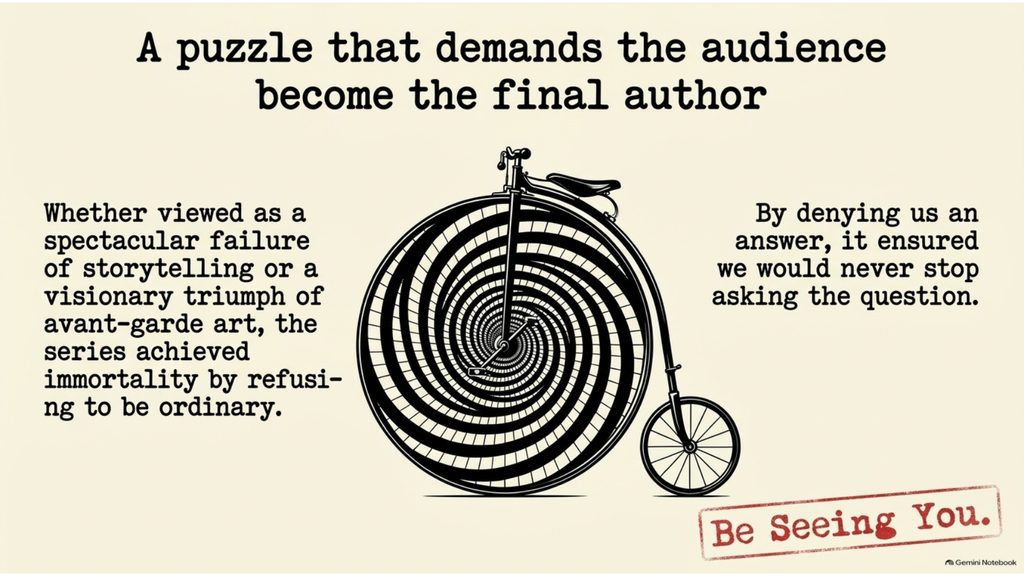
Despite the initial hostility, “Fall Out” has undergone extensive critical re-evaluation over subsequent decades [cite: 9, 16]. Media historians and television scholars now celebrate the finale as a revolutionary moment in broadcasting history—a work that defied network expectations, rejected conventional narrative closure, and proved that television drama could operate as high art, existential philosophy, and avant-garde social commentary [cite: 2, 4, 9, 16].
Analytical Synthesis and Conclusion
The Prisoner remains an unmatched achievement in visual media, standing as a comprehensive critique of modern social systems, psychological coercion, and the fragile nature of human autonomy [cite: 2, 3, 5]. Through its synthesis of Cold War paranoia, avant-garde aesthetics, and existential philosophy, the series transformed a simple espionage narrative into a timeless allegory of human existence [cite: 2, 3, 4].
By refusing to provide easy answers, establishing an inescapable narrative loop, and revealing the ultimate antagonist to be the protagonist himself, Patrick McGoohan created a work that continues to challenge viewers [cite: 9, 13]. The Prisoner asserts that human freedom is not a static state granted by institutions, but a continuous, solitary struggle against both external societal coercion and internal human weakness [cite: 3, 9, 13].


——————————————————————————–
- The Prisoner: Arrival (1967) – Midnight Only, http://www.midnightonly.com/2017/05/09/the-prisoner-arrival-1967/
- The Prisoner – Wikipedia, https://en.wikipedia.org/wiki/The_Prisoner
- Panopticism, impartial spectator and digital technology, https://scielo.org.za/scielo.php?script=sci_arttext&pid=S1445-73772022000100002
- The Prisoner | Television Heaven, https://televisionheaven.co.uk/reviews/the-prisoner
- Overview of “The Prisoner” Series | PDF – Scribd, https://www.scribd.com/document/837874241/The-Prisoner
- List of The Prisoner episodes – Wikipedia, https://en.wikipedia.org/wiki/List_of_The_Prisoner_episodes
- The Prisoner: Episode by Episode – Essays on Each Individual Episode Published on the 50th Anniversary, https://theprisonerepisodebyepisode.wordpress.com/
- The Prisoner Review: “Once Upon A Time” (Episode 16), https://reviewnebula.wordpress.com/2019/09/30/the-prisoner-review-once-upon-a-time-episode-16/
- Fall Out (The Prisoner) – Wikipedia, https://en.wikipedia.org/wiki/Fall_Out_(The_Prisoner)
- Once Upon a Time (The Prisoner) – Wikipedia, https://en.wikipedia.org/wiki/Once_Upon_a_Time_(The_Prisoner)
- TV Review – The Prisoner – PopCult Reviews, https://popcult.blog/2024/12/20/tv-review-the-prisoner/
- The Prisoner (1967-1968) – The EOFFTV Review – WordPress.com, https://eofftvreview.wordpress.com/2019/07/29/the-prisoner-1967-1968/
- Fall Out is a total failure as a piece of drama and series finale, and it’s also an admission of failure from McGoohan : r/ThePrisoner – Reddit, https://www.reddit.com/r/ThePrisoner/comments/190ulw3/fall_out_is_a_total_failure_as_a_piece_of_drama/
- BJR – The Prisoner, https://theprisonerepisodebyepisode.wordpress.com/author/bjr67/
- Six of One – The Prisoner – Patrick McGoohan – Facts 1-50, http://www.portmeiricon.com/a.1-50.htm
- Miniseries – The Prisoner – Rotten Tomatoes, https://www.rottentomatoes.com/tv/the_prisoner_1967/s01
- The Prisoner: Miniseries, Episode 4 – Rotten Tomatoes, https://www.rottentomatoes.com/tv/the_prisoner_1967/s01/e04
- Living in Harmony (The Prisoner) – Wikipedia, https://en.wikipedia.org/wiki/Living_in_Harmony_(The_Prisoner)
- The Prisoner: Once Upon a Time (1968) | Midnight Only, http://www.midnightonly.com/2017/05/30/the-prisoner-once-upon-a-time-1968/
- The Prisoner: “Once Upon A Time” – A.V. Club, https://www.avclub.com/the-prisoner-once-upon-a-time-1798207352
- Once upon a Time (1968 episode) | Prisoner Wiki – Fandom, https://prisoner.fandom.com/wiki/Once_upon_a_Time_(1968_episode)
- That’s All Folks: When The Prisoner Finale Unmasked Number One – Paste Magazine, https://www.pastemagazine.com/tv/the-prisoner/the-prisoner-1967-tv-show-ending-patrick-mcgoohan
- What made Patrick McGoohan’s TV show ‘The Prisoner’ so unique and controversial?, https://www.quora.com/What-made-Patrick-McGoohans-TV-show-The-Prisoner-so-unique-and-controversial
