Category: General-General
The Enochian Nexus: A Socio-Intellectual History of the Dee-Kelley Partnership

Socio-Educational Backgrounds and the Crucible of Early Modern Science
The intellectual landscape of late sixteenth-century England was a highly fluid environment in which scholasticism, humanism, mathematical practitioner culture, and Hermetic-Cabalist philosophy intertwined.[1, 2, 3] John Dee was born on July 13, 1527, in London, entering a world defined by the political and religious transformations of the Tudor court.[2, 3] An exceptionally gifted student, Dee attended school in Chelmsford and London before matriculating at St. John’s College, Cambridge, in 1542 at the age of sixteen.[4] He received his Bachelor of Arts in 1548 and was appointed a founding fellow of Trinity College.[4]
It was during this early academic tenure that the public association between Dee’s mechanical brilliance and sorcery was first forged.[3, 5] For a theatrical production of Aristophanes’ Peace, Dee constructed a realistic, flying mechanical beetle that appeared to ascend to the ceiling of the hall with a man on its back.[4, 5, 6] This mechanical prop astounded and terrified the audience, sparking rumors of demonic conjuration that would shadow him for the rest of his life.[3, 4, 5]
Seeking advanced mathematical training unavailable in England, Dee traveled to the Continent in 1548, studying at the University of Leuven.[3, 4] In Leuven, he established lifelong personal and intellectual relationships with the premier cartographers and mathematicians of the age, including Gerardus Mercator, Abraham Ortelius, and Gemma Frisius.[3] He lectured in Paris on Euclidean geometry to packed audiences, demonstrating a brilliant grasp of both theoretical and applied mathematics.[3]
Upon his return to England, Dee leveraged his continental prestige to enter royal circles.[2, 4] Prior to the accession of Elizabeth I, Dee cast her personal horoscope and predicted she would ascend to the throne.[5] This mathematical “calculation” was viewed with intense suspicion by the Catholic regime of Queen Mary I, who had Dee arrested and charged with practicing sorcery against the Crown.[2, 5] Though acquitted, this trial established a permanent link between his mathematical practices and illegal divination.[2, 5]
Continue reading “The Enochian Nexus: A Socio-Intellectual History of the Dee-Kelley Partnership”The 2026/2027 Super El Niño: A Strategic Review of UK Weather, Food Security, and Economic Impacts
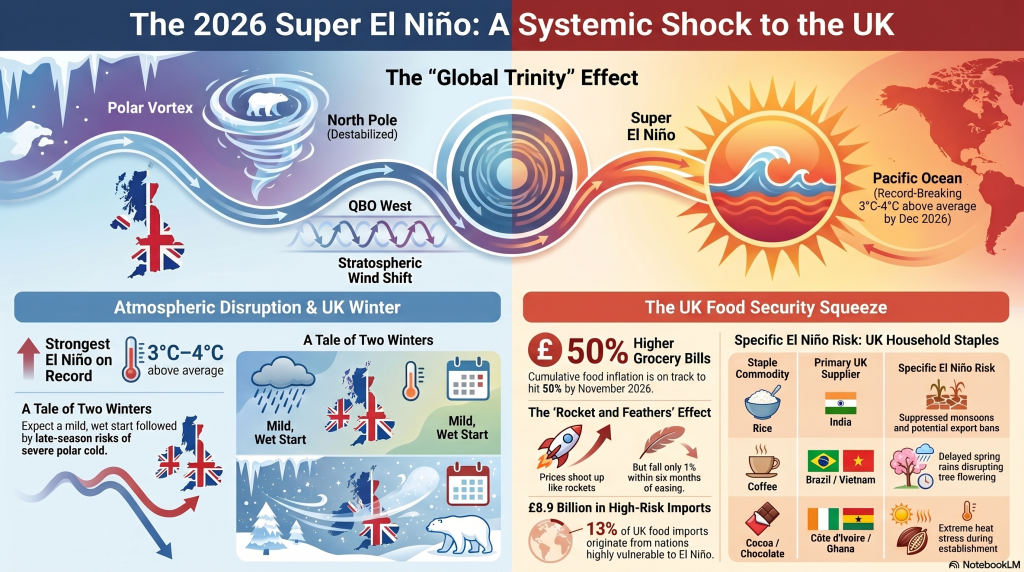
1. Understanding the Phenomenon: The Mechanics of the 2026 Super El Niño
The El Niño Southern Oscillation (ENSO) is the primary driver of global climate variability, and for the United Kingdom’s interconnected economy, its current trajectory represents a critical strategic risk. While ENSO is a Pacific-based cycle, it acts as a “global circulation reset,” triggering a reorganization of atmospheric patterns that reset weather conditions thousands of miles away. Understanding these mechanics is essential for navigating the systemic shocks now entering the North Atlantic corridor.
The 2026 event is characterized by a breakdown in the Walker Cell circulation. Typically, trade winds push warm surface water toward Asia, but a significant weakening—and in some regions, a reversal—of these winds has allowed a massive subsurface reservoir of heat to migrate eastward. This “Kelvin Wave,” driven by westerly wind bursts, is now surfacing in the eastern Pacific. As this energy is released into the atmosphere, it acts as a “pressure release valve” for years of accumulated oceanic heat, creating an “atmospheric bridge” that alters the global jet stream.
Current projections suggest the 2026 event will reach unprecedented severity, likely becoming the strongest El Niño in recorded history.
Continue reading “The 2026/2027 Super El Niño: A Strategic Review of UK Weather, Food Security, and Economic Impacts”Intelligence Assessment: The Strategic Profile, Networks, and Ideological Framework of Jiang Xueqin

Executive Summary
This comprehensive intelligence report presents an exhaustive evaluation of the operational profile, ideological framework, and collaborator network of Jiang Xueqin. Operating primarily under the moniker “Professor Jiang,” Jiang is a Chinese-Canadian educator, commentator, and highly influential YouTube personality whose content reaches millions of viewers globally.1 Through a rigorous, multi-disciplinary examination of his biographical timeline, his institutional affiliations within the People’s Republic of China, his ideological outputs, and his media networks, this assessment investigates the prevailing hypothesis that Jiang operates as an asymmetric influence asset aligned with the strategic objectives of the Chinese state apparatus—specifically its intelligence and United Front organs—rather than acting as an independent, Western-aligned intellectual.
The analysis reveals a highly sophisticated and deeply contradictory operational profile. To certain elite Western academic circles, Jiang successfully presents himself as a “civic-liberal” reformer and a “Burkean incrementalist” who harbors nuanced critiques of the Chinese Communist Party (CCP).2 However, his mass-media outputs deliver a concentrated, viral stream of anti-Western civilizational pessimism, predictive collapse narratives, and demonstrably false conspiracy theories tailored to demoralize American and European audiences.1 Furthermore, his rapid historical transition from a deported freelance journalist suspected of espionage in 2002 to a senior administrator at elite, state-linked Chinese educational institutions suggests a high likelihood of co-optation by Chinese state security services.1
By mapping his collaborative network—which heavily features known conduits of Russian state media and Chinese state-affiliated propagandists 6—and by deconstructing his deeply flawed methodological reliance on pseudoscientific “psychohistory,” biological fabrications, and virulent antisemitism 4, this report concludes that Jiang functions as a potent vector for multipolar information warfare. His primary utility lies in leveraging his Western academic credentials to degrade global trust in Western democratic institutions while remaining securely insulated within the protective architecture of the Chinese state.
Continue reading “Intelligence Assessment: The Strategic Profile, Networks, and Ideological Framework of Jiang Xueqin”The Epstein Files Transparency Act Disclosures: A Forensic Analysis of Strategic Influence, Compromise, and Geopolitical Risk

Executive Summary: The Architecture of Shadow Influence
The enactment of the Epstein Files Transparency Act (EFTA)—officially Public Law 119-38, signed into law on November 19, 2025 1—and the subsequent rolling release of over 3.5 million pages of documents by the Department of Justice between December 2025 and early 2026 has fundamentally restructured the historical understanding of Jeffrey Epstein’s operational network.2 While the initial prosecution of Epstein focused narrowly on sex trafficking crimes in Florida and New York, the EFTA disclosures reveal a far more complex reality: Epstein operated a high-level shadow brokerage of influence, intelligence, and financial leverage that penetrated the uppermost tiers of Western democracy, global finance, and technology.2
The release of these files has not merely been a tabloid event; it has precipitated a systemic crisis of governance across the G7. From the halls of the British Parliament, where the “John Pond” leaks have triggered police inquiries into state secret breaches 5, to the boardrooms of Silicon Valley, where resignation letters drafted by Epstein for Bill Gates’s staff suggest a deep-seated extortion racket 6, the “Epstein Chains”—discrete sequences of email correspondence—expose a pervasive culture of transactional morality among the global elite.
This report provides an exhaustive, forensic analysis of the top 10 most significant email chains identified within the EFTA tranches. These instances were selected not merely for the celebrity of the participants, but for their specific ramifications regarding political stability, national security, corporate governance, and legislative integrity. They document specific instances of operational collaboration, the trading of state secrets, legislative interference, and the deployment of “kompromat” (compromising material) for coercion.
Continue reading “The Epstein Files Transparency Act Disclosures: A Forensic Analysis of Strategic Influence, Compromise, and Geopolitical Risk”The Epstein-Nakamoto Nexus: A Forensic Analysis of Financial Influence, Cryptographic Origins, and the 2026 Disclosure Events

1. Executive Assessment and the 2026 Disclosure Paradigm
The release of the “Epstein Files” in early 2026, mandated by the Epstein Files Transparency Act (H.R. 4405) 1, has precipitated a paradigm shift in the historical understanding of Bitcoin’s developmental trajectory and the intricate web of influence surrounding its governance. While the pseudonymous identity of Satoshi Nakamoto remains technically unmasked, the newly declassified documents, combined with investigative reporting from 2025 and 2026, reveal a disturbing and extensive web of financial entanglement between Jeffrey Epstein and the architectural guardians of the Bitcoin network.
The central inquiry of this report—whether there are links between specific Satoshi candidates and Jeffrey Epstein—yields a complex, multi-layered answer that transcends simple binary associations. There is no definitive evidence in the current dossier to suggest Jeffrey Epstein is Satoshi Nakamoto, nor that he directly employed the pseudonym to author the white paper in 2008. In fact, evidence suggests Epstein was still being tutored on the mechanics of cryptocurrency as late as 2018 by associates such as Brock Pierce.3 However, the “behind Bitcoin” allegation holds substantial weight if interpreted as influence rather than invention. The evidence confirms that Epstein, acting as a strategic node for high-net-worth capital and intelligence networks, successfully infiltrated the governance of Bitcoin at its most vulnerable moment in 2015. Through the MIT Media Lab and direct investments in infrastructure companies like Blockstream, Epstein utilized his capital to “rescue” Bitcoin Core developers, thereby gaining proximity to the protocol’s code maintenance during the critical block-size wars.4
This report provides an exhaustive examination of these connections, categorizing them into direct financial patronage, social-intellectual influence via the “Edge” network, and geopolitical maneuvering involving Russian and Israeli interests. The analysis dissects the specific interactions between Epstein and key Satoshi candidates, the institutional capture of the MIT Digital Currency Initiative (DCI), and the broader implications of these revelations for the ethos of decentralization.
Continue reading “The Epstein-Nakamoto Nexus: A Forensic Analysis of Financial Influence, Cryptographic Origins, and the 2026 Disclosure Events”The Satoshi Enigma: A Forensic and Historical Analysis of Bitcoin’s Creator

Abstract
The identity of Satoshi Nakamoto, the pseudonymous creator of Bitcoin, remains the most significant unsolved mystery in modern financial history. Since the release of the Bitcoin white paper in October 2008 and the mining of the Genesis Block in January 2009, the persona of Nakamoto has been the subject of intense scrutiny, forensic analysis, and speculation. This report provides an exhaustive examination of the available evidence, ranging from cryptographic genealogy and linguistic stylometry to geographic profiling and behavioral analysis. By synthesizing data from the COPA v. Wright legal proceedings, historical mailing list archives, and technical analyses of pre-Bitcoin digital cash systems, we construct a probabilistic framework for identifying the individual or group behind the pseudonym. The investigation evaluates the primary candidates—Hal Finney, Nick Szabo, Len Sassaman, Adam Back, and Paul Le Roux—against a matrix of technical capability, operational security, and biographical consistency.
Continue reading “The Satoshi Enigma: A Forensic and Historical Analysis of Bitcoin’s Creator”