
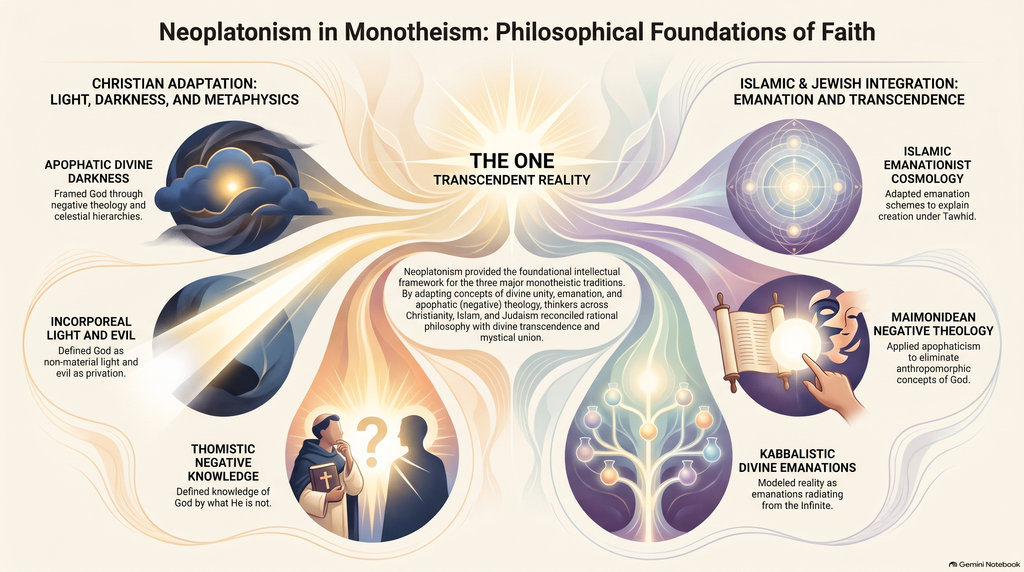
What if the highest form of knowing God requires surrendering every concept, image, and word you have ever used to describe the Divine? For centuries, Christian thinkers influenced by Neoplatonism have argued that God is not merely a supreme being among beings, but the infinite Source beyond Being itself—an incomprehensible reality encountered only by stepping into a “blinding darkness” of unknowing.
This guide equips Christian apologists with the metaphysical frameworks, historical foundations, and logical defenses necessary to articulate and defend Neoplatonic Christian mysticism. By completing this lesson, you will be able to:
- Analyze the dual methodologies of cataphatic and apophatic theology.
- Deconstruct the cosmic mechanics of remaining, procession, and reversion (mone, proodos, epistrophe).
- Evaluate the theological shift from Plotinus’s self-reliant intellectual ascent to Dionysius’s grace-filled, sacramental path toward theosis.
- Formulate compelling apologetic defenses against charges of pantheism, rationalism, and nihilistic agnosticism.
The God Beyond Being: Cataphasis and the Apophatic Ascent
At the heart of Neoplatonic Christian spirituality lies a radical premise: God’s intrinsic essence (ousia) is utterly transcendent, infinite, and beyond human comprehension. Drawing from Plato’s notion of the Good beyond Being, early Christian mystics like Saint Clement of Alexandria, Pseudo-Dionysius the Areopagite, and later Thomas Aquinas recognized that finite human intellects cannot comprehend an infinite Creator. When an apologist speaks of God, they must balance two distinct yet complementary paths of theology: cataphatic (affirmative) and apophatic (negative) theology.
Cataphatic theology operates by looking at creation and affirming true statements about God’s manifestations and energies. We say God is Goodness, Light, Life, Wisdom, and Love. These positive names are valid because creation reflects its Creator. However, cataphatic statements are inherently limited. Because God is infinite, He is not “good” in the exact same finite sense a human is good. Cataphasis is merely the starting step on the spiritual ladder.
Apophatic theology—the “negative way” (via negativa)—transcends these linguistic boundaries by systematically negating every human concept attributed to God. Apophasis asserts that God is not a physical object, nor a mental concept, nor even “a being.” Pseudo-Dionysius uses the prefix hyper- (above/beyond) to demonstrate this transcendence: God is not merely Good, but Hyper-agathos (Above-Goodness); He is not merely Being, but Hyper-ousios (Above-Being).
To understand this apophatic journey, consider the mental model of a sculptor carved by Pseudo-Dionysius. A sculptor does not build a statue by adding clay; rather, they carve away the surrounding marble to reveal the hidden form. Similarly, apophatic contemplation strips away finite concepts, mental idols, and linguistic definitions to draw the soul toward the Divine Mystery.
This journey culminates in what Pseudo-Dionysius terms the Divine Darkness (gnophos). This is not an evil or demonic pitch-blackness; rather, it is an intuitive metaphor drawn from Moses ascending Mount Sinai. Moses passed beyond sensory representations and intellectual concepts into the dense cloud on the mountain peak. This “darkness” is actually an over-abundance of unapproachable, blinding light—much like staring directly into the physical sun leaves a person temporarily unable to see. In this sacred darkness, discursive reasoning (syllogismos) falls silent, allowing the soul to experience God beyond human words.

Cosmic Architecture: Remaining, Procession, and Reversion
To defend the Christian mystical worldview, an apologist must understand how a transcendent God interacts with a created world without being diluted by it. Neoplatonic metaphysics resolves this through a continuous, three-fold metaphysical engine systematized by Proclus and adopted by Christian thinkers like John Scotus Eriugena and Pseudo-Dionysius: Remaining (Mone), Procession (Proodos), and Reversion or Return (Epistrophe).
The first movement, Remaining (Mone), asserts that God abides eternally in His own indivisible, unchangeable essence. When God creates, He suffers no loss of power, fragmentation, or alteration. He remains wholly transcendent, self-sufficient, and unmixed with creation.
The second movement, Procession (Proodos), describes the eternal, dynamic outpouring of God’s divine energy, light, and goodness into creation. God’s creative power radiates outward, bringing forth distinct levels of reality—from heavenly angelic orders down to physical matter. In Eriugena’s theology, these outpourings are understood as divine theophanies (theophania), or manifestations of God. Every created thing exists because it receives and reflects a ray of this divine procession.
The third movement, Reversion (Epistrophe), represents the innate yearning of every created entity to turn back toward its Source. Creation is not an aimless, linear timeline; it is a grand cosmic circle. Driven by a natural desire for the Good, created beings seek perfection by converting back toward God in contemplation, virtue, and prayer.
Crucially, this triadic engine safeguards Christian orthodoxy against pantheism (the belief that the universe and God are identical). God remains transcendent (mone) even while His operations and grace overflow throughout creation (proodos), drawing all things back to Himself (epistrophe). Creation is neither an evil trap nor an independent divine entity; it is a sacred mirror filled with divine tokens (synthemata) designed to lead the soul back to its Heavenly Father.

The Soul’s Ascent: From Plotinian Intellectualism to Dionysian Grace
A vital distinction every Christian apologist must master is the historical divergence between pagan Neoplatonism and Christian Neoplatonic mysticism regarding the nature of the human soul and salvation (soteriology).
Plotinus, the third-century founder of Neoplatonism, taught the doctrine of the “undescended soul.” He argued that a portion of the human soul remains permanently suspended in the intelligible realm, untouched by sin or material decay. Because the higher self remains divine, Plotinus believed humans could achieve mystical union (henosis) through their own natural intellectual effort, moral self-discipline, and philosophical dialectic. In this view, human reason is sufficient, and external rituals or divine interventions are unnecessary.
However, later Neoplatonists like Iamblichus, along with Christian thinkers like Pseudo-Dionysius, forcefully rejected this idea. Iamblichus recognized that human experience confirms our weakness: the human soul is fully descended (olo ousia) into matter, fragmented by bodily passions, ignorance, and vulnerability. Mere intellectual speculation (“god-talk” or theologia) is completely powerless to lift a fallen soul out of its material limitations.
Pseudo-Dionysius Christianized Iamblichus’s insight by replacing pagan ritual magic with Christian sacramental mysticism. Because the human soul is fully fallen and finite, the initiative for salvation must originate entirely from God. Humans cannot storm heaven by intellectual pride; rather, God condescends to humanity through divine grace and illuminations.
To bridge the infinite chasm between the Creator and the fallen soul, God imbues the material world and the Church with sacred sacraments, liturgies, and physical symbols (synthemata). Through active participation in sacramental life, prayer, and virtuous purification (katharsis), the soul is elevated. This process does not merely inform the mind; it divinizes the human person—a state early Church Fathers called theosis (deification). Through grace, human beings are made partakers of the divine nature (2 Peter 1:4), becoming by grace what God is by nature, without ever dissolving their distinct human identity.

The Apologist’s Defense: Answering Common Objections
When defending Neoplatonic Christian mysticism against critics—whether secular skeptics, rigid rationalists, or misinformed theologians—the apologist will encounter four primary objections. Here is how to navigate and refute each challenge using classic Neoplatonic Christian principles:
- Objection: “Apophaticism leads to nihilism or agnosticism. If you claim God cannot be named or conceptualized, you are essentially worshiping nothing.” Apologist Defense: Apophaticism is not agnosticism; it is hyper-affirmation. We negate finite concepts not because God lacks reality, but because He possesses an excess of reality. As Thomas Aquinas and Pseudo-Dionysius explained, saying “God is not a body” or “God is beyond being” does not reduce God to zero; it recognizes that He is the infinite Source of all bodies and being. Apophaticism prevents us from committing intellectual idolatry—reducing the infinite Creator to a manageable, finite concept made in our own mental image.
- Objection: “Claiming that creation emanates from God leads directly to Pantheism (everything is God).” Apologist Defense: This confuses Procession (Proodos) with identity. Neoplatonic Christian metaphysics insists on Remaining (Mone). God’s essence remains entirely unmixed, transcendent, and uncreated, while creation consists of created effects brought into being by His divine energies and illuminations. A sunbeam radiates from the sun, but the sunbeam is not the sun itself. Creation depends upon God for its existence at every second, but creation is not God’s internal essence.
- Objection: “Neoplatonism is anti-material and views the body as an evil prison.” Apologist Defense: While Gnostics viewed matter as an evil creation of a malicious deity, Neoplatonic Christianity vigorously defends the goodness of the material cosmos. Matter is the final, beautiful condensation of God’s creative procession. Furthermore, through the Incarnation of Christ and the establishment of sacraments, matter becomes a sacred vehicle of grace. Physical elements—water, oil, bread, wine, and sacred art—contain divine tokens (synthemata) that assist in purifying and elevating the soul.
- Objection: “Mysticism undermines logical orthodoxy and replaces theology with subjective feelings.” Apologist Defense: True Christian apophaticism does not discard logic or dogma; it anchors them. Dogmas and cataphatic statements provide the necessary, true guardrails for the mind. However, rational statements (kataphasis) are the stepping stones, not the final destination. As Saint Anselm declared in his phrase fides quaerens intellectum (faith seeking understanding), human reason must be exercised to its absolute limit, where it humbly recognizes its own boundaries and surrenders to direct, experiential communion (knowing God beyond mere rational information).

Summary
Neoplatonic Christian mysticism provides an intellectually rigorous and deeply transformative framework that harmonizes absolute divine transcendence with intimate, grace-filled immanence. By mastering apophatic theology, cosmic mechanics, and sacramental soteriology, the apologist can successfully defend the faith against rationalist reductionism, intellectual idolatry, and pantheistic confusion.
Key Takeaways:
- Cataphasis & Apophasis: Positive names describe God’s manifestations, but negative theology (apophasis) strips away finite concepts to encounter God in the blinding “Divine Darkness” (gnophos).
- Cosmic Rhythm: Reality unfolds through Remaining (Mone), Procession (Proodos), and Reversion (Epistrophe), preserving God’s transcendence while explaining creation’s return to the Good.
- Grace vs. Self-Reliance: Christian Neoplatonism rejects Plotinus’s undescended soul, affirming that a fully descended soul requires divine grace, sacraments, and liturgical synthemata to achieve theosis.
- Orthodox Defense: Mysticism is neither agnosticism nor pantheism; it is the humble fulfillment of reason, guarding against mental idolatry while facilitating direct experiential union with the Living God.
