
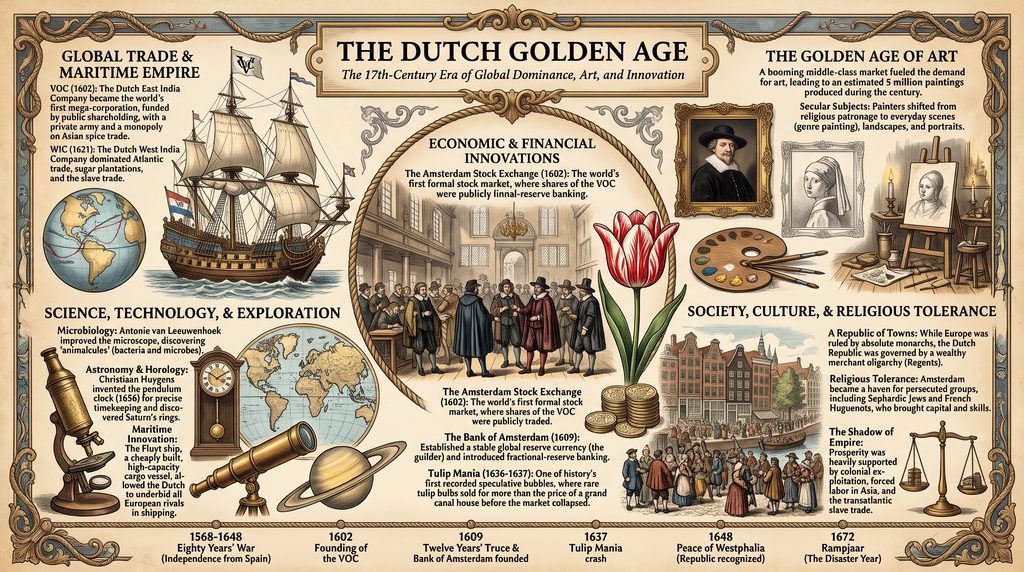
The history of the seventeenth-century Dutch Republic is defined by an absolute, seemingly irreconcilable paradox. Within the borders of its diminutive, waterlogged European geography, the Republic cultivated an unprecedented era of civic freedom, intellectual pluralism, and artistic mastery. It provided a sanctuary for religious minorities, pioneered the rule of international law, and fostered a scientific revolution, earning its enduring historiographical title: the “Golden Age” (Gouden Eeuw). Yet, simultaneously and systematically, this very same republic pioneered the armed multinational corporation, executed the genocide of indigenous populations in the Indonesian archipelago, industrialized the transatlantic chattel slave trade, and fed hundreds of thousands of its own domestic underclass into the lethal maritime meat grinder of its global logistics networks.
The “Problem Presenting” at the core of this book is not merely that these two realities coexisted in time, but that they were structurally, financially, and legally fused. The extreme civic freedom enjoyed by the Dutch urban oligarchy (the regenten) was fundamentally subsidized by the extreme outsourced violence of its corporate leviathans, the Verenigde Oostindische Compagnie (VOC) and the West-Indische Compagnie (WIC).
For centuries, historiography has attempted to manage this paradox through deliberate compartmentalization. Traditional, nationalist narratives celebrated the domestic institutions of the Republic while framing its colonial brutality as a regrettable, distant footnote. Conversely, modern post-colonial critiques often focus exclusively on the atrocities, sometimes struggling to account for the genuine, revolutionary institutional mechanics that allowed a population of 1.5 million to dominate the globe. This book rejects both compartmentalization and moralizing reductionism. Instead, it proposes a rigorous systemic analysis.
To understand the Dutch 17th century, we must reverse-engineer the corporate state. We must examine how the Republic invented revolutionary abstractions—the joint-stock share, the fiat ledger, the legal fiction of the “free sea,” and the aestheticized still-life painting—to meticulously launder the violence of primitive accumulation. By tracing the physical material flows of grain, silver, enslaved bodies, and lapis lazuli, this book forces the clean mathematics of the Amsterdam Beurs back into the mud, blood, and timber of the early modern supply chain.
The Systemic Architecture: A Roadmap
This manuscript approaches the Dutch corporate state not as a chronological timeline of battles and political successions, but as an interlocking thermodynamic and financial mechanism. The analysis is structured across nine chapters, moving from the foundational architecture of the state, through its operational realities, and culminating in the ongoing crisis of its historical and curatorial memory.
- Chapter 1: The Core Paradox: Civic Freedom and the Architecture of Corporate Extraction establishes the legal and spatial dualism of the Republic. It contrasts the civic humanism of the Stadhuis with the corporate autocracy of the Oost-Indisch Huis, demonstrating how the invention of the sovereign joint-stock company functioned as an impenetrable moral firewall between the domestic citizen and colonial violence.
- Chapter 2: The Engine of Ascendancy: Genesis, Financial Innovation, and the Moedernegotie identifies the true economic bedrock of the Republic. It traces how the unglamorous Baltic bulk trade (Moedernegotie) provided caloric security, while the Bank of Amsterdam abstracted physical wealth into the frictionless fiat ledger, creating a system that demanded a vast, disposable maritime proletariat to function.
- Chapter 3: Anomalies and Outliers: Speculative Bubbles, The Disaster Year (1672), and Republic Fragility tests the limits of this financial engine. It recontextualizes the Tulip Mania and the catastrophic Rampjaar not as bizarre aberrations, but as inevitable structural stress tests of a decentralized, hyper-financialized state that lacked deep sovereign resilience.
- Chapter 4: Deconstructing the Inevitable: Overstretch, Geography, and the Contingencies of Empire grounds the abstract financial hegemony of the Republic in physical reality. It examines the ecological cannibalism of peat extraction and the precarious terraforming of the waterschappen, proving that the Golden Age was a highly contingent, transient phenomenon heavily mortgaged against the geographic limits of its own sinking landscape.
- Chapter 5: The Corporate State: Pragmatism and Property Rights dismantles the anachronistic projection of modern democratic ideals onto the Republic. It reveals how the celebrated virtues of the era—religious toleration and intellectual liberty—were strictly managed by the regenten as economic utilities designed to optimize capital accumulation and protect property rights.
- Chapter 6: Outsourced Violence: Excluded Voices, Enslavement, and the Moral Void serves as the definitive anchor for the operational brutality of the corporate state. It details the VOC’s eradication of the Bandanese, the WIC’s industrialization of transatlantic slavery, and the lethal domestic demographic sink, proving that the moral void of the Republic was actively engineered, not passively inherited.
- Chapter 7: Towards Systemic Literacy: Polyvocal History, Material Flows, and Decentering the Regenten pivots the manuscript from historical narrative to historiographical methodology. It argues for a new systemic literacy that decenters the oligarchs, elevates the agency of the colonized and the maritime proletariat, and rigorously traces the material flows that built Amsterdam.
- Chapter 8: Navigating the Historiography: A Framework for Institutional vs. Materialist Perspectives deconstructs the 19th-century nationalist myth-making of historians like Fruin and Blok, revealing how the sanitized “Golden Age” narrative was weaponized to justify the contemporary horrors of the Cultuurstelsel in Java. It synthesizes the institutional and materialist perspectives to show how domestic liberty was deployed as the technology of global subjugation.
- Chapter 9: Reconciling High Culture with Brutal Economies: Curatorial Futures culminates the systemic analysis by addressing the contemporary crisis of memory. It grounds the abstraction of Dutch high culture in the physical supply chains of its pigments and canvases, framing the Golden Age masterpiece as a “visual ledger” of monopoly violence, and proposes a radical future of systemic curatorial display.
The Dutch Republic was the supreme laboratory of modern capitalism. It was the first society to discover that a state could achieve profound domestic liberty, rule of law, and aesthetic brilliance not by abandoning tyranny, but by corporatizing it, financializing it, and exporting it beyond the horizon. To untangle this legacy is to confront the foundational blueprint of the modern world.
Chapter 1: The Core Paradox: Civic Freedom and the Architecture of Corporate Extraction

The conceptualization of the Dutch Golden Age traditionally rests upon a narrative of miraculous civic and intellectual triumph. According to orthodox historiography, a diminutive, waterlogged federation of provinces, locked in an existential war of independence against the absolutist Spanish Habsburgs, willed itself into becoming the cultural, scientific, and financial epicenter of the 17th-century world. The defining paradox of this era—and the core thesis of this systemic analysis—is that the celebrated civic freedoms, domestic pluralism, and intellectual openness of the Dutch Republic were not merely coincidental to its brutal overseas colonial enterprise, but structurally and legally dependent upon it. The early modern Dutch state functioned as a highly engineered dual-system: a decentralized, relatively egalitarian bourgeois republic within Europe, sustained by an autocratic, violent, and extractive corporate-military apparatus outside of it.
To understand the Dutch 17th century is to examine the genesis of modern global capitalism, where the architecture of civic freedom was meticulously insulated from the mechanics of outsourced sovereignty. This chapter dissects the institutional and legal frameworks that allowed the Republic to simultaneously champion human liberty at home while pioneering the armed multinational corporation, thereby separating the domestic citizen from the violence that generated their dividends.
The Geography of Power: The Stadhuis and the Oost-Indisch Huis
The abstraction of this dual-state mechanism is best grounded in the physical geography of 17th-century Amsterdam. The architecture of the city perfectly mirrored the bifurcation of Dutch political and economic life. In the center stood the Stadhuis (City Hall, now the Royal Palace on the Dam Square), a monument to civic humanism. Built during the height of the Republic’s power, it was accessible to the citizenry, operating as the seat of the municipal court, the Bank of Amsterdam, and the civic guard. It was the physical embodiment of the rule of law, local sovereignty, and the transparent administration of the urban oligarchy (the regenten).
Yet, merely a short walk away on the Oude Hoogstraat sat the Oost-Indisch Huis (East India House). This sprawling complex served as the global headquarters of the Verenigde Oostindische Compagnie (VOC). Within its heavily guarded boardroom, the Heeren XVII (the Lords Seventeen)—the directors of the company, many of whom simultaneously served on the municipal council at the Stadhuis—managed a private empire. The Oost-Indisch Huis was not a civic building; it was the nerve center of a corporate leviathan, complete with its own arsenals, warehouses, and private intelligence networks.
The physical proximity of these two buildings belied a massive jurisprudential firewall. In the Stadhuis, the regent operated as a civic magistrate bound by Roman-Dutch law, constrained by the rights of the burgher, and committed to domestic stability. In the Oost-Indisch Huis, that same regent operated as an autocratic corporate director, unaccountable to the domestic populace, authorizing the bombardment of Asian ports and the enforcement of monopolies through mass starvation. The genius of the Dutch corporate state was designing a legal architecture that allowed the ruling class to walk seamlessly between these two buildings, employing extreme violence through the latter to subsidize the civic grandeur of the former.
The Sovereign Charter: Inventing the Corporate Leviathan
The friction between the Republic’s domestic liberty and its foreign tyranny was resolved through a profound institutional innovation: the invention of the joint-stock multinational corporation endowed with sovereign rights. When the States-General charted the VOC in 1602 (and later the West-Indische Compagnie, or WIC, in 1621), they did not merely create trading syndicates. They privatized the geopolitical expansion of the state.
The VOC charter represents the foundational blueprint for outsourced sovereignty. Article 35 of the charter explicitly granted the company the legal right to wage defensive and offensive wars, build fortresses, mint its own coinage, and negotiate treaties with Asian potentates in the name of the States-General. Operating as a state-outside-the-state, the VOC was authorized to project imperial violence globally without formally entangling the Dutch Republic in sovereign warfare in Europe.
This structure created a profound moral and financial abstraction. By structuring the VOC as a joint-stock company, the state divorced the ownership of the colonial enterprise from its administration. The charter opened investment to all citizens, meaning a Dutch artisan, baker, or Mennonite pacifist could purchase a share on the Amsterdam exchange. That share transformed the brutal realities of imperial subjugation into a sterile, abstract financial instrument. The corporate structure functioned as a moral firewall. The citizen-shareholder viewed their investment merely as property generating a dividend; they were legally and psychologically insulated from the lethal corporate discipline, the enslaved labor, and the military coercion required to produce that yield. By financializing colonial extraction, the Republic democratized the profits of imperialism while centralizing and hiding its violence behind the closed doors of the Oost-Indisch Huis.
Legalizing Monopoly: Grotius and the Jurisprudential Weaponization of Liberty
To sustain this dual-system, the Republic required an intellectual justification that could reconcile aggressive corporate expansion with the domestic self-image of a free, enlightened republic. This ideological architecture was forged through the weaponization of the very concepts of liberty and natural law, spearheaded by the brilliant young jurist Hugo Grotius.
The catalyst for this legal revolution was a brazen act of corporate piracy. In 1603, the VOC admiral Jacob van Heemskerck captured the Santa Catarina, a massive Portuguese carrack in the Strait of Singapore. The ship’s hold contained a staggering fortune in Ming porcelain, raw silk, and spices. However, the seizure presented a domestic crisis. The VOC was a private company, and Portugal, while unified with the Spanish crown, was not the primary belligerent in the Republic’s war of independence. Shareholders, particularly pacifist Mennonites, threatened to divest from a company engaging in unprovoked piracy.
To launder the seizure of the Santa Catarina, the VOC commissioned Grotius to draft a legal defense. The result was De Jure Praedae (On the Law of Prize and Booty), a chapter of which was published in 1609 as Mare Liberum (The Free Sea). Grotius argued that the ocean was international territory, fundamentally insusceptible to sovereign ownership, and therefore free for all nations to navigate and trade upon. He weaponized the language of universal liberty to legally invalidate the Iberian claim to a global maritime monopoly under the 1494 Treaty of Tordesillas.
However, a systemic analysis reveals the profound hypocrisy embedded in this jurisprudential weaponization. Mare Liberum was deployed strictly as a destructive mechanism against Spanish and Portuguese rivals. As soon as the VOC secured territorial and naval dominance in the Indonesian archipelago, the Dutch violently abandoned the principle of the “free sea.” They ruthlessly enforced their own draconian monopolies, barring English, Javanese, and Iberian merchants from the spice trade on pain of death or confiscation. The legal architecture of “freedom” was a targeted operational tactic; once the Republic secured the asset, the language of universal rights was instantly replaced by the enforcement of armed corporate exclusivity.
Nuance and Contradiction: The Stratification of Domestic Freedom
While the contrast between domestic civic liberty and overseas corporate tyranny defines the core paradox, it is vital to avoid treating the domestic sphere of the Dutch Republic as a utopian monolith. The “freedom” of the Golden Age was itself highly stratified, structurally engineered to serve the accumulation of capital.
The narrative of an egalitarian bourgeois society obscures the rigid oligarchic control exerted by the regenten. Though lacking aristocratic titles, this patrician class intermarried extensively and monopolized the municipal councils, the courts, and the corporate boardrooms. Social mobility existed, but it was largely restricted to the upper-middle commercial class. For the broader populace, the state functioned primarily as an apparatus to protect the assets and optimize the supply chains of the elite.
The famous Dutch policy of religious toleration (gedoogbeleid) further illustrates this pragmatic stratification. The Republic absorbed Sephardic Jews fleeing the Inquisition and Huguenots fleeing France not out of a secular commitment to human rights, but out of a ruthless commercial calculus. The regenten recognized that religious persecution disrupted trade, alienated foreign merchants, and drove away taxable capital. Minorities were protected so long as they remained economically useful and politically invisible; they were permitted to worship in clandestine churches but barred from public office. Intellectual freedom was similarly bounded. A citizen could read Spinoza, but when Spinoza’s radical rationalism threatened the fragile equilibrium between the Calvinist clergy and the merchant elite, his works were banned by the very state that prided itself on anti-censorship.
The architectural blueprint of the Dutch 17th century represents the inaugural triumph of the corporate state. The Republic demonstrated that a state could achieve extraordinary domestic pluralism, scientific advancement, and civic liberty not in spite of, but through its ability to systematically outsource exploitation. By inventing the legal fictions and corporate structures necessary to separate the citizen-shareholder from the violence of the armed monopoly, the regenten successfully firewalled the enlightenment of the Stadhuis from the brutality of the Oost-Indisch Huis.
Yet, this carefully engineered separation created an insatiable appetite. The architecture insulated the domestic populace from moral liability, but the state’s very survival in a hostile Europe now required a massive, uninterrupted flow of global capital to fund its defensive wars and its civic grandeur. To process, launder, and multiply the unimaginable wealth returning in the hulls of the East Indiamen, the Republic had to invent a revolutionary financial engine—an engine that would propel them to absolute hegemony, while simultaneously introducing the exact mechanisms that would expose their deepest vulnerabilities.
Chapter 2: The Engine of Ascendancy: Genesis, Financial Innovation, and the Moedernegotie

The legal and structural architecture of the Dutch corporate state, as established in the Oost-Indisch Huis, created an insatiable systemic appetite. To project armed monopolies across the globe while simultaneously maintaining domestic stability in a marshy, resource-poor European federation required an unprecedented, continuous flow of capital. The traditional historiographical imagination of the Dutch Golden Age is overwhelmingly dominated by the aesthetics of the VOC spice trade—heavily armed East Indiamen returning from Batavia laden with nutmeg and cloves. However, a rigorous systemic analysis reveals that the true engine of the Republic’s ascendancy was far less glamorous, yet infinitely more foundational.
The core thesis of this chapter is that the extreme wealth and civic infrastructure of the 17th-century Dutch Republic were generated by a synergy of two massive systems: the Moedernegotie (the unglamorous “Mother Trade” in Baltic bulk goods) and the invention of revolutionary financial abstractions. By securing monopolistic control over Europe’s caloric and material lifelines, the Republic freed its own domestic workforce. Simultaneously, by inventing the fiat ledger and the tradable joint-stock share, Amsterdam translated the chaotic, physical realities of early modern trade into clean, frictionless financial instruments. This chapter will deconstruct this economic engine, demonstrating how it weaponized capital, absorbed a massive, disposable demographic sink of maritime labor, and abstracted the brutalities of global commerce into the sanitized mathematics of the ledger.
The Genesis of Concentration: The Fall of Antwerp and Geographic Arbitrage
The sudden rise of Amsterdam as a global hegemon was not a gradual evolutionary process, but an explosive capitalization on a geopolitical catastrophe. For much of the 16th century, Antwerp (in the Spanish-controlled Southern Netherlands) was the commercial capital of northern Europe, serving as the primary hub for Portuguese spice distribution, German silver, and English wool. However, the Eighty Years’ War fundamentally ruptured this ecosystem. In 1585, following a brutal siege, the Spanish Habsburgs captured Antwerp.
In a masterstroke of economic warfare that would define their geopolitical strategy for a century, the rebelling northern provinces (the Dutch Republic) blockaded the Scheldt River, Antwerp’s vital artery to the North Sea. This blockade was aggressively maintained, effectively destroying Antwerp’s maritime economy overnight. The immediate consequence was a massive, forced migration of human and financial capital northward, primarily to the relatively secure, easily defensible city of Amsterdam. Tens of thousands of wealthy Flemish merchants, skilled textile artisans, and Sephardic Jewish financiers fled the Spanish Inquisition and the ruined southern economy.
This influx provided the nascent Republic with a sudden, massive concentration of liquid capital, international trade networks, and intellectual diversity. However, capital alone does not build an empire, particularly in a region structurally devoid of essential natural resources. The Republic possessed no timber for its fleets, no stone for its fortresses, and insufficient arable land to feed its densely packed urban population.
The Republic’s survival relied entirely on geographic arbitrage. Situated precisely at the nexus of the North Sea and the Rhine-Meuse-Scheldt delta, the Dutch were perfectly positioned to exploit the most critical trade route of the early modern era: the corridor between the resource-rich, agrarian Baltic Sea and the rapidly growing, resource-starved populations of southern and western Europe. The Dutch turned their geographic vulnerability—the absolute necessity of waterborne trade for sheer survival—into an aggressive, outward-facing mercantile dominance.
The Moedernegotie: Caloric Security and Technological Efficiency
While the VOC spice trade yielded astronomical profit margins on small volumes, it was a highly volatile, high-risk venture subject to shipwreck, piracy, and prolonged warfare. The true economic bedrock of the Republic—the trade that provided the massive, steady capital surpluses required to fund both the state and its corporate leviathans—was the Moedernegotie.
The “Mother Trade” involved the bulk shipment of grain (rye and wheat), timber, hemp, tar, and iron from the Baltic regions (primarily Poland, Prussia, and Livonia, via ports like Danzig) to Amsterdam, and from there to the rest of Europe. By the early 17th century, the Dutch effectively monopolized this route. They achieved this not through military force, but through devastatingly efficient technological and logistical innovation, most notably the invention of the fluitschip (fluyt) in the 1590s.
The fluyt was a dedicated cargo vessel designed purely for maximum economic efficiency. It featured a pear-shaped hull to maximize cargo volume, utilized specialized rigging that required a significantly smaller crew than English or Hanseatic ships, and was intentionally designed with a narrow deck. This final feature was a direct, structural response to the Sound Tolls—the transit taxes exacted by the Danish crown at the Øresund strait, which were calculated based on the square footage of a ship’s main deck. By minimizing the deck and maximizing the hull, the Dutch mathematically optimized their tax burden.
Through the fluyt, the Dutch drove shipping costs to the floor, pricing all European competitors out of the Baltic. Amsterdam evolved into Europe’s central staple market (stapelmarkt). The Dutch bought Baltic grain at rock-bottom prices during harvest gluts, stored it in massive waterfront warehouses in Amsterdam, and held it until crop failures, warfare, or famines struck the Iberian Peninsula or the Mediterranean. They then released the grain at exorbitant markups. This was a system of global caloric arbitrage.
The Moedernegotie fundamentally altered the socio-economic structure of the Republic. Because the Dutch imported their food so cheaply and reliably, they were the first European nation freed from the constraints of subsistence agriculture. This allowed the domestic workforce to urbanize rapidly and pivot toward highly specialized, high-value, export-oriented industries: refining sugar, weaving textiles, brewing beer, cutting diamonds, and painting canvases. Furthermore, the Baltic timber and hemp provided the raw material for the Republic’s massive, mechanized shipyards in the Zaan district, enabling the rapid construction of the very naval fleets that would eventually conquer the Indonesian archipelago.
The Demographic Sink: The Exploitation of the Maritime Proletariat
The celebratory narrative of the Golden Age often attributes this economic brilliance to the egalitarian spirit of the Dutch burgher. However, a systemic analysis of this engine reveals profound domestic contradictions and harsh demographic realities. The Moedernegotie, the whaling fleets, and the VOC required a staggering amount of human labor. The Republic, with its tiny native population of roughly 1.5 million, could not physically man the thousands of ships required to maintain this global logistics network.
Consequently, the Dutch economic engine functioned as a massive demographic sink, pulling in hundreds of thousands of impoverished migrants from Germany, Scandinavia, and the Spanish Netherlands, alongside the poorest echelons of Dutch society. This vast, disposable maritime proletariat was the physical muscle of the Republic, yet they were entirely excluded from its civic prosperity.
In Amsterdam and other port cities, a predatory network of zielverkopers (literally “soul sellers,” or crimps) preyed on these desperate migrants. The crimps offered them squalid room and board in exchange for signing over their first months of VOC or naval pay. Once aboard the heavily armed East Indiamen or the cramped Baltic fluyts, these sailors and soldiers were subjected to a totalitarian disciplinary regime designed to maximize corporate efficiency.
Mortality rates were astronomical. Aboard the VOC fleets bound for Batavia, the combination of scurvy, typhus, malaria, and corporate warfare resulted in staggering losses. It is estimated that roughly one million men sailed for the VOC in Asia over its two-century existence, and less than a third ever returned to Europe. The immense wealth generated on the Amsterdam exchange was concentrated entirely in the hands of the regenten—the patrician oligarchy that controlled both the municipal governments and the corporate boardrooms. The vaunted civic stability of the Republic, free from the massive peasant revolts that plagued contemporary France, was achieved by continuously funneling its surplus poor and foreign migrants into a lethal maritime machine. The domestic underclass was systematically fed into the gears of global logistics to ensure the unbroken flow of dividends to the urban elite.
The Invention of the Ledger: The Bank of Amsterdam
By the early 1600s, the caloric security of the Moedernegotie and the influx of southern capital had made Amsterdam immensely wealthy. However, this wealth was trapped in a highly inefficient, chaotic, and physical European monetary system. Merchants dealt in hundreds of different physical coins from various kingdoms, bishoprics, and city-states. These coins were subject to constant debasement by desperate monarchs fighting endless wars, and were frequently clipped or shaved by merchants to extract the precious metals.
To resolve this friction, the municipal government of Amsterdam established the Amsterdamsche Wisselbank (Bank of Amsterdam) in 1609. The Bank was a revolutionary institutional innovation that fundamentally changed the nature of wealth. It required merchants to deposit their chaotic physical coinage in the bank’s vaults. The bank’s assayers would weigh and evaluate the exact gold or silver content of the coins and credit the merchant’s account with an equivalent amount of a new, abstract, and entirely stable fiat currency: the bank florin (or bankgeld).
Because the bank florin was guaranteed by the city of Amsterdam and, in its early decades, backed by a 100% reserve ratio of physical bullion, it quickly traded at a premium (the agio) over physical coin. More importantly, the Bank introduced the mechanism of the ledger. Merchants could now settle massive international debts simply by transferring ledger balances between accounts at the Wisselbank.
This conceptual shift was profound. The Bank of Amsterdam effectively eliminated the physical movement of gold and silver in daily high-level commerce. Wealth was abstracted into pure mathematics. The ledger sanitized capital. It stripped the money of its physical origins, translating the messy, violent reality of global trade into a clean column of numbers. The Bank of Amsterdam functioned as the central clearinghouse for global trade, drastically lowering transaction costs, stabilizing exchange rates, and making Amsterdam the undisputed financial capital of the world. It was a mechanism of profound institutional trust, creating a financial architecture so robust that even merchants from nations actively at war with the Republic kept their capital safely lodged in Amsterdam’s vaults.
Financializing Empire: The Beurs and the Moral Firewall
With the caloric security of the Moedernegotie ensuring physical survival, and the ledger of the Wisselbank ensuring monetary stability, the Republic possessed the massive capital surpluses necessary to weaponize its commerce. The ultimate synthesis of this financial engine was the application of the ledger to corporate warfare through the Amsterdam Stock Exchange (Beurs).
When the VOC was founded in 1602, it was initially conceived with a ten-year liquidation clause. However, in 1612, the Heeren XVII refused to liquidate the capital, recognizing that building a permanent network of fortresses in Asia required locked-in funding. Instead, they allowed investors to sell their shares to third parties. This created the world’s first active secondary market for corporate equity.
The Beurs financialized empire. By allowing joint-stock shares to be traded openly, the state decoupled the individual investor’s capital from the operational timeline of the corporation. A citizen could invest in the brutal, decades-long process of building a colonial monopoly, but liquidate their position for cash on a Tuesday afternoon. The share price became an abstraction of the company’s imperial success, entirely divorced from the physical acts of violence required to generate it.
This financial architecture was the final, critical engine of Dutch ascendancy. It allowed the VOC and later the WIC to mobilize unprecedented levels of private capital to fund their sovereign mandates. But more importantly, it completed the systemic architecture of the corporate state. The ledger of the Wisselbank and the shares traded on the Beurs served as an impenetrable psychological and moral firewall. They allowed the domestic citizens of the Republic to reap the immense dividends of colonial extraction—funding their immaculate canal houses, philanthropic orphanages, and the vibrant public sphere of the Golden Age—without ever having to witness, manage, or take moral responsibility for the brutality that generated them.
The Dutch Golden Age was powered by an engine of profound abstraction. The Moedernegotie provided the physical calories and the timber, while exploiting a vast and silent maritime proletariat. The Bank of Amsterdam and the Beurs translated the spoils of that physical labor and the violence of the VOC into the pristine mathematics of the ledger. The problem presenting in the Republic’s ascendancy is that this engine was built on the premise of perpetual optimization and limitless credit. Yet, the very financial abstractions that insulated the Republic from the moral liability of its empire also disconnected its economy from physical reality, leaving it acutely vulnerable to internal speculative gravity and the geopolitical limits of its own overextension.
Chapter 3: Anomalies and Outliers: Speculative Bubbles, The Disaster Year (1672), and Republic Fragility

The historiographical construct of the Dutch Golden Age is frequently anchored by an image of continuous, rational, and seamlessly managed prosperity. The Dutch regenten are typically portrayed as sober, calculating stewards of a decentralized republic, steering their state through the turbulent waters of 17th-century European geopolitics with an almost flawless administrative competence. The financial engine of the Bank of Amsterdam and the Beurs, established in the previous chapter, implies a system of perfect economic equilibrium. Yet, this idealized narrative of perpetual solvency and rational civic action shatters when confronted with two of the era’s most profound anomalies: the speculative contagion of the Tulip Mania (1636–1637) and the catastrophic near-collapse of the Republic during the Rampjaar, or Disaster Year (1672).
The core thesis of this chapter is that these events were not bizarre aberrations, “black swans,” or temporary lapses in Dutch Calvinist rationality. Rather, they were the inevitable, structural stress tests of a highly financialized, decentralized corporate state that lacked the deep sovereign backing of a traditional monarchy. The same institutional architecture that enabled extreme civic freedom, hyper-efficient capital accumulation, and global colonial extraction also produced a system uniquely vulnerable to speculative bubbles and cascading institutional insolvency. By examining these outliers, we can map the friction between the celebrated “Golden Age” narrative and the material reality of a republic that was, beneath its immense abstracted wealth, structurally overextended and geopolitically fragile.
The Mechanics of Mania: Financialization and the Windhandel
The traditional recounting of the Tulip Mania often moralizes the event, reducing it to a cautionary tale of “crowd madness” where irrational burghers traded fortunes for a single Semper Augustus bulb. However, a systemic historical analysis reveals that the crisis of 1636–1637 was a highly rational outcome of the financial innovations pioneered by the Dutch Republic. The tulip bubble was the direct byproduct of the immense liquidity generated by the Moedernegotie and the colonial monopolies, combined with the invention of sophisticated, unregulated derivative markets.
To understand this anomaly, one must examine the mechanics of the Windhandel—literally, the “wind trade.” By the mid-1630s, the physical trade in tulip bulbs, which could only be uprooted and exchanged during their brief late-summer dormancy period, had been entirely abstracted. Dutch merchants and artisans, operating in the taverns of Haarlem, Amsterdam, and Leiden, began trading promissory notes for bulbs that were still in the ground, and in many cases, for bulbs that had not yet been cultivated. This was the birth of the modern futures market.
The Windhandel was fueled by a dangerous democratization of credit within a decentralized state. The sudden influx of wealth from overseas colonial extraction and the Baltic bulk trade had created an environment of excess domestic liquidity searching for high-yield returns. The Bank of Amsterdam stabilized high-level corporate and international trade, but it did not function as a modern central bank; it did not regulate domestic lending or cap leverage for ordinary citizens. Consequently, a vast secondary market of municipal and interpersonal credit emerged. Buyers in the tavern colleges did not need to produce capital upfront; they traded on extreme margins, utilizing a complex web of mutual debt obligations.
The tulip became a purely financialized asset, entirely disconnected from its intrinsic agricultural value. The systemic glitch here was not psychological, but institutional. The Republic had invented the financial architecture to abstract value (the ledger, the share, the futures contract) without inventing the corresponding regulatory state apparatus to manage systemic domestic risk.
The Legal Freeze: Protecting the Core at the Expense of the Contract
When the tulip market inevitably collapsed in February 1637—triggered when buyers at a routine auction in Haarlem simply refused to honor the inflated futures contracts—the ensuing crisis exposed the limits of the regent legal framework.
Because the contracts were legally ambiguous, operating outside the formal strictures of the Beurs, a strict enforcement of the debts would have triggered a total cascade of bankruptcies across the middle and lower-middle classes of Holland. The foundational ideology of the Dutch Republic was the absolute sanctity of the contract and the protection of property rights. However, the municipal councils (controlled by the regenten) were forced into a stark systemic choice: uphold the strict letter of the law and destroy the domestic economy, or intervene and violate their own foundational principles.
The oligarchs chose systemic self-preservation. The provincial Court of Holland effectively froze the enforcement of tulip contracts. They relegated the massive debts to the jurisdiction of local city magistrates, who pushed for settlements at a tiny fraction (often 3% to 10%) of the contracted price, or simply allowed the contracts to evaporate. The Tulip Mania demonstrated that the Republic’s vaunted financial architecture could easily turn inward, creating systemic domestic risk. The resolution proved that the corporate state’s ultimate loyalty was not to abstract legal principles of individual debt enforcement, but to the macroeconomic preservation of the capital engine. The state absorbed the glitch by simply erasing the ledger of the lower classes, preserving the stability of the elite’s corporate investments.
The Façade of Administrative Invincibility and Terrestrial Neglect
The vulnerability exposed by the tulip market was a microcosm of a much larger, structural deficiency within the Republic: the systemic flaw of its decentralized military governance. The Seven United Provinces operated without a strong central executive. The States-General in The Hague was essentially an assembly of delegates from the provincial estates, with the province of Holland—and specifically the city of Amsterdam—wielding disproportionate power because it supplied over 58% of the federal budget.
This federated structure meant that the Republic’s defense was not funded by a unified national treasury, but by a quota system (Repartitie). Each province was statutorily obligated to contribute a specific percentage to maintain the State Army and fortify the Generality Lands (the southern buffer zones). However, the ruling regent oligarchs were fundamentally merchants, heavily invested in the maritime supply chains of the Moedernegotie, the VOC, and the WIC. They consistently prioritized keeping domestic taxation low and funding the naval fleets over maintaining a robust standing land army.
By the mid-17th century, the Republic was functionally operating on a model of extreme administrative overextension. The provincial governments, particularly in the wealthy west, routinely fell short of their statutory financial obligations for terrestrial defense in the poorer eastern provinces (Gelderland, Overijssel). They relied on a dangerous, arrogant calculus: assuming that their immense wealth could always be used to hire foreign mercenaries at the eleventh hour, or that their naval supremacy and complex diplomatic alliances would deter any terrestrial invasion.
This structural underfunding of the State Army, driven by the oligarchic prioritization of global commercial extraction over sovereign terrestrial security, created a hollow shell of military capability on the Republic’s eastern and southern borders. The regenten had built an economic titan that was simultaneously a geopolitical glass cannon. The very abstraction that made Amsterdam rich—viewing defense as a purchasable commodity rather than a sovereign duty—left the physical territory of the state critically exposed.
The Rampjaar (1672): Systemic Collapse and Institutional Insolvency
The consequences of this decentralized financial and military shortfall culminated in the catastrophic Rampjaar (Disaster Year) of 1672. The geopolitical contingencies that had allowed the Dutch to rise in the early 17th century—namely, the internal civil wars and distractions of France and England—had evaporated. Louis XIV of France, infuriated by Dutch economic hegemony, Protestant arrogance, and punitive tariffs, secretly negotiated the Treaty of Dover with Charles II of England. They aligned with the Prince-Bishops of Münster and Cologne to execute a coordinated, existential strike on the Republic.
In the spring of 1672, the illusion of Dutch invincibility was shattered. While the English attacked the Dutch fleet by sea, an allied force of over 120,000 men under French command bypassed the heavily fortified southern Dutch border (the Spanish Netherlands) and invaded from the east, marching straight into the under-defended heartland of the Republic.
The resulting collapse was virtually instantaneous, exposing the fragility of the regent administration. The fortress cities of the eastern provinces, structurally underfunded and neglected for decades, fell within days. The sudden realization that the state could no longer meet its most fundamental obligation—the physical protection of its citizens and their property—triggered widespread institutional panic. It was akin to a catastrophic municipal bankruptcy cascading at a national level. The state effectively issued declarations of its own defensive inability.
This military collapse immediately tested the core of the Republic’s financial engine. Credit markets froze entirely. The Amsterdam Beurs crashed. Most critically, a massive bank run besieged the Bank of Amsterdam. The institution that had pioneered the abstract fiat ledger was suddenly confronted by thousands of panicked citizens demanding physical silver and gold specie. The Bank survived the run—proving that it had indeed maintained a highly responsible reserve ratio—but the psychological damage was absolute. The abstraction of wealth cannot survive the physical reality of an invading army.
The Republic was saved from total annihilation only by geographic contingency and deliberate, catastrophic ecological sabotage. The government authorized the inundation of the Hollandic Water Line (Hollandse Waterlinie). By opening the sluices and destroying their own dikes, the Dutch intentionally flooded the low-lying countryside from the Zuiderzee down to the river Waal. They created an impassable, shallow inland sea that halted the French advance just miles from Amsterdam. The physical core of global corporate extraction was preserved, but at the cost of drowning the Republic’s own agricultural heartland. The myth of the invincible, rationally managed Republic was utterly washed away.
The Crisis of the Oligarchy and the Implosion of the Social Contract
The sudden shock of 1672 triggered a violently reactive domestic upheaval that exposed the deep class divisions masked by the “Golden Age” aesthetic. The regent class, personified by the brilliant Grand Pensionary Johan de Witt, had built their legitimacy on a strict social contract: the oligarchy retained absolute political control, and in exchange, they provided continuous economic growth, civic liberty, and peace.
When the dividends of this system abruptly stopped flowing, and the reality of a hostile foreign army materialized within the Republic’s borders, this social contract imploded. The domestic underclasses—the same demographic sink that had borne the brunt of the VOC’s staggering maritime mortality rates and had been squeezed by the regenten‘s regressive excise taxes—revolted. They viewed the French invasion not just as a military defeat, but as the treasonous result of administrative incompetence and oligarchic greed.
In August 1672, this proletarian fury culminated in one of the darkest episodes of Dutch history: the public lynching and mutilation of Johan de Witt and his brother Cornelis by an Orangist mob in The Hague. This brutal assassination was not merely a random act of mob violence; it was a systemic rejection of the decentralized, bourgeois-republican model that had defined the Golden Age.
In the wake of the collapse, the populace demanded a return to centralized, quasi-monarchical leadership. Prince William III of Orange was elevated to the position of Stadtholder and Captain-General, tasked with restoring sovereign solvency and military capability. The regenten, who had previously viewed the House of Orange as a mortal threat to their civic and commercial freedoms, were forced to concede absolute military authority to save their state, their property, and their lives from total annihilation.
The anomalies of the Tulip Mania and the Rampjaar are crucial for a systemic understanding of the Dutch 17th century because they map the precise limits of the Republic’s institutional architecture. The exact same mechanisms that allowed Amsterdam to monopolize global trade, financialize corporate extraction, and foster domestic intellectual liberty also stripped the state of the central, sovereign resilience required to survive internal speculative contagion and external military shocks.
The extreme civic freedom enjoyed by the Dutch elite was heavily subsidized by the extreme extraction practiced overseas, but it was also mortgaged against the structural underfunding of the very terrestrial state apparatus meant to protect it. The Dutch Golden Age was, fundamentally, an era defined by a brilliant, aggressive, and highly leveraged risk calculus. The regenten built the modern capitalist world by outsourcing violence and abstracting wealth, but in doing so, they left the physical Republic perpetually hovering on the razor’s edge of institutional insolvency, vulnerable to the very geopolitical forces their commerce had helped to unleash.
Chapter 4: Deconstructing the Inevitable: Overstretch, Geography, and the Contingencies of Empire

The catastrophic collapse of the Dutch Republic’s terrestrial defenses during the Rampjaar of 1672 shattered the contemporary illusion of invincible, rationally managed prosperity. Yet, despite this historical trauma, subsequent nationalist historiography has consistently attempted to frame the Republic’s preceding century of ascendancy as an inevitable triumph. In this traditional teleological framework, the Dutch dominated the 17th century because their superior institutions, driven by a Calvinist work ethic, naturally outcompeted the archaic, aristocratic empires of Europe, aided by the seemingly perfect geographic destiny of the Rhine-Meuse-Scheldt delta.
The core thesis of this chapter dismantles this deterministic illusion. A rigorous systemic analysis reveals that the Dutch Golden Age was not preordained, but was rather the product of highly transient historical contingencies—a brief, fragile window where the internal crises of major European rivals aligned perfectly with the Republic’s aggressive institutional innovations. Furthermore, the very physical landscape upon which the Republic was built was not a natural fortress of maritime advantage, but a precarious, sinking marshland that required constant, massive capital expenditure simply to exist. The architecture that allowed the Republic to exploit the global geopolitical vacuum—the outsourced violence of the corporate monopolies and the financialization of war—inevitably guaranteed its geopolitical overstretch. By grounding the abstraction of Dutch financial hegemony in the stark mud, peat, and demographic realities of the era, we can observe how the corporate state leveraged its way to empire, only to be crushed by the thermodynamic and fiscal limits of its own geography.
The Precarious Ground: Waterschappen and the Cost of Existence
A primary pillar of the deterministic narrative is the assumption that the Dutch Republic was geographically destined for maritime supremacy. Situated at the nexus of the North Sea and the major river arteries of Western Europe, the provinces of Holland and Zeeland appear, in retrospect, perfectly positioned to control both the Baltic Moedernegotie and the Atlantic carrying trade. However, framing this as a “natural” advantage obscures the highly engineered, deeply vulnerable physical reality of the Dutch landscape.
The economic core of the Republic was not a natural stronghold; it was a waterlogged, subsiding peat bog. Much of the province of Holland lay below sea level. To simply inhabit this space required the continuous, capital-intensive terraforming of the landscape. This physical vulnerability necessitated the creation of the waterschappen (water boards)—highly decentralized, heavily capitalized civic institutions tasked with the perpetual construction and maintenance of dikes, sluices, canals, and wind-driven pumping stations.
The Dutch landscape had to be violently subdued to support urban civilization. This relentless hydraulic engineering was incredibly expensive. The wealth generated on the Amsterdam Beurs was constantly being taxed and redirected back into the mud just to prevent the sea and the rivers from reclaiming the cities. The Republic’s geographic position was, therefore, a massive domestic liability. Their reliance on waterborne trade for sheer caloric and material survival (the Baltic grain trade) meant that the state had to maintain open sea lanes at all costs, because a sustained naval blockade would result not merely in economic depression, but in immediate, physical starvation. The Dutch did not conquer the oceans simply because they possessed natural ports; they conquered them because their domestic geography offered no agrarian alternative for survival. Their global empire was born of the acute, systemic need to secure external lifelines to feed a sinking metropolis.
Ecological Cannibalism: Peat Extraction and the Sinking Republic
The material vulnerability of the Republic is most starkly illustrated by its energy economy. The Dutch Golden Age was a highly industrialized phenomenon, requiring vast amounts of thermal energy to boil WIC sugar, brew beer, distill gin (jenever), bake bricks for urban expansion, and refine salt. However, the Republic possessed virtually no timber of its own, having deforested its limited highlands centuries prior. Its sole domestic energy source was peat (turf).
The extraction of peat became a massive domestic industry, but it functioned as a form of ecological cannibalism. To harvest turf, laborers literally dug up the ground upon which the Republic rested. In the low-lying western provinces, digging below the water table to extract peat resulted in the creation of massive, artificial inland lakes (plassen). As the prevailing western winds whipped across these new bodies of water, they eroded the surrounding soft peat banks, expanding the lakes and threatening nearby villages and cities. The infamous Haarlemmermeer (Haarlem Lake) grew into a “water wolf” that consumed several villages and actively threatened the cities of Leiden and Amsterdam.
This thermodynamic reality brutally grounds the abstract financial triumphs of the Republic. The Dutch were burning their own geographic footprint to fuel the boiling houses of their global supply chains. The capital surpluses generated by the corporate leviathans were structurally required to fund the ever-increasing height of the dikes and the growing number of windmills needed to pump out the water replacing the extracted peat. The Golden Age was literally consuming the ground beneath its feet, proving that the economic engine of Amsterdam was entirely unnatural, sustained only through relentless, precarious engineering and the continuous influx of foreign capital.
The Architecture of Contingency: Exploiting Distracted Rivals
If the physical geography was an immense liability, how did a state of roughly 1.5 million people subjugate global trade routes? The answer lies in the geopolitical contingencies of the late 16th and early 17th centuries. The Dutch Golden Age occurred precisely within a historical vacuum created by the simultaneous, crippling internal crises of Europe’s traditional demographic and military superpowers: Spain, France, and England.
The Republic’s initial survival against the Spanish Habsburgs during the Eighty Years’ War (1568–1648) was largely contingent on Spanish imperial overstretch. Philip II and his successors were fighting a multi-front war for absolute global hegemony: battling the Ottoman Empire in the Mediterranean, funding Catholic factions in the French Wars of Religion, suppressing rebellions in the Americas, and eventually fighting the Thirty Years’ War in central Europe. This massive overextension destroyed the Spanish treasury. The Spanish Crown repeatedly declared sovereign bankruptcy (in 1575, 1596, 1607, 1627, and 1647). These bankruptcies starved the Army of Flanders of pay, triggering massive mutinies that repeatedly saved the Dutch from total conquest just as Spanish tercios were poised to break through the Republic’s defenses.
Similarly, as the VOC and WIC were establishing their armed monopolies in the 1620s and 1630s, the Republic’s most logical maritime rival, England, was descending into constitutional crisis. The escalating tensions between the Stuart monarchy and Parliament culminated in the English Civil War (1642–1651). This internal bloodletting completely neutralized English naval and commercial competition during the exact decades the Dutch were solidifying their grip on the Baltic, the Mediterranean, and the East Indies. France, the preeminent land power of the era, was similarly paralyzed by the Fronde (1648–1653), a series of brutal civil wars that prevented the French monarchy from projecting coherent external force.
The Dutch “miracle” was therefore highly contextual. The Republic’s institutional innovations—the Bank of Amsterdam, the joint-stock corporation, the fluitschip—were brilliant force multipliers, but they were deployed in a uniquely permissive geopolitical environment. The regenten of Amsterdam capitalized on a half-century window where the heavyweights of Europe were bleeding themselves dry. The profound systemic flaw in the Dutch grand strategy was the oligarchic assumption that this permissive environment was a permanent state of affairs, rather than a transient geopolitical anomaly.
Corporate Overstretch and the Catastrophe of Nieuw Holland
The delusion of permanent supremacy, fostered by the ledger’s abstraction of violence, led directly to the first major phase of Dutch overstretch. This was orchestrated not by the state directly, but by the West-Indische Compagnie (WIC). While the VOC successfully established a highly profitable, localized monopoly in the Indonesian archipelago by leveraging naval supremacy against geographically isolated island populations, the WIC’s mandate in the Atlantic proved to be an insurmountable structural overreach.
In 1630, the WIC captured the incredibly lucrative sugar-producing capitania of Pernambuco in Portuguese Brazil, establishing the colony of Nieuw Holland. The aim was to vertically integrate the Atlantic economy: controlling the West African slaving fortresses to supply the labor, and controlling the vast Brazilian plantations to supply the raw sugar to Amsterdam’s refineries.
However, this corporate-military model fundamentally fractured when applied to a vast, continental landmass defended by an entrenched settler population. The WIC operated on the strict logic of a joint-stock company; it required continuous, predictable dividends to placate its shareholders on the Beurs. But holding Brazil required a massive, permanent standing army to fight a grueling, decades-long guerrilla war against the Portuguese-Brazilian moradores, who were fighting for their land, their religion, and their own enslaved workforce.
Here, the physical and demographic limits of the Republic became glaringly apparent. The WIC could not recruit enough reliable European soldiers from its domestic demographic sink to garrison the vast interior of Brazil. Furthermore, the decentralized Dutch state, bound by provincial quotas and the parsimony of the regenten, refused to provide the massive, deficit-spending sovereign bailouts the WIC required to fund a continental war. When the Portuguese successfully recaptured Recife in 1654, effectively expelling the Dutch from Brazil, it bankrupted the original WIC and destroyed the myth of corporate omnipotence.
The Brazilian catastrophe exposed the fatal flaw in the Dutch systemic architecture: a private corporation, legally mandated to maximize short-term shareholder profit, is fundamentally incapable of sustaining the long-term, deficit-heavy military expenditures required for vast territorial empire. The ledger could not abstract the reality of thousands of miles of hostile jungle.
Mercantilist Encirclement and the Demographic Trap
The turning point of the Dutch Golden Age—the moment the contingencies evaporated and the geographic reality closed in—occurred in the 1650s and 1660s. As the absolute monarchies of Europe restabilized, they immediately recognized the existential threat posed by Dutch economic hegemony. With the conclusion of the English Civil War and the Fronde, both England and France pivoted toward aggressive state mercantilism, a zero-sum economic philosophy that viewed global wealth as finite and held that state power required the explicit, legislative destruction of rival trade.
In England, Oliver Cromwell’s government passed the Navigation Acts in 1651. This legislation explicitly targeted the Dutch carrying trade by mandating that only English ships, or ships from the country of origin, could import goods into England and its colonies. This was a direct legislative assault on the Republic’s foundational role as the global middleman. Simultaneously in France, Jean-Baptiste Colbert, the brilliant finance minister to Louis XIV, erected massive tariff barriers against Dutch manufactured goods (like refined sugar and textiles), deliberately attempting to strangle the Republic’s export economy and drain its bullion reserves.
The Dutch response to this encirclement exposed the final limits of their decentralized, maritime-focused state. To defend their global monopolies and their European carrying trade against mercantilist legislation, the Republic was forced into a series of exhausting, existential conflicts: the First, Second, and Third Anglo-Dutch Wars, alongside the devastating Franco-Dutch War initiated during the Rampjaar.
While the Dutch fleet under admirals like Michiel de Ruyter scored spectacular tactical victories—most notably the 1667 Raid on the Medway, where the Dutch sailed up the Thames and burned the English fleet at anchor—the strategic reality was a slow, agonizing attrition. The Republic was fighting a two-front war of survival against states with vastly superior demographic and territorial resources.
England and France could afford to lose fleets and armies, easily replacing them from their deep, agrarian populations. The Dutch Republic, however, functioned as a demographic sink. The VOC, the WIC, the whaling fleets, and the endless naval wars were consuming hundreds of thousands of young men, hollowing out the domestic labor force. This massive consumption of manpower drove up domestic wages to unsustainable levels in Amsterdam and Leiden, destroying the cost-competitiveness of Dutch manufacturing on the global market. The demographic sink had finally run dry, exposing the physical limits of a state attempting to punch perpetually above its weight.
Conclusion
The trajectory of the Dutch Republic reveals that its hegemony was neither a divine right, nor an inevitable outcome of Protestant institutions, nor a gift of perfect geography. It was a spectacular, fleeting phenomenon built on the ability of the regent class to aggressively leverage the temporary internal weaknesses of vastly larger neighbors, while simultaneously terraforming a sinking marshland into a global logistics hub.
The problem presenting in the structural analysis of the Dutch 17th century is that the tools used to secure domestic civic freedom and immense corporate wealth—the outsourced violence of the VOC, the financialization of debt, and the heavy reliance on an imported maritime proletariat—were the exact instruments that guaranteed the Republic’s geopolitical overstretch. The Golden Age was effectively mortgaged against the contingencies of a chaotic Europe and the ecological cannibalism of its own peat bogs. When its neighbors consolidated their power and adopted the very mechanisms of state-sponsored capitalism that the Dutch had pioneered, the decentralized Republic lacked the demographic depth, the territorial mass, and the sovereign resilience to maintain its supremacy. The abstracted ledger of the Beurs ultimately could not protect the Republic from the physical, geopolitical realities of the mud upon which it was built.
Chapter 5: The Corporate State: Pragmatism and Property Rights

The conceptual framework of the 17th-century Dutch Republic is frequently subjected to a profound historical anachronism: the retroactive projection of 18th-century Enlightenment ideals and 19th-century liberal democracy onto an early modern mercantile reality. In the popular imagination, the Republic stands as a beacon of proto-democratic egalitarianism, a society that pioneered religious tolerance, intellectual liberty, and the rule of law because it possessed a fundamentally humanist moral compass. The core thesis of this chapter dismantles this ideological projection. The Seven United Provinces did not constitute a democracy, nor a republic of citizens in the modern sense; it was a highly engineered corporate state operated by, and strictly for, an urban merchant oligarchy.
The celebrated civic virtues of the Dutch Golden Age—domestic stability, the sanctuary provided to refugees, and a robust legal system—were not rooted in universal humanist philosophy. Rather, they were the pragmatic, meticulously calculated byproducts of a system designed to achieve one supreme objective: the protection of property rights and the optimization of capital accumulation. To understand the domestic governance of the Republic is to observe how the regenten (the ruling patrician class) constructed a domestic ideological architecture that perfectly mirrored the corporate logic of the Oost-Indisch Huis. Every aspect of civic life, from religious worship to intellectual discourse, was measured on a ledger of economic utility, creating a society where civic freedom was not a universal right, but an exclusive dividend paid to the stakeholders of the corporate state.
The Sovereignty of Property: The Vroedschap as Board of Directors
To comprehend the ideological foundation of the Dutch state, one must analyze the unique sociology of its ruling class. Unlike the agrarian, feudal aristocracies that dominated France, Spain, or England, the Dutch regenten derived their power not from divine right, military conquest, or inherited rural estates, but from commercial capital, municipal administration, and corporate boardrooms. The absence of a strong, centralized monarch and the weakness of the traditional nobility in the province of Holland created a power vacuum that these non-noble, urban patricians filled with ruthless efficiency.
The mechanism of their power was the vroedschap—the municipal council that governed a city. In Amsterdam, the vroedschap consisted of thirty-six men. This council was not elected by the populace; it was entirely self-selecting and co-opting. When a member died, the remaining members chose his successor, almost exclusively from a closed network of immensely wealthy merchant families who intermarried to consolidate capital and political influence. Because the decentralized Republic was essentially a confederation of powerful cities, whoever controlled the vroedschap of Amsterdam effectively controlled the province of Holland, and by extension, the foreign and economic policy of the entire States-General in The Hague.
For the regenten, the ultimate imperative of governance was the creation of a predictable, legally secure environment for commerce. The rule of law in the Dutch Republic was extraordinarily robust by contemporary European standards, but its primary function was the absolute sanctity of the contract. The state functioned as an apparatus to protect the physical and abstract assets of the elite. The regenten fiercely defended their own civic liberties against the centralizing tendencies of the House of Orange (the Stadtholders), framing their resistance in the elevated language of “True Freedom” (Ware Vrijheid).
However, this “freedom” was highly stratified and exclusive. It meant the freedom of the urban oligarchy to conduct global trade, to dictate the terms of the corporate monopolies, and to levy regressive excise taxes on the lower classes without monarchical interference. The Republic was an impenetrable sanctuary for capital, but it remained a society where the vast majority of the population—the artisans, the laborers, and the massive maritime proletariat dying in the VOC fleets—possessed zero political agency. The vroedschap functioned indistinguishably from a corporate board of directors, managing the municipality not as a commonwealth of citizens, but as a joint-stock enterprise where only the wealthiest held voting shares.
The Pragmatism of Toleration: Gedoogbeleid as Economic Policy
The most universally celebrated civic virtue of the Dutch Golden Age is its religious and intellectual toleration, continually cited as proof of the era’s inherent enlightenment. A systemic analysis, however, reveals that Dutch tolerance—institutionalized as gedoogbeleid (a policy of strategic toleration or “turning a blind eye”)—was a heavily calculated economic strategy rather than a moral absolute.
Following the Union of Utrecht in 1579, the Republic adopted Calvinism as the “public” religion, but the founding document explicitly forbade the inquisition of individual conscience. This was not born of secular humanism; it was born of acute commercial pragmatism forged in the trauma of the Eighty Years’ War. The regenten had witnessed firsthand how the religious fanaticism of the Spanish Inquisition had destroyed the economy of Antwerp, driving its financial and artisanal elite northward. The Dutch oligarchs were determined not to repeat that catastrophic error in Amsterdam.
Consequently, the Republic opened its doors to demographics that were violently persecuted elsewhere: Sephardic Jews fleeing the Iberian Peninsula, Huguenots escaping Catholic France, and dissenting Protestants (like the Mennonites and English Puritans) from across the continent. These groups were welcomed primarily because they brought vital, highly mobile assets: liquid capital, international trade networks (particularly the Sephardic connections to the Levant and the Atlantic sugar trade), and specialized manufacturing skills (like the Huguenot silk weavers).
However, this toleration was strictly bounded by the requirement of public order and the preservation of the corporate state’s hierarchy. The ledger of tolerance had precise limits. Minorities were allowed to live in peace and practice their faith, but only in clandestine, invisible spaces. Catholics and dissenting Protestants worshipped in schuilkerken (hidden churches)—such as the famous “Our Lord in the Attic” in Amsterdam—which were physically concealed within the shells of standard canal houses. These minority groups were formally barred from holding public office, joining certain prestigious guilds, or publicly proselytizing. They were protected so long as they remained economically useful and visually invisible to the public sphere.
Toleration in the Dutch Golden Age was, therefore, an economic utility. It was the deliberate commodification of coexistence. The regenten understood that persecuting minorities disrupted the supply chain, alienated foreign merchants, and drove away taxable capital. Peace was simply more profitable than piety.
The Boundaries of Enlightenment: The Case of Baruch Spinoza
This corporate pragmatism extended directly into the intellectual sphere, defining the absolute limits of the Republic’s celebrated freedom of thought. The relative lack of state censorship allowed the Dutch Republic to become the publishing capital of Europe, printing scientific, philosophical, and political works that would have triggered the Inquisition in Rome or the Star Chamber in London. But just as religious toleration was conditional, intellectual liberty was protected only insofar as it functioned as an asset to trade and did not threaten the foundational stability of the state.
When intellectual inquiry threatened to destabilize the social order or antagonize the precarious alliance between the merchant elite and the Calvinist clergy, toleration was swiftly and ruthlessly revoked. The most glaring example of this systemic boundary is the treatment of the philosopher Baruch Spinoza.
Born into the Sephardic Jewish community of Amsterdam—a community that the regenten explicitly protected for its financial utility—Spinoza began developing a radical rationalist philosophy. He challenged the divine authorship of the Hebrew Bible, proposed a pantheistic view of God equated with nature, and argued for the absolute separation of theology from state philosophy. In 1656, at the age of 23, Spinoza was issued a cherem (a brutal writ of excommunication and expulsion) by the leaders of the Sephardic community.
Crucially, this excommunication was not merely an internal theological dispute; it was a political maneuver highly encouraged by the Dutch authorities. The Sephardic leaders, acutely aware that their safety in Amsterdam depended entirely on the continued goodwill of the Calvinist regenten, could not afford to harbor a radical atheist who might provoke the fury of the Dutch Reformed Church. Spinoza was expelled to protect the community’s economic standing.
Furthermore, when Spinoza later published his Tractatus Theologico-Politicus (1670) anonymously, it caused a massive scandal across the Republic. Despite the era’s vaunted intellectual freedom, the Dutch corporate state eventually banned the book, alongside his posthumous Ethics. Spinoza’s radical democratic ideals and his dismantling of religious authority threatened the carefully maintained, conservative equilibrium that kept the oligarchs in power and the lower classes obedient. In the corporate state, freedom of thought was measured on the same ledger as imported grain: it was a permitted commodity, but when it became a liability to systemic cohesion, it was aggressively suppressed.
The Illusion of Egalitarianism: The Civic Guard as Corporate Security
The ideology of the corporate state also visually permeated its society, most notably in the institution of the schutterij (the civic guard). In the popular imagination, largely shaped by the monumental group portraits of the era—such as Rembrandt’s The Night Watch (1642) or the works of Frans Hals—the civic guard is often viewed as a democratic, egalitarian militia of ordinary citizens banding together to defend their republic.
A materialist and systemic analysis shatters this illusion. The schutterij was not a democratic institution; it was a highly exclusive, heavily armed fraternity of the property-owning class. Membership in the civic guard required individuals to purchase their own expensive weaponry, armor, and uniforms, instantly pricing out the vast majority of the urban population (the laborers, the sailors, the peat-cutters).
The civic guard functioned essentially as the private security apparatus of the regent oligarchy. While they theoretically existed to defend the city against foreign invasion, their primary, day-to-day operational function was the violent suppression of domestic unrest. When the crushing burden of regressive excise taxes—taxes levied on essential goods like beer, grain, and peat to fund the Republic’s soaring sovereign debt—sparked bread riots among the impoverished underclass, it was the elegantly dressed men of the schutterij who deployed into the streets with muskets and pikes to put down the rebellion.
When we look at The Night Watch, we are not looking at a cross-section of a free, egalitarian society. We are looking at a corporate portrait. We are viewing the merchants, the cloth guild leaders, and the VOC shareholders who formed the armed wing of capital, ensuring that the physical property of the elite and the uninterrupted flow of commerce were protected against the very demographic sink their economy exploited. The painting is a masterpiece of ideological laundering, elevating the brutal mechanics of class suppression into a grand tableau of civic nobility.
Conclusion
The domestic architecture of the 17th-century Dutch Republic was a masterpiece of institutional engineering, but it was not a cradle of modern human rights. It was a corporate state that recognized property as the sole sovereign and commercial pragmatism as the only workable theology. By structuring municipal governance as a closed board of directors, the regenten built a domestic society of unprecedented stability, wealth, and intellectual output.
Yet, this domestic achievement was governed by the exact same ruthless, quantitative logic that governed the VOC and the WIC. Just as the colonial monopolies reduced indigenous populations and enslaved Africans to abstract numbers on a ledger in the Oost-Indisch Huis, the domestic state reduced religious freedom, intellectual inquiry, and civic participation to variables on a ledger of municipal utility.
The problem presenting in the Dutch Golden Age—the jarring paradox of extreme civic freedom funded by extreme corporate extraction—begins to resolve when we recognize that the domestic “freedom” was never universal. It was a highly managed, exclusive ecosystem designed to optimize the accumulation of capital. The Dutch Republic demonstrated for the first time in history that a state could dispense with the divine right of kings and the fanaticism of a state church, replacing them with a far more resilient, efficient, and ultimately formidable mechanism: the absolute sovereignty of the contract and the physical defense of the dividend.
Chapter 6: Outsourced Violence: Excluded Voices, Enslavement, and the Moral Void

The historiography of the Dutch 17th century has long struggled to reconcile the philosophical and civic advancements of the Dutch Republic with the catastrophic human toll of its global empire. Traditional nationalist narratives frequently compartmentalize these phenomena, treating the extreme violence of the Verenigde Oostindische Compagnie (VOC) and the West-Indische Compagnie (WIC) as unfortunate, albeit inevitable, byproducts of early modern global trade, entirely separate from the domestic enlightenment of Amsterdam. The core thesis of this chapter argues the exact opposite: the horrific violence, chattel enslavement, and lethal exploitation perpetrated by the Dutch corporate state were not anomalies or peripheral accidents, but the foundational, structural prerequisites for the Republic’s domestic prosperity.
The Dutch “Golden Age” was engineered through the systemic outsourcing of sovereign violence to private joint-stock corporations. As established in the legal architecture of the Oost-Indisch Huis, this framework created a deliberate moral void. It erected a financial firewall that allowed the urban oligarchy (regenten) and domestic shareholders to harvest the staggering wealth of global subjugation without bearing the political, moral, or physical liabilities of its execution. By examining the operational violence of the VOC in Asia, the WIC’s industrialization of the transatlantic slave trade, and the lethal consumption of the domestic maritime proletariat, this chapter will deconstruct how the civic freedoms of the Dutch Republic were intrinsically, mathematically subsidized by the silenced voices of the global and domestic underclass.
The Calculus of Eradication: The VOC and the Bandanese Genocide
To understand the scale and mechanics of Dutch colonial violence, one must observe the operationalization of the corporate charters in the field. The VOC’s strategy in the Indian Ocean was not predicated on free trade, market competition, or the production of superior goods. It was built entirely on the violent enforcement of absolute monopoly—or more accurately, monopsony (the condition of being the sole permitted buyer). The epicenter of this ruthless corporate logic was the Banda Islands, a small volcanic archipelago in the Moluccas that held a unique geographic distinction: it was the world’s sole source of nutmeg and mace.
In the early 17th century, the indigenous Bandanese elites (orang kaya) fiercely resisted VOC attempts to force them into exclusive, artificially low-priced contracts. The Bandanese correctly recognized that yielding to the VOC meant economic subjugation, and they continued to trade with English, Javanese, and Portuguese merchants who offered fair market rates. The VOC, mandated by its shareholders in Amsterdam to maximize dividends, could not tolerate this breach of its projected monopoly.
The corporate response was dictated by Governor-General Jan Pieterszoon Coen, the chief architect of the VOC’s Asian empire. Coen operated on a brutally rational systemic calculus, famously advising the Heeren XVII (the board of directors) in 1614 that “we cannot carry on trade without war nor war without trade.” In 1621, Coen arrived in the Banda Islands with a massive fleet of VOC mercenaries and a contingent of Japanese ronin to permanently resolve the friction between native sovereignty and corporate monopoly.
The ensuing campaign was not a war of conquest; it was a premeditated genocide designed to optimize a supply chain. Of the estimated 15,000 original inhabitants of the Banda Islands, the vast majority were systematically slaughtered, starved to death after being driven into the mountainous interior, or captured and sold into chattel slavery in Batavia (Jakarta). Only a few hundred survived by fleeing across the sea to neighboring islands.
Having eradicated the indigenous population, Coen implemented a chillingly rational corporate reorganization of the territory. He divided the depopulated islands into sixty-eight agricultural tracts (perken) and granted them to former VOC employees (perkeniers). Because the native labor force had been annihilated, the VOC inaugurated a new, massive human trafficking network, importing thousands of enslaved people from East Africa, Madagascar, the Indian subcontinent, and other parts of the Indonesian archipelago to work the nutmeg groves under brutal conditions.
This event represents the apex of the VOC’s structural logic. To secure a perfect corporate monopoly, the company did not simply conquer a territory; it completely erased an indigenous civilization and replaced it with an artificial, hyper-efficient, enslaved demographic engineered solely for export production. The astronomical profit margins generated by this monopoly—nutmeg purchased for pennies in Banda could be sold for a 32,000% markup in Amsterdam—flowed directly back into the Dutch economy. The ledger was clear: the civic infrastructure, the flourishing art market, and the intellectual patronage of the Golden Age were directly funded by the deliberate erasure of the Bandanese people.
The WIC and the Industrialization of Transatlantic Slavery
While the VOC monopolized the Asian theater through targeted violence, the WIC was engineered to dominate the Atlantic world. Initially founded in 1621 as a massive privateering syndicate designed to prey on Spanish silver fleets, the WIC swiftly recognized that the true, sustainable wealth of the Atlantic lay in the plantation economy. By the 1630s, the WIC pivoted its massive capitalization toward the systematic industrialization of transatlantic chattel slavery.
To secure a monopoly on human labor, the WIC launched aggressive, highly capitalized military campaigns against the Portuguese in West Africa. The Dutch captured the heavily fortified slaving fortress of Elmina (in modern-day Ghana) in 1637 and Luanda (in Angola) in 1641. Simultaneously, as detailed previously, they conquered the sugar-producing capitanias of Portuguese Brazil, establishing Nieuw Holland. Through these conquests, the Dutch corporate state seized control of both the supply and the demand ends of the transatlantic slave trade, becoming the premier maritime human traffickers of the mid-17th century.
The mechanics of the Dutch slave trade were defined by the same ruthless corporate abstraction that governed the Bank of Amsterdam. The WIC meticulously quantified human life, translating breathing people into standardized financial assets on a ledger. Enslaved Africans were evaluated for age and physical condition, branded with the corporate seal of the WIC with red-hot irons to establish undeniable legal property rights, and insured as maritime cargo.
The middle passage aboard Dutch slaving vessels was a masterpiece of thermodynamic horror. Human beings were packed into the holds with mathematically calculated density to maximize profit per square foot, fully factoring in a staggering “acceptable depreciation” of human life. Mortality rates from dysentery, smallpox, dehydration, and suicide routinely exceeded 15 to 20 percent per voyage. These deaths were not viewed as tragedies, but as statistically modeled losses written off against the overall profitability of the expedition.
In the Dutch colonies of Brazil, and later in the dense jungle plantations of Suriname and the Caribbean entrepôt of Curaçao, the WIC engineered brutal agro-industrial complexes. Sugar production—the primary driver of the Atlantic economy—required grueling, dangerous, and ceaseless physical labor in boiling houses and cane fields. The life expectancy of an enslaved person upon arriving at a Dutch sugar plantation was catastrophically short, often less than seven to ten years.
Operating under the strict directives of capital optimization, WIC administrators and Dutch planters calculated that it was more cost-effective to literally work the enslaved populations to death and constantly import new captives from Elmina than to provide the food, shelter, and medical care necessary to allow for natural demographic reproduction. The wealth extracted from this system—the sugar refined in Amsterdam, the tobacco smoked in Dutch taverns, and the immense dividends paid to WIC shareholders—deeply enriched the western provinces. The celebrated urban expansion of Amsterdam, the elegant Grachtengordel (canal ring) with its pristine patrician houses, was constructed during the exact decades the WIC was perfecting the mass torture and exploitation of Africans.
The Climax of the Demographic Sink: Consuming the Maritime Proletariat
A rigorous systemic analysis must also turn its lens inward, for the violence of the corporate state was not reserved solely for foreign populations and enslaved Africans. The vaunted wealth and domestic peace of the Dutch Republic were maintained through the ruthless exploitation of its own underclass—a demographic reality aggressively excluded from the traditional, bourgeois-centric “Golden Age” narrative.
The VOC, the WIC, the naval fleets, and the whaling industry required an insatiable supply of human labor. The Republic, possessing a small native population, could not sustain this demand internally. As established in the analysis of the Moedernegotie, the Dutch maritime empire functioned as a massive demographic sink, pulling in hundreds of thousands of impoverished economic migrants from across northern Europe alongside the poorest echelons of Dutch society.
The VOC was the ultimate mechanism of this domestic consumption. In Amsterdam, the predatory network of zielverkopers (crimps) operated with the tacit approval of the regenten. They funneled desperate young men into the East India House, where they signed contracts binding them to years of service in the tropics. Once aboard the heavily armed East Indiamen, these sailors and soldiers were subjected to a totalitarian disciplinary regime characterized by keelhauling, flogging, and summary executions.
The mortality rates of this maritime proletariat were staggering. It is estimated that roughly one million men sailed for the VOC in Asia between its founding in 1602 and its collapse at the end of the 18th century. Less than a third ever returned to Europe. The rest succumbed to scurvy on the grueling eight-month voyage, died of tropical diseases (malaria, dysentery, typhus) in the disease-ridden canals of Batavia, or were killed in the VOC’s endless corporate wars against indigenous populations or European rivals.
By exporting this massive, volatile demographic of young, poor, and desperate men to die in the tropics, the regent oligarchy achieved a masterful, cynical dual objective. First, they secured the vast, cheap labor force necessary to maintain the physical supply chains of their global monopolies. Second, they effectively solved the problem of domestic political unrest. The potential for a proletarian uprising in Amsterdam or Leiden—a very real threat given the crushing burden of regressive excise taxes—was neutralized by continuously feeding the surplus poor into the corporate meat grinder of the VOC. The celebrated domestic stability of the Dutch Republic was not achieved through egalitarian consensus; it was achieved by institutionalizing the deaths of its underclass at sea.
The Illusion of a Moral Void: Contemporary Dissent and Deliberate Silence
A common, apologetic defense in the historiography of empire is the assertion of a true “moral void”—the relativist argument that 17th-century actors cannot be judged for slavery or colonial violence because “everyone thought it was acceptable at the time.” A structural analysis shatters this defense by highlighting the excluded voices of contemporary Dutch dissent. The moral void was not an inherent symptom of an unenlightened era; it was actively constructed and fiercely defended by the regenten against domestic critics.
From the very inception of the colonial project, there was fierce theological, economic, and moral debate within the Republic. Willem Usselincx, a Calvinist merchant from Antwerp and one of the original intellectual founders of the WIC, vehemently opposed the institution of transatlantic slavery on both moral and macroeconomic grounds. He argued tirelessly that a colony built on the labor of free European settlers would be structurally sounder, more innovative, and ultimately more economically dynamic than an extractive system reliant on the brutal coercion of enslaved Africans. Usselincx’s proposals were systematically marginalized and ignored by the Heeren XIX and the States-General, who preferred the immediate, massive profit margins of the slave-and-sugar nexus over long-term, equitable development.
Similarly, within the ranks of the Dutch Reformed Church, there were ministers (particularly among the Remonstrant factions) who occasionally preached against the cruelties of the VOC, the arrogance of the monopolies, and the fundamental immorality of treating human beings as cargo. However, the church was deeply financially dependent on the municipal governments, and the municipal governments were controlled by the same regenten who directed the VOC and WIC. When ministers became too vocal in their condemnation of the colonial project, they were swiftly silenced, reassigned, or dismissed by the civic authorities.
The Dutch elite were fully aware of the moral contradictions of their empire. They read Hugo Grotius’s treatises on natural law, liberty, and the rights of mankind in the Stadhuis, while simultaneously reviewing corporate ledgers detailing the purchase, branding, and acceptable mortality rates of human beings in the Oost-Indisch Huis. The silence surrounding these atrocities in the art and literature of the Golden Age was not born of ignorance; it was born of a calculated, systemic prioritization of capital. The voices of dissent—whether from the slaughtered Bandanese, the enslaved Africans, the dying maritime proletariat, or the dissenting domestic moralists—were deliberately excluded from the halls of power because acknowledging their humanity would threaten the foundational premise of the corporate state.
Conclusion
The paradox of the Dutch Golden Age is absolute. The highest achievements of 17th-century European civilization—the unparalleled realism of Rembrandt and Vermeer, the rationalist philosophy of Spinoza, the legal frameworks of religious toleration, and the birth of modern finance—were structurally, mathematically tethered to the lowest depths of human exploitation.
The problem presenting in the systemic analysis of the Dutch 17th century is that the extreme civic freedom enjoyed by the Dutch elite was purchased entirely through the outsourced, corporate violence of the VOC and WIC. The Republic was not a beacon of enlightened humanism shining in a dark world; it was a highly efficient, dual-state engine that pioneered the mechanics of modern capitalism. It demonstrated for the first time in history how a society could cultivate profound domestic liberty and aesthetic beauty by systematically financing, abstracting, and ignoring the subjugation of the rest of the globe. The ledger of the Dutch Golden Age balanced perfectly, provided one accepted that the lives of the colonized, the enslaved, and the poor possessed no value outside of their utility to the corporate dividend.
Chapter 7: Towards Systemic Literacy: Polyvocal History, Material Flows, and Decentering the Regenten

If the material reality of the Dutch Republic was fundamentally defined by outsourced violence, the catastrophic consumption of a maritime proletariat, and a highly engineered corporate extraction, a profound historiographical question emerges: how did this reality effectively disappear from the dominant historical record for over three centuries? How did a corporate state built on global subjugation become universally canonized as a “Golden Age” of enlightened humanism? The answer requires a definitive pivot in our inquiry. We must shift from recounting the historical narrative of the 17th century to interrogating the methodologies used to construct its memory. We must move toward systemic literacy.
The core thesis of this chapter is that resolving the paradox of the Dutch Republic requires a methodological revolution. For centuries, the narrative was dominated by a nationalist, aestheticized framework that celebrated the Republic as a miraculous triumph of Calvinist ingenuity, republican liberty, and artistic genius. This traditional approach inherently isolated the domestic achievements of the Stadhuis from the global violence of the Oost-Indisch Huis. Systemic literacy dismantles this firewall. It demands that we decenter the regent oligarchs as the sole protagonists of history, adopt a polyvocal approach that integrates the excluded voices of the colonized and the domestic underclass, and rigorously trace the physical material flows that linked the atrocities of the global periphery directly to the civic infrastructure of Amsterdam.
Systemic literacy does not seek to replace a purely celebratory narrative with a purely condemnatory one; it is not an exercise in anachronistic moralizing. Rather, it seeks to map the total, unvarnished architecture of the Republic, demonstrating how the intellectual freedom, economic stability, and cultural flourishing of the Dutch metropolis were structurally, physically, and financially tethered to a vast, outsourced engine of human exploitation.
The Illusion of the Protagonist: Decentering the Regenten
Traditional histories of the Dutch Republic have overwhelmingly relied on a “Great Man” framework, focusing near-exclusively on the regenten—the urban merchant oligarchs—alongside celebrated statesmen like Johan de Witt, naval commanders like Michiel de Ruyter, and artistic geniuses like Rembrandt van Rijn. This historiographical focus reinforces the illusion that the wealth, stability, and cultural supremacy of the Republic were the natural, moral dividends of superior Dutch intellect, bravery, and Protestant thrift.
Decentering the regenten does not mean ignoring their immense institutional power, nor does it deny their administrative brilliance. Instead, it requires redefining them. We must cease viewing them as enlightened, benevolent patriarchs guiding a democratic republic, and analyze them accurately as the executive architects of a ruthless corporate state. The men who sat on the municipal councils and simultaneously populated the boards of the VOC (Heeren XVII) and WIC (Heeren XIX) engineered a legal and financial system designed explicitly to concentrate capital and externalize risk.
By focusing exclusively on the civic philanthropy of the regenten—such as the founding of municipal almshouses, orphanages, and hospitals—traditional historiography falls victim to a highly successful 17th-century public relations strategy. This philanthropy was, in reality, a mechanism of social control designed to placate the domestic underclass and assuage Calvinist anxieties regarding extreme wealth. When a VOC director endowed an orphanage, they were laundering the violent origins of their capital through domestic charity.
A systemic approach shifts the analytical focus from the individual virtue of these oligarchs to the mechanics of the institutions they controlled. We must examine how the States-General deliberately utilized legal fictions to justify corporate piracy, and how municipal governments violently suppressed domestic dissent to maintain the unbroken flow of trade. By decentering the oligarchs, we strip away the ideological veneer of the “Golden Age,” creating the analytical space required to examine the vast, invisible human machinery that actually operated the Republic’s global empire.
Tracing Material Flows: Grounding the Ledger in the Mud
The defining institutional genius of the Dutch Republic, as explored in earlier chapters, was its ability to abstract violence into capital. The Bank of Amsterdam and the Amsterdam Stock Exchange (Beurs) functioned as massive laundering mechanisms, transforming the physical realities of colonial subjugation—stolen land, coerced labor, and extracted resources—into clean, abstract financial instruments: bank florins, joint-stock shares, and sovereign debt.
Systemic literacy requires historians to reverse-engineer this financial abstraction by meticulously tracing the material flows of the empire. Wealth did not spontaneously generate on the floor of the Beurs; it was physically harvested, violently extracted, and laboriously transported. We must force the clean mathematics of the ledger back into the physical mud, blood, and timber of the 17th-century supply chain.
We must trace the caloric flow of the Moedernegotie (the Baltic grain trade). The pristine, orderly streets of Amsterdam were paved and populated by a workforce freed from subsistence farming by millions of tons of cheap, imported Polish rye. We must follow the flow of Indonesian spices. The nutmeg and mace that seasoned the banquets of the Dutch elite did not arrive through fair trade; their presence in Holland was the direct, physical result of the genocide of the Bandanese.
Most critically, systemic literacy forces us to ground the era’s celebrated high culture in its brutal material origins. Consider a masterpiece painting of the Dutch Golden Age—a serene Vermeer interior or a soaring Ruisdael landscape. In traditional curation, these objects float in a purely aesthetic ether. But a systemic analysis traces the physical supply chain of the painting itself. The canvas upon which the masterpiece was painted was woven from Baltic flax, secured by the ruthless shipping efficiency of the Moedernegotie. The linseed oil that bound the pigments was pressed in the industrial windmills of the Zaan district, powered by the ecological cannibalization of the Dutch peat bogs. The brilliant, defining ultramarine blue used by Vermeer was derived from lapis lazuli, mined in the mountains of Afghanistan and transported across the globe in the holds of heavily armed VOC East Indiamen.
The cultural artifacts of the Golden Age are not isolated examples of Dutch aesthetic achievement; they are the terminal points of a global supply chain of extraction. The silver used to mint the Dutch leeuwendaalder was mined by enslaved indigenous populations in Spanish Potosí and obtained through WIC smuggling and piracy in the Caribbean. Systemic literacy forces us to see the blood on the ledger and the physical subjugation embedded in the very pigments, canvases, and luxury goods of the Dutch elite.
Polyvocal History: Reintegrating the Excluded Demographics
To permanently break the monopoly of the regent narrative, historiography must become actively polyvocal. This involves elevating the agency, resistance, and lived experiences of the demographics that the corporate state systematically exploited and silenced. This integration is not merely an exercise in modern inclusivity; it is an absolute structural requirement for understanding the true economic and geopolitical foundations of the Republic.
The Agency of the Colonized and Enslaved
First, systemic literacy requires integrating the history of the colonized. Traditional narratives frame indigenous populations and enslaved Africans merely as passive victims or silent backdrops to the grand drama of European expansion. This erases their profound historical agency.
The indigenous Bandanese who fought the VOC to the death, the Javanese merchants who fiercely resisted being squeezed out of their own regional trade networks, and the enslaved Africans who launched devastating Maroon rebellions in the dense jungles of Suriname were central economic and political actors. Their resistance had massive, quantifiable impacts on the corporate ledgers of Amsterdam. The guerrilla wars waged by the Maroons in Suriname forced the WIC and local planters to expend vast amounts of military capital and negotiate humiliating peace treaties, fundamentally shaping the profitability and structure of the plantation economy. By viewing the colonized strictly through the lens of Dutch corporate records, we misread the history of the 17th century; we must read the ledger against the grain to uncover the friction of resistance that constantly threatened the corporate monopolies.
The Domestic Maritime Proletariat
Second, a polyvocal approach must aggressively center the domestic underclass. The “Golden Age” aesthetic of wealthy merchants and clean civic squares entirely obscures the hundreds of thousands of sailors and soldiers—the maritime proletariat recruited from the poorest sectors of Europe—who manned the East Indiamen and the Baltic fluyts.
They were the disposable, physical engine of the Republic’s logistics network. Their staggering mortality rates from scurvy, tropical disease, and corporate discipline were structurally necessary for the regenten to maintain profit margins. Examining the frequent, brutally suppressed mutinies aboard Dutch ships, or the bread riots in the streets of Leiden, reveals the intense class conflict that boiled constantly beneath the surface of the Republic. The maritime proletariat did not passively accept their role as a demographic sink; their constant resistance and the extreme violence required to discipline them highlight the coercive domestic core of the corporate state.
The Economic Necessity of Women
Finally, systemic literacy must integrate the indispensable economic role of women in the Republic. Because the corporate state functioned as a demographic sink, permanently siphoning hundreds of thousands of men into the lethal maritime economy of the VOC, the WIC, and the naval fleets, a massive demographic imbalance occurred in Dutch cities.
Consequently, the Dutch Republic relied heavily on female labor and female merchants to maintain domestic commerce, manage local supply chains, and ensure societal stability. Dutch women enjoyed unique legal rights compared to their European contemporaries—such as the ability to inherit property, draft wills, and manage businesses in their own name (handlichting). However, these legal rights were not born of early feminist enlightenment; they were a systemic necessity. If women were not legally empowered to manage the domestic economy, the Republic would have collapsed while its men were deployed overseas. Yet, despite holding the domestic economy together, the legal and political frameworks of the Republic systematically excluded women from formal power on the municipal councils and corporate boards. A complete history must recognize that the engine of Dutch ascendancy was kept running by women who managed the home front while navigating a deeply patriarchal corporate state.
Conclusion
The ultimate goal of moving toward systemic literacy, polyvocal history, and the rigorous tracing of material flows is to resolve the central “Problem Presenting” of the Dutch 17th century: the jarring paradox of extreme civic freedom funded by extreme corporate extraction.
For centuries, historians attempted to resolve this paradox by simply ignoring the extraction. They built an impenetrable historiographical firewall, framing the violence of the VOC and WIC as regrettable, distant footnotes to the primary, triumphant narrative of the Dutch Republic. Systemic literacy permanently dismantles this firewall.
It reveals that the Republic was not a society of contradiction, but a society of ruthless, calculated synergy. The extreme freedom, religious toleration, and economic security enjoyed by the Dutch bourgeoisie in the Stadhuis were only made possible by externalizing the violence, coercion, and subjugation required to generate early modern wealth through the Oost-Indisch Huis. By decentering the oligarchs, tracing the physical origins of abstracted wealth, and amplifying the voices of the enslaved, the colonized, and the exploited, we finally see the complete architecture of the Dutch corporate state. It becomes undeniably clear that the Enlightenment of the metropolis was fundamentally, mathematically, and physically underwritten by the darkness of the periphery.
Chapter 8: Navigating the Historiography: A Framework for Institutional vs. Materialist Perspectives

The historiography of the 17th-century Dutch Republic is defined by a profound methodological and ideological schism. For over a century, the scholarly attempt to comprehend how a diminutive, resource-poor federation achieved unprecedented global hegemony has fractured historians into two distinct, often antagonistic camps: the Institutional and the Materialist perspectives. The core thesis of this chapter is that the enduring paradox of the Dutch Golden Age—extreme civic freedom running parallel to extreme colonial brutality—cannot be resolved by championing one framework over the other. Rather, resolution requires understanding them as two halves of a single, highly engineered capitalist mechanism.
The Institutional perspective accurately identifies the Republic’s revolutionary legal, financial, and civic architectures as the engine of its power. However, without the Materialist perspective—which grounds that power in physical extraction, demographic exploitation, and outsourced violence—the institutional narrative inevitably devolves into nationalist hagiography. Conversely, a purely materialist critique that ignores the brilliance of Dutch institutional innovation fails to explain exactly how the Republic managed to outcompete vastly larger absolutist rivals. To navigate the historiography of the Dutch 17th century is to construct a synthesized framework. We must rigorously examine how the extreme civic freedoms and abstract financial instruments celebrated by institutionalists were deliberately designed to optimize, launder, and protect the brutal material realities of the colonial extraction detailed by materialists.
The Institutional Perspective: The Architecture of Liberty and Capital
The Institutional perspective dominated the historiography throughout much of the 20th century. This framework posits that the Dutch Republic succeeded because it pioneered the institutional foundations of modernity. In this view, the Republic was an anomaly of enlightenment and rational administration in a dark, absolutist Europe. While the Spanish Habsburgs, the French Bourbons, and the English Stuarts were mired in divine-right monarchism, aristocratic privilege, and the aggressive, inefficient centralization of power, the Dutch operated under the decentralized Union of Utrecht (1579). This empowered a bourgeois oligarchy (the regenten) who prioritized the rule of law, the sanctity of contracts, and the pragmatic management of capital above dynastic glory.
This historiographical framework heavily emphasizes the financial innovations that transformed Amsterdam into the clearinghouse of the global economy. The establishment of the Amsterdamsche Wisselbank (Bank of Amsterdam) in 1609 is championed as a triumph of institutional trust and macroeconomic stability. By replacing the chaotic, debased physical coinages of warring European states with a stable fiat ledger (the bank florin), the Dutch created a frictionless environment for international trade. This was closely followed by the formalization of the Amsterdam Stock Exchange (Beurs), where the revolutionary joint-stock shares of the Verenigde Oostindische Compagnie (VOC) could be freely traded. The institutionalist argues that these mechanisms democratized investment, spread risk, and allowed the Republic to mobilize capital on a scale incomprehensible to traditional monarchies reliant on terrestrial taxation.
Furthermore, the Institutional perspective highlights the legal and civic innovations of the era. It points to Hugo Grotius and his foundational text on international law, Mare Liberum (1609), framing the Dutch as the enlightened champions of free trade and open seas against Iberian monopoly. It celebrates the Republic’s gedoogbeleid (policy of toleration), which provided a sanctuary for persecuted minorities—Sephardic Jews, Huguenots, and radical thinkers like Spinoza and Descartes. In this lens, the “Golden Age” was the inevitable dividend of superior social technology: a society that protected property rights, tolerated intellectual pluralism, and rewarded rational, Protestant thrift.
The Materialist Perspective: Blood on the Ledger
The Materialist perspective, which gained immense traction with the rise of Marxist, post-colonial, and global history approaches in the late 20th century, fundamentally disrupts this celebratory narrative. Materialist historians argue that institutional history is inherently a history of the elites. By focusing on abstract legal theories and banking ledgers, institutionalism fundamentally obscures the physical violence, coercion, and thermodynamic realities that actually generated the Republic’s wealth. In this framework, the Bank of Amsterdam and the Beurs are not monuments to civic virtue, but highly efficient machines for laundering the proceeds of global subjugation.
A materialist analysis grounds the Dutch ascendancy not in legal treatises, but in the brutal realities of the Moedernegotie (the Baltic grain trade) and the colonial monopolies. It strips away the myth of the “free sea,” pointing out that as soon as Grotius provided the legal justification to break the Portuguese monopoly in Asia, the VOC ruthlessly enforced an even more draconian monopoly through catastrophic violence. The materialist points to Governor-General Jan Pieterszoon Coen and the 1621 eradication of the Bandanese population as the true foundation of Dutch economic supremacy. The VOC did not outcompete rivals solely through superior business acumen or double-entry bookkeeping; it outcompeted them by deploying heavily armed East Indiamen to physically destroy competing merchant networks and enslave indigenous producers.
Crucially, the materialist framework centers the transatlantic atrocities of the West-Indische Compagnie (WIC). The celebrated wealth of the province of Zeeland and the explosive growth of Amsterdam’s canal ring cannot be decoupled from the WIC’s capture of Elmina and Luanda, and its subsequent domination of the transatlantic slave trade. The materialist perspective demands that we look at the physical flow of calories and human bodies. The sugar refined in Dutch mills was produced by the lethal exploitation of enslaved Africans in Brazil, Suriname, and the Antilles.
Furthermore, the materialist perspective turns its lens on the domestic reality of the Republic, exposing the “egalitarian” myth by highlighting the vast maritime proletariat. The Dutch fleets required hundreds of thousands of impoverished men who were fed into a lethal corporate system where mortality rates routinely exceeded sixty percent. In the materialist view, the Dutch Golden Age was a massive demographic sink that ground up the poor of Europe, Africa, and Asia to produce luxury commodities and dividends for a tiny, insulated urban oligarchy.
Forging the “Golden Age”: The 19th-Century Nationalist Myth
To understand why the Institutional perspective remained dominant for so long, and why the Materialist realities were systematically excluded from public memory, one must analyze the historiographical origins of the term Gouden Eeuw (Golden Age). This terminology is not a neutral historical descriptor; it is a weaponized historiographical myth, constructed in the 19th century to serve specific, urgent political needs.
Following the devastating Napoleonic Wars, the modern Kingdom of the Netherlands was established in 1815. It was a fractured, economically diminished, and geopolitically irrelevant state, a shadow of its former 17th-century glory. To forge a cohesive national identity, restore a sense of historical destiny, and heal the deep political divides between Orangists and republicans, 19th-century Dutch historians engaged in a massive project of retroactive myth-making.
Historians such as Robert Fruin and Petrus Johannes Blok constructed a nationalistic historiography that systematically sanitized the 17th-century corporate state. The ruthless, pragmatic oligarchs of the regent class were reimagined as enlightened, democratic founding fathers. The corporate monopolists and privateers of the VOC and WIC were elevated to the status of national heroes and maritime geniuses. The extreme violence of the colonial project was either entirely omitted from the textbooks, reframed as isolated “excesses,” or justified as a necessary civilizing mission against archaic Spanish tyranny or backward indigenous populations.
This 19th-century historiography built an impenetrable firewall around Dutch culture. It taught generations to view the paintings of Rembrandt and the philosophy of Spinoza as the purest expressions of the “Dutch spirit,” entirely divorced from the corporate extraction that funded them. The “Golden Age” myth was engineered to provide a struggling 19th-century nation with an impeccable, unifying historical pedigree.
The Cultuurstelsel Connection: Justifying Contemporary Extraction
This historiographical weaponization was not merely an academic exercise in nostalgia; it served a critical, ongoing economic function. In 1830, facing state bankruptcy following the Belgian Revolution, the Dutch government implemented the Cultuurstelsel (Cultivation System) in the Dutch East Indies (Java). This was a brutally extractive agricultural policy that forced Javanese peasants to devote a massive portion of their land and labor to export crops—primarily coffee, sugar, and indigo—for the exclusive benefit of the Dutch treasury.
The Cultuurstelsel generated enormous wealth, essentially saving the Dutch state from insolvency and funding the modernization and industrialization of the 19th-century Netherlands. However, it caused widespread famine, poverty, and demographic collapse among the Javanese population.
To legitimize this systemic starvation and exploitation to an increasingly liberal European audience, the Dutch elite deployed the newly minted myth of the Golden Age. By pointing to the 17th century as incontrovertible evidence of the inherent benevolence, rationality, and moral superiority of Dutch institutional administration, they framed their ongoing exploitation of Indonesia not as a brutal extraction, but as the natural, historical continuation of their geopolitical destiny.
The sanitized history of the VOC provided direct moral cover for the Cultuurstelsel. The “Golden Age” became a rhetorical shield, a weaponized nostalgia used to silence contemporary critics of 19th-century imperialism by insisting that the Dutch possessed a unique, historically proven genius for global management. The Institutional historiography of the 19th century was therefore not an objective recording of the past, but an active technology of contemporary colonial justification.
The Synthesis: Institutions as Technologies of Extraction
To achieve true systemic literacy regarding the Dutch Golden Age, modern scholarship must transcend the schism between the Institutional and Materialist camps. We must understand that the institutional brilliance of the Republic was the precise mechanism of its material extraction. The two are not mutually exclusive; they are profoundly symbiotic.
The invention of the joint-stock company with sovereign rights was an institutional triumph, but it was the exact tool required to finance and execute the materialist horror of the Bandanese genocide. By allowing a broad base of citizens to buy shares on the Beurs, the VOC aggregated the massive capital needed for a protracted, intercontinental war. Simultaneously, the corporate structure provided a crucial moral and legal firewall. The institutional abstraction of the “share” allowed the Amsterdam merchant to distance themselves from the physical violence occurring in the tropics. They were not funding conquest; they were simply holding an asset.
Similarly, the celebrated domestic toleration and rule of law (gedoogbeleid) were institutional policies designed to protect the material flow of capital. The regenten protected Jewish financiers, Huguenot artisans, and radical philosophers not out of modern humanism, but because disrupting these demographics would damage the mercantile efficiency of the state. The legal protections of property rights, so fiercely defended in the Republic’s courts, were the exact same legal frameworks used by the WIC to classify enslaved Africans as insurable cargo. The institutions of liberty at home were seamlessly weaponized as the institutions of subjugation abroad.
Conclusion
The problem presenting in the Dutch Golden Age—the jarring paradox of extreme civic freedom funded by extreme corporate extraction—is fully resolved only when viewed through this synthesized framework. The Dutch Republic was the supreme laboratory of early modern capitalism. It was the first state to discover that extreme domestic liberty, intellectual pluralism, and the rule of law are not inherently incompatible with global violence and chattel slavery. In fact, if engineered through the correct corporate and financial institutions, they can be flawlessly integrated.
When 19th-century historians like Fruin and Blok isolated the Institutional triumphs from the Materialist horrors, they successfully severed the domestic miracle from its colonial cost, creating a historiographical blind spot that persists in public memory today. Navigating the historiography of the Dutch 17th century requires dismantling this 19th-century myth. It requires acknowledging that the Golden Age of the Dutch Republic was a masterpiece of systemic architecture, where the highest aspirations of human civic institutionalism were deployed to flawlessly execute the most brutal imperatives of material extraction.
Chapter 9: Reconciling High Culture with Brutal Economies: Curatorial Futures

The enduring legacy of the 17th-century Dutch Republic presents a profound historiographical and curatorial dilemma: the seemingly irreconcilable dissonance between the era’s extraordinary high culture and the catastrophic brutality of the global economic engine that funded it. For centuries, the aesthetic triumph of Dutch master painters, the philosophical breakthroughs of Spinoza and Descartes, and the civic innovations of Amsterdam were curated and analyzed in deliberate isolation from the violence of the Verenigde Oostindische Compagnie (VOC) and the West-Indische Compagnie (WIC). The core thesis of this chapter is that this separation is a deeply flawed historiographical fiction. The high culture of the Dutch Golden Age was not merely coincident with a brutal colonial economy; it was structurally, financially, and ideologically fused to it.
To definitively resolve the systemic paradox of the Republic—a society of extreme civic freedom funded by extreme corporate extraction—we must abandon the binary that pits aesthetic appreciation against moral condemnation. Instead, the current state of historical analysis, and the future of museum curation, must move toward a model of radical synthesis. We must analyze 17th-century Dutch culture as the ultimate mechanism for laundering the violence of primitive accumulation, and redesign our cultural institutions to display the canvas and the corporate ledger as inextricably linked artifacts of a single, systemic whole.
Grounding the Abstraction: The Physical Supply Chain of Art
To fully understand the cultural explosion of the Dutch Republic, one must first recognize that the art market of the 17th century was a direct, physical derivative of the Republic’s unprecedented maritime logistics and financial liquidity. Between 1580 and 1700, an estimated five to ten million paintings were produced in the Dutch Republic. This hyper-production was not the spontaneous result of Calvinist aesthetic genius; it was the result of a massive influx of capital searching for a store of value, combined with a supply chain uniquely capable of sourcing the physical materials required for mass cultural production.
In traditional curation, a masterpiece by Johannes Vermeer or Jacob van Ruisdael floats in a purely aesthetic ether, analyzed strictly for its composition, handling of light, and iconographic meaning. Systemic literacy demands that we ground this abstraction by rigorously tracing the physical material origins of the art object itself. The painting is not merely a representation of the Golden Age; its very physical composition is an artifact of the Republic’s extractive logistics.
Consider the canvas upon which a masterpiece was painted. It did not materialize from the humanist ether of the Stadhuis; it was woven from vast quantities of flax secured through the Moedernegotie (the Baltic bulk trade). The affordability of this canvas was a direct result of the Dutch mercantile fleets dominating the Baltic Sea and driving down the caloric and material costs of Northern Europe. The linseed oil that bound the pigments was pressed in the massive, industrialized windmills of the Zaan district. Those windmills were built with imported Baltic timber and operated in an economy powered by the ecological cannibalization of the Dutch landscape through relentless peat (turf) extraction.
Most critically, the brilliant pigments that defined the era’s visual supremacy were the direct spoils of corporate empire. The luminous ultramarine blue that defines Vermeer’s Girl with a Pearl Earring or The Milkmaid was derived from lapis lazuli. This semi-precious stone was mined in the remote mountains of Afghanistan, traded through the complex networks of the Indian Ocean, and transported back to Amsterdam in the holds of heavily armed VOC East Indiamen. The cochineal red utilized by Rembrandt was derived from crushed insects harvested by coerced indigenous labor in Spanish America and frequently seized by WIC privateers. When we look at a Dutch masterpiece, we are looking at the physical culmination of a global supply chain maintained by naval bombardment, monopoly enforcement, and outsourced violence. We must fuse the high culture back to the mud, the shipping lane, and the corporate ledger.
Aestheticizing Extraction: The Art Object as Visual Ledger
If the physical composition of Dutch art was tethered to global extraction, its thematic and ideological function was to deliberately obscure those brutal supply chains. The art of the 17th century acted as a powerful ideological filter, aestheticizing corporate violence into objects of serene domestic consumption. Through this lens, the cultural output of the Republic functioned as a “visual ledger,” carefully balancing the psychological books of the regent class.
The Pronkstilleven and the Erasure of Origin
The pronkstilleven (sumptuous still life) is the quintessential visual artifact of the Dutch corporate state. Paintings by artists like Willem Kalf or Abraham van Beyeren depict tables groaning under the weight of global commodities: Ming porcelain, Turkish carpets, Brazilian sugar, Indonesian pepper, cloves, and Baltic silver.
In the 19th and 20th centuries, these paintings were curated as testaments to Dutch painterly skill or interpreted as vanitas moralizing—reminders of the fleeting nature of earthly wealth. However, a systemic analysis requires us to read these canvases as visual ledgers of monopoly violence. The pepper depicted on the table was secured by VOC gunships bombarding the Malabar coast. The sugar was harvested by enslaved Africans on WIC plantations in Pernambuco or Suriname, where the life expectancy of a laborer was often less than a decade.
The pronkstilleven strips these commodities of the blood, coercion, and forced labor required to extract them. It translates the horrific thermodynamic reality of the colonial supply chain into a sanitized, beautiful interior. This aesthetic laundering allowed the Amsterdam merchant to gaze upon the spoils of his corporate investments on his dining room wall without ever confronting the moral abyss of their origins. The visual ledger recorded the dividend while entirely erasing the human liability.
Portraiture and the Commodification of the Enslaved
This process of aesthetic laundering extended brutally to human subjects. As the wealth of the WIC flowed into the Republic, the inclusion of enslaved Black attendants in the portraits of wealthy Dutch patricians became a prominent status symbol. In works by painters such as Bartholomeus van der Helst or Michiel van Musscher, these figures were almost universally painted in the shadows, positioned marginally, and adorned in exoticized liveries or silver collars.
These portraits were not documents of social reality or humanist inclusion; they were calculated assertions of global reach and absolute ownership. By reducing enslaved human beings to the status of luxury accessories—functionally equivalent to a rare macaw, a hunting dog, or a silver ewer—the regent class reinforced their own mastery over the globe. The art erased the humanity, agency, and suffering of the enslaved, presenting the brutal mechanics of chattel slavery as a natural, elegant extension of Dutch civic prosperity. The visual ledger classified living people strictly as property, seamlessly integrating them into the aestheticized assets of the corporate elite.
The Curatorial Crisis of the 21st Century
For over a century, the primary custodians of this cultural legacy—national museums, galleries, and academic institutions—actively maintained the firewall between high culture and brutal economies. The traditional “white cube” curatorial model isolated the painting from its historical context, presenting Dutch masterpieces strictly within an aesthetic, formalist, or nationalist framework. This approach implicitly endorsed the 19th-century historiography of Fruin and Blok, perpetuating the myth of a flawless Gouden Eeuw to sanitize the Republic’s history.
However, the current state of historical scholarship has triggered a profound institutional crisis. The rise of polyvocal, post-colonial, and systemic histories has made the traditional curatorial firewall intellectually indefensible.
This crisis manifested publicly and explosively in 2019 when the Amsterdam Museum announced it would systematically retire the term “Golden Age” from its exhibitions. The museum’s curators argued accurately that a term defined exclusively by prosperity, peace, and cultural flourishing inherently erased the experiences of the enslaved, the colonized, and the exploited domestic maritime proletariat. This decision sparked intense national controversy in the Netherlands, revealing the deep, painful friction between a public accustomed to a celebratory, unifying national myth and an academic consensus demanding systemic accountability.
Furthermore, major institutions have begun the difficult work of structurally addressing the material realities of their collections. The Rijksmuseum’s landmark 2021 exhibition on Slavery marked a definitive, paradigm-shifting moment. Rather than relegating the history of WIC and VOC slavery to specialized ethnographic museums, the Rijksmuseum integrated it directly into the national cultural narrative, placing the stories of the enslaved on equal footing with the regenten. Yet, the current state of the art remains transitional. Institutions frequently struggle with “addition rather than integration”—appending colonial history to the margins of exhibitions via supplementary placards, rather than allowing the violence of extraction to fundamentally disrupt and redefine the core narrative of Dutch exceptionalism.
Curatorial Futures: Toward Systemic Display
If the overarching problem presenting in the Dutch Golden Age is the systemic paradox of extreme civic freedom funded by extreme extraction, the curatorial future must involve the creation of systemic displays. The goal is not iconoclasm—we do not remove Rembrandt or Vermeer from the gallery walls in a fit of retroactive moralizing. Instead, we radically recontextualize them, forcing the visual ledger into direct conversation with the corporate ledger.
Reintegrating the Ledger and the Canvas
Future curation must physically and intellectually collapse the distance between the boardroom in Amsterdam and the fortress in Batavia. This means displaying the artifacts of high culture in direct dialogue with the artifacts of physical extraction and violence.
A portrait of a VOC director by Frans Hals should not be presented solely with a plaque detailing the painter’s revolutionary brushwork. It must be accompanied by the demographic data of the enslaved populations and the maritime mortality rates that generated the director’s wealth. A pronkstilleven featuring a silver chalice must be curated alongside the WIC ledgers detailing the human cost of the Atlantic smuggling routes that secured the bullion. By physically placing the corporate ledger next to the canvas within the museum space, curators can force the viewer to confront the economic alchemy of the Republic: the deliberate transformation of human suffering into aesthetic beauty.
Polyvocal Curation and Institutional Transparency
Systemic display also demands rigorous polyvocal curation. The traditional, omniscient curatorial voice, which historically mirrored the perspective of the regenten, must be decentralized. Exhibitions must incorporate the archival testimonies, resistance narratives, and material cultures of the colonized and enslaved populations alongside the European masterpieces.
Furthermore, museums must embrace absolute material transparency regarding the provenance of their own institutions. The monumental civic architecture of Amsterdam, The Hague, and Middelburg—the very buildings that frequently house these national collections—was financed by the exact same mercantile elite who directed the colonial monopolies. Acknowledging that the museum building itself is an artifact of this extractive system is a crucial step toward intellectual honesty.
Conclusion: Resolving the Problem Presenting
The Dutch 17th century represents the inaugural triumph of modern corporate capitalism, a system uniquely designed to partition the brutality of wealth generation from the refinement of its consumption. The enduring power of the Golden Age myth lies in how spectacularly the Republic’s artists, legal scholars, and politicians engineered that partition.
The problem presenting across this nine-chapter systemic analysis—the paradox of extreme civic freedom funded by extreme extraction—is ultimately resolved by recognizing that these two forces were never in opposition. They were the symbiotic engines of the Dutch corporate state. The Republic demonstrated that domestic liberty, religious toleration, and unparalleled artistic genius could be achieved not by abandoning tyranny, but by corporatizing it, financializing it, and exporting it across the globe.
Moving toward a rigorous historiographical and curatorial future requires dismantling the meticulously constructed illusions of the regenten and their 19th-century apologists. Reconciling the high culture of the Dutch Republic with its brutal economies does not diminish the aesthetic genius of the era; rather, it demystifies it. It strips away the nationalist hagiography to reveal the Dutch 17th century not as a miraculous era of unblemished light, but as a complex, ruthlessly engineered mechanism. It forces us to confront the foundational reality of the modern world: that the highest achievements of our civic and cultural institutions have historically been heavily mortgaged against the systemic exploitation of those deliberately excluded from the ledger of humanity.
Epilogue: The Ledger and the Mud

The history of the seventeenth-century Dutch Republic is frequently approached as a closed, miraculous chapter of European history—a brief, glittering anomaly where a damp corner of the continent spontaneously produced an unparalleled density of genius, wealth, and liberty. This manuscript has systematically dismantled that illusion. The Dutch Golden Age was not a miracle; it was a mechanism. It was a highly engineered, relentlessly optimized, and ruthlessly executed corporate architecture designed to extract wealth from the global periphery and funnel it into the protected civic core of the metropolis.
By applying a systemic analysis across nine chapters, we have sought to resolve the enduring “Problem Presenting” of this era: the jarring paradox of extreme domestic freedom running perfectly parallel to extreme overseas tyranny. The final systemic verdict of this book is that these two forces were not contradictory. They were structurally, legally, and financially interdependent. The enlightenment of the Stadhuis was fundamentally subsidized by the bloodshed directed from the Oost-Indisch Huis.
The Final Systemic Verdicts
To understand the Republic is to understand the supreme power of abstraction. The defining genius of the regent oligarchy was not merely their naval prowess or their Calvinist thrift, but their invention of the institutional firewalls required to launder the violence of primitive accumulation.
We have traced how the joint-stock charter of the VOC and WIC outsourced sovereign violence, allowing the domestic citizen-shareholder to reap the dividends of the Bandanese genocide and transatlantic chattel slavery without ever confronting the moral liability of their investments. We have mapped the financial engine of the Bank of Amsterdam and the Beurs, which translated the physical horrors of the colonial supply chain and the lethal consumption of a vast maritime proletariat into the frictionless, sanitized mathematics of the fiat ledger. And we have examined how this abstraction permeated the very culture of the era, utilizing the pronkstilleven (sumptuous still life) and the elite portrait as “visual ledgers” to aestheticize extraction into objects of serene domestic consumption.
Yet, this systemic analysis has also demonstrated that the abstraction of capital could never fully escape the physical thermodynamic realities of the earth. The financial hegemony of the Republic was heavily mortgaged against the ecological cannibalism of its own peat bogs, the geographic fragility of the waterschappen, and the demographic exhaustion of its working class. When the geopolitical contingencies of the early 17th century evaporated and rival mercantilist empires encircled the state, the decentralized corporate leviathan buckled. The Republic was ultimately crushed by the very physical gravity it had spent a century trying to abstract.
The Blueprint for the Modern World
The legacy of the Dutch 17th century extends far beyond the confines of the Rijksmuseum or the historic canals of Amsterdam. We do not study the Dutch Golden Age merely to deconstruct a 19th-century nationalist myth; we study it because the regenten of Holland drafted the foundational blueprint for modern global capitalism.
The mechanisms they invented—the multinational corporation, the secondary financial market, the legal fiction of corporate personhood, and the deliberate externalization of ecological and human costs—are the exact mechanisms that govern the 21st-century global economy. The Dutch Republic demonstrated for the first time how a society could cultivate profound domestic stability, fund massive civic infrastructure, and foster unparalleled technological and artistic innovation precisely by pushing the violence required to fund it beyond the visible horizon.
When modern multinational corporations utilize complex legal frameworks to distance themselves from the ecological devastation of their supply chains, or when the consumers of the Global North enjoy frictionless access to technology manufactured by the invisible, exploited labor of the Global South, they are operating within the precise systemic architecture pioneered by the Heeren XVII. The ledger still abstracts the violence; the distance still provides the moral alibi.
Conclusion: The Water and the Ledger
To confront the history of the Dutch Republic with systemic literacy is to accept a permanent dual vision. It requires the capacity to stand in the Grachtengordel—the magnificent canal ring of Amsterdam—and recognize it simultaneously as a triumph of early modern urban planning and as a monument to the industrialization of human trafficking. It requires the ability to look at a Vermeer canvas and marvel at the manipulation of light, while simultaneously tracing the blood and the mud embedded in the lapis lazuli and the Baltic flax.
The Dutch Golden Age forces us to ask a terrifying, enduring question about the nature of our own civic advancements: what invisible extraction currently subsidizes our own liberty, and who is being fed into the demographic sinks of our own era to maintain the pristine ledgers of our prosperity?
The 17th-century Republic sank back into the mud from which it was so violently terraformed, its hegemony eclipsed by vastly larger empires who adopted its methods. But the corporate state it invented never truly died; it simply went global. The ultimate legacy of the Dutch Golden Age is the realization that the ledger and the mud are forever fused, and that the beautiful, serene surface of the dividend always reflects the depths of the violence required to produce it.
