Tag: philosophy
The Unreasonable Silence: Albert Camus
* Slide deck generated using NotebookLM


The Cure: Killing An Arab
Inspired by the book “The Stranger” – Albert Camus
The Stranger: A Confrontation with the Absurd
* Infographic generated using NotebookLM

Albert Camus

* Post generated using NotebookLM
Albert Camus (1913–1960) was a French-Algerian novelist, playwright, journalist, and philosopher who rose from an impoverished childhood to become a leading moral voice of the 20th century. He was the second-youngest recipient of the Nobel Prize in Literature in 1957, awarded for work that “illuminates the problems of the human conscience in our times”. While often associated with existentialism, Camus firmly rejected the label, instead developing his own philosophy centered on the Absurd and the necessity of Revolt.
Early Life and Education
Born on November 7, 1913, in Mondovi (present-day Dréan), French Algeria, Camus was a pied-noir – a person of European descent born in Algeria. His father, Lucien, died in the Battle of the Marne during World War I when Albert was less than a year old. Raised in the working-class Belcourt section of Algiers by his mother, Catherine Hélène Sintès, who was deaf and illiterate, Camus grew up in severe poverty without electricity or running water. This background instilled in him a lifelong sympathy for the marginalized and a distaste for abstract ideologies that ignored human suffering.
Camus’s intellectual potential was recognized by his elementary school teacher, Louis Germain, who helped him secure a scholarship to the local lyceum. Camus maintained a deep gratitude toward Germain, dedicating his Nobel Prize acceptance speech to him decades later. In his youth, Camus was an avid footballer and swimmer, finding a sense of morality and team spirit in sports. However, in 1930, at the age of 17, he contracted tuberculosis, which ended his athletic pursuits, forced him to leave his crowded family home, and permanently compromised his health.
He studied philosophy at the University of Algiers, writing his thesis on Plotinus and St. Augustine. During the 1930s, he founded theater troupes (Théâtre du Travail and Théâtre de l’Equipe) to bring culture to working-class audiences and worked as a journalist for Alger Républicain, where he wrote scathing exposés on the poor living conditions of the Kabylie people.
The Cycle of the Absurd
Camus organized his work into cycles, the first of which dealt with the Absurd – the confrontation between the human desire for meaning and the “unreasonable silence” of the universe.
• The Myth of Sisyphus (1942): In this philosophical essay, Camus argues that realizing life is meaningless does not necessitate suicide. Instead, he proposes revolt: accepting the absurdity of existence and living defiantly within it. He uses the Greek myth of Sisyphus, condemned to eternally push a rock up a hill, as the ultimate “absurd hero,” concluding that “one must imagine Sisyphus happy”.
• The Stranger (1942): This novel follows Meursault, an indifferent French Algerian who kills an Arab man on a beach. Meursault refuses to play by society’s rules or feign emotions he does not feel (such as crying at his mother’s funeral), which leads to his condemnation by a society terrified by his lack of pretense.
• Caligula: A play exploring the insanity of absolute power and the nihilistic response to absurdity.
World War II and The Resistance
In 1940, Camus moved to Paris and married pianist Francine Faure. During the German occupation of France, he joined the French Resistance and became the editor of the outlawed newspaper Combat. He wrote editorials encouraging resistance not just against the Nazis, but against all forms of totalitarianism and injustice. It was during this time that he met Jean-Paul Sartre, beginning a famous friendship that would later turn into a bitter rivalry.
The Cycle of Revolt and the Break with Sartre
Following the war, Camus moved to his second cycle of works, focusing on Revolt.
• The Plague (1947): An allegorical novel about a virus sweeping through the town of Oran. While often read as a metaphor for the Nazi occupation, it also illustrates Camus’s ethics of solidarity and “common decency” in the face of suffering.
• The Rebel (1951): This book-length essay critiques revolutionary violence, arguing that absolute revolution (specifically Soviet Communism) inevitably leads to tyranny and state-sponsored murder.
The publication of The Rebel caused a permanent rupture between Camus and the French Left, particularly Jean-Paul Sartre. While Sartre believed violence could be justified to achieve a communist end, Camus argued that no ideology justified the sacrifice of human life. Sartre’s magazine, Les Temps Modernes, published a harsh review of the book, and Sartre subsequently wrote a public open letter dismissing Camus, stating, “You have become the victim of an excessive sullenness”.
The Algerian War and Final Years
The Algerian War of Independence (1954–1962) placed Camus in an impossible position. He condemned French colonial abuses but also rejected the terrorism of the National Liberation Front (FLN). He advocated for a multicultural, pluralistic Algeria and attempted to broker a “civil truce” to save civilians, but he was met with distrust by both sides.
In a famous incident in Stockholm after winning the Nobel Prize, Camus was challenged by an Algerian critic. He responded, “People are now planting bombs in the tramways of Algiers. My mother might be on one of those tramways. If that is justice, then I prefer my mother“. This statement, prioritizing concrete human life over abstract revolutionary justice, isolated him further from the intellectual left.
His later works included The Fall (1956), a dark, confessional novel about guilt and judgment, and the short story collection Exile and the Kingdom (1957).
Death
On January 4, 1960, Albert Camus died instantly in a car accident near Villeblevin, France, at the age of 46. He had intended to take the train with his family but decided to drive with his publisher, Michel Gallimard, who also died from his injuries. Police found an unused train ticket in Camus’s pocket.
In the wreckage, investigators found the unfinished manuscript of The First Man, an autobiographical novel about his childhood in Algeria which Camus believed would be his masterpiece. Though officially ruled an accident, theories have surfaced – such as those by author Giovanni Catelli – suggesting KGB involvement due to Camus’s anti-Soviet rhetoric, though these claims remain speculative.
Jean-Paul Sartre wrote a eulogy for his former friend, praising Camus’s “stubborn humanism” and acknowledging him as a man who reaffirmed “the existence of the moral act” against the “golden calf of realism”.
Kierkegaard’s Leap: A Guide to the Paradox
* Infographic generated using NotebookLM

Kierkegaard – Wit, Suffering, and the Knight of Faith
* Podcast generated using NotebookLM
5 Surprising Insights from Søren Kierkegaard That Speak Directly to Our Anxious Age
* Report generated using NotebookLM
Introduction: The Philosopher for Our Anxious Age
We live in an age defined by a low hum of anxiety. We feel the weight of endless possibilities, a choice paralysis that can leave us feeling like spectators in our own lives. We scroll through curated versions of other people’s realities while asking ourselves: What does it mean to be an authentic self? What choices truly matter? These aren’t new questions, but they feel uniquely urgent today. It might come as a surprise, then, that one of the most profound guides for this modern condition lived and wrote in 19th-century Copenhagen.
Søren Kierkegaard is often pictured as a stern, melancholic religious philosopher, a dusty figure preoccupied with obscure theological debates. But to read him is to find a thinker of startling relevance. He was a master psychologist of the human soul who dissected anxiety, boredom, choice, and despair with an unnerving precision that feels more contemporary than ever. He offers no easy answers or comforting systems; instead, he holds up a mirror and insists that we take our own existence seriously.
This article distills five of Kierkegaard’s most counter-intuitive and impactful ideas. They challenge our common assumptions about innocence, freedom, faith, choice, and even boredom, providing a bracing and powerful framework for navigating the anxieties of our time.
——————————————————————————–
1. Your Innocence Was Secretly a State of Anxiety
We tend to think of innocence—especially the innocence of childhood—as a state of blissful, carefree peace. It’s the paradise we’ve lost, a time before the burdens of knowledge and responsibility. Kierkegaard turns this idea completely on its head. For him, innocence is not a state of peace; it is identical with anxiety.
This anxiety, however, doesn’t arise from a specific threat or fear. It is an anxiety born of “nothing.” It is the dizzying sensation of freedom, the terrifying and seductive awareness of what one could do. In the state of innocence, the spirit is dreaming, and in that dream, it projects the possibility of its own freedom. That possibility is a “nothing” because it hasn’t been actualized, yet its presence is profoundly unsettling.
This is a shocking reframing. It suggests that anxiety isn’t a flaw to be overcome but a fundamental, inescapable part of the human condition, deeply tied to our spiritual nature and our capacity for freedom. It is the vertigo we feel when we stand at the edge of our own potential. This fundamental anxiety is the vertigo of freedom—a feeling so unsettling that many, as we will see, spend their entire lives trying to escape it.
This is the profound secret of innocence, that it is at the same time anxiety. Dreamily the spirit projects its own actuality, but this actuality is nothing, and innocence always sees this nothing outside itself.
——————————————————————————–
2. The True Opposite of Freedom Isn’t Constraint—It’s Guilt
When we talk about freedom, we almost always frame it in opposition to external constraints. Freedom is the absence of necessity, the ability to act without being physically or politically restricted. Kierkegaard finds this debate superficial. He moves the conversation from the external to the internal, arguing that the true drama of freedom is its relationship not with necessity, but with guilt.
For Kierkegaard, freedom’s essential nature is revealed in its confrontation with its own possibility. The moment you are free, you are also confronted with the possibility of misusing that freedom and thus becoming guilty. The true opposite of freedom, therefore, is not the chain but the conscience. Freedom’s greatness, he argues, is that it has to do only with itself; it projects the possibility of guilt and, when it acts, posits guilt all by itself.
This idea is incredibly impactful because it personalizes the abstract concept of freedom. It ceases to be a lofty political or metaphysical ideal and becomes a matter of profound and terrifying personal responsibility. The real struggle for freedom is not against an external tyrant but within your own soul.
No, the opposite of freedom is guilt, and it is the greatness of freedom that it always has to do only with itself, that in its possibility it projects guilt and accordingly posits it by itself.
——————————————————————————–
3. The Ultimate Spiritual Hero Looks Deceptively Ordinary
What does a person of profound faith look like? Our cultural imagination often conjures images of ascetics, martyrs, or charismatic leaders—people whose spiritual depth is reflected in a distinct and often dramatic outward appearance. Kierkegaard’s ultimate spiritual hero, the “knight of faith,” shatters this mold in the most surprising way possible.
The knight of faith is outwardly indistinguishable from a common citizen, a regular bourgeois philistine. He enjoys his dinner, loves his wife, goes to his job, and takes pleasure in the finite world. There is absolutely nothing about his exterior that signals the infinite, world-shaking spiritual movements taking place within him. First, through “infinite resignation,” he acknowledges the impossibility of his deepest earthly desire and gives it up completely, finding peace in this renunciation. Then, in a second, more difficult movement, he makes a leap of faith “by virtue of the absurd”—believing that he will receive back in this life what he has already renounced, a belief that defies all human reason and calculation. This miracle, however, is entirely invisible.
This reveals Kierkegaard’s radical conception of faith as a matter of pure “inwardness.” It is a private, paradoxical relationship between the individual and the absolute that requires no external validation, no special aesthetic, and no public recognition. The greatest spiritual heroism may be taking place in the person sitting next to you on the bus, and you would never, ever know it.
Those, on the other hand, who bear the jewel of faith easily deceive, because their exterior has a remarkable likeness to that which both infinite resignation and faith utterly disdain—bourgeois philistinism.
——————————————————————————–
4. Real Choice Isn’t About What You Choose, But That You Choose
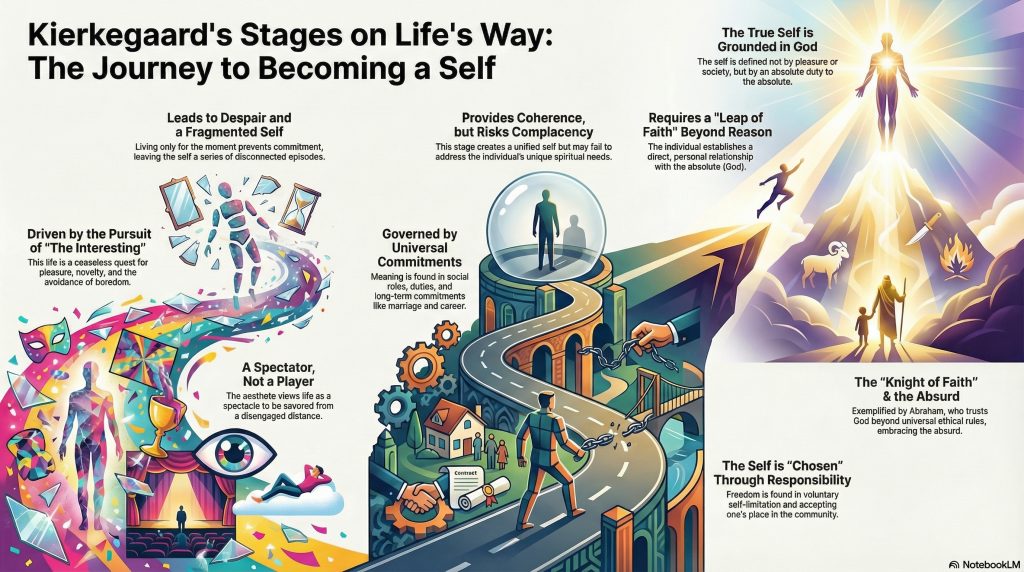
If the anxiety of freedom is our basic condition, Kierkegaard, in his monumental work Either/Or, presents two primary ways of responding to it: the aesthetic and the ethical. The “aesthetic” life is not just about art and beauty, but about living as a spectator. The aesthete avoids commitment, lives for the interesting moment, and ultimately evades the burden of making a real, defining choice. The “ethical” life, by contrast, is defined by commitment and responsibility. The crucial step from the aesthetic to the ethical, however, is not what most people would expect.
Kierkegaard argues that the most important choice is not between good and evil. The first and most decisive choice is “choosing choice itself.” This means moving from a life of passive experience to one of active responsibility. It is the moment an individual stops hovering above their own life and chooses to own it, to take responsibility for who they are and who they will become.
This is the act that, for Kierkegaard, truly creates a self. Before this, the individual is a bundle of possibilities, moods, and fleeting desires. In the passionate act of choosing, the self is consolidated. The earnestness with which one chooses is more fundamental than the specific content of the choice.
This idea speaks directly to our modern feeling of being overwhelmed by options. We spend so much time analyzing what to choose—which career, which partner, which lifestyle—that we can forget the transformative power of simply choosing, of committing to a path and, in doing so, creating a coherent self for the first time.
My either/or does not in the first instance designate the choice between good and evil; it designates the choice whereby one chooses good and evil/or excludes them. … it is not so much a matter of choosing between this or that as of the earnestness with which one chooses.
——————————————————————————–
5. Boredom is the True Root of All Evil
The ultimate consequence of the aesthetic life—the life spent evading true choice—is not excitement, but a profound spiritual sickness that Kierkegaard provocatively identifies as the true root of all evil: boredom. He makes a sharp distinction between idleness and boredom. Idleness, he claims, can be a “truly divine way of life,” a state of restful contemplation. Boredom, on the other hand, is a spiritual sickness, a state of empty restlessness and meaninglessness. He calls it a “demonic pantheism.”
Boredom is the defining ailment of the aesthetic life. In an endless effort to keep this spiritual emptiness at bay, the aesthete chases after the “interesting,” seeking constant novelty and distraction. Life becomes a series of disconnected moments to be consumed, a desperate attempt to rotate the crops of experience before the soil of the soul becomes completely barren. This 19th-century diagnosis perfectly captures the modern condition of endlessly scrolling through social media feeds or binge-watching streaming services—a frantic “rotation of crops” to keep the terror of meaninglessness at bay.
Kierkegaard’s insight is that this is not a trivial problem. It is the spiritual void that opens up when a life is built on no real commitments or passions. When existence is not grounded in an ethical choice, it becomes a frantic, and ultimately failing, flight from the terror of meaninglessness. In this view, evil isn’t born from malice, but from the empty despair of a life that stands for nothing.
Idleness as such is by no means a root of evil; quite the contrary, it is a truly divine way of life so long as one is not bored. … The root of evil is boredom, and that is what must be kept at bay.
——————————————————————————–
Conclusion: Your Life is the Answer
Kierkegaard’s ideas are not comfortable. They are designed to be unsettling, to shake us out of our complacency and force us to confront the gravity of our own freedom. He pushes us to see that anxiety is not just a symptom to be managed but a sign of our freedom; that true spirituality is an invisible, inward passion; and that the most fundamental act of self-creation lies in the earnestness of our choices.
He does not offer a system to follow or a set of rules for a happy life. His philosophy is a call to action, but the action is internal. He insists that the meaning of one’s life cannot be found in an external philosophy or a social trend, but must be forged by the individual through passionate, committed engagement with their own existence. He doesn’t give us the answers; he insists that our lived, chosen life must become the answer.
Kierkegaard offers no easy system, only a mirror. If you had to make a choice today to move from being a spectator to a participant in your own life, what would that choice be?
Kierkegaard’s Stages on Life’s Way
* Infographic generated using NotebookLM

Søren Kierkegaard – The Journey of the Self
* Slide Deck generated using NotebookLM


Plato’s Allegory of the Cave
* Report generated using Gemini AI
The Architecture of Enlightenment: A Comprehensive Treatise on Plato’s Allegory of the Cave
Abstract
This report provides an exhaustive examination of Plato’s Allegory of the Cave, found in Book VII of The Republic (514a–520a). It serves as a definitive reference document, analyzing the allegory’s visual mechanics, philosophical underpinnings, and enduring legacy in Western art and modern media. By integrating primary textual analysis with secondary scholarly interpretation and art historical data, this treatise deconstructs the allegory into its constituent parts—imprisonment, liberation, ascent, and return—and maps these narrative movements onto Plato’s broader epistemological and metaphysical systems. Furthermore, this document addresses the user’s request for illustration by providing detailed “Visual Plate Specifications”—textual blueprints for the visual reconstruction of the cave, serving as a guide for understanding the spatial and symbolic relationships within the allegory.
Part I: The Contextual Foundation of the Republic
To understand the Allegory of the Cave, one must first situate it within the architectural framework of The Republic. The dialogue, ostensibly a search for the definition of dikaiosyne (justice), evolves into a grand investigation of the soul and the ideal state (polis). The Cave does not stand alone; it is the climax of a trilogy of analogies presented by Socrates to Glaucon in Books VI and VII, designed to elucidate the nature of reality and the philosopher’s role within it. These three images—the Sun, the Divided Line, and the Cave—form a cohesive metaphysical system.1
1.1 The Pedagogy of the Soul (Paideia)
The explicit purpose of the Cave Allegory is to illustrate “the effect of education (paideia) and the lack of it on our nature”.1 Plato posits that education is not the insertion of vision into blind eyes, nor the filling of an empty vessel with information. Rather, the capacity for learning exists in the soul already. Education is the art of periagoge—the “turning around” of the entire soul. Just as an eye cannot turn from darkness to light without the turning of the whole body, the instrument of knowledge can only be turned from the “world of becoming” (the changing, physical world) to the “world of being” (the eternal Forms) by reorienting the entire desires and habits of the soul.4
1.2 Precursors: The Sun and The Divided Line
Before descending into the cave, Socrates establishes the metaphysical hierarchy through two preceding analogies which are essential for decoding the Cave’s symbolism.
The Analogy of the Sun (507b–509c):
Socrates compares the Form of the Good to the Sun. In the visible realm, the sun is the source of light, making sight possible and causing growth and generation. In the intelligible realm, the Form of the Good is the source of truth and reality, giving “being” to the Forms and making them knowable to the human intellect. The sun is to the visible world what the Good is to the intelligible world.2
The Divided Line (509d–511e):
Plato divides existence into two major realms: the Visible (horatos) and the Intelligible (noetos). He then subdivides these, creating four distinct levels of reality and cognition:
- Eikasia (Imagination/Imaging): The perception of shadows, reflections, and illusions.
- Pistis (Belief/Conviction): The perception of physical objects (animals, plants, artifacts).
- Dianoia (Thought/Mathematical Reasoning): Abstract thinking using hypotheses and diagrams (e.g., geometry).
- Noesis (Understanding/Intellection): Direct dialectical apprehension of the Forms, culminating in the Good.1
The Cave Allegory is the narrative dramatization of the Divided Line. The prisoner’s journey from the shackles to the sun is a literal movement through these four stages of cognition.
Part II: The Visual Anatomy of the Cave
The Allegory of the Cave is visually specific. Plato describes a complex apparatus of illusion, a subterranean theater with precise spatial relations. For the purpose of this report, we reconstruct the cave’s layout to facilitate accurate visualization.
2.1 The Subterranean Chamber and the Bonds
The setting is an underground “den” or “cave-like residence”.4 Crucially, it is not a sealed dungeon; it has a “mouth open towards the light,” stretching along the entire width of the cave. This implies a wide entrance, but one that is distant and reached only by a “steep and rugged ascent”.1
The Prisoners:
At the bottom of this chamber sit the prisoners. They are not criminals but human beings “like ourselves”.4 They have been imprisoned “from childhood,” suggesting that their warped perception is their native state, not a punishment inflicted later in life.
- Restraints: They are fettered by their legs and necks. The neck chains are critical: they prevent the prisoners from turning their heads. They are locked in a fixed perspective, forced to gaze eternally at the wall in front of them.4
- Field of Vision: Because of their bonds, they cannot see themselves, their neighbors, or the machinery behind them. Their entire visual reality is restricted to the shadows on the cave wall.3
Illustration Directive: The image should be framed from the viewpoint of the prisoners or slightly behind them. The viewer sees a row of seated figures, their backs to the viewer, shackled at the ankles and necks. The atmosphere is gloomy and subterranean. Directly in front of them is a rough stone wall. On this wall, shadows are dancing—silhouettes of vases, birds, and geometric shapes. The lighting should be flickering and warm, characteristic of firelight. The prisoners’ posture should indicate transfixed attention, as if watching a screen.
2.2 The Mechanism of Illusion: The Parapet and the Puppeteers
Behind the prisoners, unknown to them, lies the machinery that generates their reality.
- The Raised Way: Between the prisoners and the fire, the ground rises. On this slope, there is a “raised way” or path.10
- The Wall (Teichion): Along this path runs a low wall, described by Socrates as similar to the screen (paraphragma) that marionette players set up to hide themselves while displaying their puppets.10
- The Puppeteers: Behind this low wall walk men carrying various artifacts. These objects—”statues of people and other animals, made out of stone, wood, and every material”—project above the top of the wall.1
- The Concealment: The puppeteers themselves are hidden by the wall (or their bodies do not cast shadows). Only the artifacts they carry cast shadows. This ensures the prisoners see only the floating silhouettes of objects, not the humans controlling them.3
Illustration Directive: A side-view (cutaway) technical diagram of the cave.
- Left side (Bottom): The prisoners seated, facing a wall on the far left.
- Center: A low stone wall (parapet). Behind it, figures (puppeteers) walk, holding up statues and cut-outs of objects.
- Right side (Top): A large fire burning on a ledge.
- Far Right (Exit): A long, steep, jagged tunnel sloping upward toward a small opening of bright white daylight.
- Light Rays: Dotted lines should trace the path of light from the fire, over the wall, hitting the artifacts, and projecting shadows onto the prisoners’ wall.
2.3 The Artificial Sun: The Fire
High up and behind the puppeteers burns a fire.10 This fire acts as the “sun” of the cave world. It provides the illumination necessary for the shadows to exist. Without the fire, the cave would be pitch black; with it, a “false” visibility is created. The fire represents a derivative source of light—man-made, fuel-dependent, and flickering—contrasted with the eternal, self-sustaining light of the sun outside.2
2.4 The Acoustic Echo Chamber
Plato adds an auditory dimension to the illusion. The cave walls have an echo. When the puppeteers speak (some are talking, some are silent), the sound reverberates off the wall facing the prisoners. Because the prisoners see the shadows moving in synchronization with the sounds, they attribute the voices to the shadows.4
- Implication: This completes the sensory deception. The shadows are not just visual shapes; they are “speaking” entities. The prisoners believe they are observing a living, breathing reality.5
Table 1: Structural Components of the Cave and Their Symbolism
| Component | Physical Description | Metaphysical Symbolism | Divided Line Correspondent |
| The Cave | Subterranean chamber | The Visible Realm (Horatos Topos) | Segment A & B |
| Prisoners | Chained from childhood | The uneducated masses; “Us” | The Soul in ignorance |
| Shadows | Silhouettes on the wall | Illusions, prejudices, images | Eikasia (Imagination) |
| Artifacts | Statues/objects carried | Physical objects, conventions | Pistis (Belief) |
| Puppeteers | Hidden carriers | Opinion-makers, Sophists, Poets | Manipulators of Pistis |
| Fire | Artificial light source | The physical Sun; Political power | Source of Visible Light |
| Ascent | Steep, rugged path | Dialectic; Education; Math | Dianoia (Thought) |
| Outside | The surface world | The Intelligible Realm (Noetos) | Noesis (Understanding) |
| The Sun | Celestial body | The Form of the Good (Agathon) | The Supreme Principle |
Part III: The Narrative Phenomenology of the Cave
The Allegory is a dynamic narrative of movement. It describes the phenomenological experience of the soul as it transitions between ontologically distinct worlds. This journey is characterized by compulsion, pain, confusion, and eventual clarity.
3.1 The State of Imprisonment (The Shadow World)
The prisoners are not passive observers; they are active participants in their illusion. They engage in intellectual contests. They name the shadows, identifying them as they pass. They bestow “honors and praises” on those who have the sharpest eyes for the passing shadows, who can best remember the sequence of their arrival, and who can predict which shadow will come next.8
- Analysis: This satirizes the political and social life of the polis. The “wisdom” of the cave is merely the ability to predict patterns in empirical data without understanding the underlying causes. It is empirical guesswork, not knowledge. The “great men” of this society are simply those best at guessing the behavior of illusions.8
3.2 The Compulsion and the Turning (Periagoge)
Socrates introduces a disruption: “At first, when any of them is liberated and compelled suddenly to stand up and turn his neck round and walk and look towards the light, he will suffer sharp pains”.4
- Compulsion: The prisoner does not free himself. He is “liberated” (lytheie) and “compelled” (anankazoito). This suggests that the initial stage of education is involuntary. The teacher must force the student to look away from the comfortable shadows.
- Pain: The physical act of turning the stiff neck is painful. The eyes, accustomed to the dark, are “distressed” by the glare of the fire.4
- Confusion: When the prisoner looks at the artifacts (the statues), he is perplexed. If asked to name them, he cannot. In fact, he believes the shadows he saw before were “truer” and clearer than the blurry, bright objects he sees now.9 He resists enlightenment, desiring to return to the coherence of the shadows.
3.3 The Rugged Ascent (The Path of Dialectic)
The next stage involves being “dragged… by force, up the rough ascent, the steep way up”.9 This imagery of violence continues. The path to the surface is not a gentle slope; it is rugged and steep.
- Symbolism: This ascent corresponds to the mathematical disciplines (arithmetic, geometry, astronomy) described later in Book VII. These studies are difficult and require the mind to abstract away from the senses. The prisoner is “pained and irritated” by this process.9
3.4 The Dazzling Upper World (The Intelligible Realm)
Upon emerging into the sunlight, the prisoner is initially blinded. He is “unable to see the realities” of the upper world.4 His adaptation must be gradual:
- Shadows and Reflections: First, he looks at shadows outside and reflections of men and trees in water. This stage is less painful and corresponds to Dianoia (thinking through images/mathematics).9
- Night Sky: Next, he gazes at the moon and stars by night. These are easier to behold than the sun.
- The Things Themselves: He begins to see the trees, the rocks, and the people—not their reflections, but the objects themselves.
- The Sun: Finally, he is able to look at the Sun, “not mere reflections of him in the water, but… in his own proper place”.9
The Realization:
Once he sees the Sun, he reasons that it is the cause of the seasons, the years, and the guardian of all things in the visible world. He realizes that the Sun is the author of the light that made the shadows in the cave possible.2 He creates a comprehensive worldview based on the First Principle (The Good). He remembers his fellow prisoners and “pities” them. He would rather “suffer anything” than live their life of illusion again.4
3.5 The Descent and the Crisis of Return
The allegory concludes with the prisoner’s return. This is crucial for Plato’s political theory. The enlightened philosopher cannot remain in the “Isles of the Blessed”; he must descend back into the cave to govern.3
- Blindness: Returning from the light to the dark, his eyes are “full of darkness”.4 He stumbles. He cannot see the shadows as well as the prisoners who never left.
- The Ridicule: The prisoners mock him. They say, “Up he went and down he came without his eyes”.4 They conclude that the ascent ruins one’s eyesight and that it is dangerous to leave the cave.
- The Threat: Socrates asks, “If anyone tried to loose another and lead him up to the light, let them only catch the offender, and they would put him to death”.4 This is a haunting allusion to the fate of Socrates, who was executed by the Athenian democracy (the cave dwellers) for trying to make them question their shadows (cultural values).7
Illustration Directive: The scene depicts the returning prisoner entering the cave from the right. He is stumbling, shielding his eyes from the darkness, looking disoriented. His clothes are different, perhaps brighter or worn from the journey. The seated prisoners look at him with expressions of mockery, anger, and suspicion. One prisoner points a finger in accusation. The “shadows” on the wall continue uninterrupted, contrasting the static illusion with the dynamic, chaotic return of the enlightened man.
Part IV: Philosophical Interpretations and Debates
The Cave is a dense philosophical text that has generated millennia of debate. Two specific areas require deeper analysis: the identity of the Puppeteers and the symbolism of the Fire/Sun.
4.1 Who Are the Puppeteers?
The “Puppeteers” (or carriers) are the most ambiguous figures in the allegory. They are inside the cave but not bound like the prisoners. They walk freely. They manipulate the artifacts. Who do they represent?
- The Sophists and Politicians: A dominant interpretation aligns them with the political manipulators of Athens. They use words and legislation (artifacts) to cast shadows (ideologies) that keep the public (prisoners) docile. They know the shadows are manufactured, but they may not know the True Good (the Sun). They are masters of the “Fire” (conventional power).15
- The Poets and Artists: In Book X, Plato banishes the poets for being “imitators of imitations.” The puppeteers carry “statues” and “figures,” which are artistic representations. Thus, they may represent the cultural producers—Homer, the tragedians, the painters—who create the “myths” that society mistakes for reality.16
- The Colonizers: Modern post-colonial interpretations, such as those by Wilberding and others, view the puppeteers as “colonizers” or “masters of the hegemony” who control the distribution of knowledge and social norms to oppress the “colonized” prisoners.15
4.2 The Metaphysics of the Fire vs. The Sun
The relationship between the Fire and the Sun is one of analogy and dependence.
- The Fire: Represents the physical sun in the visible world. It is the source of light for our ordinary eyes. However, within the context of the allegory (where the cave = the visible world), the Fire represents the “political sun”—the dominant light of society. It is the artificial illumination of human culture.
- The Sun: Represents the Form of the Good (Tou Agathou Idea). Just as the sun generates light and visibility, the Good generates truth and intelligibility. It is the “cause of all things,” the highest ontological principle.2
- The Eye: Plato draws a parallel between the eye and the soul. The eye needs light to see; the soul needs truth (from the Good) to know. When the soul focuses on the world of becoming (shadows/fire), it has only “opinion” (doxa). When it focuses on the world of being (Sun), it has “knowledge” (episteme).6
Part V: The Iconography of the Cave in Art History
The visual nature of the Cave has challenged artists for centuries. Depicting the simultaneity of the illusion and the reality requires sophisticated composition.
5.1 Jan Saenredam’s Antrum Platonicum (1604)
The most significant visual representation of the allegory is the engraving Antrum Platonicum by Jan Saenredam (after Cornelis Cornelisz van Haarlem). This work is a masterclass in Northern Mannerism and offers a specific interpretation of the text.18
Visual Analysis:
- The Wall as Barrier: Saenredam depicts a massive wall dividing the composition.
- The Shadows as Vices: In a moralizing twist, the shadows are not just shapes but personifications of the Seven Vices (Avarice, Drunkenness, etc.). This shifts the allegory from pure epistemology (reality vs. illusion) to ethics (virtue vs. vice). The prisoners are seduced by the “shadows” of sin.19
- The Crowd: The prisoners are not a few chained individuals but a chaotic, teeming mass of humanity. They are debating, pointing, and obsessed with the shadows. This emphasizes the social contagion of ignorance.20
- The Philosophers: In the foreground, a group of scholars stands apart, holding books and compasses (symbols of Dianoia), turning away from the shadows toward the light.
- The Exit: In the background, a small, narrow path leads to the outside world, where three tiny figures walk in the light, emphasizing the rarity of true enlightenment.19
5.2 Michiel Coxie’s Plato’s Cave (c. 1535)
Attributed to Michiel Coxie, the “Flemish Raphael,” this oil painting resides in the Musée de la Chartreuse. It reflects the influence of the Italian High Renaissance.22
- Michelangelesque Form: The prisoners are depicted with the heroic, muscular tension of Michelangelo’s figures. Their struggle is physical and dramatic. The central figure, often associated with the “Falling Galatian” statue, represents the physical agony of the “turning around”.24
- Chiaroscuro: Coxie uses dramatic lighting contrasts to emphasize the cavernous gloom versus the piercing light of the exit. The painting focuses less on the mechanism of the puppets and more on the human drama of the soul’s torture in the material world.
5.3 Modern Conceptual Art
- Mike Kelley (Plato’s Cave, Rothko’s Chapel, Lincoln’s Profile, 1985): Kelley subverts the allegory. His installation uses comic book imagery, logos, and pop culture debris as the “shadows.” He suggests that in the modern world, the “cave” is not just a lack of education but an active bombardment of consumerist garbage. The “ideal” is no longer the Sun, but a manufactured desire.25
- Joseph Kosuth: His text-based neon works often reference Plato, questioning the definition of “representation” itself. He uses neon (artificial light) to highlight the gap between the word (shadow) and the thing (reality).25
Part VI: The Cave in Modern Media and Cinema
The 20th and 21st centuries saw the “screen” of the puppeteers evolve into the cinema screen, the television, and the VR headset. Film theory often cites the Cave as the “ur-myth” of the cinematic apparatus.
6.1 Cinema as the Mechanical Cave
The structural parallel between Plato’s Cave and the movie theater is precise:
- Immobility: The audience is seated, facing forward, largely immobile.
- The Projector: The “fire” is the projector lamp behind the audience.
- The Film Strip: The “artifacts” are the film frames passing in front of the light.
- The Screen: The “wall” where the shadows (projected images) play.
- Suspension of Disbelief: The audience enters a pact to treat the shadows as real for the duration of the film.17
6.2 Key Cinematic Interpretations
1. The Matrix (1999):
This is the most explicit modern adaptation.
- The Cave: The Matrix (a neural interactive simulation).
- The Prisoners: Humanity, grown in pods (chains), fed a digital reality.
- The Liberation: Morpheus (the teacher) offers the Red Pill. Neo’s waking up in the pod—atrophied muscles, blinding light—mirrors the physical pain of Plato’s prisoner standing up.26
- The Sun: The “Desert of the Real.” It is not beautiful; it is a scorched earth. This subverts Plato: the “real” is harsh, while the “shadows” (the steak Cypher eats) are pleasant.
- The Return: Neo must return to the Matrix to free others, possessing the “dual vision” of the philosopher (seeing the code behind the walls).26
2. The Truman Show (1998):
- The Cave: Seahaven Island, a giant studio set.
- The Puppeteer: Christof, the creator/director in the “moon” control room (the artificial sun).
- The Shadows: The actors who play Truman’s family and friends.
- The Ascent: Truman’s journey on the boat Santa Maria to the edge of the world. He literally strikes the “wall” of the sky. The exit is a door in the sky-painted wall. His exit is a choice to leave the “perfect” shadow world for the messy truth.26
3. Us (2019):
- Inversion: Jordan Peele presents the “Tethered” living in underground tunnels, mimicking the actions of the people above. Here, the “shadows” (the Tethered) have agency and rise up to reclaim the surface. It suggests that the “shadows” we repress (class, race, history) will eventually return to destroy the illusion of the surface world.26
4. The LEGO Movie:
- The Cave: The structured world of Lord Business.
- The Shadows: The instructions and the “Kragle” (static perfection).
- The Ascent: Emmet discovers the “Piece of Resistance” and sees beyond the instructions (Forms/Creativity).26
Part VII: The Digital Cave and the 21st Century
In the digital age, the “cave” has become portable and personalized. The allegory provides a diagnostic tool for understanding the “Metaverse,” social media, and virtual reality.
7.1 Virtual Reality (VR) as the Perfected Cave
Modern VR technology fulfills the conditions of the cave more perfectly than any physical dungeon.
- The Headset: Acts as the shackles and the wall simultaneously. It blocks out the physical world entirely.
- The Simulation: The user sees a world of pure “artifacts” (code).
- The Danger: As Plato warned, prisoners might prefer the shadows. In VR, the “shadows” can be engineered to be more beautiful, more responsive, and more satisfying than the “Sun” (reality). The “Return” to the physical world becomes disappointing—a phenomenon known as “post-VR sadness”.27
7.2 Social Media and the Algorithmic Puppeteers
- Echo Chambers: The acoustic echo in Plato’s cave reinforced the prisoners’ belief that the shadows spoke. Social media algorithms function as these echoes, feeding users content that reinforces their existing biases. The prisoner hears only the “voices” that confirm his reality.28
- The Curated Self: The images on Instagram or TikTok are “shadows” of real lives—edited, filtered, and performed. Users (prisoners) scroll and attribute happiness or success to these shadows, unaware of the complex reality behind the screen.28
- Fake News: The deliberate manufacturing of “statues” (false narratives) by modern puppeteers (disinformation agents) to cast specific shadows on the public wall. The “contests” of the prisoners (likes, shares) reward those who best engage with the most sensational shadows, regardless of truth.28
Conclusion: The Eternal Relevance of the Cave
Plato’s Allegory of the Cave is not a relic of antiquity; it is a living map of the human cognitive condition. It asserts that “reality” is often a construct of social convention, sensory error, and political manipulation.
- Epistemologically: It challenges us to distinguish between doxa (opinion based on images) and episteme (knowledge based on reason).
- Politically: It warns us that the liberator (the philosopher) will always be endangered by the liberated. The “cave” is self-policing; ignorance defends itself with violence.
- Existentially: It frames life as a choice between the comfort of the “screen” and the agony of the “ascent.”
From the ink of Jan Saenredam to the code of the Metaverse, the Cave remains the primary metaphor for our struggle to discern the real from the fake. As we descend deeper into digital illusions, Plato’s command to “turn around” (periagoge) becomes the most urgent ethical imperative of our time.
Appendix: Comprehensive Visual Reference for Illustrators
To fulfill the requirement for illustration, the following table synthesizes all visual data into a master guide for artists wishing to reconstruct the allegory.
| Element | Visual Specification | Lighting Notes |
| Overall Composition | A deep, sloping cross-section. Left = Deep Underground; Right = Surface/Sky. | Gradient from deep shadow (left) to flickering orange (center) to pure white (right). |
| The Prisoners | Seated in a row, facing a blank stone wall. Chains on ankles and necks. Emaciated or average build. | Lit by the flickering, warm glow of the fire from behind. Faces are in profile or back-view. |
| The Shadows | Projected on the wall in front of prisoners. Silhouettes of vases, horses, birds, geometric shapes. | Distorted, elongated, “dancing” on the rough stone texture. |
| The Parapet | A waist-high stone wall behind the prisoners. Rough-hewn texture. | The side facing the fire is lit; the side facing prisoners is in shadow. |
| The Puppeteers | Hidden behind the parapet. Only their hands or props are visible, or they are cloaked. | They are backlit by the fire. |
| The Artifacts | Statues of wood and stone held up on sticks or by hand. | They must obstruct the firelight to cast the shadows. |
| The Fire | A large bonfire on a raised ledge/platform behind the puppeteers. | The primary light source for the cave. Smoke drifts up to the ceiling. |
| The Ascent Path | A steep, jagged, rocky tunnel leading upward from the fire level. | Dimly lit, transitioning to blinding white at the mouth. |
| The Exit | A small opening at the top right, revealing a glimpse of the sun/sky. | The light here is cool, sharp, and blinding (Daylight). |
| The Returned | A figure entering from the right, shielding eyes, stumbling in the dark. | Silhouetted against the daylight entrance, casting a long shadow into the cave. |
Works cited
- Plato’s ‘Republic’ – 11. The Allegory of the Cave, accessed December 8, 2025, https://books.openbookpublishers.com/10.11647/obp.0229/ch11.xhtml
- The Republic: The Allegory of the Cave | SparkNotes, accessed December 8, 2025, https://www.sparknotes.com/philosophy/republic/themes/
- Allegory of the cave – Wikipedia, accessed December 8, 2025, https://en.wikipedia.org/wiki/Allegory_of_the_cave
- Plato: Republic: Book VII – Le Moyne, accessed December 8, 2025, https://web.lemoyne.edu/courseinformation/Magee/PHL101/Plato%20%20Republic%20%20Book%20VII.pdf
- The Allegory of the Cave Plato’s Republic, Book 7 – The Philosophy Teaching Library, accessed December 8, 2025, https://philolibrary.crc.nd.edu/article/allegory-of-the-cave/
- Plato’s sunlight and firelight: the philosophical metaphor of light in the allegory of the Cave, accessed December 8, 2025, https://philosophy.stackexchange.com/questions/60833/platos-sunlight-and-firelight-the-philosophical-metaphor-of-light-in-the-alleg
- Plato’s Allegory of the Cave: the Journey Out of Ignorance – 1000-Word Philosophy, accessed December 8, 2025, https://1000wordphilosophy.com/2023/05/26/allegory-of-the-cave/
- Plato The Allegory of the Cave (Republic, Book Seven) – St. Bonaventure University, accessed December 8, 2025, https://web.sbu.edu/theology/bychkov/plato%20republic%207.pdf
- Plato’s Cave, accessed December 8, 2025, http://webspace.ship.edu/cgboer/platoscave.html
- Plato “Allegory of the Cave” (The Republic, Book VII, 514a-521d), accessed December 8, 2025, http://faculty.tamuc.edu/jherndon/documents/plato.pdf
- The Allegory of the Cave – Philosophical Thought – OPEN OKSTATE, accessed December 8, 2025, https://open.library.okstate.edu/introphilosophy/chapter/on-the-allegory-of-the-cave-plato/
- The FIRE in the Alegory of the Cave : r/askphilosophy – Reddit, accessed December 8, 2025, https://www.reddit.com/r/askphilosophy/comments/o9mzip/the_fire_in_the_alegory_of_the_cave/
- Lower Two Stages of the Prisoner in Plato’s Analogy of the Cave “‘, accessed December 8, 2025, https://tohoku.repo.nii.ac.jp/record/136845/files/0289-064X-2019-52-(1).pdf
- Allegory of the Cave by Plato | Summary, Symbolism & Meaning – Lesson – Study.com, accessed December 8, 2025, https://study.com/academy/lesson/the-allegory-of-the-cave-by-plato-summary-analysis-explanation.html
- Out of the Shadows and into the Light: Liberation through Education – UVM ScholarWorks, accessed December 8, 2025, https://scholarworks.uvm.edu/cgi/viewcontent.cgi?article=1007&context=tvc
- The Political Significance of Plato’s Allegory of the Cave – SciELO Colombia, accessed December 8, 2025, http://www.scielo.org.co/pdf/idval/v66n165/0120-0062-idval-66-165-00237.pdf
- (PDF) Cinematic Spelunking Inside Plato’s Cave – ResearchGate, accessed December 8, 2025, https://www.researchgate.net/publication/363697812_Cinematic_Spelunking_Inside_Plato’s_Cave
- Plato’s Cave by Jan Pietersz Saenredam, Hendrik Hondius I – National Gallery of Art, accessed December 8, 2025, https://www.nga.gov/artworks/62542-platos-cave
- Cave of Plato, Jan Saenredam, 1604 Canvas Print – CanvasPrints.com, accessed December 8, 2025, https://canvasprints.com/products/cave-of-plato-jan-saenredam-1605
- print | British Museum, accessed December 8, 2025, https://www.britishmuseum.org/collection/object/P_1852-1211-120
- Antique Master Print-CAVE-PLATO-ANTRUM PLATONICUM-Mulder-Saenredam-1694, accessed December 8, 2025, https://pictura-prints.com/product/antique-master-print-cave-plato-antrum-platonicum-mulder-saenredam-1694/
- Plato’s Allegory of the Cave – Fine Art Images, accessed December 8, 2025, https://www.fine-art-images.net/en/showIMG_33273.html
- File:La Grotte de Platon, Michiel Coxcie, XVIe.jpg – Wikimedia Commons, accessed December 8, 2025, https://commons.wikimedia.org/wiki/File:La_Grotte_de_Platon,_Michiel_Coxcie,_XVIe.jpg
- Michiel Coxie – Wikipedia, accessed December 8, 2025, https://en.wikipedia.org/wiki/Michiel_Coxie
- Plato in L.A.: Contemporary Artists’ Visions – Getty Museum, accessed December 8, 2025, https://www.getty.edu/art/exhibitions/plato/inner.html
- Plato’s Allegory of the Cave — Summary & Meaning Explained – StudioBinder, accessed December 8, 2025, https://www.studiobinder.com/blog/platos-allegory-of-the-cave/
- Modern Take on Plato’s Cave: Virtual Reality and the Illusion of Truth | Free Essay Example, accessed December 8, 2025, https://studycorgi.com/modern-take-on-platos-cave-virtual-reality-and-the-illusion-of-truth/
- Modern social media—and Plato’s Allegory of the Cave – Texas Public Policy Foundation, accessed December 8, 2025, https://www.texaspolicy.com/modern-social-media-and-platos-allegory-of-the-cave/