Month: February 2026


The Dhammapada: Canonical Verses on Buddhist Philosophy and Ethics

The Dhammapada is a foundational collection of Buddhist verses that outlines the psychological and ethical framework necessary for spiritual liberation. The central thesis is that human existence is fundamentally a product of thought; mental discipline is therefore the primary determinant of suffering or happiness. The text emphasizes earnestness (vigilance) as the path to immortality (Nirvana) and identifies thirst (desire/craving) as the root of all human bondage. To transcend the cycle of birth and decay, an individual must achieve absolute self-mastery, abandon worldly attachments, and follow the “Eightfold Way.” The document concludes that true holiness—exemplified by the Arhat or Brahmana—is defined not by birth or ritual, but by the complete extinction of passion and the attainment of profound inner quietude.
Continue reading “The Dhammapada: Canonical Verses on Buddhist Philosophy and Ethics”The Operating System of the State: An Exhaustive Analysis of Palantir Technologies’ Contracts, Procurement Mechanisms, and Political Influence in the United Kingdom (2020–2026)

Executive Summary
By February 2026, Palantir Technologies UK Ltd. has transcended the status of a mere third-party software vendor to become a foundational component of the United Kingdom’s critical national infrastructure. Through a methodical strategy of crisis-driven entry, aggressive lobbying, and the creation of technical dependencies, the Denver-based corporation has secured a dominant position across the Ministry of Defence (MoD), the National Health Service (NHS), the Home Office, and increasingly, local policing. This report provides a comprehensive examination of Palantir’s current contract portfolio, the specific procurement mechanisms utilized to secure these agreements, and the network of political and bureaucratic actors involved in their facilitation.
The analysis reveals that Palantir’s entrenchment in the UK public sector has accelerated dramatically under the premiership of Keir Starmer, culminating in a “Strategic Partnership” announced in September 2025. This partnership, which frames Palantir’s presence as a pillar of national security and economic growth, has been followed by significant direct contract awards, most notably a £240.6 million agreement with the MoD in January 2026. These awards have frequently bypassed standard competitive tendering processes, utilizing “defence and security exemptions” and framework agreements to solidify the company’s hold on government data architecture.
Crucially, this expansion has occurred against a backdrop of intensifying scrutiny regarding the “revolving door” between government officials and the private sector. The dual role of Peter Mandelson—as both a co-owner of the lobbying firm Global Counsel, which counts Palantir as a client, and as the UK Ambassador to Washington—has raised profound questions regarding conflict of interest and the integrity of public procurement. This report details how high-level political access, combined with a “land and expand” technical strategy involving “free trials” and proprietary data ontologies, has effectively locked the UK government into a long-term dependency on Palantir’s operating systems.
The investigation draws upon public contract notices, parliamentary records, legal filings from advocacy groups such as Foxglove and the Good Law Project, and investigative journalism to construct a complete picture of Palantir’s operations in the UK. It concludes that while the company provides undeniable functional utility in data integration—specifically through its “Foundry” and “AIP” platforms—its procurement methods rely heavily on leveraging geopolitical alliances and opacity to circumvent competitive market forces, fundamentally altering the sovereignty of the UK’s digital state.
Continue reading “The Operating System of the State: An Exhaustive Analysis of Palantir Technologies’ Contracts, Procurement Mechanisms, and Political Influence in the United Kingdom (2020–2026)”The Ecclesiastical Landscape of the United Kingdom: A Comprehensive Analysis of Christian Denominations, Traditions, and Trends

1. Introduction: The Transformation of British Christianity
The religious landscape of the United Kingdom has undergone a profound and irrevocable transformation over the last century, shifting from a monocultural Christendom dominated by state-established churches to a pluralistic, competitive, and highly fragmented spiritual marketplace. For over a millennium, the identity of the British nations was inextricably linked to their respective national churches, creating a society where religious affiliation was largely a matter of geography, birth, and civic obligation. However, the 21st century has witnessed the dissolution of this monolithic structure, replaced by a complex tapestry of faith that defies simple categorization.
The release of data from the 2021 Census for England and Wales marked a historic watershed in this evolution. For the first time in the history of the census, the proportion of the population identifying as “Christian” fell below the fiftieth percentile, settling at 46.2%, a precipitous drop from 59.3% just a decade prior.1 This statistical recession represents a seismic shift in the cultural self-understanding of the nation. It indicates that the era of “nominal” Christianity—where individuals identified with the church as a default cultural marker regardless of belief or practice—is rapidly drawing to a close. The rise of the “No Religion” category to 37.2% suggests that the British public is increasingly comfortable shedding religious labels that no longer correspond to their lived reality.2
However, to interpret these statistics merely as a narrative of secularization would be a simplification. While the “passive” adherence to historic institutions is collapsing, “active” Christianity is demonstrating remarkable resilience and, in specific sectors, vibrant growth. The landscape is characterized by a “mixed economy” of decline and renewal. On one hand, the historic denominations—Anglicanism, Catholicism, and traditional Non-Conformity—face the attrition of an aging membership and the loss of cultural privilege. On the other, the religious marketplace is being energized by the explosive growth of Pentecostalism, the establishment of independent “New Church” networks, and the arrival of global Christian diasporas who are reshaping the theological geography of the UK.3
This report provides an exhaustive examination of the Christian denominations currently operating within the United Kingdom. It aims to move beyond a mere cataloging of groups to analyze the theological DNA, governance structures, and practical lived realities that distinguish them. It explores how the “Parish” model of the Church of England differs from the “Gathered” model of the Baptists; how the ancient, sensory-rich liturgies of the Orthodox diaspora contrast with the informal, band-led worship of the Vineyard movement; and how the silence of the Quakers sits alongside the brass bands of the Salvation Army. By mapping the unity and diversity of British Christianity, this analysis reveals a faith tradition that is simultaneously contracting in its institutional forms and expanding in its grassroots expressions.
Continue reading “The Ecclesiastical Landscape of the United Kingdom: A Comprehensive Analysis of Christian Denominations, Traditions, and Trends”Strategic Financial Viability Assessment: Hampshire County Council (2026-2031)
Executive Summary
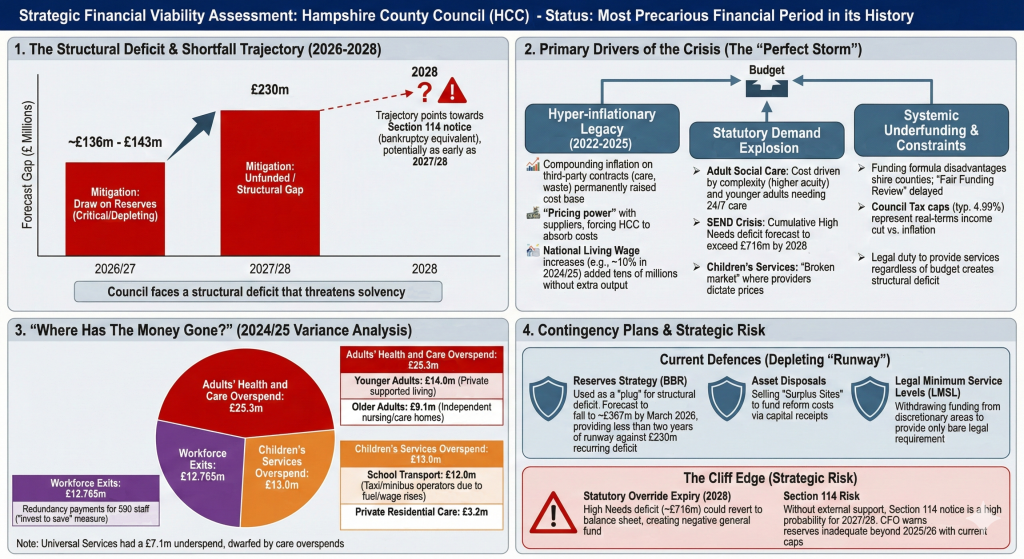
This report presents a comprehensive financial viability assessment of Hampshire County Council (HCC) as of February 2026. It has been commissioned to evaluate the Authority’s funding outlook, quantify potential shortfalls over the medium term (2026-2031), analyze the root causes of the prevailing fiscal distress, and interrogate the contingency measures currently in place. Furthermore, the report provides a forensic analysis of expenditure trends to answer the critical stakeholder question: “Where has the money gone?”
The analysis indicates that Hampshire County Council is currently navigating the most precarious financial period in its history. Despite a longstanding reputation for prudent fiscal management and a reserve position that historically exceeded the national average 1, the Council faces a structural deficit that threatens its solvency within the current Medium Term Financial Strategy (MTFS) period.
As of the 2026/27 budget setting process, the unmitigated budget shortfall stands at approximately £136 million to £143 million.2 This gap is projected to widen to £230 million by 2027/28 2, creating a trajectory that, without external intervention or radical structural change, points towards the issuance of a Section 114 notice—the local government equivalent of bankruptcy—potentially as early as the 2027/28 financial year.2
The drivers of this crisis are multifaceted but can be categorized into three primary vectors:
- Hyper-inflationary Legacy (2022-2025): The compounding effect of inflation on third-party contracts (particularly in care and waste) has permanently raised the cost base beyond the capacity of Council Tax and Business Rates to compensate.5
- Statutory Demand Explosion: There has been an unprecedented surge in demand for high-cost statutory services, specifically Adult Social Care (complex needs in younger adults) and Special Educational Needs and Disabilities (SEND), where the cumulative deficit is forecast to exceed £716 million by 2028.7
- Systemic Underfunding: The delay in the “Fair Funding Review” and the structural disadvantage of the current funding formula for shire counties have left HCC with a core spending power that is insufficient to meet its legal duties.6
Contingency planning is now heavily reliant on “one-off” measures. The Council is balancing its 2026/27 budget primarily through a massive drawdown of its Budget Bridging Reserve (BBR), a strategy acknowledged by the Chief Financial Officer (CFO) as unsustainable.2 Other contingencies include the “Savings Programme 2026” (SP26), aggressive asset disposals under the “Surplus Sites” programme 9, and requests for Exceptional Financial Support (EFS) from central government to bypass Council Tax referendum limits.2
The following report details these findings, providing a rigorous examination of the financial data, strategic risks, and operational realities facing Hampshire County Council.
Continue reading “Strategic Financial Viability Assessment: Hampshire County Council (2026-2031)”The Epstein Files Transparency Act Disclosures: A Forensic Analysis of Strategic Influence, Compromise, and Geopolitical Risk

Executive Summary: The Architecture of Shadow Influence
The enactment of the Epstein Files Transparency Act (EFTA)—officially Public Law 119-38, signed into law on November 19, 2025 1—and the subsequent rolling release of over 3.5 million pages of documents by the Department of Justice between December 2025 and early 2026 has fundamentally restructured the historical understanding of Jeffrey Epstein’s operational network.2 While the initial prosecution of Epstein focused narrowly on sex trafficking crimes in Florida and New York, the EFTA disclosures reveal a far more complex reality: Epstein operated a high-level shadow brokerage of influence, intelligence, and financial leverage that penetrated the uppermost tiers of Western democracy, global finance, and technology.2
The release of these files has not merely been a tabloid event; it has precipitated a systemic crisis of governance across the G7. From the halls of the British Parliament, where the “John Pond” leaks have triggered police inquiries into state secret breaches 5, to the boardrooms of Silicon Valley, where resignation letters drafted by Epstein for Bill Gates’s staff suggest a deep-seated extortion racket 6, the “Epstein Chains”—discrete sequences of email correspondence—expose a pervasive culture of transactional morality among the global elite.
This report provides an exhaustive, forensic analysis of the top 10 most significant email chains identified within the EFTA tranches. These instances were selected not merely for the celebrity of the participants, but for their specific ramifications regarding political stability, national security, corporate governance, and legislative integrity. They document specific instances of operational collaboration, the trading of state secrets, legislative interference, and the deployment of “kompromat” (compromising material) for coercion.
Continue reading “The Epstein Files Transparency Act Disclosures: A Forensic Analysis of Strategic Influence, Compromise, and Geopolitical Risk”The Epstein-Nakamoto Nexus: A Forensic Analysis of Financial Influence, Cryptographic Origins, and the 2026 Disclosure Events

1. Executive Assessment and the 2026 Disclosure Paradigm
The release of the “Epstein Files” in early 2026, mandated by the Epstein Files Transparency Act (H.R. 4405) 1, has precipitated a paradigm shift in the historical understanding of Bitcoin’s developmental trajectory and the intricate web of influence surrounding its governance. While the pseudonymous identity of Satoshi Nakamoto remains technically unmasked, the newly declassified documents, combined with investigative reporting from 2025 and 2026, reveal a disturbing and extensive web of financial entanglement between Jeffrey Epstein and the architectural guardians of the Bitcoin network.
The central inquiry of this report—whether there are links between specific Satoshi candidates and Jeffrey Epstein—yields a complex, multi-layered answer that transcends simple binary associations. There is no definitive evidence in the current dossier to suggest Jeffrey Epstein is Satoshi Nakamoto, nor that he directly employed the pseudonym to author the white paper in 2008. In fact, evidence suggests Epstein was still being tutored on the mechanics of cryptocurrency as late as 2018 by associates such as Brock Pierce.3 However, the “behind Bitcoin” allegation holds substantial weight if interpreted as influence rather than invention. The evidence confirms that Epstein, acting as a strategic node for high-net-worth capital and intelligence networks, successfully infiltrated the governance of Bitcoin at its most vulnerable moment in 2015. Through the MIT Media Lab and direct investments in infrastructure companies like Blockstream, Epstein utilized his capital to “rescue” Bitcoin Core developers, thereby gaining proximity to the protocol’s code maintenance during the critical block-size wars.4
This report provides an exhaustive examination of these connections, categorizing them into direct financial patronage, social-intellectual influence via the “Edge” network, and geopolitical maneuvering involving Russian and Israeli interests. The analysis dissects the specific interactions between Epstein and key Satoshi candidates, the institutional capture of the MIT Digital Currency Initiative (DCI), and the broader implications of these revelations for the ethos of decentralization.
Continue reading “The Epstein-Nakamoto Nexus: A Forensic Analysis of Financial Influence, Cryptographic Origins, and the 2026 Disclosure Events”The Satoshi Enigma: A Forensic and Historical Analysis of Bitcoin’s Creator

Abstract
The identity of Satoshi Nakamoto, the pseudonymous creator of Bitcoin, remains the most significant unsolved mystery in modern financial history. Since the release of the Bitcoin white paper in October 2008 and the mining of the Genesis Block in January 2009, the persona of Nakamoto has been the subject of intense scrutiny, forensic analysis, and speculation. This report provides an exhaustive examination of the available evidence, ranging from cryptographic genealogy and linguistic stylometry to geographic profiling and behavioral analysis. By synthesizing data from the COPA v. Wright legal proceedings, historical mailing list archives, and technical analyses of pre-Bitcoin digital cash systems, we construct a probabilistic framework for identifying the individual or group behind the pseudonym. The investigation evaluates the primary candidates—Hal Finney, Nick Szabo, Len Sassaman, Adam Back, and Paul Le Roux—against a matrix of technical capability, operational security, and biographical consistency.
Continue reading “The Satoshi Enigma: A Forensic and Historical Analysis of Bitcoin’s Creator”The Charioteer’s Guide to Radical Focus: 5 Timeless Lessons from the Bhagavad-Gita

Introduction: The Battlefield of the Mind
In the modern era, we are frequently besieged by a “paralysis of choice.” We inhabit a world of infinite digital noise and existential overwhelm, where every decision feels weighted with the pressure of optimal outcomes and the crushing visibility of the “global village.” This internal friction is not a product of the internet age, but a fundamental human condition described vividly in the Bhagavad-Gita, a third-century dialogue set on the precipice of a great war.
The narrative opens on the battlefield of Kurukshetra, where the warrior-prince Arjuna stands paralyzed between two massive armies. Confronted with the prospect of fighting his own kinsmen, his “members fail” and his “life within seems to swim and faint.” Arjuna’s distress is a profound metaphor for our own inner conflicts—the moments when duty, desire, and doubt collide, leaving us frozen. His guide, the divine charioteer Krishna, responds not with simple platitudes, but with a rigorous philosophical framework for navigating life with clarity and a radical, detached focus.
Continue reading “The Charioteer’s Guide to Radical Focus: 5 Timeless Lessons from the Bhagavad-Gita”The Mystery of the Missing Arms: A Deep Dive into the Venus de Milo

Discovered in 1820 on the Greek island of Milos, the Venus de Milo is arguably the most famous example of Hellenistic sculpture in the world. Carved from Parian marble around 100 BCE, she is widely believed to represent Aphrodite, the Greek goddess of love and beauty (known as Venus to the Romans). However, her identity remains a subject of scholarly debate; some suggest she might actually be Amphitrite, the sea goddess worshipped on Milos.
The sculpture is a masterclass in Hellenistic aesthetics, characterized by a shift away from the stiff, idealistic poses of earlier eras toward more dynamic, human-like movement. Venus is captured in a contrapposto stance—her weight shifted onto one foot, creating a subtle “S-curve” in her torso. This technique gives the heavy stone a sense of fluidity and life.
But what about those famous missing arms? When she was unearthed by a peasant named Yorgos Kentrotas, fragments of a hand holding an apple and a left upper arm were reportedly found nearby. These fragments suggested she was originally holding the “Apple of Discord” from the Judgment of Paris. However, during the journey to France and subsequent restoration, these pieces were separated or lost, and the Louvre eventually decided to display her as she was found to avoid inaccurate reconstructions.
Interestingly, Venus wasn’t always the “plain” white marble we see today. Like most classical statues, she was likely originally polychromed (painted in vibrant colors) and adorned with metal jewelry. Holes in her ears, head, and arms indicate she once wore earrings, a headband, and armbands.
Today, she stands as a symbol of classical perfection, proving that even a “fragmented” masterpiece can possess a timeless, complete beauty.