Tag: general
Intelligence Assessment: The Strategic Profile, Networks, and Ideological Framework of Jiang Xueqin

Executive Summary
This comprehensive intelligence report presents an exhaustive evaluation of the operational profile, ideological framework, and collaborator network of Jiang Xueqin. Operating primarily under the moniker “Professor Jiang,” Jiang is a Chinese-Canadian educator, commentator, and highly influential YouTube personality whose content reaches millions of viewers globally.1 Through a rigorous, multi-disciplinary examination of his biographical timeline, his institutional affiliations within the People’s Republic of China, his ideological outputs, and his media networks, this assessment investigates the prevailing hypothesis that Jiang operates as an asymmetric influence asset aligned with the strategic objectives of the Chinese state apparatus—specifically its intelligence and United Front organs—rather than acting as an independent, Western-aligned intellectual.
The analysis reveals a highly sophisticated and deeply contradictory operational profile. To certain elite Western academic circles, Jiang successfully presents himself as a “civic-liberal” reformer and a “Burkean incrementalist” who harbors nuanced critiques of the Chinese Communist Party (CCP).2 However, his mass-media outputs deliver a concentrated, viral stream of anti-Western civilizational pessimism, predictive collapse narratives, and demonstrably false conspiracy theories tailored to demoralize American and European audiences.1 Furthermore, his rapid historical transition from a deported freelance journalist suspected of espionage in 2002 to a senior administrator at elite, state-linked Chinese educational institutions suggests a high likelihood of co-optation by Chinese state security services.1
By mapping his collaborative network—which heavily features known conduits of Russian state media and Chinese state-affiliated propagandists 6—and by deconstructing his deeply flawed methodological reliance on pseudoscientific “psychohistory,” biological fabrications, and virulent antisemitism 4, this report concludes that Jiang functions as a potent vector for multipolar information warfare. His primary utility lies in leveraging his Western academic credentials to degrade global trust in Western democratic institutions while remaining securely insulated within the protective architecture of the Chinese state.
Continue reading “Intelligence Assessment: The Strategic Profile, Networks, and Ideological Framework of Jiang Xueqin”The Operating System of the State: An Exhaustive Analysis of Palantir Technologies’ Contracts, Procurement Mechanisms, and Political Influence in the United Kingdom (2020–2026)

Executive Summary
By February 2026, Palantir Technologies UK Ltd. has transcended the status of a mere third-party software vendor to become a foundational component of the United Kingdom’s critical national infrastructure. Through a methodical strategy of crisis-driven entry, aggressive lobbying, and the creation of technical dependencies, the Denver-based corporation has secured a dominant position across the Ministry of Defence (MoD), the National Health Service (NHS), the Home Office, and increasingly, local policing. This report provides a comprehensive examination of Palantir’s current contract portfolio, the specific procurement mechanisms utilized to secure these agreements, and the network of political and bureaucratic actors involved in their facilitation.
The analysis reveals that Palantir’s entrenchment in the UK public sector has accelerated dramatically under the premiership of Keir Starmer, culminating in a “Strategic Partnership” announced in September 2025. This partnership, which frames Palantir’s presence as a pillar of national security and economic growth, has been followed by significant direct contract awards, most notably a £240.6 million agreement with the MoD in January 2026. These awards have frequently bypassed standard competitive tendering processes, utilizing “defence and security exemptions” and framework agreements to solidify the company’s hold on government data architecture.
Crucially, this expansion has occurred against a backdrop of intensifying scrutiny regarding the “revolving door” between government officials and the private sector. The dual role of Peter Mandelson—as both a co-owner of the lobbying firm Global Counsel, which counts Palantir as a client, and as the UK Ambassador to Washington—has raised profound questions regarding conflict of interest and the integrity of public procurement. This report details how high-level political access, combined with a “land and expand” technical strategy involving “free trials” and proprietary data ontologies, has effectively locked the UK government into a long-term dependency on Palantir’s operating systems.
The investigation draws upon public contract notices, parliamentary records, legal filings from advocacy groups such as Foxglove and the Good Law Project, and investigative journalism to construct a complete picture of Palantir’s operations in the UK. It concludes that while the company provides undeniable functional utility in data integration—specifically through its “Foundry” and “AIP” platforms—its procurement methods rely heavily on leveraging geopolitical alliances and opacity to circumvent competitive market forces, fundamentally altering the sovereignty of the UK’s digital state.
Continue reading “The Operating System of the State: An Exhaustive Analysis of Palantir Technologies’ Contracts, Procurement Mechanisms, and Political Influence in the United Kingdom (2020–2026)”Strategic Financial Viability Assessment: Hampshire County Council (2026-2031)
Executive Summary
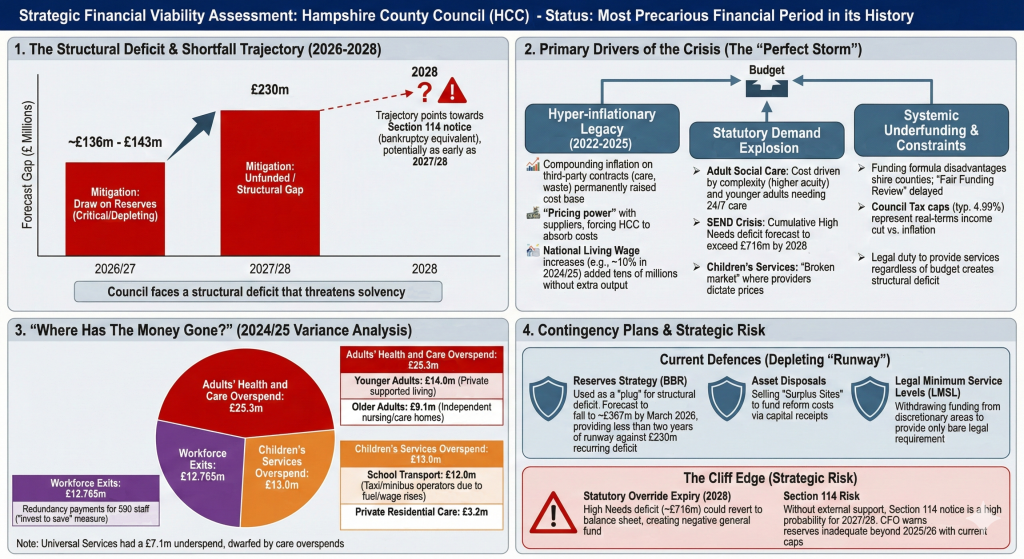
This report presents a comprehensive financial viability assessment of Hampshire County Council (HCC) as of February 2026. It has been commissioned to evaluate the Authority’s funding outlook, quantify potential shortfalls over the medium term (2026-2031), analyze the root causes of the prevailing fiscal distress, and interrogate the contingency measures currently in place. Furthermore, the report provides a forensic analysis of expenditure trends to answer the critical stakeholder question: “Where has the money gone?”
The analysis indicates that Hampshire County Council is currently navigating the most precarious financial period in its history. Despite a longstanding reputation for prudent fiscal management and a reserve position that historically exceeded the national average 1, the Council faces a structural deficit that threatens its solvency within the current Medium Term Financial Strategy (MTFS) period.
As of the 2026/27 budget setting process, the unmitigated budget shortfall stands at approximately £136 million to £143 million.2 This gap is projected to widen to £230 million by 2027/28 2, creating a trajectory that, without external intervention or radical structural change, points towards the issuance of a Section 114 notice—the local government equivalent of bankruptcy—potentially as early as the 2027/28 financial year.2
The drivers of this crisis are multifaceted but can be categorized into three primary vectors:
- Hyper-inflationary Legacy (2022-2025): The compounding effect of inflation on third-party contracts (particularly in care and waste) has permanently raised the cost base beyond the capacity of Council Tax and Business Rates to compensate.5
- Statutory Demand Explosion: There has been an unprecedented surge in demand for high-cost statutory services, specifically Adult Social Care (complex needs in younger adults) and Special Educational Needs and Disabilities (SEND), where the cumulative deficit is forecast to exceed £716 million by 2028.7
- Systemic Underfunding: The delay in the “Fair Funding Review” and the structural disadvantage of the current funding formula for shire counties have left HCC with a core spending power that is insufficient to meet its legal duties.6
Contingency planning is now heavily reliant on “one-off” measures. The Council is balancing its 2026/27 budget primarily through a massive drawdown of its Budget Bridging Reserve (BBR), a strategy acknowledged by the Chief Financial Officer (CFO) as unsustainable.2 Other contingencies include the “Savings Programme 2026” (SP26), aggressive asset disposals under the “Surplus Sites” programme 9, and requests for Exceptional Financial Support (EFS) from central government to bypass Council Tax referendum limits.2
The following report details these findings, providing a rigorous examination of the financial data, strategic risks, and operational realities facing Hampshire County Council.
Continue reading “Strategic Financial Viability Assessment: Hampshire County Council (2026-2031)”The Epstein Files Transparency Act Disclosures: A Forensic Analysis of Strategic Influence, Compromise, and Geopolitical Risk

Executive Summary: The Architecture of Shadow Influence
The enactment of the Epstein Files Transparency Act (EFTA)—officially Public Law 119-38, signed into law on November 19, 2025 1—and the subsequent rolling release of over 3.5 million pages of documents by the Department of Justice between December 2025 and early 2026 has fundamentally restructured the historical understanding of Jeffrey Epstein’s operational network.2 While the initial prosecution of Epstein focused narrowly on sex trafficking crimes in Florida and New York, the EFTA disclosures reveal a far more complex reality: Epstein operated a high-level shadow brokerage of influence, intelligence, and financial leverage that penetrated the uppermost tiers of Western democracy, global finance, and technology.2
The release of these files has not merely been a tabloid event; it has precipitated a systemic crisis of governance across the G7. From the halls of the British Parliament, where the “John Pond” leaks have triggered police inquiries into state secret breaches 5, to the boardrooms of Silicon Valley, where resignation letters drafted by Epstein for Bill Gates’s staff suggest a deep-seated extortion racket 6, the “Epstein Chains”—discrete sequences of email correspondence—expose a pervasive culture of transactional morality among the global elite.
This report provides an exhaustive, forensic analysis of the top 10 most significant email chains identified within the EFTA tranches. These instances were selected not merely for the celebrity of the participants, but for their specific ramifications regarding political stability, national security, corporate governance, and legislative integrity. They document specific instances of operational collaboration, the trading of state secrets, legislative interference, and the deployment of “kompromat” (compromising material) for coercion.
Continue reading “The Epstein Files Transparency Act Disclosures: A Forensic Analysis of Strategic Influence, Compromise, and Geopolitical Risk”The Epstein-Nakamoto Nexus: A Forensic Analysis of Financial Influence, Cryptographic Origins, and the 2026 Disclosure Events

1. Executive Assessment and the 2026 Disclosure Paradigm
The release of the “Epstein Files” in early 2026, mandated by the Epstein Files Transparency Act (H.R. 4405) 1, has precipitated a paradigm shift in the historical understanding of Bitcoin’s developmental trajectory and the intricate web of influence surrounding its governance. While the pseudonymous identity of Satoshi Nakamoto remains technically unmasked, the newly declassified documents, combined with investigative reporting from 2025 and 2026, reveal a disturbing and extensive web of financial entanglement between Jeffrey Epstein and the architectural guardians of the Bitcoin network.
The central inquiry of this report—whether there are links between specific Satoshi candidates and Jeffrey Epstein—yields a complex, multi-layered answer that transcends simple binary associations. There is no definitive evidence in the current dossier to suggest Jeffrey Epstein is Satoshi Nakamoto, nor that he directly employed the pseudonym to author the white paper in 2008. In fact, evidence suggests Epstein was still being tutored on the mechanics of cryptocurrency as late as 2018 by associates such as Brock Pierce.3 However, the “behind Bitcoin” allegation holds substantial weight if interpreted as influence rather than invention. The evidence confirms that Epstein, acting as a strategic node for high-net-worth capital and intelligence networks, successfully infiltrated the governance of Bitcoin at its most vulnerable moment in 2015. Through the MIT Media Lab and direct investments in infrastructure companies like Blockstream, Epstein utilized his capital to “rescue” Bitcoin Core developers, thereby gaining proximity to the protocol’s code maintenance during the critical block-size wars.4
This report provides an exhaustive examination of these connections, categorizing them into direct financial patronage, social-intellectual influence via the “Edge” network, and geopolitical maneuvering involving Russian and Israeli interests. The analysis dissects the specific interactions between Epstein and key Satoshi candidates, the institutional capture of the MIT Digital Currency Initiative (DCI), and the broader implications of these revelations for the ethos of decentralization.
Continue reading “The Epstein-Nakamoto Nexus: A Forensic Analysis of Financial Influence, Cryptographic Origins, and the 2026 Disclosure Events”The Satoshi Enigma: A Forensic and Historical Analysis of Bitcoin’s Creator

Abstract
The identity of Satoshi Nakamoto, the pseudonymous creator of Bitcoin, remains the most significant unsolved mystery in modern financial history. Since the release of the Bitcoin white paper in October 2008 and the mining of the Genesis Block in January 2009, the persona of Nakamoto has been the subject of intense scrutiny, forensic analysis, and speculation. This report provides an exhaustive examination of the available evidence, ranging from cryptographic genealogy and linguistic stylometry to geographic profiling and behavioral analysis. By synthesizing data from the COPA v. Wright legal proceedings, historical mailing list archives, and technical analyses of pre-Bitcoin digital cash systems, we construct a probabilistic framework for identifying the individual or group behind the pseudonym. The investigation evaluates the primary candidates—Hal Finney, Nick Szabo, Len Sassaman, Adam Back, and Paul Le Roux—against a matrix of technical capability, operational security, and biographical consistency.
Continue reading “The Satoshi Enigma: A Forensic and Historical Analysis of Bitcoin’s Creator”The Davos Realignment: An Exhaustive Analytical Review of President Donald Trump’s 2026 World Economic Forum Address

Executive Summary
On January 21, 2026, President Donald J. Trump returned to the World Economic Forum in Davos, Switzerland, to deliver a defining address of his second term. Marking the one-year anniversary of his inauguration, the speech served as both a victory lap for his administration’s radical economic restructuring and a stark warning to the globalist status quo represented by the Davos attendees. Under the banner of an American “Golden Age,” President Trump outlined a series of profound shifts in United States policy, ranging from the aggressive dismantling of the federal bureaucracy and the imposition of a protectionist trade regime to a reassertion of American energy dominance and a transactional approach to geopolitical security.1
This report provides a comprehensive, expert-level analysis of the claims, strategies, and implications embedded in the President’s address. By synthesizing data from federal agencies—including the Bureau of Economic Analysis (BEA), the Bureau of Labor Statistics (BLS), the Energy Information Administration (EIA), and the Census Bureau—with independent economic assessments and historical records, this document evaluates the factual basis of the President’s assertions. Furthermore, it situates these claims within the broader context of a global order in rupture, contrasting President Trump’s vision of national sovereignty with the “rules-based order” advocated by other leaders at the forum, such as Mark Carney.3
The analysis confirms that the U.S. economy is indeed undergoing a period of extraordinary volatility and transformation. Verified data supports the President’s claims regarding robust GDP growth in late 2025, the historic contraction of the federal workforce, and record levels of domestic oil production. However, significant discrepancies exist regarding the administration’s characterization of inflation, gasoline prices, and the historical record concerning Greenland. Moreover, the headline success of reducing the monthly trade deficit by 77% masks a complex reality of inventory volatility and record annual deficits. This report deconstructs these narratives to provide a granular view of the Trump 2.0 economic model.
Continue reading “The Davos Realignment: An Exhaustive Analytical Review of President Donald Trump’s 2026 World Economic Forum Address”The Architecture of Influence: A Forensic Audit of the Starmer Cabinet’s Structural Affiliations, Financial Patronage, and Third-Party Interdependencies (January 2026)
* Generated using Gemini AI

Executive Summary: The Transition from Sleaze to Systemic Sponsorship
Eighteen months into the administration of Sir Keir Starmer, the political landscape of the United Kingdom has undergone a profound transformation. The erratic, often personal nature of the ethical scandals that characterized the final years of the Conservative government—typified by the “Partygate” era and ad-hoc procurement violations—has largely receded. In its place, however, a new and distinct morphology of governance has emerged. This investigation, conducted from the perspective of a senior political integrity analyst in January 2026, posits that the Starmer administration is defined not by individual venality, but by a highly professionalized, systemic integration of third-party interests into the heart of the executive.
The “Change” manifesto of 2024 promised a “clean up” of Westminster standards. Yet, a forensic examination of the Register of Members’ Financial Interests, departmental transparency releases, and corporate filings reveals a government that operates through a complex web of “sponsorship governance.” This model relies heavily on the outsourcing of policy architecture and, crucially, personnel staffing, to a select group of think tanks, private equity-backed entities, and corporate interest groups.
The investigation identifies four primary pillars of this influence network:
- The “Labour Together” Hegemony: A think tank that has effectively functioned as a shadow staffing agency, seconding personnel to key Cabinet ministers and shaping the strategic direction of the government from an opaque funding base.
- The Health-Capital Nexus: A deep financial and ideological interdependency between the Department of Health and Social Care (DHSC) and private capital—specifically recruitment and private healthcare investors—raising critical questions about the trajectory of NHS reform.
- The Technocratic-Lobbying Complex: The wholesale integration of the Tony Blair Institute (TBI) and Big Tech lobbyists into the Department for Science, Innovation and Technology (DSIT), driving a “growth” agenda that mirrors the commercial imperatives of Silicon Valley.
- The Financialization of Climate Policy: The reliance of the Treasury and the Department for Energy Security and Net Zero (DESNZ) on the Green Finance Institute (GFI) and wealthy philanthropists to underwrite the staffing and design of the National Wealth Fund.
This report details these connections, analyzing the flow of funds, the movement of personnel, and the alignment of policy outcomes with donor interests. It argues that while the government is technically compliant with the letter of the Ministerial Code, it has constructed a system where access and influence are structurally reserved for a professionalized donor class, creating a “porous state” where the lines between public interest and private capital are increasingly indistinct.
Continue reading “The Architecture of Influence: A Forensic Audit of the Starmer Cabinet’s Structural Affiliations, Financial Patronage, and Third-Party Interdependencies (January 2026)”The Shadow Brokers: A Forensic Audit of the Conservative Official Opposition’s Financial and Ideological Networks (January 2026)

* Report generated using Gemini AI
1. Introduction: The Anatomy of a fractured Opposition
In the turbulent political landscape of January 2026, the United Kingdom’s Official Opposition stands at a precipice. The defection of Robert Jenrick to Reform UK on January 15, 2026, was not merely a personnel crisis but a symptomatic rupture revealing the deep structural and financial fissures within the Conservative Party. Following a catastrophic electoral defeat in 2024 and a subsequent period of internecine warfare, the Shadow Cabinet led by Kemi Badenoch has emerged not as a unified government-in-waiting, but as a loose confederation of ideological factions, each sustained by distinct and often conflicting networks of patronage.
This report provides a comprehensive, forensic investigation into the individual members of the Shadow Cabinet as of mid-January 2026. By triangulating data from the Register of Members’ Financial Interests, corporate filings at Companies House, transparency data from Westminster think tanks, and recent geopolitical developments, we have mapped the “Shadow State”—the web of third-party organizations, high-net-worth individuals, and corporate entities that currently underwrite the operations of His Majesty’s Opposition.
The investigation reveals a party operationally dependent on a shrinking pool of donors who are increasingly hedging their bets. It exposes deep entanglements with the fossil fuel lobby, significant conflicts of interest involving sanctioned oligarchs, and a “revolving door” mechanism where former ministers monetize their security clearance and contacts with global asset managers immediately upon entering opposition. Furthermore, the infiltration of “Tufton Street” libertarianism has moved from the fringes to the office of the Leader of the Opposition, reshaping the party’s policy platform on climate change and economic regulation in the image of its financiers.
This document dissects these connections, moving beyond surface-level declarations to understand the flow of influence that will shape British politics in the coming legislative cycle.
Continue reading “The Shadow Brokers: A Forensic Audit of the Conservative Official Opposition’s Financial and Ideological Networks (January 2026)”The Suspension of the Ballot: A Comprehensive Analysis of the 2026 Local Election Postponements and the Crisis of English Local Governance
* Report generated using Gemini AI in “deep research” mode
Introduction: The Collision of Reform and Democracy
The governance of England stands at a critical juncture, caught in the friction between a centralized drive for structural efficiency and the foundational principles of local democratic accountability. The upcoming local elections, originally scheduled for May 7, 2026, have become the focal point of a constitutional and administrative storm. The proposal to postpone these elections in up to 63 local authority areas represents not merely a logistical adjustment, but a profound intervention in the democratic cycle of the United Kingdom. This report offers an exhaustive analysis of the reasons behind this decision, the complex web of local and national political interests driving it, and the far-reaching implications for the future of English local government.
At the heart of this issue is the “Devolution Revolution”—a radical attempt by the central government to dismantle the historic two-tier system of county and district councils in favor of unitary authorities and mayoral combined authorities. This structural transformation, intended to streamline decision-making and unlock regional economic levers, has collided violently with the fixed electoral calendar. The Ministry of Housing, Communities and Local Government (MHCLG), under the stewardship of Secretary of State Steve Reed and Minister of State Alison McGovern, has initiated a process that could see millions of voters denied the opportunity to cast a ballot in 2026.1
The government’s narrative is one of pragmatism: why elect councillors to “zombie councils” that will be abolished within a year? They argue that the administrative burden of reorganization is so immense that holding an election simultaneously would risk the collapse of essential services.3 However, this rationale is fiercely contested. The Electoral Commission has issued rare and stringent warnings, arguing that “capacity constraints” are never a legitimate justification for suspending the democratic process.5 Opposition parties, particularly the Liberal Democrats and the surging Reform UK, accuse the Labour government and compliant Conservative council leaders of “running scared” from a volatile electorate, using administrative reform as a shield against a potential ballot box mauling.6
This report dissects these competing narratives. It explores the legal mechanisms of delay, specifically the controversial use of Henry VIII powers under the Local Government Act 2000. It provides a granular analysis of the regions most affected—from the coastal towns of Sussex to the rural expanses of East Anglia—and examines the financial “Devolution Penalty” that threatens to deprive these areas of hundreds of millions in investment.8 Ultimately, it posits that England is entering a period of “Democratic Interregnum,” where the suspension of accountability may have lasting consequences for the legitimacy of the state.
Continue reading “The Suspension of the Ballot: A Comprehensive Analysis of the 2026 Local Election Postponements and the Crisis of English Local Governance”