Month: May 2026
The Teleology of Action and the Metaphysics of All-Unity: A Comparative Analysis of Vladimir Solovyov, August Cieszkowski, and Nikolai Berdyaev
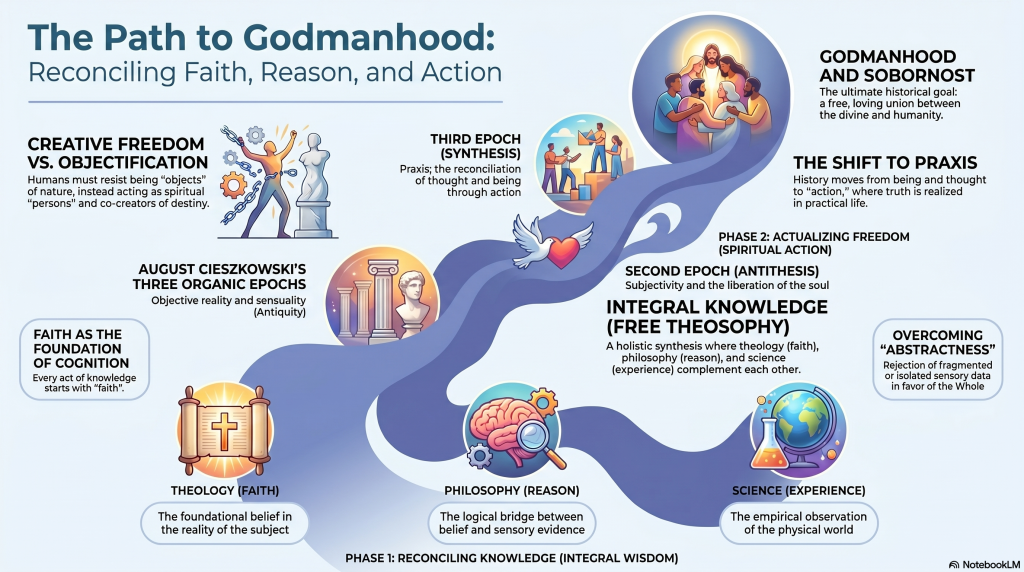
The intellectual landscape of Eastern and Central Europe during the nineteenth and early twentieth centuries was characterized by a profound struggle to reconcile the inherited structures of Christian revelation with the burgeoning demands of rationalist philosophy, the empirical rigors of modern science, and the urgent necessity for historical praxis. This intellectual ferment found its most sophisticated expressions in the work of Vladimir Solovyov, the foundational figure of the Russian religious-philosophical renaissance; Count August Cieszkowski, the Polish philosopher who transformed Hegelian dialectics into a philosophy of action; and Nikolai Berdyaev, the existentialist thinker who synthesized these traditions into a radical defense of creative freedom and personalism. These three figures, though rooted in distinct national contexts—Russian Orthodoxy and Polish Messianism—shared a common vision of history as a divinely-human process (Godmanhood) moving toward a definitive “Kingdom of God” or an “Epoch of the Holy Spirit.” Their philosophies represent an attempt to move beyond the “abstract principles” of Western metaphysics toward an “integral knowledge” where thought and action, the divine and the human, find their ultimate reconciliation.[1, 2]
Continue reading “The Teleology of Action and the Metaphysics of All-Unity: A Comparative Analysis of Vladimir Solovyov, August Cieszkowski, and Nikolai Berdyaev”