Author: BlackHole
Intelligence Assessment: The Strategic Profile, Networks, and Ideological Framework of Jiang Xueqin

Executive Summary
This comprehensive intelligence report presents an exhaustive evaluation of the operational profile, ideological framework, and collaborator network of Jiang Xueqin. Operating primarily under the moniker “Professor Jiang,” Jiang is a Chinese-Canadian educator, commentator, and highly influential YouTube personality whose content reaches millions of viewers globally.1 Through a rigorous, multi-disciplinary examination of his biographical timeline, his institutional affiliations within the People’s Republic of China, his ideological outputs, and his media networks, this assessment investigates the prevailing hypothesis that Jiang operates as an asymmetric influence asset aligned with the strategic objectives of the Chinese state apparatus—specifically its intelligence and United Front organs—rather than acting as an independent, Western-aligned intellectual.
The analysis reveals a highly sophisticated and deeply contradictory operational profile. To certain elite Western academic circles, Jiang successfully presents himself as a “civic-liberal” reformer and a “Burkean incrementalist” who harbors nuanced critiques of the Chinese Communist Party (CCP).2 However, his mass-media outputs deliver a concentrated, viral stream of anti-Western civilizational pessimism, predictive collapse narratives, and demonstrably false conspiracy theories tailored to demoralize American and European audiences.1 Furthermore, his rapid historical transition from a deported freelance journalist suspected of espionage in 2002 to a senior administrator at elite, state-linked Chinese educational institutions suggests a high likelihood of co-optation by Chinese state security services.1
By mapping his collaborative network—which heavily features known conduits of Russian state media and Chinese state-affiliated propagandists 6—and by deconstructing his deeply flawed methodological reliance on pseudoscientific “psychohistory,” biological fabrications, and virulent antisemitism 4, this report concludes that Jiang functions as a potent vector for multipolar information warfare. His primary utility lies in leveraging his Western academic credentials to degrade global trust in Western democratic institutions while remaining securely insulated within the protective architecture of the Chinese state.
Continue reading “Intelligence Assessment: The Strategic Profile, Networks, and Ideological Framework of Jiang Xueqin”Shattering The Mirrors

Introduction: Shattering the Mirrors
In less than twenty-four months, the most disciplined, impeccably dressed youth subculture in British history didn’t just fade away, it intentionally set itself on fire. Between 1965 and 1967, the immaculate, amphetamine-fuelled Mods of London and the South Coast violently dismantled their own pristine image, trading bespoke Italian suits for crushed velvet and drowning their beloved American soul music in a sea of psychedelic feedback.
For decades, mainstream music history has suffered from a glaring blind spot. Documentaries and retrospectives tend to treat the early-60s Mod movement and the 1967 Psychedelic Summer of Love as two entirely distinct, unrelated epochs. They present the narrative as if a switch was simply flipped overnight, instantly transforming sharp-suited rhythm and blues purists into kaftan-wearing acid casualties. But culture doesn’t operate on a light switch; it mutates in the shadows.
This book solves the mystery of the “missing link”, that volatile, hyper-accelerated transitional period known as the Freakbeat era. Shattering the Mirrors explains exactly how and why working-class kids abandoned the safety of strict sartorial rules and predictable rhythms for the terrifying, chaotic freedom of the underground counterculture.
As a cultural historian and archivist who has spent over two decades excavating the forgotten corners of 1960s British youth movements, I have made it my life’s work to map this exact transition. I haven’t just studied the hit records; I’ve tracked down the lost gig flyers from legendary provincial Mod strongholds along the South Coast, from the local scenes in Portsmouth & Brighton, the crowded floor of the Birdcage club and the Aquarium on the Seafront. I have interviewed the Carnaby Street tailors who were forced to change their cutting patterns overnight, the DJs who watched their prized Stax record collections become obsolete, and the surviving musicians from bands like The Action and The Creation who physically stood on stage and mutated the sound in real-time. My background isn’t just in the music; it’s in the socio-economic friction that forced these teenagers to rebel against the very subculture they invented.
In the pages that follow, we are going to dive head-first into the clubs, the cafes, and the recording studios where this revolution was synthesised. You will learn:
The Sociology of the Suit: Why the Mod uniform was originally created as a form of psychological armor against a bleak, postwar, working-class destiny, and why it ultimately became a suffocating trap.
The Chemical Catalyst: How the shift from mechanical, stamina-inducing amphetamines to mind-expanding LSD completely rewired the artistic ambitions of British teenagers.
The Sonic Deconstruction: How bands intentionally used volume, distortion, and feedback to break the rigid, three-minute pop song structure, turning rhythm and blues into avant-garde art.
The Provincial Engine: Why the true evolution didn’t just happen in wealthy London enclaves, but in the gritty, fiercely loyal seaside towns and provincial clubs that served as testing grounds for the new noise.
To guide you through this hyper-accelerated timeline, Shattering the Mirrors is broken down into six distinct phases of mutation:
Chapter 1: The Armour of the Elite – We begin in 1965 at the absolute zenith of Mod culture, exploring the strict, unforgiving social codes, the obsession with imported American soul, and the desperation to look perfect at all costs.
Chapter 2: The Amphetamine Exhaustion – We examine the breaking point. This chapter delves into the unsustainable pace of the weekend all-nighters, the burnout of the working-class youth, and the creeping realization that looking sharp wasn’t enough to change their lives.
Chapter 3: Talcum Powder & Boiling Oil – Leaving London, we travel to the South Coast. Through the lens of Portsmouth’s Birdcage club and its surrounding satellite scenes, we watch as liquid light shows and distorted guitars first begin to infect the purist R&B dance-floors.
Chapter 4: The Bow and the Feedback – A deep dive into the sonic pioneers. We follow bands like The Creation and The Action as they risk alienating their devoted fanbases by introducing violin bows, extreme volume, and intentional dissonance into their sets.
Chapter 5: Velvet Revolutions – The physical transformation. We track the rapid decay of the Mod aesthetic on King’s Road and Carnaby Street, exploring how the adoption of Victorian military tunics, paisley, and crushed velvet served as a visual rejection of modern societal expectations.
Chapter 6: The Final Chord – The culmination of the Freakbeat era. We sit in the studio with The Small Faces as they record “Itchycoo Park,” perfectly fusing the tight, rhythmic discipline of their Mod roots with the boundless, flanged chaos of the psychedelic future.
By the time you reach the final page of this book, your understanding of the 1960s will be irrevocably changed. But more importantly, Shattering the Mirrors will hold up a looking glass to your own life. We all build identities, routines, and “uniforms” that eventually start to feel like cages. We often cling to past successes and familiar rules, terrified of what might happen if we let go of control. By witnessing how a generation of British youth bravely dismantled their own identities to discover something infinitely more profound, you will realise that the strict disciplines you eventually outgrow are never wasted time. They are the exact foundations you need to reinvent yourself. You will walk away from this history with the courage to embrace the chaos of your own evolution, ready to shatter your own mirrors.
William Blake – The First Book of Urizen
As you begin your reading, it is helpful to view the narrative as a battle between Vision and Measurement. Urizen, whose name likely plays on “Your Reason” or the “Horizon” that limits our sight, seeks to impose a “solid without fluctuation” upon the void. He is the architect of the “Mathematical Form” you may have encountered in Blake’s other philosophies, arming himself with compasses and scales to quantify an existence that was once boundless. This process of categorization and law-making is depicted not as enlightenment, but as the construction of a “stony sleep,” where the human soul is gradually petrified by its own logical structures.
To truly experience this book, you must engage with it as a Prophetic Book, where text and hand-etched illustrations are inseparable. Blake’s vivid, haunting imagery, of bodies bound in chains, weeping giants, and constricting webs, is designed to provoke a physical reaction in the reader. He wants you to feel the claustrophobia of a world governed solely by rules and “one command, one joy, one desire.” As you turn the pages, watch for the moment the “Living Form” of the spirit begins to struggle against the “Mathematical” cage Urizen builds, setting the stage for a rebellion that is as much about your own imagination as it is about Blake’s mythology.
A Quick “Who’s Who” in The Book of Urizen
To navigate Blake’s complex mythology, it helps to see these characters not as literal people, but as psychological forces battling within the human mind.
1. Urizen: The Architect of Constraint
- The Concept: Cold Reason, Law, and Memory.
- The Role: He is the “Ancient of Days” who seeks to impose “One command, one joy, one desire” upon the universe. He represents the Mathematical Form, the part of us that wants to measure, categorize, and control everything to avoid the “terrible” chaos of pure creativity.
- Key Imagery: An old man with a long white beard, often shown clutching books of laws or reaching down with a giant compass to “limit” the infinite.
2. Los: The Blacksmith of Imagination
- The Concept: Creative Energy, Time, and the “Living Form.”
- The Role: When Urizen’s cold logic shatters the original unity of existence, Los is the one who tries to forge a new world out of the wreckage. He is a blacksmith who beats red-hot iron on an anvil, trying to give “shape” to the abstract ideas of Urizen so they don’t remain purely destructive.
- Key Imagery: A powerful, muscular figure working at a flaming forge with a hammer and tongs. He represents the artist’s struggle to make sense of a broken world.
3. Enitharmon: The First Shadow
- The Concept: Pity, Space, and the “Vegetated” (Material) World.
- The Role: In the trauma of creation, Los “splits” into two, and Enitharmon emerges as his female counterpart. She represents the birth of Space and the beginning of biological life. In Blake’s myth, her separation from Los marks the moment humanity becomes divided against itself, the start of “gender” and “mortality” as we know them.
- Key Imagery: Often depicted as a soft, ethereal figure, she represents the “Pity” that Los feels for Urizen’s suffering, which eventually crystallizes into the physical world.
4. Orc: The Fire of Revolution
- The Concept: Rebellion, Youth, and Energy.
- The Role: The child of Los and Enitharmon, Orc is the first “human” born into this new, restricted world. He is pure, unbridled energy, the spirit of revolution that naturally rises up against Urizen’s suffocating laws.
- Key Imagery: A youth wrapped in flames or struggling against “The Chain of Jealousy” that Los uses to bind him to a mountain.
The “Seven Deadly Sins” of Urizen, it’s important to understand that Blake isn’t talking about the traditional biblical sins like gluttony or sloth. Instead, he is describing the seven stages of the “Stony Sleep”, the process by which the human spirit is trapped inside a physical body and a logical mind.
In Chapter IV of the book, as Urizen hides in his “holiness,” his body begins to manifest as a series of restrictive “changes.” Here is how the “Mathematical Form” binds the “Living Form” into a prison of flesh:
Continue reading “William Blake – The First Book of Urizen”

The Dhammapada: Canonical Verses on Buddhist Philosophy and Ethics

The Dhammapada is a foundational collection of Buddhist verses that outlines the psychological and ethical framework necessary for spiritual liberation. The central thesis is that human existence is fundamentally a product of thought; mental discipline is therefore the primary determinant of suffering or happiness. The text emphasizes earnestness (vigilance) as the path to immortality (Nirvana) and identifies thirst (desire/craving) as the root of all human bondage. To transcend the cycle of birth and decay, an individual must achieve absolute self-mastery, abandon worldly attachments, and follow the “Eightfold Way.” The document concludes that true holiness—exemplified by the Arhat or Brahmana—is defined not by birth or ritual, but by the complete extinction of passion and the attainment of profound inner quietude.
Continue reading “The Dhammapada: Canonical Verses on Buddhist Philosophy and Ethics”The Operating System of the State: An Exhaustive Analysis of Palantir Technologies’ Contracts, Procurement Mechanisms, and Political Influence in the United Kingdom (2020–2026)

Executive Summary
By February 2026, Palantir Technologies UK Ltd. has transcended the status of a mere third-party software vendor to become a foundational component of the United Kingdom’s critical national infrastructure. Through a methodical strategy of crisis-driven entry, aggressive lobbying, and the creation of technical dependencies, the Denver-based corporation has secured a dominant position across the Ministry of Defence (MoD), the National Health Service (NHS), the Home Office, and increasingly, local policing. This report provides a comprehensive examination of Palantir’s current contract portfolio, the specific procurement mechanisms utilized to secure these agreements, and the network of political and bureaucratic actors involved in their facilitation.
The analysis reveals that Palantir’s entrenchment in the UK public sector has accelerated dramatically under the premiership of Keir Starmer, culminating in a “Strategic Partnership” announced in September 2025. This partnership, which frames Palantir’s presence as a pillar of national security and economic growth, has been followed by significant direct contract awards, most notably a £240.6 million agreement with the MoD in January 2026. These awards have frequently bypassed standard competitive tendering processes, utilizing “defence and security exemptions” and framework agreements to solidify the company’s hold on government data architecture.
Crucially, this expansion has occurred against a backdrop of intensifying scrutiny regarding the “revolving door” between government officials and the private sector. The dual role of Peter Mandelson—as both a co-owner of the lobbying firm Global Counsel, which counts Palantir as a client, and as the UK Ambassador to Washington—has raised profound questions regarding conflict of interest and the integrity of public procurement. This report details how high-level political access, combined with a “land and expand” technical strategy involving “free trials” and proprietary data ontologies, has effectively locked the UK government into a long-term dependency on Palantir’s operating systems.
The investigation draws upon public contract notices, parliamentary records, legal filings from advocacy groups such as Foxglove and the Good Law Project, and investigative journalism to construct a complete picture of Palantir’s operations in the UK. It concludes that while the company provides undeniable functional utility in data integration—specifically through its “Foundry” and “AIP” platforms—its procurement methods rely heavily on leveraging geopolitical alliances and opacity to circumvent competitive market forces, fundamentally altering the sovereignty of the UK’s digital state.
Continue reading “The Operating System of the State: An Exhaustive Analysis of Palantir Technologies’ Contracts, Procurement Mechanisms, and Political Influence in the United Kingdom (2020–2026)”The Ecclesiastical Landscape of the United Kingdom: A Comprehensive Analysis of Christian Denominations, Traditions, and Trends

1. Introduction: The Transformation of British Christianity
The religious landscape of the United Kingdom has undergone a profound and irrevocable transformation over the last century, shifting from a monocultural Christendom dominated by state-established churches to a pluralistic, competitive, and highly fragmented spiritual marketplace. For over a millennium, the identity of the British nations was inextricably linked to their respective national churches, creating a society where religious affiliation was largely a matter of geography, birth, and civic obligation. However, the 21st century has witnessed the dissolution of this monolithic structure, replaced by a complex tapestry of faith that defies simple categorization.
The release of data from the 2021 Census for England and Wales marked a historic watershed in this evolution. For the first time in the history of the census, the proportion of the population identifying as “Christian” fell below the fiftieth percentile, settling at 46.2%, a precipitous drop from 59.3% just a decade prior.1 This statistical recession represents a seismic shift in the cultural self-understanding of the nation. It indicates that the era of “nominal” Christianity—where individuals identified with the church as a default cultural marker regardless of belief or practice—is rapidly drawing to a close. The rise of the “No Religion” category to 37.2% suggests that the British public is increasingly comfortable shedding religious labels that no longer correspond to their lived reality.2
However, to interpret these statistics merely as a narrative of secularization would be a simplification. While the “passive” adherence to historic institutions is collapsing, “active” Christianity is demonstrating remarkable resilience and, in specific sectors, vibrant growth. The landscape is characterized by a “mixed economy” of decline and renewal. On one hand, the historic denominations—Anglicanism, Catholicism, and traditional Non-Conformity—face the attrition of an aging membership and the loss of cultural privilege. On the other, the religious marketplace is being energized by the explosive growth of Pentecostalism, the establishment of independent “New Church” networks, and the arrival of global Christian diasporas who are reshaping the theological geography of the UK.3
This report provides an exhaustive examination of the Christian denominations currently operating within the United Kingdom. It aims to move beyond a mere cataloging of groups to analyze the theological DNA, governance structures, and practical lived realities that distinguish them. It explores how the “Parish” model of the Church of England differs from the “Gathered” model of the Baptists; how the ancient, sensory-rich liturgies of the Orthodox diaspora contrast with the informal, band-led worship of the Vineyard movement; and how the silence of the Quakers sits alongside the brass bands of the Salvation Army. By mapping the unity and diversity of British Christianity, this analysis reveals a faith tradition that is simultaneously contracting in its institutional forms and expanding in its grassroots expressions.
Continue reading “The Ecclesiastical Landscape of the United Kingdom: A Comprehensive Analysis of Christian Denominations, Traditions, and Trends”Strategic Financial Viability Assessment: Hampshire County Council (2026-2031)
Executive Summary
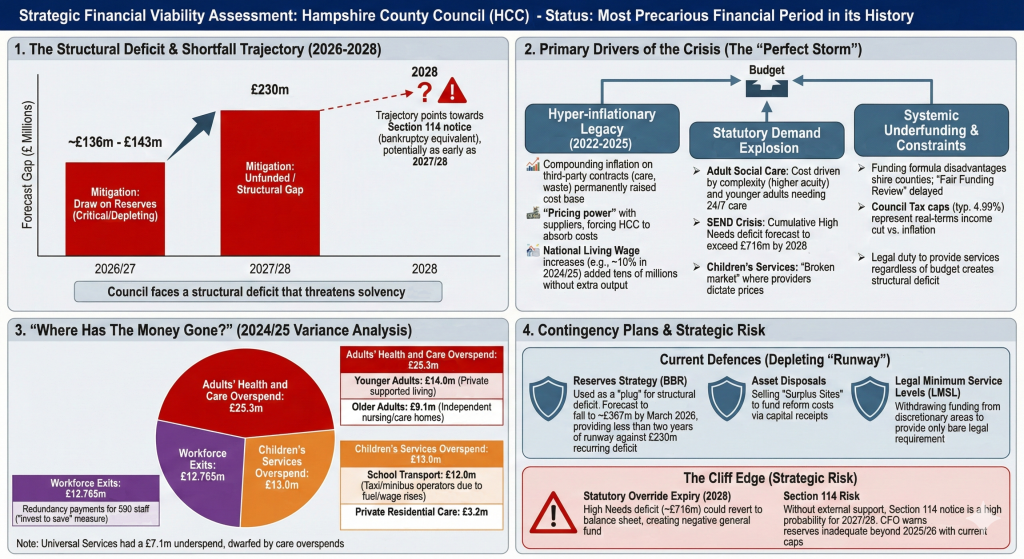
This report presents a comprehensive financial viability assessment of Hampshire County Council (HCC) as of February 2026. It has been commissioned to evaluate the Authority’s funding outlook, quantify potential shortfalls over the medium term (2026-2031), analyze the root causes of the prevailing fiscal distress, and interrogate the contingency measures currently in place. Furthermore, the report provides a forensic analysis of expenditure trends to answer the critical stakeholder question: “Where has the money gone?”
The analysis indicates that Hampshire County Council is currently navigating the most precarious financial period in its history. Despite a longstanding reputation for prudent fiscal management and a reserve position that historically exceeded the national average 1, the Council faces a structural deficit that threatens its solvency within the current Medium Term Financial Strategy (MTFS) period.
As of the 2026/27 budget setting process, the unmitigated budget shortfall stands at approximately £136 million to £143 million.2 This gap is projected to widen to £230 million by 2027/28 2, creating a trajectory that, without external intervention or radical structural change, points towards the issuance of a Section 114 notice—the local government equivalent of bankruptcy—potentially as early as the 2027/28 financial year.2
The drivers of this crisis are multifaceted but can be categorized into three primary vectors:
- Hyper-inflationary Legacy (2022-2025): The compounding effect of inflation on third-party contracts (particularly in care and waste) has permanently raised the cost base beyond the capacity of Council Tax and Business Rates to compensate.5
- Statutory Demand Explosion: There has been an unprecedented surge in demand for high-cost statutory services, specifically Adult Social Care (complex needs in younger adults) and Special Educational Needs and Disabilities (SEND), where the cumulative deficit is forecast to exceed £716 million by 2028.7
- Systemic Underfunding: The delay in the “Fair Funding Review” and the structural disadvantage of the current funding formula for shire counties have left HCC with a core spending power that is insufficient to meet its legal duties.6
Contingency planning is now heavily reliant on “one-off” measures. The Council is balancing its 2026/27 budget primarily through a massive drawdown of its Budget Bridging Reserve (BBR), a strategy acknowledged by the Chief Financial Officer (CFO) as unsustainable.2 Other contingencies include the “Savings Programme 2026” (SP26), aggressive asset disposals under the “Surplus Sites” programme 9, and requests for Exceptional Financial Support (EFS) from central government to bypass Council Tax referendum limits.2
The following report details these findings, providing a rigorous examination of the financial data, strategic risks, and operational realities facing Hampshire County Council.
Continue reading “Strategic Financial Viability Assessment: Hampshire County Council (2026-2031)”The Epstein Files Transparency Act Disclosures: A Forensic Analysis of Strategic Influence, Compromise, and Geopolitical Risk

Executive Summary: The Architecture of Shadow Influence
The enactment of the Epstein Files Transparency Act (EFTA)—officially Public Law 119-38, signed into law on November 19, 2025 1—and the subsequent rolling release of over 3.5 million pages of documents by the Department of Justice between December 2025 and early 2026 has fundamentally restructured the historical understanding of Jeffrey Epstein’s operational network.2 While the initial prosecution of Epstein focused narrowly on sex trafficking crimes in Florida and New York, the EFTA disclosures reveal a far more complex reality: Epstein operated a high-level shadow brokerage of influence, intelligence, and financial leverage that penetrated the uppermost tiers of Western democracy, global finance, and technology.2
The release of these files has not merely been a tabloid event; it has precipitated a systemic crisis of governance across the G7. From the halls of the British Parliament, where the “John Pond” leaks have triggered police inquiries into state secret breaches 5, to the boardrooms of Silicon Valley, where resignation letters drafted by Epstein for Bill Gates’s staff suggest a deep-seated extortion racket 6, the “Epstein Chains”—discrete sequences of email correspondence—expose a pervasive culture of transactional morality among the global elite.
This report provides an exhaustive, forensic analysis of the top 10 most significant email chains identified within the EFTA tranches. These instances were selected not merely for the celebrity of the participants, but for their specific ramifications regarding political stability, national security, corporate governance, and legislative integrity. They document specific instances of operational collaboration, the trading of state secrets, legislative interference, and the deployment of “kompromat” (compromising material) for coercion.
Continue reading “The Epstein Files Transparency Act Disclosures: A Forensic Analysis of Strategic Influence, Compromise, and Geopolitical Risk”The Epstein-Nakamoto Nexus: A Forensic Analysis of Financial Influence, Cryptographic Origins, and the 2026 Disclosure Events

1. Executive Assessment and the 2026 Disclosure Paradigm
The release of the “Epstein Files” in early 2026, mandated by the Epstein Files Transparency Act (H.R. 4405) 1, has precipitated a paradigm shift in the historical understanding of Bitcoin’s developmental trajectory and the intricate web of influence surrounding its governance. While the pseudonymous identity of Satoshi Nakamoto remains technically unmasked, the newly declassified documents, combined with investigative reporting from 2025 and 2026, reveal a disturbing and extensive web of financial entanglement between Jeffrey Epstein and the architectural guardians of the Bitcoin network.
The central inquiry of this report—whether there are links between specific Satoshi candidates and Jeffrey Epstein—yields a complex, multi-layered answer that transcends simple binary associations. There is no definitive evidence in the current dossier to suggest Jeffrey Epstein is Satoshi Nakamoto, nor that he directly employed the pseudonym to author the white paper in 2008. In fact, evidence suggests Epstein was still being tutored on the mechanics of cryptocurrency as late as 2018 by associates such as Brock Pierce.3 However, the “behind Bitcoin” allegation holds substantial weight if interpreted as influence rather than invention. The evidence confirms that Epstein, acting as a strategic node for high-net-worth capital and intelligence networks, successfully infiltrated the governance of Bitcoin at its most vulnerable moment in 2015. Through the MIT Media Lab and direct investments in infrastructure companies like Blockstream, Epstein utilized his capital to “rescue” Bitcoin Core developers, thereby gaining proximity to the protocol’s code maintenance during the critical block-size wars.4
This report provides an exhaustive examination of these connections, categorizing them into direct financial patronage, social-intellectual influence via the “Edge” network, and geopolitical maneuvering involving Russian and Israeli interests. The analysis dissects the specific interactions between Epstein and key Satoshi candidates, the institutional capture of the MIT Digital Currency Initiative (DCI), and the broader implications of these revelations for the ethos of decentralization.
Continue reading “The Epstein-Nakamoto Nexus: A Forensic Analysis of Financial Influence, Cryptographic Origins, and the 2026 Disclosure Events”