Month: August 2026
The Architecture of Self-Reference: An Exhaustive Analysis of Douglas Hofstadter’s Gödel, Escher, Bach

The central inquiry of Douglas Hofstadter’s Pulitzer Prize-winning masterpiece, Gödel, Escher, Bach: An Eternal Golden Braid, is fundamentally ontological: how can conscious, animate selves emerge from inanimate, selfless matter [cite: 1, 2]? Hofstadter pursues this question not through speculative metaphysics, but by constructing an elaborate, interdisciplinary analogy [cite: 1, 3]. This analogy maps the relationship between meaningless physical tokens and emergent semantic systems [cite: 1, 4]. By braiding the mathematical logic of Kurt Gödel, the visual paradoxes of M. C. Escher, and the contrapuntal music of Johann Sebastian Bach, Hofstadter reveals a shared underlying structure: the “Strange Loop” [cite: 4, 5]. This structural phenomenon, wherein moving hierarchically through a system unexpectedly returns one to its origin, is proposed as the foundational mechanism of human consciousness and self-awareness [cite: 4, 5, 6].
Introduction: A Musico-Logical Offering and the Genesis of Strange Loops

The treatise opens with the historical visit of Johann Sebastian Bach to the court of King Frederick the Great of Prussia at Potsdam in 1747 [cite: 7, 8, 9]. The King, an enthusiastic flutist and patron of Gottfried Silbermann’s newly developed fortepianos, presented Bach with a complex, highly chromatic “Royal Theme” and challenged him to improvise a three-part fugue on it [cite: 7, 8, 9].
Bach complied, subsequently composing The Musical Offering (including a three-part ricercar, a six-part ricercar, ten canons, and a trio sonata) [cite: 10, 11]. This historical vignette introduces the primary themes of the book [cite: 8, 9, 12]. Hofstadter demonstrates that The Musical Offering is saturated with self-reference and structural loops [cite: 8, 9, 12]. Specifically, the Canon per Tonos (the Endlessly Rising Canon) modulates upward through six successive keys ($C \to D \to E \to F^\sharp \to G^\sharp \to A^\sharp \to C$) [cite: 11]. This structural architecture means that while the listener feels a constant rise in pitch, they are returned to the starting key, demonstrating a musical Strange Loop [cite: 4, 10, 11].
Hofstadter links Bach’s musical transformations to mathematical isomorphisms [cite: 11]. Transposing, inverting (flipping a theme upside-down), and retrograde copying (playing a theme backward in time, as in a crab canon) are presented as formal, structural operations that preserve relational information while altering physical form [cite: 11, 13]. A strange loop arises when moving only upwards or downwards through a hierarchical system unexpectedly brings one back to the starting point [cite: 5, 6]. To explore how these loops generate consciousness, Hofstadter weaves a continuous, alternating narrative of expository chapters and whimsical dialogues featuring characters borrowed from Lewis Carroll—principally Achilles and the Tortoise [cite: 4, 14, 15]. Each dialogue foreshadows or allegorically embeds a logical or mathematical concept that the subsequent chapter explores at the formal object level [cite: 4].
Continue reading “The Architecture of Self-Reference: An Exhaustive Analysis of Douglas Hofstadter’s Gödel, Escher, Bach”The Architecture of Infinity: A Comprehensive Analysis of the Life, Art, and Mathematical Legacy of M.C. Escher
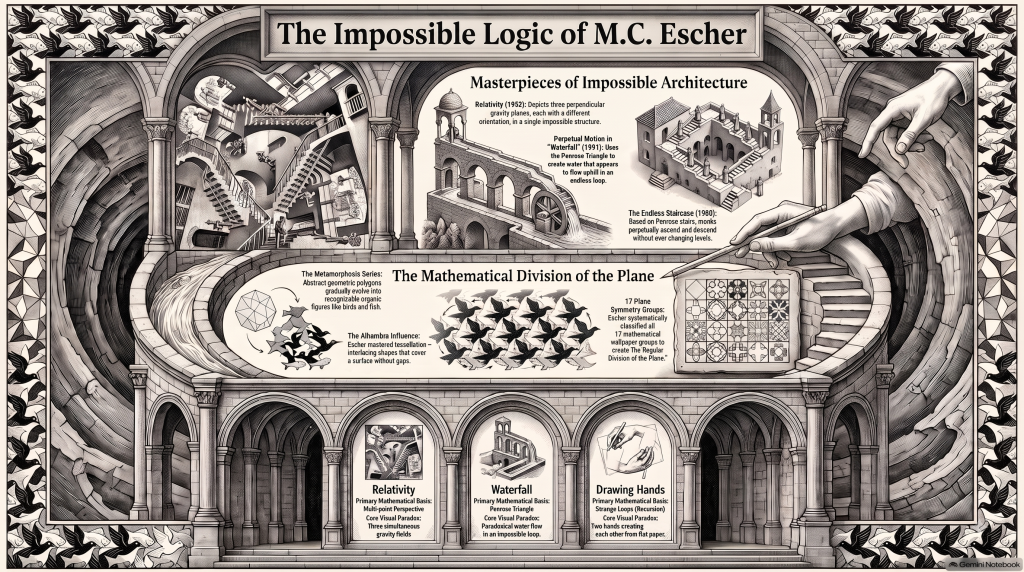
1. Background and Early Life
Maurits Cornelis Escher (1898–1972) occupies a distinct and somewhat paradoxical position in the history of twentieth-century visual culture. Born on June 17, 1898, in Leeuwarden, the capital of the Dutch province of Friesland, Escher was the youngest son of George Arnold Escher and his second wife, Sara Gleichman1. His father was a prominent civil and hydro-mechanical engineer who had spent years working on harbors and dams in Japan at the behest of the emperor1. Raised in a stately city palace known as the Princessehof, the young Escher—affectionately nicknamed “Mauk” by his family—grew up in an environment characterized by intellectual rigor, discipline, and upper-middle-class comfort1. It is highly probable that the influence of his father, whose profession required structural logic and precise drafting, laid the earliest subconscious foundations for Escher’s later obsession with spatial geometry.
Despite this privileged upbringing, Escher’s childhood was marked by physical fragility. A sickly constitution frequently kept him indoors, and in 1905, at the age of seven, he was sent to a children’s convalescent home in Zandvoort for an extended period to recover his strength1. This physical isolation forced the young boy to entertain himself through acute observation of his immediate surroundings, cultivating a meticulous eye for the structural anomalies of the physical world. His family encouraged a broad education; he took carpentry and piano lessons, and frequently used a telescope mounted on the flat roof of his home to observe the stars with his father1.
Academically, Escher struggled profoundly. After the family relocated to Arnhem in 1903, he attended secondary school but proved to be an unexceptional student. He was left-handed, highly intelligent, but socially perceived as an outsider3. Ultimately, he failed his final secondary school examinations in 19181. A persistent lack of aptitude for formal mathematics was particularly notable; Escher would later famously confess to having never received a passing grade in the subject4. Hoping to channel his son’s undeniable talent for drawing into a respectable profession, George Escher leveraged his connections to enroll Maurits at the Technical College of Delft in 1918 to study architecture1. However, recurring illness and a lack of passion for the rigid curriculum led to his swift departure before completing his first year1.
The pivotal turning point in Escher’s early development occurred in the autumn of 1919 when he transferred to the Haarlem School of Architecture and Decorative Arts. Although he initially enrolled in the architecture department to placate his parents, his graphic experiments caught the eye of Samuel Jessurun de Mesquita, a highly regarded graphic arts instructor and Jewish artist known for his bold, definitive style2. Recognizing an innate genius for printmaking, de Mesquita persuaded both Escher and his skeptical parents that the young man was “too good to waste his time on architectural drawings”1. Under de Mesquita’s mentorship, Escher mastered the unforgiving techniques of woodcut and linocut. These mediums require absolute precision, a flawless understanding of positive and negative space, and a high degree of forethought—skills that became the cornerstone of his mature aesthetic3. In 1922, he produced an early masterpiece of interconnectivity, Eight Heads, signaling his burgeoning interest in tessellating forms10.
Following his graduation in 1922, Escher embarked on extensive recuperative and educational travels through Italy and Spain. The Mediterranean landscape, with its intense light, dramatic coastal cliffs, and cascading hilltop towns, captivated him8. Settling in Rome in 1923, he met Jetta Umiker, whom he married in 1924, and the couple subsequently had three sons6. For the next decade, Escher operated primarily as an observational landscape artist. He spent his springs hiking through the desolate, rugged terrains of Tuscany, Calabria, and the Amalfi Coast, executing meticulously detailed sketches that he later transformed into lithographs and woodcuts in his studio3. These early works, though lacking the impossible geometry of his later output, demonstrate an emerging fascination with unusual perspectives, plunging viewpoints, and the structural interplay between natural rock formations and human architecture8.
The trajectory of Escher’s art was forcibly altered by geopolitical instability. The rise of Benito Mussolini’s fascist regime in Italy created a stifling and increasingly dangerous atmosphere, prompting the Escher family to flee to Château-d’Oex, Switzerland, in 19357. Denied the beloved Italian landscapes that had fueled his inspiration, and finding the Swiss snowscapes visually unstimulating, Escher turned his creative gaze inward. To escape the high cost of living and the unfavorable climate, Escher brokered a deal with the Adria shipping company, trading original prints for passage on a Mediterranean freighter, allowing him to revisit Southern Europe and Spain7. Following this, the family moved to Belgium in 1937, and finally, driven by the German invasion during World War II, settled permanently in Baarn, the Netherlands, in 19416.
This period of geographical dislocation and eventual internal exile forced him to transition from observing the external world to exploring the “landscapes of the mind,” marking the genesis of his signature style: the exploration of mathematical theory, rational symmetry, and impossible architectures6.
Continue reading “The Architecture of Infinity: A Comprehensive Analysis of the Life, Art, and Mathematical Legacy of M.C. Escher”