Month: October 2026
The Epistemology of Assimilation: A Comprehensive Analysis of Walt Whitman’s “There Was a Child Went Forth”
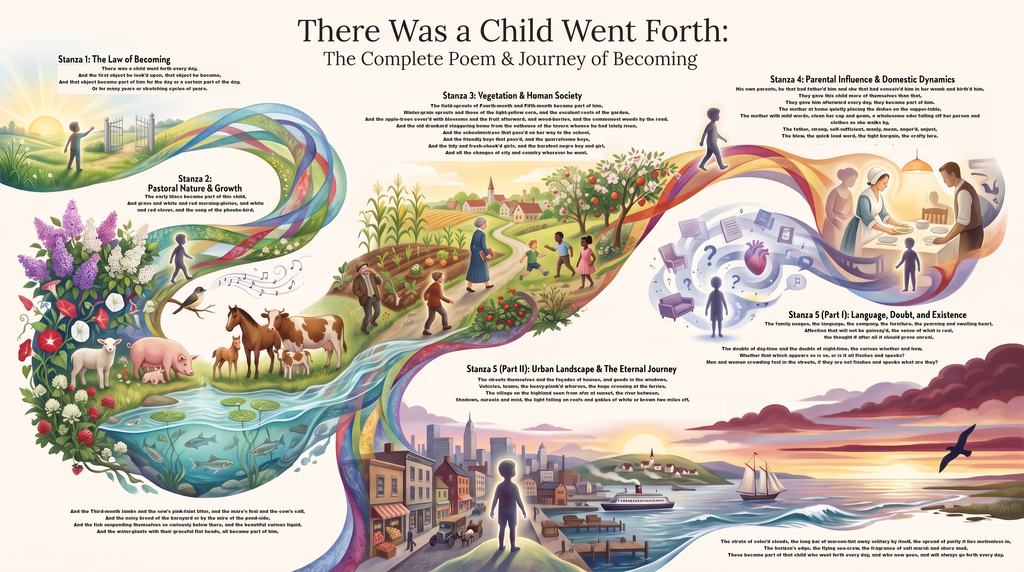
Biographical Context and Intellectual Genesis
Walt Whitman’s poetic vision emerged from a complex interplay of ancestral legacy, volatile family dynamics, self-directed intellectual development, and the rapidly shifting social landscape of nineteenth-century America [cite: 1, 2, 3]. Born on May 31, 1819, in West Hills, Long Island, Whitman was descended from English and Dutch settlers whose roots in North America stretched back to the seventeenth century [cite: 1, 2]. The Whitman family presence on Long Island began when Zechariah Whitman emigrated from England in 1660, followed by his son Joseph, who acquired land that eventually expanded into a 500-acre farmstead [cite: 1]. By the late eighteenth century, this estate was managed by Whitman’s paternal great-grandparents, Nehemiah and Phoebe Whitman [cite: 1]. Local history remembered Phoebe as a formidable, assertive woman who commanded the estate with strict authority [cite: 1]. However, subsequent generations experienced severe economic contraction; by the time Whitman’s father reached adulthood, the family holdings had dwindled to merely 60 acres [cite: 1].
Continue reading “The Epistemology of Assimilation: A Comprehensive Analysis of Walt Whitman’s “There Was a Child Went Forth””