Month: November 2026
The Ledger and the Mud: A Systemic Analysis of the Dutch Golden Age
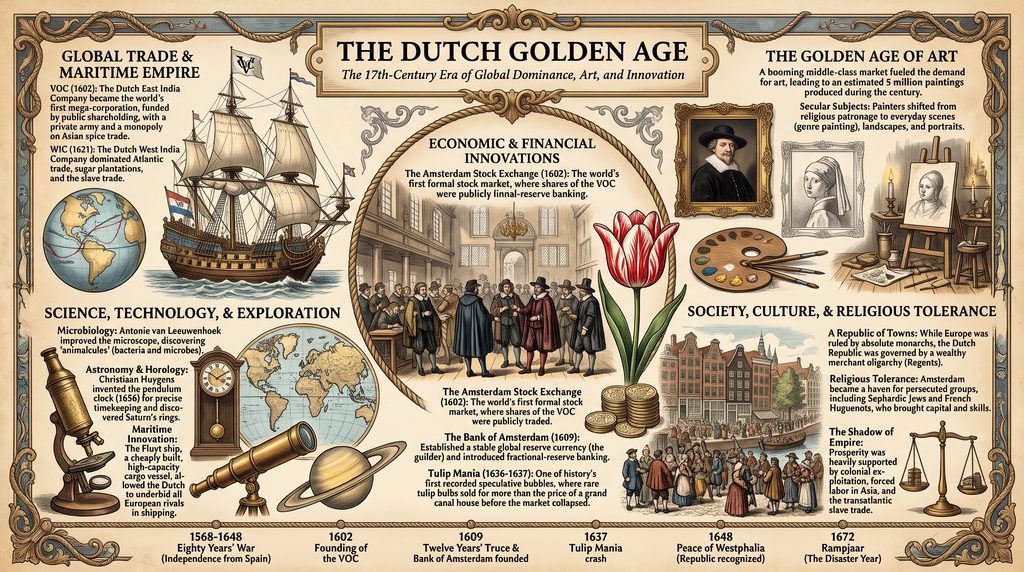
The history of the seventeenth-century Dutch Republic is defined by an absolute, seemingly irreconcilable paradox. Within the borders of its diminutive, waterlogged European geography, the Republic cultivated an unprecedented era of civic freedom, intellectual pluralism, and artistic mastery. It provided a sanctuary for religious minorities, pioneered the rule of international law, and fostered a scientific revolution, earning its enduring historiographical title: the “Golden Age” (Gouden Eeuw). Yet, simultaneously and systematically, this very same republic pioneered the armed multinational corporation, executed the genocide of indigenous populations in the Indonesian archipelago, industrialized the transatlantic chattel slave trade, and fed hundreds of thousands of its own domestic underclass into the lethal maritime meat grinder of its global logistics networks.
The “Problem Presenting” at the core of this book is not merely that these two realities coexisted in time, but that they were structurally, financially, and legally fused. The extreme civic freedom enjoyed by the Dutch urban oligarchy (the regenten) was fundamentally subsidized by the extreme outsourced violence of its corporate leviathans, the Verenigde Oostindische Compagnie (VOC) and the West-Indische Compagnie (WIC).
For centuries, historiography has attempted to manage this paradox through deliberate compartmentalization. Traditional, nationalist narratives celebrated the domestic institutions of the Republic while framing its colonial brutality as a regrettable, distant footnote. Conversely, modern post-colonial critiques often focus exclusively on the atrocities, sometimes struggling to account for the genuine, revolutionary institutional mechanics that allowed a population of 1.5 million to dominate the globe. This book rejects both compartmentalization and moralizing reductionism. Instead, it proposes a rigorous systemic analysis.
To understand the Dutch 17th century, we must reverse-engineer the corporate state. We must examine how the Republic invented revolutionary abstractions—the joint-stock share, the fiat ledger, the legal fiction of the “free sea,” and the aestheticized still-life painting—to meticulously launder the violence of primitive accumulation. By tracing the physical material flows of grain, silver, enslaved bodies, and lapis lazuli, this book forces the clean mathematics of the Amsterdam Beurs back into the mud, blood, and timber of the early modern supply chain.
Continue reading “The Ledger and the Mud: A Systemic Analysis of the Dutch Golden Age”Neoplatonism: Philosophical Foundations of Faith
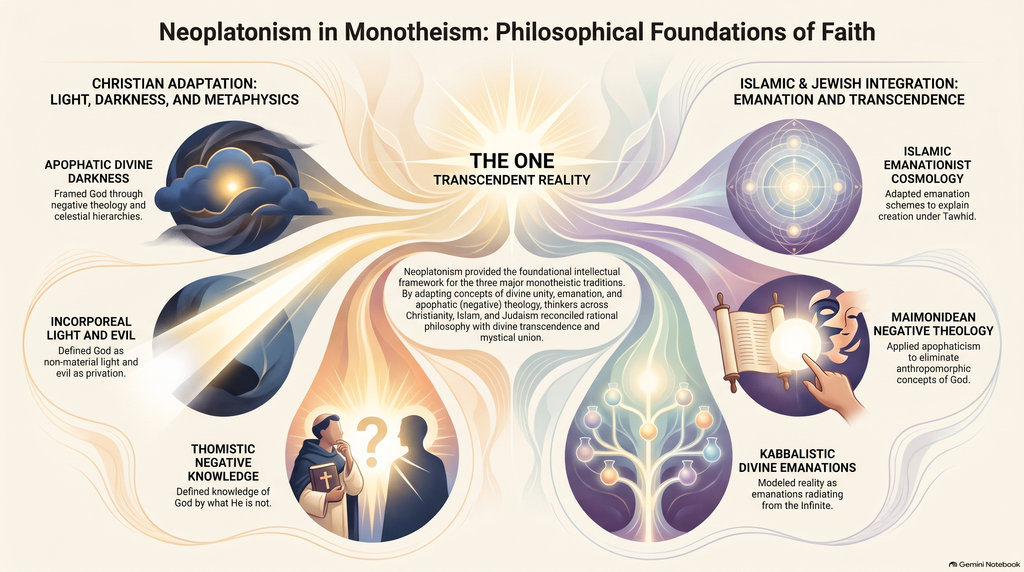
What if the highest form of knowing God requires surrendering every concept, image, and word you have ever used to describe the Divine? For centuries, Christian thinkers influenced by Neoplatonism have argued that God is not merely a supreme being among beings, but the infinite Source beyond Being itself—an incomprehensible reality encountered only by stepping into a “blinding darkness” of unknowing.
This guide equips Christian apologists with the metaphysical frameworks, historical foundations, and logical defenses necessary to articulate and defend Neoplatonic Christian mysticism. By completing this lesson, you will be able to:
- Analyze the dual methodologies of cataphatic and apophatic theology.
- Deconstruct the cosmic mechanics of remaining, procession, and reversion (mone, proodos, epistrophe).
- Evaluate the theological shift from Plotinus’s self-reliant intellectual ascent to Dionysius’s grace-filled, sacramental path toward theosis.
- Formulate compelling apologetic defenses against charges of pantheism, rationalism, and nihilistic agnosticism.